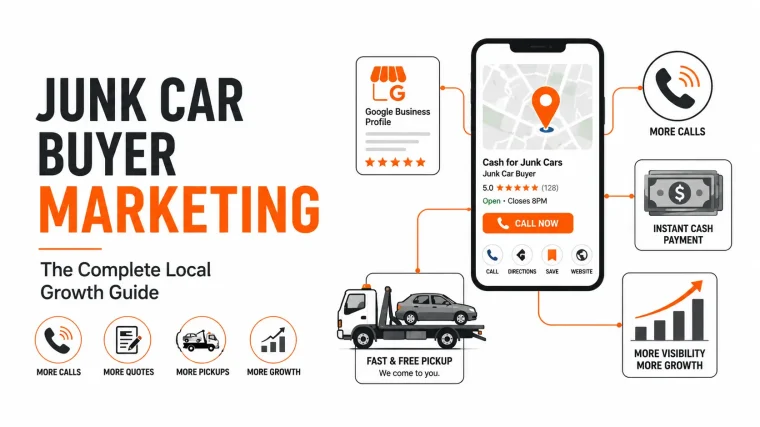
If you’re a junk car buyer trying to get more calls, more quotes, and more scheduled pickups, this guide covers exactly what works in 2026. No fluff, no generic advice borrowed from a plumber’s marketing plan. Just the systems that actually move a junk car buying business forward, from Google Maps to first-call trust to the mistakes quietly costing you leads right now.
A successful junk car buyer needs more than occasional advertising to keep vehicles coming in. The businesses that grow consistently build a marketing system that attracts sellers, captures inquiries, and turns interested vehicle owners into completed pickups. For the broader approach, see our Self-service salvage yard growth strategy.
📌 KEY TAKEAWAYS
- Junk car buyer marketing = get sellers to call you first, not competitor. GBP, local SEO, paid ads, reviews, trust content, all working together
- Distinct from salvage yards and auto recyclers, different audience, different keywords, treating them same wastes spend
- Google Maps first thing sellers see, category selection single biggest mistake, wrong category = invisible for months
- City pages beat one generic page, need pricing, title laws, pickup logistics per city, not admission/tool policy
- First call trust decides booking, most content ignores seller hesitation, answer title/scam fears before asked
- Reviews carry full trust weight here, one-time transactions, recency beats count, ask right after cash handoff
- DIY vs agency vs Google/Facebook Ads vs junk yard/salvage yard distinction, all covered as real trade-offs not sales pitch
- Costs section flags wrong category, no reviews, no local targeting as top mistakes, sized for single-location not $2M+ operations
What Is Junk Car Buyer Marketing?
Junk car buyer marketing is the practice of getting more people who want to sell their car to call you first, instead of a competitor. It covers everything from local search visibility to trust-building content, built specifically for businesses that buy vehicles for cash, not businesses that sell parts.
It includes Google Business Profile optimization, local SEO built around city and neighborhood searches, paid ads targeting people ready to sell today, review generation, and website content that answers a seller’s questions before they even call. Each piece works together. A strong GBP profile gets you found. Good local content gets you trusted. Paid ads fill the gaps while your organic rankings build.
Locally, it works by matching your business to the exact moment someone decides to sell. Most sellers search with urgency, “sell my junk car,” “cash for junk cars near me,” phrases that mean they want an answer today, not next week. Winning that moment means showing up on Google Maps, having a Business Profile that answers their questions instantly, and having a website or landing page that gives them a real sense of what to expect before they pick up the phone.
Junk car buyers need both SEO and paid ads because they solve different problems. SEO builds long-term visibility that compounds, once you rank, you keep showing up without paying per click. Paid ads fill the gap while that ranking builds, and they let you show up immediately for high-intent searches in a competitive market. Relying on only one leaves money on the table, SEO alone is too slow to start, ads alone get expensive and stop working the moment you pause them.
Junk Car Buyers vs Salvage Yards vs Auto Recyclers: Why This Distinction Matters
Most marketing advice online treats these three businesses as one audience. They’re not. A salvage yard sells used parts, either the customer pulls them or staff does. A junk car buyer buys whole vehicles for cash, usually from a seller who never comes back. An auto recycler operates at bigger scale, often selling wholesale to shops, insurers, and other yards. Marketing built for one doesn’t transfer cleanly to the others, the keywords are different, the trust signals are different, and the customer’s intent is different. Getting this right from the start is what separates marketing that actually converts from marketing that just gets clicks.
How a Junk Car Buyer Builds a Consistent Lead Pipeline
The biggest challenge for a junk car buyer is not finding vehicles once in a while. It is creating a predictable flow of sellers every week. For the detailed steps, use our guide to Buy more cars directly from local owners.
A strong lead generation system combines multiple channels:
- Local SEO to capture people searching for cash offers.
- Google Business Profile optimization to appear in local searches.
- Paid advertising for immediate seller demand.
- Quote forms that make contacting your business simple.
- Follow-up systems that recover missed opportunities.
The goal of junk car buyer marketing is not simply generating traffic. It is creating a repeatable system that produces qualified sellers. For the detailed steps, use our guide to Junk car leads guide.
Google Maps and Google Business Profile for Junk Car Buyers
For a junk car buyer, Google Maps is often the very first thing a seller sees. Someone searches “sell my junk car near me,” Google shows a map with three local results, and most sellers call one of those three without ever scrolling further. If you’re not in that map pack, you’re invisible to the majority of ready-to-sell searchers, no matter how good your website is. For a full walkthrough of setting this up correctly and for the detailed steps, use our guide to Google Maps optimization for junk car buyers.
Setting Up Your GBP Profile Correctly
Your Google Business Profile needs accurate hours, a real service area, your correct phone number, and photos that show your actual operation, not stock images. Sellers want to know a real business will show up when they call, and a thin or generic profile creates doubt before the conversation even starts.
Choosing the Right GBP Category
Category selection is one of the most overlooked parts of GBP setup, and it’s where a lot of junk car buyers lose visibility without realizing why. Picking a category built for a salvage yard or a general auto business, instead of one that matches “buys vehicles for cash,” puts you in front of the wrong searches entirely. The category tells Google who to show your profile to, get it wrong and you’re competing for map visibility you were never going to win in the first place.
Common Failure Mode: Wrong Category Selection
This is the single most common mistake we see. A business picks the closest-sounding category during setup, moves on, and never revisits it. Months later, they’re wondering why competitors with worse reviews are outranking them on Maps. The fix takes minutes. Diagnosing it usually takes an audit, because most owners never think to check.
Getting More Calls and Quote Requests from Maps
Ranking on Maps only matters if it turns into calls. Once you’re visible, the profile itself needs to do the convincing, clear service descriptions, recent reviews, quick response times to messages, and photos that build trust. A yard ranking third with a strong, active profile often gets more calls than a yard ranking first with a stale, empty one.
"Sell My Junk Car" Local SEO and City Pages
Once you’re visible on Maps, the next battleground is search results themselves, specifically the searches that carry real intent. “Sell my junk car” and “cash for junk cars near me” aren’t casual searches. Someone typing that has already decided to sell, they’re just deciding who to call. Winning that moment locally means your content needs to speak directly to their city, not to junk car buyers everywhere in general.
Why City Pages Outperform One Generic Service Page
A single “We Buy Junk Cars” page trying to rank for every city you serve almost always underperforms. Google favors content that clearly matches a searcher’s specific location, and a seller in one city wants to know you actually operate near them, not that you’re a national brand with a broad service area. Dedicated city pages, each written around local landmarks, local pricing context, and local pickup logistics, consistently outrank one generic page trying to do everything at once.
For the detailed steps, use our guide to Build sell my junk car city pages.
Building Local Landing Pages for Junk Car Buyers
Junk car buyers should create local landing pages that match the exact areas they serve. A strong location page should explain pickup availability, service areas, local requirements, and what sellers can expect when they contact the business.
These pages help capture searches from people looking for a junk car buyer in their specific city instead of forcing every seller through one generic service page.
Title Laws by State: What Sellers Need to Know Before They Call
Whether a seller can sell their car without a title, and what paperwork they’ll need, varies from state to state. This is one of the biggest hesitation points for a first-time seller, and it’s also one of the most under-addressed topics in junk car marketing content generally. Answering it clearly, and encouraging sellers to confirm the specifics for their own state before calling, removes a major point of friction and builds trust before the phone even rings. This is also the kind of specific, practical content that tends to get pulled directly into AI Overviews and featured snippets.
Pricing Transparency: What Sellers Actually Search For
Sellers search for pricing information constantly, “how much is my junk car worth,” “average price for a junk car,” because the biggest unknown in this transaction is whether they’re being lowballed. Content that explains, in general terms, what actually affects a junk car’s value, weight, condition, local scrap rates, demand, builds credibility even without publishing exact numbers. A seller who understands roughly what to expect trusts the offer they get more, and trusts the business making it.
This type of content also supports junk car buyer lead generation because it targets sellers who are already comparing their options. When someone searches how much their junk car is worth, they are often closer to contacting a buyer than someone performing a general research search.
First-Call Trust and Conversion
Ranking and visibility get a seller to your phone number. What happens on that first call, or what they read right before dialing, decides whether they actually book with you. This is the section most junk car buyer marketing skips entirely, because it’s easier to write about SEO tactics than it is to write about the seller’s actual state of mind in that moment.
Strong junk car buyer marketing does not stop when someone finds your phone number. The seller experience after the first click or call determines whether the lead becomes an actual vehicle purchase. Clear answers, transparent expectations, and fast responses create the trust needed to convert more inquiries. For the detailed steps, use our guide to Build seller trust before the first call.
Common Failure Mode: Ignoring Seller Hesitation
Most junk car buyer websites and marketing are written entirely from the operator’s perspective, how to get more leads, how to close more calls, how to dispatch faster. Almost none of it addresses what the seller is actually feeling: uncertainty about the offer, worry about scams, confusion about paperwork. If your content never speaks to that hesitation, you’re asking sellers to trust you blind, and a lot of them will call a competitor instead who answered their real question first.
Answering Title and Scam Questions Before They're Asked
Two questions sit in almost every seller’s mind before they call: is this legitimate, and what happens if I don’t have my title. Content that answers both plainly, before the seller has to ask, does more for conversion than almost anything else on this list. It signals you have nothing to hide, and it removes the exact friction that makes someone hang up mid-call to “think about it.”
What Same-Day Pickup Actually Looks Like
Urgency is often the whole reason someone is selling today instead of next month, a car that’s in the way, a deadline, a need for quick cash. Sellers want to know what actually happens after they say yes: how fast someone shows up, what the driver needs from them, how payment works on the spot. Laying this out clearly turns a vague promise of “fast pickup” into something concrete enough to actually book on.
Reviews and Local Reputation
For most businesses, a customer might come back a dozen times before ever leaving a review. A junk car buyer rarely gets that chance, most sellers only ever do this once. That makes reviews carry more weight here than almost any other local business, they’re often the only proof a new seller has that you’re legitimate before they hand over their keys and title. For the detailed steps, use our guide to Build a review system after vehicle pickups.
Why Review Velocity Matters More for One-Time Transactions
Since each seller is a one-time transaction, your review count only grows through constant, steady requests, there’s no repeat-customer safety net topping it up over time. A junk car buyer with 15 reviews from two years ago looks frozen in time next to a competitor with 40 reviews from the last three months. Sellers notice recency more than total count, a steady stream of recent reviews signals you’re actively, currently doing business, which matters a lot when someone’s about to hand a stranger their car.
Turning Every Pickup Into a Review
The best moment to ask for a review is right after the pickup is done and the seller has cash in hand, that’s when trust and satisfaction are highest. A simple, consistent system, a text with a direct review link sent the same day, works far better than hoping sellers remember to leave one later. The goal isn’t asking once and hoping, it’s building a repeatable habit into every single completed pickup.
Choosing the Right Marketing Approach
Once you understand what junk car buyer marketing actually involves, the next question is how to execute it, do it yourself, hire an agency, or run ads on your own. There’s no single right answer, but there is a right answer for your specific situation, and it depends on your time, your budget, and how fast you need results. For the detailed steps, use our guide to Compare DIY, in-house, and agency marketing.
DIY vs Agency: An Honest Comparison
Doing it yourself costs less upfront but costs more in time, and SEO especially punishes inconsistency, a GBP profile updated once and forgotten falls behind competitors who post weekly. An agency costs more upfront but brings systems already built and tested, which usually means faster results, particularly on the technical side, schema, GBP structure, local SEO, where mistakes are easy to make and hard to notice until months later. The honest answer is that DIY works if you genuinely have the time and will stay consistent. Most owners running a business day to day don’t.
For many junk car buyers, the biggest challenge is not choosing a marketing channel but creating a consistent system that produces leads. Without proper tracking, follow-up, and local targeting, even good campaigns can waste budget.
Google Ads vs Facebook Ads for Junk Car Buyers
Google Ads captures people already searching with intent, someone typing “sell my junk car” is ready to act, which usually means a higher cost per click but a stronger conversion rate. Facebook Ads work differently, they interrupt someone scrolling who wasn’t necessarily thinking about selling their car that day, which can work well for brand awareness and retargeting but generally converts at a lower rate for this kind of urgent, transactional search. Most junk car buyers see the best results starting with Google Ads for intent capture, then layering in Facebook once the budget allows for both.
Where Junk Car Buyers Should Advertise
The best advertising channels for a junk car buyer depend on search intent. Google Ads captures sellers who are actively searching for services like “sell my junk car,” while local SEO builds long-term visibility for those same searches. Facebook advertising can support awareness and retargeting, but high-intent search traffic usually produces stronger seller opportunities.
Junk Yard vs Salvage Yard: What's the Difference
These terms get used interchangeably online, but they describe different businesses. A junk car buyer purchases a whole vehicle for cash and the seller relationship usually ends there. A salvage yard sells used parts, either the customer pulls them themselves or staff does it for them, and that customer often comes back again and again. Knowing which one you actually are changes everything about your marketing, from the keywords you target to the trust signals your content needs to build.
Costs, Mistakes, and Industry Data
Most of what’s covered so far is about what to do. This section is about what’s already costing you money right now, without you necessarily seeing it, and about setting realistic expectations for growth based on the size of business you actually run.
7 Marketing Mistakes Killing Junk Car Buyers in 2026
The most common mistakes aren’t exotic, they’re small oversights that compound over months. Wrong GBP category, no consistent review requests, a website that doesn’t answer title questions, ad spend with no local targeting. None of these are hard to fix individually. The problem is most owners don’t know which ones apply to them until someone points them out.
For the detailed steps, use our guide to Diagnose junk car buying marketing mistakes.
The Real Cost of Missed Calls
Every missed call is a car that likely went to a competitor. When a seller can’t reach you, they don’t wait, they call the next name on the search results. Add up a handful of missed calls a week over a year, and the lost revenue is often far higher than what proper marketing and a reliable answering system would have cost in the first place.
Sized for Single-Location Operators, Not $2M+ Yards
Most junk car buyers are running one location, not a multi-site operation pulling millions a year. A lot of industry advice online is written for that bigger scale, budget numbers, timelines, and growth benchmarks that don’t map onto a single-location business at all. What matters here is realistic guidance sized to where you actually are, not a roadmap built for a business ten times your size.
Frequently Asked Questions
Junk car buyer marketing is the process of attracting vehicle sellers through channels like Google Maps, local SEO, paid advertising, reviews, and trust-building content.
A junk car buyer purchases whole vehicles for cash from a seller who usually never comes back. A salvage yard sells used parts to repeat customers, either self-service or staff-pulled. The keywords, trust signals, and customer journey are different for each, so the marketing approach needs to be different too.
Foundational work like GBP optimization and website trust content typically shows early movement within the first month or two. Meaningful, compounding results from local SEO and review growth usually build over the following months, with the strongest gains typically showing up in the second half of the first year.
The biggest mistake is relying on one lead source instead of building a complete system. Many junk car buyers lose opportunities because of weak local visibility, poor follow-up, or content that does not answer seller concerns.
Yes. A Google Business Profile gets you found, but your website is what answers the questions that turn a call into a booked pickup, title concerns, what to expect from pickup, and proof that you’re a legitimate local business.
It depends on your market size and competition, but the biggest waste isn’t spending too little, it’s spending on the wrong things, ads with no local targeting, or a website that doesn’t address seller hesitation. A free audit is the fastest way to see where your specific budget should actually go.
Get Your Free Junk Car Marketing Audit
Ready to get more calls, more quotes, and more booked pickups. We’ll show you exactly where your current marketing is losing you leads, and what to fix first. Our junk car buyer clients have seen up to 35% more off-street car buying in 45 days. No generic advice, no pressure. Just a clear plan built for your business.