Marketing options for junk car buyers usually come down to three real choices: do it yourself, hire an in-house marketer, or bring in an agency. For junk car buyers, each approach fits a different stage of business, budget, and level of available time.
This guide breaks down the honest trade-offs behind the main marketing options for junk car buyers, compares Google Ads against Facebook Ads for this specific industry, and clears up the difference between junk yards and full-service salvage yards. The goal is to help junk car buyers choose the approach that actually fits where the business is right now.
📌 KEY TAKEAWAYS
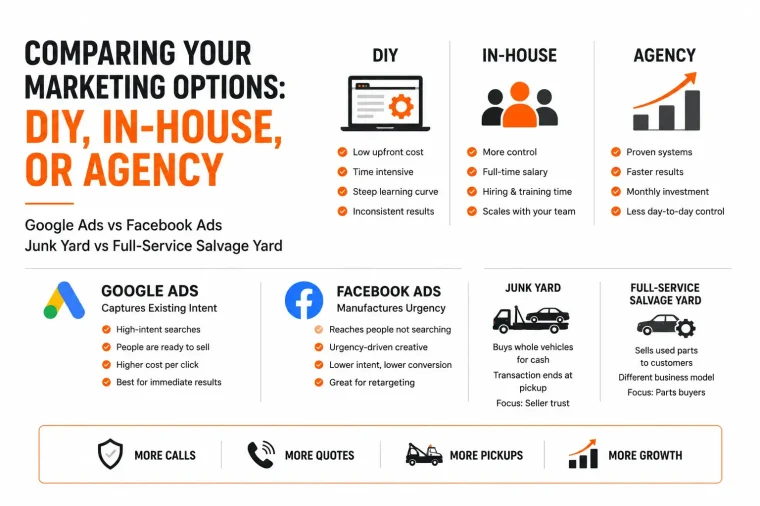
- Junk car buyers have three main marketing paths: DIY, in-house marketing, or hiring an agency.
- DIY marketing works best for single-location businesses with low competition, limited budgets, and enough time to stay consistent.
- DIY can become difficult when junk car buyers need technical SEO, multiple city pages, paid advertising, or ongoing marketing management.
- In-house marketing provides more control but requires the cost of hiring, training, software, and ongoing management.
- Marketing agencies bring established systems and specialized expertise but offer less day-to-day control.
- Google Ads generally captures high-intent sellers who are already searching for terms like “sell my junk car.”
- Facebook Ads can help create urgency and reach potential sellers before they begin actively searching.
- For many junk car buyers, the strongest paid strategy is to start with Google Ads and add Facebook Ads as the budget grows.
- A junk yard primarily focuses on buying vehicles from sellers, while a full-service salvage yard also sells used parts to other customers.
- Choosing the correct business category is important because it affects keywords, content, advertising, and overall marketing options for junk car buyers.
- The best marketing approach depends primarily on your time, budget, competition, and stage of business growth.
DIY Marketing vs Hiring a Junk Car Marketing Agency
If you’d like to know more, this expands on what’s covered briefly in our Junk Car Buyer Marketing: The Complete Local Growth Guide.
For many junk car buyers, the decision between DIY marketing and professional help is one of the most important marketing options for junk car buyers to evaluate. The right choice depends on more than just the monthly budget.
What DIY Actually Costs, Beyond the Obvious
DIY marketing has no agency fee, which is one reason it appeals to junk car buyers operating on a tight budget. However, the time spent learning GBP optimization, writing city pages, tracking rankings, managing ads, and understanding local SEO is a real cost too.
An owner running pickups all day rarely has much bandwidth left to learn SEO from scratch and stay consistent with it. Among the available marketing options for junk car buyers, DIY often looks like the cheapest choice until the value of the owner’s time is factored into the equation.
Where DIY Genuinely Works
DIY can work well for junk car buyers with a single location in a low-competition market. It can also make sense for an owner who has genuine time and interest in learning marketing.
For early-stage junk car buyers with a limited budget, DIY allows the business to trade time for money. Basic Google Business Profile setup, review requests, local content, and simple website improvements can often be handled internally.
Of all the marketing options for junk car buyers, DIY is usually the best fit when the business is small, the owner has available time, and growth expectations are realistic.
Where DIY Breaks Down
Technical SEO, schema markup, city-page architecture at scale, conversion tracking, paid advertising, and ongoing algorithm changes are where DIY marketing becomes more difficult for junk car buyers.
A GBP profile set up once and then forgotten can quickly fall behind competitors that update their profiles, collect reviews, and publish new local content consistently. Most owners start strong, but bandwidth often runs out within a few months.
This is the main weakness of DIY among the available marketing options for junk car buyers: consistency. Marketing activity may begin well but stall when daily pickups, dispatch, customer calls, and operations take priority.
What a Junk Car Marketing Agency Actually Brings
For growing junk car buyers, an agency brings more than extra hands. A specialized agency can provide systems that have already been tested across similar businesses.
Category selection mistakes, city-page structure, review timing, landing-page strategy, and campaign organization can be solved once and applied repeatedly instead of being learned through expensive trial and error.
Among the professional marketing options for junk car buyers, an experienced agency can reduce the learning curve and allow owners to focus more of their time on buying vehicles and running operations.
What an Agency Costs, Beyond the Monthly Fee
An agency is not free from trade-offs. Junk car buyers may experience ramp-up time while the agency learns the specific market, competition, service area, and internal operation.
There is also less day-to-day control over execution details compared with handling marketing personally or employing someone directly in-house.
Still, these are different costs from DIY’s hidden time investment. When comparing marketing options for junk car buyers, the real question is whether the business wants to spend more time or more money to achieve consistent marketing execution.
Where In-House Marketing Fits
Hiring an in-house marketer is another option for established junk car buyers that have enough lead volume, budget, and operational scale to support a dedicated employee.
In-house marketing offers more day-to-day control and closer communication with the business. The marketer can learn the local market, understand the company’s pickup process, coordinate promotions, and respond quickly to operational changes.
However, hiring in-house also means paying a full salary and potentially covering benefits, training, software, and management time. For smaller junk car buyers, one employee may also lack the broad expertise needed for SEO, PPC, content, website optimization, analytics, and social advertising.
When considering marketing options for junk car buyers, in-house marketing usually makes more sense once the business has reached a scale where a full-time role can stay productive.
The Honest Answer
DIY works if there is genuinely enough time and discipline to stay consistent for months, not just weeks.
In-house marketing works best when junk car buyers have the budget and workload to justify a dedicated employee. An agency often fits businesses that need specialized systems and consistent execution without hiring a full internal team.
For most owners running daily pickups, dispatch, and customer calls, available time becomes the deciding factor more than budget alone. That is why choosing between these marketing options for junk car buyers should start with an honest assessment of capacity.
Google Ads vs Facebook Ads for Junk Car Buyers
Paid advertising gives junk car buyers another set of marketing decisions. Google Ads and Facebook Ads work differently because they reach sellers at different stages of the decision process.
Facebook Ads Can Manufacture Urgency, Not Just Wait for It
Facebook Ads can reach potential sellers before they actively search for junk car buyers.
Someone scrolling through Facebook may not be thinking about selling a vehicle. However, the right ad creative can change that. A photo of a driveway with a beat-up car and copy such as, “That car’s not going to sell itself. Get cash today,” can move someone from “someday” to “today.”
Facebook does not primarily capture existing urgency the way Google does. Instead, it can help create urgency and awareness. This makes it useful for junk car buyers trying to reach sellers who have not started searching yet.
Google Ads Captures Intent That's Already There
Google Ads works differently. Someone searching for “sell my junk car” or “cash for junk cars near me” has already expressed a strong intention to sell.
For junk car buyers, this means the searcher is often deciding who to contact rather than whether to sell the vehicle at all.
High-intent search terms in this industry can vary significantly by market, from lower-cost smaller markets to highly competitive metropolitan areas. The economics can work well when junk car buyers have a healthy landing-page conversion rate, strong call handling, and enough margin per vehicle purchased.
Google Ads is generally one of the strongest paid marketing options for junk car buyers because it captures demand at the moment sellers are actively looking for a solution.
Where Facebook Genuinely Earns Its Spot
Facebook Ads can be valuable for junk car buyers in several situations:
- Urgency-driven creative aimed at people who have not searched yet
- Retargeting website visitors who did not convert
- Building local brand recognition in a newer market
- Promoting fast pickup, same-day service, or simple cash offers
- Reaching potential sellers before competitors capture search intent
The key is creative that gives people a reason to act now.
Where Facebook Underperforms for Junk Car Buyers
Facebook Ads often underperform when junk car buyers use cold audience targeting with no urgency angle.
Passive brand-awareness copy that does not push someone from “someday” to “today” can produce attention without producing enough qualified sellers.
A junk car business running only Facebook Ads with weak, generic creative will often underperform compared with Google’s ability to capture existing intent. It can also underperform Facebook’s own potential to manufacture urgency through stronger messaging.
The Honest Advertising Sequence
Most junk car buyers see the strongest results by starting with Google Ads to capture existing intent.
Once the budget allows, Facebook can be layered in to reach sellers who have not started searching yet. The focus should be on local, urgency-driven creative rather than passive brand awareness alone.
For many junk car buyers, this sequence provides a more balanced paid acquisition strategy: capture the demand that already exists, then create additional demand among people who were not actively searching.
Junk Yard vs Full-Service Salvage Yard: What's the Difference?
Different from a seller-facing comparison, this section is for junk car buyers and owners trying to determine which business category they actually fit into.
The distinction matters for positioning, keywords, content strategy, and the marketing options for junk car buyers available to the business.
Junk Yard: What Your Business Likely Is
A traditional junk yard or cash-for-cars business buys whole vehicles for cash, and the seller relationship generally ends at pickup.
The staff may dismantle, recycle, scrap, or process the vehicle afterward, but the original customer does not return to purchase parts.
For these junk car buyers, revenue is primarily built around acquiring vehicles from sellers rather than generating repeat retail transactions.
Full-Service Salvage Yard: A Different Business Model
A full-service salvage yard sells used auto parts to customers. Staff may pull, clean, inspect, or test parts, while customers may order by phone or online.
A salvage yard can still buy vehicles from the public, just like junk car buyers, but the downstream business model is different. Instead of ending the transaction after vehicle acquisition, the company generates additional revenue by selling parts to another customer.
Why Owners Confuse the Two
Both business models may buy junk, wrecked, damaged, or non-running cars from the public. Both may operate from similar-looking lots.
The difference is not primarily on the acquisition side. The real difference is what happens after the vehicle is purchased.
Do you sell parts to a second customer, or does the transaction effectively end with the seller?
Understanding this distinction is important because the best marketing options for junk car buyers are not necessarily the same as the best strategies for a retail-focused salvage operation.
Why This Matters for Your Marketing
If you are primarily a junk yard or cash-for-cars operation, your marketing should focus on seller acquisition.
Your keywords should center on terms such as:
- “Sell my junk car”
- “Cash for junk cars”
- “Junk car buyers near me”
- “Sell my car for cash”
Your trust content should address seller hesitation, including title concerns, scam fears, towing questions, payment timing, and same-day pickup.
A full-service salvage yard, on the other hand, may target keywords such as:
- “Used auto parts”
- “OEM parts near me”
- “Used engines”
- “Used transmissions”
Its trust content will focus on different concerns, including warranties, part condition, testing, availability, and shipping.
Getting the category right helps junk car buyers choose the right keywords, advertising campaigns, and overall marketing direction.
Quick Self-Check
Do you sell parts to a second customer after buying the car?
No: You are primarily operating as a junk yard or cash-for-cars business focused on vehicle acquisition.
Yes: You are operating as a full-service salvage yard, even if you also buy whole vehicles directly from sellers.
For junk car buyers, getting this classification right shapes everything else in the marketing plan. Wrong category can lead to the wrong keywords, wrong content, and wasted advertising spend.
Frequently Asked Questions
It depends more on time than budget. If you are personally running daily pickups and dispatch, DIY consistency often breaks down within a few months. For many busy junk car buyers, an agency can make more sense once marketing starts competing with core operations.
Yes, once the budget allows. Google captures sellers who are actively searching, while Facebook can help junk car buyers reach sellers who have not started searching yet. Urgency-focused local creative is especially important.
Ask whether you sell parts to a second customer after buying the car. If no, you are primarily a junk yard or vehicle acquisition business. If yes, you are operating as a full-service salvage yard, even if you also function as one of the local junk car buyers in your market.
In-house marketing provides more day-to-day control but requires a full salary, hiring time, training, and management. An agency can bring specialized systems and experience more quickly but offers less direct oversight.
The answer depends on available time, budget, competition, and business stage. Smaller junk car buyers may benefit from DIY basics, growing businesses may benefit from agency support, and larger operations may eventually justify in-house marketing.
See Which Approach Fits Your Yard
There is no single right answer among the available marketing options for junk car buyers.
DIY, in-house marketing, and agency support each fit different businesses. The right approach depends on your available time, budget, competition, and current stage of growth.
We’ll help junk car buyers determine which approach makes sense for their yard, with no pressure either way.