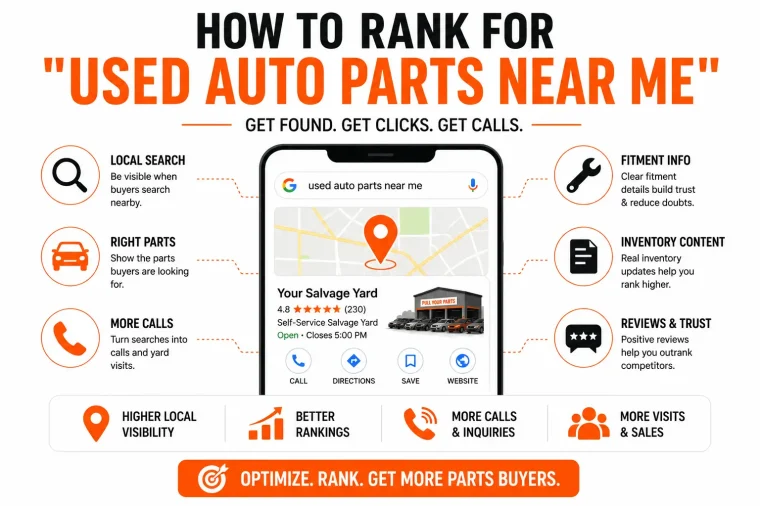
Someone standing in their driveway with a dead alternator doesn’t type a long search. They type “used auto parts near me,” pull up three or four results, and decide fast. If your yard isn’t giving Google and that buyer the right signals in that moment, the sale goes to whoever is.
This guide isn’t about your Google Business Profile or your Maps ranking, those are covered elsewhere. It’s about the content on your pages, how you talk about fitment on used inventory, what wins that quick phone comparison, and how to show up in the answers Google and AI Overviews pull directly for part-specific searches. This guide focuses specifically on the content that helps parts buyers choose your yard after they find you. For the complete strategy covering Google Business Profile optimization, Maps visibility, city pages, citations, customer reviews, schema, and local ranking factors, start with our local SEO for salvage yards playbook.
📌 KEY TAKEAWAYS
- “Used auto parts near me” behaves differently than a regular parts search, your inventory is donor-vehicle based, not a fixed catalog, and content needs to reflect that.
- Fitment language matters more than fitment guarantees – phrasing like “commonly fits, confirm your exact trim” builds trust and still ranks for make, model, and year searches.
- The driveway moment is real – buyers compare 3-4 yards in about sixty seconds on their phone, and the page that answers fastest wins the call.
- Buyers still deciding between new and used are an open gap – almost nobody in salvage SEO writes honest comparison content for them.
- Part-level Q&A beats generic yard-level FAQs for search visibility – short, focused answers tied to specific parts are what Google and AI Overviews actually pull.
- Ranking gets someone to the page, the content on it is what gets them to actually call.
What Makes This Search Different From a Regular Parts Search
A “used auto parts near me” search doesn’t behave like a regular auto parts search, and treating it the same way is where most yards lose the match before the buyer even lands on the page.
Why a Self-Service Yard Search Doesn't Work Like a Parts Store Search
At a retail parts store, the customer types a part number or picks a filter, and the system returns an exact match from a catalog. That works because new parts are standardized, one SKU, one product, always the same.
A self-service yard doesn’t have that. Your inventory is made up of donor vehicles, not standardized products. A part isn’t “in stock” the way a new alternator is in stock at a parts store, it’s sitting on one specific car in your row, and whether it fits depends on that exact donor vehicle, not a catalog entry. Customers searching for you are asking a fundamentally different question than someone searching a parts store. They’re not asking “what SKU matches my car.” They’re asking “does anyone near me happen to have my car’s twin sitting in their yard right now.”
Why Fitment Depends on the Donor Vehicle, Not a Part Number
This is the piece most fitment tools built for new parts completely miss. A used alternator’s fitment isn’t just about the part number, it’s about the exact donor vehicle it came from, the year, trim, and sometimes even the production run. Two vehicles with the same model name can still have parts that don’t interchange cleanly.
That’s not a flaw in your inventory, it’s just how used parts work, and it’s worth explaining to customers plainly rather than pretending your inventory behaves like a parts store catalog. A customer who understands why fitment works this way is more likely to call and ask than assume your yard can’t help and move on to the next search result.
What a Self-Service Buyer Is Actually Looking For
A parts store customer wants confirmation. A self-service buyer wants possibility, are the right donor vehicles here, and can I come confirm the fit myself. That’s a different search intent entirely, and it changes what your page needs to say. Instead of promising an exact match like a catalog would, your content’s job is to show that the right kind of vehicle is likely on your lot and make it easy for the buyer to come verify it, whether that’s a general inventory note, a make/model callout, or an invitation to call and check what’s currently in.
Writing Fitment Language for Used, Non-Cataloged Inventory
Once a buyer understands why your inventory doesn’t work like a parts store, the next job is writing page content that says the right thing, confident enough to keep them interested, honest enough that nobody shows up expecting a guarantee you can’t make.
How to Phrase "This Likely Fits" on a Page Without Overpromising
The goal is language that signals probability, not certainty. Instead of stating a part fits a vehicle outright, phrase it around what’s typically compatible and invite verification. Something like “commonly fits [model] years [range], confirm your exact trim with our team” does more work than a flat “fits [model]” claim that falls apart the moment someone’s specific vehicle doesn’t match.
This kind of phrasing actually helps SEO too. It naturally includes the make, model, and year range searchers are typing, while staying accurate about how used-parts fitment really works. Vague is bad for ranking. False certainty is bad for trust. Specific-but-qualified hits both.
Disclaimer Language That Protects You Without Killing the Sale
A disclaimer doesn’t have to sound like a warning label. Buried legal language nobody reads protects nothing and reads as cold. The better approach is folding the disclaimer into the same sentence that builds interest, so it feels like helpful honesty instead of a liability shield.
Something like “used parts vary by donor vehicle, our team confirms exact fitment before you pull” tells the buyer three things at once: you’re upfront about how used parts work, you’re not going to let them waste a trip, and there’s a real person ready to help them get it right. That builds more trust than silence ever would, and it keeps the buyer moving toward a call instead of bouncing to a competitor’s page that also can’t promise a guarantee, just pretends to.
The Driveway Moment: How Buyers Actually Compare Yards Before They Drive
By the time someone searches “used auto parts near me,” they’ve usually already decided they’re buying used, they just haven’t decided from whom. That decision happens fast, and it happens before anyone picks up a phone.
What a Buyer Is Doing on Their Phone in the 60 Seconds Before They Choose
Picture the actual moment. Car’s dead, part’s identified, phone’s out. They tap into search results, and now they’re skimming three or four yards side by side on a small screen, fast. They’re not reading paragraphs. They’re scanning for three things: does this place likely have my part, is it worth the drive, and does this yard look like it’ll actually answer if I call.
Whichever page answers those three questions fastest, without making the buyer dig, wins the tap. This isn’t a research moment. It’s a fast, comparative one, and content written like a brochure loses to content written like a quick, honest answer.
The Content That Wins That Moment (and the Content That Loses It)
What wins: a page that states plainly what kinds of vehicles are typically in stock, a clear sense of what the visit involves, and language that reads like a real person, not a template. A short line like “regularly stocking domestic trucks and SUVs, call to check current inventory” answers the buyer’s real question faster than a long paragraph about company history ever will.
What loses: generic “we buy and sell auto parts” copy that could belong to any yard in the country, walls of text a buyer has to scroll through on a cracked phone screen in a driveway, and pages that bury the one thing the buyer actually wants to know, do you likely have my part, under paragraphs of filler. In that sixty-second window, the yard that gets to the point first is the yard that gets the call.
Capturing Buyers Still Deciding Between New and Used
Not every searcher has already decided to buy used. Some are still weighing new versus used, and right now, almost nobody in salvage yard SEO is writing content for that undecided moment, they only write for the buyer who’s already made up their mind.
The Comparison Searcher Nobody in Salvage SEO Targets
This searcher types something a little different, “used vs new alternator,” “is a used transmission worth it,” “used auto parts vs new near me.” They’re not asking which yard to visit yet. They’re asking whether used is even the right call. Every guide in this space assumes that decision is already made and skips straight to “here’s how to rank once they’ve chosen used.” That’s a real gap, and it means a whole segment of buyers never sees a self-service yard’s case made to them at all before they land on a parts store instead.
Content That Makes the Case for Used Without Sounding Like a Sales Pitch
The content that wins this searcher isn’t a hard sell, it’s a straight, useful comparison. Cost difference, real numbers if you have them. What actually changes with a used part versus new, and what doesn’t. When used makes sense, and when it honestly doesn’t, being upfront about the cases where new is the better call actually builds more trust than pretending used is always the answer.
A short, honest comparison like this does two jobs at once. It captures a searcher your competitors are ignoring, and it reads as trustworthy enough that even a buyer leaning toward new might reconsider once they see a yard willing to tell them the truth instead of just pitching them. That kind of content earns the call this searcher was never going to make otherwise.
Part-Level Q&A That AI Overviews and Google Can Pull Directly
Most of the Q&A content covered elsewhere on this site lives at the yard level, hours, tools, admission fee, general questions about visiting. This section is different. It’s about Q&A built around individual parts, the kind of content Google and AI Overviews can lift directly when someone searches something specific like “used alternator near me.”
Structuring Mini-FAQs Around Individual Part Searches
Instead of one generic FAQ block for the whole site, build small, focused Q&A sets tied to specific high-demand parts, engines, transmissions, alternators, doors, whatever moves most at your yard. Each one answers the handful of questions a buyer actually has about that specific part: how fitment works for it, roughly what it costs, and what to expect when they come to pull or buy it.
Keep each answer short and direct, a sentence or two that fully answers the question on its own. That’s not just easier for a buyer to scan, it’s exactly the format Google and AI Overviews pull from when generating an instant answer, and it’s a format almost no salvage yard content currently uses.
Why Part-Level Q&A Is Different From Yard-Level Q&A
Yard-level Q&A answers “should I visit this yard.” Part-level Q&A answers “does this yard have what I need.” They’re solving two different moments in the buyer’s decision, and conflating them into one generic FAQ block means neither question gets answered clearly.
This is also genuinely new ground, the yard-level Q&A is already well covered in the Get More Calls From Google Maps guide, so there’s no overlap here. Part-level Q&A gives Google specific, structured content to match against specific searches, “used alternator near me” pulls a different, more useful answer than a vague “do you have parts for my car” FAQ ever could.
Frequently Asked Questions
Because search engines and fitment tools are built around new-parts catalogs with fixed SKUs. Your inventory is used, donor-vehicle-based, and constantly changing, so your content has to work differently to signal relevance for that same search.
No. Overpromising fitment on a page creates trust problems and returns. The stronger approach is phrasing that signals likely compatibility and invites a quick call or in-person check, which is more accurate and still ranks well for make, model, and year searches.
Not every part, but your highest-demand ones (engines, transmissions, alternators) benefit from their own short Q&A content. That’s what gives Google and AI Overviews something specific to pull when someone searches for that exact part near them.
Your GBP and Maps presence get someone to notice your yard exists. This content is what happens after they click through, whether the page itself answers their real questions fast enough to convert the visit into a call.
Yes. Buyers who haven’t decided between new and used yet almost never see content written for them in this space. A short, honest comparison section captures that searcher before a parts store does.
Ranking Gets Them There. This Content Gets Them to Call.
Most yards chase rankings and stop there, then wonder why the calls don’t match the traffic. Showing up for “used auto parts near me” is only step one. What happens in the next sixty seconds on the page, fitment language that builds trust instead of overpromising, content that answers the driveway-moment questions fast, part-level Q&A Google can actually pull, is what turns a search result into a phone ringing.
That’s the piece most independent yards are missing, and it’s exactly what we build for self-service yards that want the search and the sale.