Off-street car buying is the highest leverage thing an independent self-service salvage yard can fix right now. Not because everything else doesn’t matter but because your entire operation runs on inventory and how you source that inventory determines your margins, your cash flow, and how competitive you can actually be in your local market. Most yards are losing money on the buy side without realizing it. This guide breaks down exactly what each sourcing channel is costing you, what a direct off-street car buying system looks like in practice, and how to start winning more cars from local sellers before brokers and aggregators get to them first.
📌 KEY TAKEAWAYS
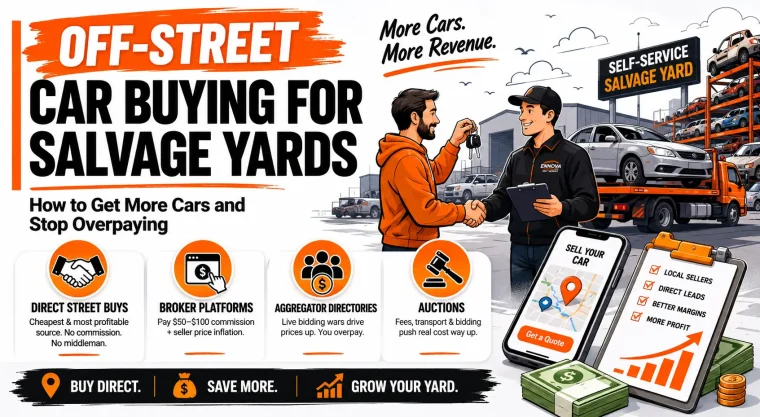
- There are 4 ways salvage yards source cars — direct street buys, broker platforms, aggregator directories, and auctions
- Direct street buys are the cheapest and most profitable channel — but most yards don’t have a system generating them consistently
- Broker platforms like Peddle and Wheelzy add $50–$100 commission per car on top of an already inflated seller price expectation
- Aggregator directories put you in a live bidding war against every other yard in your city — and the seller’s price goes up every time
- Auctions look like a good source until the fees stack up — a $300 car can cost over $1,200 by the time it hits your lot
- Most yards overpay not because they negotiate badly but because low direct lead volume leaves them with no other option
- A direct off-street car buying system connects local sellers straight to your yard — before any broker or platform gets to them first
- Your “Sell Your Car” page, local SEO, and same-day pickup are your biggest weapons against Peddle and Copart locally
- Cutting out the middleman on just 10 cars a month saves $500 to $1,000 every single month — $6,000 to $12,000 a year
- We build this system and deliver +35% off-street car buying in 45 days — or you pay nothing
The 4 Ways Salvage Yards Source Cars — And What Each One Actually Costs You
Not all car sources are equal. Every channel between you and the seller adds cost, adds competition, or adds both. Before we break down what each sourcing channel is actually costing you, it helps to understand that off-street car buying is one piece of a complete growth engine built specifically for independent self-service salvage yards. See how it all connects in
“How to grow a Self-Service Salvage Yard, without a Big-Chain Budget.”
Salvage yard vehicle acquisition breaks down into exactly four channels, and each one carries a different cost structure. Understanding where each dollar goes is the first step to fixing your acquisition strategy before it fixes itself the expensive way.
- Direct Street Buys
This is the cheapest and most profitable sourcing channel available to any salvage yard — a seller contacts you directly, you agree on a price, the car comes in. No commission. No markup. No middleman taking a cut before the deal is done.
A typical direct street buy runs anywhere from $200 to $500 depending on the vehicle, the market, and what the seller expects. That’s the true cost. Nothing hidden. Nothing added. The problem is that most independent yards don’t have a system generating these leads consistently — so they end up falling back on every other channel on this list just to keep inventory moving.
- Broker Platforms (Peddle, Wheelzy, Cash for Cars)
Broker platforms are the most common fallback for yards that don’t have a direct buying system. They work — leads come in, cars get bought — but the cost adds up fast in ways that aren’t always obvious upfront.
First there’s the broker commission, which typically runs $50 to $100 per car on top of whatever the seller gets paid. Then there’s the price inflation — sellers who go through a broker platform already have a number in their head from the instant quote tool, and that number is almost always $100 to $200 higher than what a direct seller would expect. So you’re paying the commission AND paying more for the car itself. Every single time.
- Aggregator Directories
Aggregator directories — websites and platforms that connect sellers with multiple buyers at once — put your yard in a lineup. The seller submits their car details, the directory sends it to every yard in your area, and now you’re competing on price in real time with every other buyer in your market.
You might win the car. But you won that car by outbidding your competition, which means you paid more than you needed to. And the directory took their cut on top of that. It’s a model designed to drive the seller’s price up — not to help your margins.
- Auctions
Auctions are where yards go when they need specific vehicles — usually newer, better-condition cars that command higher resale value on parts. The inventory quality can be good. The cost is where it falls apart for most self-service yards.
Entry fees alone can run $500 or more before you’ve bought anything. Then add transport costs, auction platform fees, and the competitive bidding environment that pushes prices well above street value. A car that would have cost you $300 from a direct seller can easily run $1,200 to $1,500 by the time it’s sitting in your yard. For a self-service operation pulling $80 to $150 worth of parts off a vehicle, that math rarely works.
Why Most Independent Yards End Up Overpaying for Inventory
Here’s the real reason independent yards overpay for cars — and it has nothing to do with bad negotiating.
When your direct lead pipeline is empty, you don’t have options. A seller calls, you need the car, and you pay whatever it takes to get it. A broker sends you a lead, you know you’re overpaying the commission, but you take it anyway because the yard needs inventory. An auction comes around and you bid higher than you should because you can’t afford to go home empty. Every single buying mistake that hurts salvage yard margins comes back to the same root cause — desperation born from low lead volume.
It’s not a pricing problem. It’s a pipeline problem.
When yards don’t have a consistent flow of direct sellers coming to them, they become price takers instead of price setters. They can’t walk away from a bad deal because there’s no next deal waiting behind it. That’s how broker commissions become a regular line item. That’s how auction costs spiral. That’s how a yard that runs a perfectly good operation ends up bleeding margin on every single vehicle it buys.
The fix isn’t a better negotiating script. It’s building a system that generates enough direct off-street car leads that you can afford to be selective. When three sellers are reaching out on the same day, you set the price. You buy the right car at the right number. You walk away from the ones that don’t make sense — because you know another one is coming.
That’s what separates yards that buy profitably from yards that are always one slow week away from overpaying just to keep the lot full.
How to Get More Junk Car Leads
Every system in this guide comes back to one thing: junk car leads. More direct junk car leads means fewer broker fees, fewer bidding wars at auction, and a yard that sets its own price instead of chasing whatever’s left over. Junk car lead generation isn’t complicated, but it does need to be deliberate. It comes down to three things running at once: local visibility so sellers find you first, a fast capture process so the lead doesn’t slip to a competitor, and consistent follow-up so the ones you do capture actually close.
Yards asking how to get more junk cars usually already have the operational side handled. What’s missing is the front end, the part that turns a seller thinking about offloading a car into a seller who actually calls your yard instead of Peddle. Fix junk car lead generation first, and the rest of your buying system has something to work with.
What a Direct Off-Street Car Buying System Actually Looks Like
A direct off-street car buying system isn’t a single tool or a single ad. It’s a connected workflow that takes a seller from “I need to get rid of this car” all the way to cash in hand and keys dropped off at your yard — without a broker touching the deal at any point.
Here’s what that workflow looks like end to end.
- It starts with visibility. Before any seller can come to you directly, they need to know you exist and trust that you’re the right buyer. That means showing up when they search “sell my junk car” in your city, running targeted local awareness through Google or Meta ads that put your yard in front of people who are actively thinking about offloading a vehicle, and having a local presence strong enough that your name comes up before Peddle or Wheelzy does. You don’t need a massive ad budget — you need to be visible in the right places at the right time.
- Then comes the capture. A seller finds you, lands on your “Sell Your Car” page, and submits their vehicle details. This is where most yards drop the ball — no dedicated page, no clear offer process, no reason for the seller to choose you over the aggregator that gave them an instant quote in 30 seconds. A properly built capture system gives the seller a fast, clear, trustworthy path to getting an offer from your yard specifically.
- Then the follow-up. Speed matters more than almost anything else in off-street car buying. A seller who submits their car at 2pm and doesn’t hear back until the next morning has already called three other buyers. An automated follow-up system makes sure every lead gets a response fast — quote sent, appointment scheduled, deal moving forward before anyone else gets the chance.
- Then dispatch and payout. Once the offer is accepted, the operational workflow kicks in — tow truck dispatched, pickup scheduled, cash or payment ready at the handoff. The seller gets a smooth, professional experience from first contact to final payout. That experience becomes the review. That review builds the authority that brings the next seller in.
The whole system runs on automation and smart local targeting — not manual chasing, not broker dependency, not hoping someone finds your number on a directory. Just a clean direct pipeline from seller to your yard.
What to Put on a "Sell Your Car" Page That Actually Converts
Most salvage yard websites have a contact form and a phone number. That’s not a sell your car page — that’s a dead end. If you’re spending anything on visibility, whether that’s local SEO, Google ads, or Meta campaigns, and you’re sending that traffic to a generic contact page, you’re paying to lose leads.
Here’s what a high-converting vehicle acquisition page actually needs.
- A headline that speaks to the seller’s exact moment. They’re not browsing. They’re looking to get rid of a car right now. Your headline needs to meet them there — fast cash, same-day pickup, no hassle. Not “Welcome to our vehicle acquisition department.” Speak like a human, not a corporation.
- An instant offer form above the fold. The national aggregators win on speed. Your page needs to match that. A simple form — year, make, model, condition, zip code — that gives the seller a clear next step in under 60 seconds. The longer they have to think, the more likely they are to go back to Peddle and take the first number they see.
- Trust signals that beat the national competitors. This is where independent yards can actually win. Real reviews from local sellers. A local phone number, not an 800 number. A photo of your actual yard and your actual team. Years in business. A money-back or price-match guarantee if you can stand behind one. National chains look polished but they don’t look local — and local trust converts better than a slick brand when someone is handing over their car for cash.
- A mobile-first layout built for urgency. The majority of sellers searching “sell my junk car” are on their phone — and a significant number of them are in a stressful situation right now. Broken down car. Unexpected expense. They need this done fast. Your page needs to load instantly, be thumb-friendly, have a click-to-call button visible at all times, and remove every possible friction point between landing and submitting.
- A Thank You page that closes the door on shopping around. Most yards send a generic “thanks for your submission” message and leave the seller with nothing to do but keep searching. Your confirmation page should do the opposite — confirm what happens next and when, show a testimonial from a seller who had a smooth experience, and give them a direct number to call if they have questions. The goal is to make them feel like the decision is already made. Because the moment they leave that page undecided, they’re opening Peddle again.
How to Compete With Peddle and Copart for Local Car Sellers
Let’s be straight about something. You’re not going to out-spend Peddle or Copart. They have national ad budgets, full technology teams, and years of brand recognition built into every Google search result in your city. Trying to beat them at their own game is the wrong fight.
The right fight is the one they can’t win — and that’s local.
- Speed and immediacy is your first weapon. Peddle and Copart operate on a model that takes days. Quote submitted, offer reviewed, pickup scheduled, payment processed — the whole thing can drag out for a week. You can have a tow truck at a seller’s door the same day they call and cash in their hand before the truck leaves. That’s not a small advantage. For a seller who needs this done now — and most of them do — same-day pickup and immediate cash payout beats a slightly higher offer from a national platform every single time. Lead with that. Put it on your page, your Google profile, your ads. Same day. Cash today. Done.
- Local SEO is your second weapon — and it’s the one that compounds. National aggregators rank nationally. But when someone in your city searches “sell my junk car in [your city]” or “junk car buyers near me” — that’s a local search. And local searches favor local businesses with strong Google Business Profiles, consistent reviews, and location-specific content. A properly optimized Google Business Profile with your exact service area, regular photo updates, and a steady stream of real local reviews will outrank a national platform in your specific zip codes more often than most yard owners realize. This is a winnable battle — and most independent yards aren’t even fighting it yet.
- Personal trust is your third weapon. Peddle is a faceless platform. Copart is a corporation. You’re a real person in their community with a real yard they can drive past. That matters to a certain type of seller — and it’s the type you want. The seller who wants to know who they’re dealing with, who appreciates a straight conversation about price, and who will leave you a review and send their neighbor next month when their car breaks down. Build that relationship into your buying process. Answer the phone. Follow up personally. Be the yard people talk about because the experience was genuinely good.
None of this requires a national budget. It requires showing up locally better than they ever will.
Pricing Strategy: How to Stay Competitive Without Killing Your Margins
Pricing is where a lot of independent yards quietly bleed out. Not because they’re charging too little on parts — but because they’re overpaying for cars on the buy side just to stay competitive with platforms that are willing to lose money on acquisition to build market share. You can’t run your yard on that logic.
The first thing to understand is that your price doesn’t have to match Peddle’s quote. It has to beat the seller’s overall experience. A seller who gets $50 less from you but has their car picked up same day, gets paid in cash on the spot, and doesn’t have to navigate a confusing platform or wait three days for a confirmation email — that seller chose you and felt good about it. Price is one variable. Convenience, speed, and trust are the others. When you control all three, you don’t need to win on number alone. That’s the foundation of any junk car acquisition strategy that actually holds up past the first slow week.
That said, your buy price still needs to be anchored to what the car is actually worth to your yard. The math has to work before you make the offer — not after. Most yards that overpay do it because they’re pricing emotionally, pricing out of desperation, or pricing without a clear model for what a given make, model, year, and condition is worth in pulled parts. Build a simple internal pricing framework. Know your floor on every vehicle category before the seller calls. That way you’re negotiating from a number that protects your margin — not from a number you made up to win the deal.
The second margin killer is inconsistency. Paying wildly different prices for similar vehicles depending on who’s on the phone that day creates unpredictable costs and makes it nearly impossible to forecast inventory spend. Standardize your pricing tiers. Give your team a framework they can work from. Consistency protects margin and speeds up the buying conversation at the same time.
The yards that stay competitive without killing their margins aren’t the ones paying the most. They’re the ones buying smarter — more direct leads, lower cost per acquisition, a pricing model built on real numbers, and enough pipeline that they can afford to walk away from a deal that doesn’t make sense.
How Much Can You Save by Cutting Out the Middleman?
Let’s put real numbers on this.
Every car you buy through a broker platform costs you the vehicle price plus $50 to $100 in commission plus the inflated seller expectation that the instant quote tool already set. Every car you buy through an aggregator directory puts you in a bidding war that pushes the price up before you’ve even made an offer. Every car you buy at auction starts at $500 in entry fees before you’ve touched a single vehicle.
Now compare that to a direct street buy. Seller finds you. You agree on a price. Car comes in. No commission. No markup. No platform fee. No bidding war. Just the vehicle at the price that actually works for your yard.
Consistent street buy leads for salvage yards change this math permanently, not just on one car but across every vehicle that comes through the gate. If your yard is buying 200 cars a month and even half of those are coming through brokers or aggregators — you’re adding $50 to $100 in unnecessary cost to every single one of those 100 cars. That’s $5,000 to $10,000 every month going straight to a middleman who did nothing for your yard except introduce you to a seller who was already looking to sell.
Over 12 months that’s $60,000 to $120,000 in pure margin walking out the door.
And that’s a conservative number. Yards leaning heavily on auctions or multiple broker platforms can easily double that figure. The middleman cost isn’t just the commission — it’s the higher buy price, the slower process, the lost deals you couldn’t win because you were already stretched thin on margin.
A direct off-street car buying system doesn’t just save you money on individual cars. It changes the math on your entire inventory operation — lower cost per vehicle, better margins, more predictable spend, and a pipeline you actually control.
More cars coming into your yard through direct street buys only compounds when the right pullers know about them fast. See how the yard admissions system turns fresh inventory into walk-in traffic in How to Increase Yard Admissions for Your Self-Service Salvage Yard.
Want a Car Buying System Built for Your Yard?
You already know your yard can handle more inventory. The operation is there. The space is there. What’s missing is a consistent, direct pipeline of local sellers coming to you first — before the brokers, before the aggregators, before anyone else gets to them.
That’s exactly what we build.
The results we put on the table are straightforward: +35% increase in off-street car buying in 45 days. Or you don’t pay.
Not a projection. A commitment. Built specifically for independent self-service salvage yards that are done handing margin to middlemen and ready to control their own inventory pipeline.
One free audit call is all it takes to see exactly what a direct car buying system looks like for your specific market, your current volume, and your growth targets.
No fluff. No generic marketing plan. Just a system built for your yard with a guarantee behind it.