
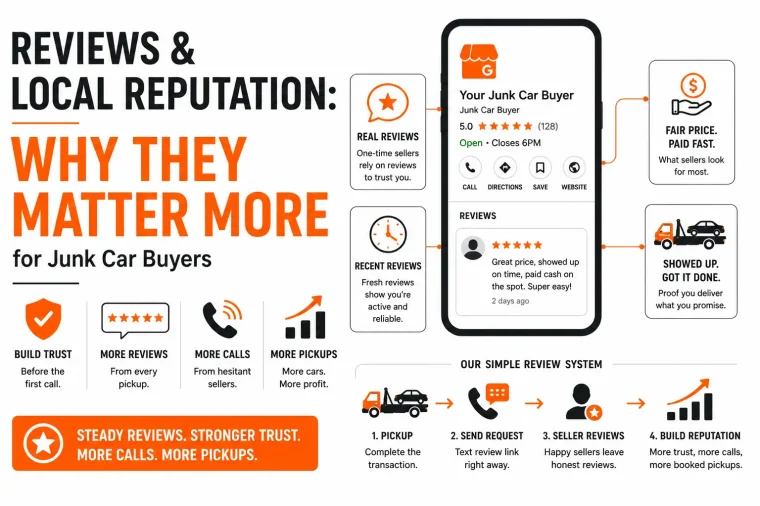
Reviews and local reputation carry more weight for a junk car buyer than almost any other local business. Most sellers only transact once, no repeat visits, no ongoing relationship, which means reviews do the entire job of proving you’re trustworthy before a stranger ever calls. This guide covers why that matters, how to build a review system into every completed pickup, and what a review actually needs to say to earn the next call. For the complete guide to generating more calls, quotes, and booked pickups through local SEO, Google Maps, trust content, paid ads, and reputation, see our Junk Car Buyer Marketing Guide.
📌 KEY TAKEAWAYS
- Reviews carry the entire trust burden for junk car buyers, no repeat customers to build trust over time
- Recency beats count, steady flow of recent reviews signals you’re actively operating right now
- Ask for reviews right after payment and paperwork, highest satisfaction moment
- Text beats email for the ask, sellers already on their phone during pickup
- Track response rate, not just review count, fix timing or wording if conversion is low
- Reviews should mention fair price, on-time arrival, paid as promised, specific beats generic
- Free audit shows what a review system could do for your yard’s booked pickups
Why Reviews and Local Reputation Matter More for Junk Car Buyers Than Any Other Business
Most local businesses build trust slowly, over repeat visits, a regular customer who comes back a dozen times before ever leaving a review, and even if they never leave one, the relationship itself carries the trust. A junk car buyer doesn’t get that. Almost every seller is a one-time transaction, they call once, sell once, and never come back. That changes everything about how trust actually gets built.
With no repeat relationship to lean on, reviews end up carrying the entire trust burden by themselves. A seller has no history with you, no personal referral, often no prior awareness the business even exists. The only signal they have, beyond your website copy, is what other one-time sellers said about their own experience. That’s a heavier load than reviews carry for almost any other local business type.
This also means review recency matters more here than review count. A business with forty reviews from two years ago looks frozen in time to a new seller, since there’s no way to know if that same experience still holds true today. A business with a steady stream of recent reviews signals something different: this is happening right now, other people just like me are calling and getting a fair outcome. For a one-time buyer, recent proof beats old proof every time.
The practical result is that review generation can’t be a one-time project for a junk car buyer, a quick push to get some reviews and move on. It has to be an ongoing system, built into every single pickup, because the moment reviews go stale, the trust they were built to provide starts eroding, regardless of how many were collected in the past.
How to Build a Review System After Every Junk Car Pickup
Getting more reviews isn’t one big push, it’s a repeatable habit built into every pickup. No tool needed, just a consistent process anyone on team can run.
- Ask at the right moment. Right after cash handed over, paperwork signed, truck about to leave, highest satisfaction point. Waiting till later, satisfaction fades, request feels random.
- Make it a step, not an afterthought. Add “send review link” as literal last step in pickup checklist, same as confirming VIN or signing title. Habit built into process beats relying on memory every time.
- Text beats email here. Sellers checking phone anyway during pickup, text link gets opened fast. Email often sits unread for days, momentum lost.
- Keep the ask short. One line: “Thanks for selling us your car today. Mind leaving a quick review?” plus link. No long explanation needed, seller just experienced whole process, doesn’t need reminding what it was.
- Template varies slightly by driver, not by seller. Same core message every driver sends, but let each driver’s name sign it, feels personal not automated even though process is systematic.
- Track response rate, not just review count. If only 1 in 10 requests convert to review, timing or message wording likely off. Test moment of ask, test message wording, before assuming sellers just don’t leave reviews.
- Follow up once, not more. One same-day request plus one follow-up 2-3 days later if no response. Pushing harder than that risks annoying seller, hurting reputation instead of helping it.
What Sellers Actually Look for in a Review Before Calling
Star rating alone doesn’t convert, most sellers scan actual review text for specific proof points before calling. Knowing what they’re looking for shapes what kind of reviews worth encouraging.
- Fair price mentioned specifically. “Paid what they quoted” or “offer matched what they said on phone” beats generic “great service.” Seller’s biggest fear is lowball after inspection; a review naming fair price directly kills that fear fast.
- Showed up on time. Punctuality reassurance matters more here than in typical business, seller often waiting around, sometimes took time off, needs car gone by a certain point. Review mentioning “arrived when they said” answers unspoken scheduling worry.
- Paid as promised, on the spot. Cash or instant payment right there, no “check coming later,” no payment delay. Review confirming this directly addresses the biggest scam fear, get paid or not.
- Easy process, no hassle. Mentions of “handled the paperwork,” “no title, still worked out,” “quick, maybe 20 minutes” signal smooth experience, reduces fear of complicated or drawn-out ordeal.
- Specific over generic. Five-word review “Good service, thanks!” does little. Two-sentence review naming price, timing, and payment does real work. Encourage reviewers naturally toward detail, don’t just ask for “a review,” ask what stood out.
- What doesn’t matter as much: parts selection, inventory, facility appearance, things that matter for salvage yard reviews. Junk car buyer reviews live or die on transaction trust, not physical yard impression.
Point: review content itself is the trust signal, not just star count. Encourage specific detail, not just volume.
Frequently Asked Questions
Less about total count, more about recency and specificity. Steady flow of recent, detailed reviews beats large stale total every time.
Respond calmly, address specifics, offer to make it right if legitimate. One honest response to a negative review often builds more trust than another five-star review would.
Not required. Consistent manual process, same step every pickup, works fine without paid tools. Automation helps scale later, but habit matters more than tool at start.
Yes, review count and recency feed into prominence, one of Google’s three core local ranking factors. Review system helps both ranking and conversion at once.
See How We Build Review Systems That Convert
Review system that runs itself, built into every pickup, turns one-time transactions into ongoing proof new sellers trust. Our junk car buyer clients have seen up to 35% more off-street car buying in 45 days.