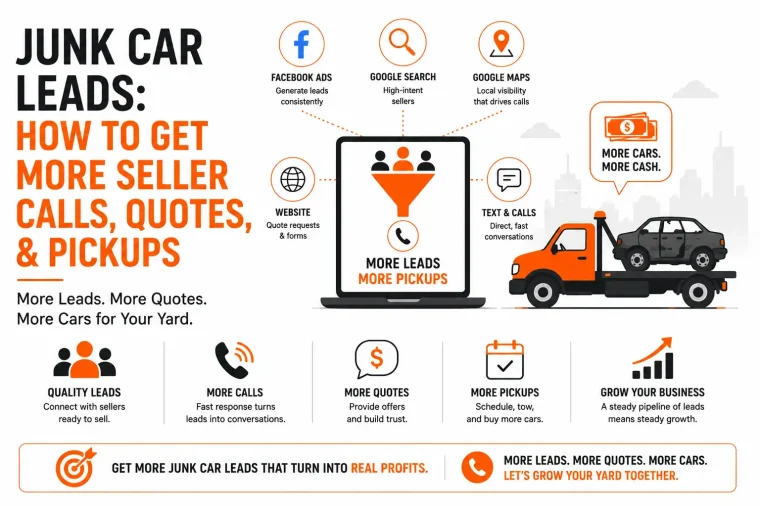
If you’re a junk car buyer trying to buy more vehicles every week, getting more junk car leads is only part of the job. The real challenge is generating seller opportunities consistently, reaching them fast, and turning more calls, forms, and messages into completed pickups. This guide breaks down where junk car leads actually come from, how Facebook Ads can create a steady pipeline, what other channels support that growth, and how to track which leads are actually putting more cars in your yard. For the broader approach, see our Junk car buyer marketing strategy.
📌 KEY TAKEAWAYS
- Junk car leads are only valuable when they turn into purchased vehicles. Focus on contacted sellers, quotes, pickups, and profitable car buys—not just lead volume.
- Qualified leads usually have a vehicle your team can buy, valid contact information, realistic expectations, and a location within your profitable pickup area.
- Use multiple lead sources. Facebook Ads can create demand, while Google Ads, Google Maps, local SEO, referrals, and your website capture sellers at different stages.
- Facebook Ads can build a steady pipeline. Keep targeting focused on your service area, make the offer clear, use simple lead forms, and show real vehicles, pickups, and your team.
- Google captures higher-intent sellers. Focus on searches from people actively looking to sell and avoid irrelevant traffic that wastes your budget.
- Fast follow-up matters. Contact new leads and missed calls quickly. Use calls and texts to recover sellers who do not respond immediately.
- Keep the quote process simple. Ask for the information you actually need and make it easy for sellers to understand pickup, paperwork, and payment.
- Buying leads can provide speed, but you have less control. Shared leads can create competition, while exclusive leads should still be carefully evaluated.
- Building your own pipeline creates a long-term asset. Your ads, SEO, website, reviews, data, and seller relationships continue working for your business.
- Track what actually produces cars. Measure leads → contacted → quotes → pickups → purchased vehicles. Scale the sources that consistently produce profitable cars.
What Are Junk Car Leads?
Junk car leads are people who have a vehicle they want to sell and have taken a real step toward getting an offer. That might mean filling out a Facebook lead form, calling your yard, sending a text, or requesting a quote through your website. The best junk car leads give you enough information to start a real buying conversation, not just another website visit to count in a report.
For a junk car buyer, junk car leads can vary a lot in value. A seller five miles away with a complete vehicle and plans to sell this week is different from someone outside your pickup radius who is only checking what their car might be worth. Both may technically be leads, but only one may be close to turning into a car your team actually buys.
That is why junk car leads should never be judged on volume alone. What matters is how many turn into contacted sellers, real quotes, scheduled pickups, and purchased vehicles.
What Makes a Junk Car Lead Qualified?
A qualified lead is one your team can realistically buy from. Qualified junk car leads are usually inside your service area, connected to a vehicle the seller can actually sell, and ready to have a conversation about price and pickup.
Useful information normally includes the vehicle’s year, make, model, condition, location, title status, and a working phone number. You do not always need every detail before making contact, but you need enough to decide whether the opportunity makes sense and what your team should do next.
Qualification also comes down to economics. A real seller can still be a poor opportunity if towing distance, vehicle condition, or the seller’s price expectation makes the deal unprofitable. The point is not to chase every form submission equally. It is to identify the junk car leads most likely to become profitable car buys and respond to those opportunities first.
Calls, Quote Requests, and Text Leads: What Counts as a Lead?
Phone calls, Facebook lead forms, website quote requests, texts, Google Business Profile messages, and direct social messages can all generate junk car leads. The channel matters less than whether you have a real way to continue the conversation with the seller.
A missed call with a valid number still counts if your team follows up quickly. A Facebook form with vehicle details and contact information is a lead even before the seller speaks to someone. A quote request becomes stronger once the seller is reached and the vehicle, location, and pickup details are confirmed.
This is why tracking junk car leads by source and outcome matters. Knowing Facebook produced 100 leads tells you something. Knowing how many were contacted, quoted, scheduled, and actually purchased tells you whether those leads are helping put more cars in your yard.
Where Do Junk Car Leads Come From?
Junk car leads can come from several places, but they do not all behave the same once they reach your team. A seller who fills out a Facebook form after seeing an ad is different from someone who searches “sell my junk car near me” and calls from Google Maps. Both are real opportunities, but the intent, urgency, and follow-up needed to turn them into bought vehicles can be very different.
For most junk car buyers, the strongest approach is a mix of channels rather than depending on one source. Facebook Ads can create a steady flow of junk car leads and reach sellers before they start calling every buyer in town. Google Ads and Maps capture people already searching. Local SEO and city pages build longer-term visibility. Referrals and local partnerships can add another layer. What matters is knowing which sources consistently produce vehicles your team can actually buy at a profitable number.
High-Intent vs Lower-Intent Junk Car Leads
High-intent junk car leads usually come from sellers who are already trying to get rid of a vehicle. They search terms like “sell my junk car,” “cash for junk cars near me,” or “junk car buyer,” then call, text, or request a quote. These sellers are often comparing offers right now, so response time matters. Wait too long and there is a good chance another buyer gets the car first.
Lower-intent junk car leads are earlier in the decision process. This is common with Facebook Ads, where someone may see your offer while scrolling even though they were not actively searching for a buyer that minute. That does not make the lead bad. It means your follow-up has to do more work. The seller may need help understanding what the vehicle is worth, whether you buy cars in that condition, how pickup works, or what paperwork they need.
The mistake is treating all junk car leads as if they should close the same way. A high-intent Google lead may book quickly, while a Facebook lead may need several calls or texts before the seller is ready. What matters is whether the acquisition cost and follow-up effort still result in a profitable car buy.
Local Leads vs Leads Outside Your Pickup Area
Location changes the value of junk car leads fast. A real seller with a real vehicle can still be a weak opportunity if the car sits too far outside your normal pickup radius. Longer towing time, fuel, driver hours, and scheduling pressure all cut into what you can afford to pay.
That is why your lead generation should be tied to a clear service area. Facebook campaigns should focus on cities and ZIP codes your trucks can realistically cover. Google Ads should avoid spending money outside that range, and local SEO pages should target towns where you actually want more vehicles.
Generating junk car leads outside your profitable pickup area may make the lead count look better, but it does not necessarily grow the business. The number that matters is how many of those opportunities your team can quote competitively, schedule efficiently, and turn into purchased cars.
The best junk car leads fit both sides of the deal: the seller is serious enough to move forward, and the vehicle is somewhere your team can serve profitably. More leads are useful only when they translate into more cars bought.
How to Get More Junk Car Leads
Getting more junk car leads is not about turning on one ad campaign and hoping the phone starts ringing. The strongest lead flow comes from combining paid demand generation, local search visibility, and a follow-up process that turns interest into an actual vehicle purchase. For most junk car buyers, Facebook Ads can be one of the fastest ways to build that pipeline because they let you reach vehicle owners before they start calling every competitor in town.
The goal is not simply to generate the highest number of junk car leads. It is to consistently bring in sellers inside your service area, contact them quickly, quote the right vehicles, and track which sources actually put more cars in your yard. For the detailed steps, use our guide to Get more junk car leads.
Facebook Ads for Junk Car Leads
Facebook Ads give junk car buyers something search-based channels do not: the ability to reach sellers before they actively search for a buyer. Someone may have a non-running car sitting in the driveway for months without ever typing “sell my junk car” into Google. A strong Facebook ad can put the offer in front of that person at the right time and turn passive interest into one of your next junk car leads.
That is why Facebook can become a dependable source of junk car leads when the campaign is built around the seller, not around generic brand awareness. The ad has to make the offer clear, remove uncertainty, and give the seller an easy way to request a quote.
Once a Facebook lead comes in, the next steps matter: fast contact, vehicle qualification, quoting, follow-up, and pickup. For a detailed breakdown of how to turn Facebook leads into actual vehicle purchases, read our guide to Facebook Ads for Junk Car Leads.
– Why Facebook Ads Work for Junk Car Sellers
Most sellers are not thinking about junk car buyers every day. They start thinking about selling when the vehicle becomes a problem, it stops running, takes up space, fails inspection, gets damaged, or becomes more expensive to repair than it is worth.
Facebook lets you reach those people before they start comparing five different buyers on Google. That creates an opportunity to generate junk car leads earlier in the decision process and start the conversation before competitors are involved.
The trade-off is intent. Someone searching Google may already be ready to sell today. A Facebook lead may still be deciding. That does not make Facebook junk car leads worse, it means the campaign and follow-up have to do more of the conversion work.
When the targeting, creative, lead form, and follow-up all work together, Facebook Ads can create a steady flow of junk car leads without depending entirely on sellers who are already searching.
– How to Target Vehicle Sellers on Facebook
The biggest targeting mistake is trying to find a perfect “junk car owner” audience inside Facebook. There is no clean audience of everyone currently sitting on an unwanted vehicle. A better approach is to control geography tightly, give Meta enough room to find responders, and let the ad itself help qualify the seller.
Your service area should come first. Target the cities, ZIP codes, or surrounding areas where your trucks can realistically pick up vehicles at a profitable number. There is no value in generating junk car leads two hours outside your normal route just because the cost per lead looks cheap.
The creative and copy should then make it obvious who the offer is for. Talk about junk, wrecked, damaged, unwanted, or non-running vehicles. Mention pickup. Explain the basic process. If you buy certain vehicles without a title where legally possible, make that clear without promising something your team cannot actually do.
This helps filter out people looking for parts, repairs, financing, or unrelated vehicle services and gives Facebook better signals around the people responding to your offer. Better targeting is not just about lowering cost, it is about producing junk car leads your buyers can actually work.
– Lead Forms vs Landing Pages
Facebook lead forms reduce friction because the seller can request an offer without leaving the app. That usually makes it easier to generate a higher volume of junk car leads, especially when the form asks only for information your buying team actually needs.
A useful lead form can collect:
- Name and phone number
- ZIP code or city
- Vehicle year
- Make and model
- Vehicle condition
- Title status
- Preferred contact method
Do not turn the form into a full vehicle inspection. Every additional question creates another reason for someone to leave before submitting.
Landing pages work differently. They give you more space to explain the offer, show reviews, answer title questions, explain pickup, and build trust before the seller sends their information. You may generate fewer junk car leads than with a simple instant form, but those sellers can arrive with more context about what your business does.
Neither option automatically wins. The right choice depends on your operation. If your team follows up immediately and can qualify sellers on the phone, lead forms can work extremely well. If sellers need more information before they are comfortable requesting an offer, a focused landing page may make more sense.
The real comparison is not form leads versus landing-page leads. It is which path produces more purchased vehicles at a profitable acquisition cost.
– Creative Angles That Get More Junk Car Leads
Generic ads saying “We Buy Cars” blend into everything else a vehicle owner sees online. Strong Facebook creative speaks to the situation that made the seller want the car gone in the first place.
Useful angles can include:
- A non-running vehicle taking up driveway space
- A damaged car that is not worth repairing
- A vehicle that has been sitting for months
- Fast or same-day pickup where available
- Cash offers without arranging your own tow
- A simple process for getting an unwanted vehicle removed
The visual matters too. Real tow trucks, actual pickups, vehicles your team has bought, and people doing the work create more credibility than generic automotive stock photos.
The seller should understand the offer within a few seconds. What vehicles do you buy? Do you pick them up? How do they get an offer? What happens next?
That clarity is what turns attention into junk car leads.
Do not judge creative only by clicks or engagement. An ad can get plenty of reactions and still produce poor business results. The creative that matters is the one generating junk car leads that your team can contact, quote, and convert into vehicles at a number that makes sense.
– How Fast Follow-Up Impacts Facebook Lead Quality
Facebook lead quality often gets blamed when the real problem is what happens after the form is submitted.
A seller may fill out a Facebook form while sitting at home, on a lunch break, or scrolling at night. Their attention moves on quickly. Wait hours to contact them and they may forget which company they submitted to, respond to another ad, or start calling buyers on Google.
Contact new junk car leads as quickly as your operation can realistically handle them. If the first call is missed, follow it with a text that identifies the business and reminds the seller why you are reaching out.
One unanswered call should not automatically turn a lead into a dead lead. Build a simple follow-up process for sellers who do not answer immediately. Calls, texts, and another attempt later can recover junk car leads that would otherwise disappear.
Speed matters because the same lead can look completely different depending on when it is contacted. A Facebook lead reached within minutes may answer, provide vehicle details, accept a quote, and schedule pickup. Contact that same seller the next day and they may have already sold the car.
Before blaming Facebook for poor junk car leads, look at response time, contact rate, follow-up attempts, quote rate, and actual cars bought.
Google Ads for Junk Car Leads
Google Ads captures a different type of seller. These people are already searching terms like “sell my junk car,” “cash for junk cars near me,” or “junk car buyer,” which usually means they are further along in the decision.
That makes Google an important source of junk car leads, but higher intent also brings more competition. You are bidding at the same moment other buyers want that seller.
Campaigns should stay focused on searches that clearly signal someone wants to sell a vehicle. Negative keywords matter just as much. Searches for junkyard parts, repair information, used vehicles, or unrelated towing can burn through budget without creating usable junk car leads.
Geography needs the same discipline as Facebook. Do not pay for seller traffic from locations your trucks cannot serve profitably.
And do not send high-intent traffic to a generic homepage. The page should immediately confirm that you buy the seller’s type of vehicle, cover their area, and provide a clear path to call or request a quote.
Google Maps and Google Business Profile Leads
Google Maps catches sellers at one of the fastest decision points in the process. Someone searches for a junk car buyer nearby, sees a handful of local businesses, checks reviews, and often calls one without spending much time anywhere else.
A strong Google Business Profile can generate junk car leads through calls, messages, website visits, and quote requests. Category selection, services, recent reviews, real photos, service-area information, and an accurate description all help the seller decide whether your business looks legitimate enough to contact.
The profile should tell one clear story: you buy unwanted vehicles, you serve this area, and getting a quote or pickup is straightforward.
Maps should also be tracked like any other lead source. Knowing the profile gets views is not enough. Track how many calls and quote requests become real junk car leads, and then how many of those turn into vehicles purchased.
Local SEO for Junk Car Leads
Local SEO builds the longer-term side of the pipeline. Instead of paying every time someone clicks an ad, you create useful pages that can continue bringing in junk car leads from searches tied to the vehicles you buy and the locations you serve.
The strongest content matches what sellers are actually searching for. That includes terms around selling a junk car, cash offers, damaged vehicles, non-running vehicles, title questions, pickup, and location-specific searches.
SEO takes longer to build than turning on a Facebook or Google campaign, but the visibility can compound. A page that ranks consistently can keep producing junk car leads without paying for every single visit.
That makes local SEO a strong supporting channel even when Facebook Ads are already driving the majority of immediate lead volume.
City and Service-Area Pages That Generate Seller Leads
A pickup-based business usually serves far more than the city where the yard physically sits. That creates opportunities to build city and service-area pages for towns where you genuinely want to buy more vehicles.
These pages should prove you actually serve the area. Include pickup expectations, local service information, relevant title or paperwork details, and an obvious way for the seller to request an offer.
Do not build fifty copies of the same page with a different city name dropped into each one. That gives the seller almost nothing useful and creates weak local content.
A strong city page turns a location-based search into one of your junk car leads by answering the seller’s immediate question: can this company actually come here and buy my car?
Junk Car Landing Pages and Quote Forms
Every lead source eventually needs somewhere to convert. Whether the seller arrives from Facebook, Google Ads, Maps, or organic search, the next step should be obvious.
A landing page should make clear what vehicles you buy, where you operate, how pickup works, and how the seller gets an offer. The quote form should collect enough information to start a buying conversation without becoming a twenty-question inspection.
Year, make, model, condition, ZIP code, title status, name, and contact information are usually enough to begin qualifying junk car leads.
The form itself is only one part of the system. What happens immediately afterward matters just as much. The lead should reach the right person, the seller should be contacted quickly, and the outcome should be tracked.
A hundred completed forms can look impressive on a marketing report. What matters is how many junk car leads were reached, how many received quotes, how many pickups were scheduled, and how many vehicles actually made it back to your yard.
That is the standard every lead source should eventually be measured against: not how much activity it creates, but how many profitable cars it helps you buy.
Buying Junk Car Leads vs Generating Your Own Leads
There are two basic ways to build a steady flow of junk car leads: pay another company to send them to you, or build your own system that generates sellers directly through Facebook Ads, Google, local SEO, and your website.
Both can work. The difference is control.
When you buy junk car leads, you are paying for access to demand someone else generated. When you generate your own, you control the ads, the targeting, the seller experience, the follow-up data, and the system that produced the lead in the first place.
For a junk car buyer trying to grow consistently, that difference matters more than the price of an individual lead. For the detailed steps, use our guide to Compare exclusive and shared junk car leads.
What Are Purchased Junk Car Leads?
Purchased junk car leads are seller inquiries generated by a third-party lead company and then sold to junk car buyers.
The seller may have filled out a quote form, responded to an advertisement, or entered their vehicle information on a website owned by the lead provider. The provider then sends that seller’s information to one or more buyers operating in the area.
A typical purchased lead may include:
- Seller name and phone number
- Vehicle year, make, and model
- Vehicle condition
- ZIP code or location
- Title information
- Basic seller intent
On paper, buying junk car leads can look simple. You pay for leads, your buyers call them, and your team tries to purchase the vehicles.
The problem is that you usually have limited control over what happened before that lead reached you.
You may not know what advertisement the seller saw, what offer was made, how long ago the form was completed, or whether the same information was already sent to another buyer. That makes the quality of purchased junk car leads heavily dependent on the company generating them.
A cheap lead is not automatically valuable. If your team cannot reach the seller, the vehicle sits outside your profitable pickup radius, or three other buyers are calling at the same time, the low cost per lead does not mean much.
The real question is what you paid for the vehicle opportunities you actually bought.
Shared vs Exclusive Junk Car Leads
One of the first things to understand before buying junk car leads is whether they are shared or exclusive.
Shared junk car leads can be sold to multiple buyers. That means several companies may receive the same seller information and start calling within minutes of each other.
The advantage is usually price. Shared leads tend to cost less because the provider can sell the same opportunity more than once.
The disadvantage is competition.
Your buyer may call a seller five minutes after the lead arrives and still hear, “Someone else already offered me more.” You are not just trying to contact the seller. You are entering an active bidding situation created by the lead itself.
Exclusive junk car leads are supposed to be sent to one buyer rather than distributed to several businesses.
That can give your team more room to have a real conversation, quote the vehicle, and follow up without three competitors chasing the same seller at the exact same time.
But “exclusive” should not be accepted blindly.
Ask what exclusive actually means. Is the lead sold only once? Is it exclusive for a certain amount of time? Could the seller have submitted their information through another site? How quickly is the lead delivered after submission?
The label matters less than what happens operationally.
If your purchased junk car leads arrive late, contain bad information, or consistently turn into bidding wars, the source may not be as valuable as the headline cost suggests.
Pros and Cons of Buying Junk Car Leads
Buying junk car leads can make sense in the right situation.
The biggest advantage is speed. You do not have to build campaigns, create landing pages, wait for SEO rankings, or learn Facebook Ads before inquiries start coming in. If the provider already has traffic in your market, you can start receiving leads quickly.
That can be useful when:
- You are entering a new service area
- Your current lead volume has dropped
- Your buyers have capacity for more calls
- You need additional vehicle opportunities immediately
- You want to test whether a market has enough seller demand
Purchased junk car leads can also help fill gaps while your own marketing system is being built.
But there are trade-offs.
You have less control over lead quality, targeting, messaging, and seller expectations. The provider owns the marketing system. If prices increase, lead quality drops, or the company stops serving your market, your lead flow can disappear quickly.
You are also not building much of an asset.
Pay $5,000 for purchased junk car leads this month and you have whatever opportunities that spend produced. Stop paying next month and the pipeline usually stops with it. That does not automatically make buying leads bad. It makes them rented demand. The mistake is depending on rented demand as the entire acquisition strategy. For the detailed steps, use our guide to Calculate cost per junk car lead.
Why Building Your Own Lead Pipeline Creates a Long-Term Asset
Generating your own junk car leads takes more work upfront, but it gives you control over the entire system.
With Facebook Ads, for example, you control the markets you target, the creative sellers see, the questions on the lead form, the budget, the follow-up process, and the data showing which campaigns actually produce purchased cars.
As campaigns run, you learn.
You see which cities produce stronger vehicles, which ads generate better junk car leads, which seller situations close more often, and which areas cost too much to service. That information stays with your business instead of sitting inside a third-party lead provider’s platform.
The same applies to local SEO.
A city page that starts ranking can continue producing junk car leads month after month. A strong Google Business Profile can keep generating calls. Reviews build over time. Your website becomes more authoritative. Your Facebook campaigns accumulate conversion data that can improve future performance.
Each part makes the next part stronger.
That is why an owned lead pipeline becomes an asset instead of just another monthly expense.
It also gives you more control over seller expectations.
If your own Facebook ad tells the seller exactly what vehicles you buy and what happens after they request an offer, your buyer starts the conversation with more context. If your landing page explains pickup and title requirements before the form is submitted, your junk car leads arrive better informed.
You are shaping the lead before your team ever picks up the phone.
That is difficult to do when someone else owns the front half of the seller journey.
The strongest strategy does not necessarily mean refusing all purchased leads. Some operators can use third-party junk car leads profitably alongside their own campaigns.
But the long-term goal should be reducing dependence on a source you do not control.
When Facebook Ads, local search, your website, reviews, quote forms, and follow-up systems consistently produce your own junk car leads, you are no longer waiting for another company to decide how many opportunities you get or what they cost.
You own the pipeline, the data, and the relationship with the seller from the first click through the completed pickup.
How to Turn More Junk Car Leads Into Purchased Vehicles
Generating junk car leads is only useful if your team can turn those opportunities into vehicles bought. A high lead count means very little when sellers go unanswered, quotes take too long, or nobody follows up after the first call.
The goal is simple: contact sellers quickly, make the process easy, build enough trust to move forward, and stay in front of leads that are not ready to sell immediately. For the detailed steps, use our guide to Plan a profitable junk car acquisition strategy.
Respond to New Leads Fast
Speed matters because most sellers are not contacting just one junk car buyer. Someone who submits a Facebook form or requests a quote may also be checking Google and comparing other offers.
The faster your team responds to junk car leads, the better chance you have of starting the conversation before a competitor does.
You do not need a complicated system. Get the lead to the right buyer quickly, make the first call, and send a short text if they do not answer. A strong campaign can still lose cars when leads sit untouched for hours.
Make the Quote Process Simple
Sellers should not have to work hard to get an offer.
Collect the information you actually need: year, make, model, condition, location, title status, and basic vehicle details. Then move toward a quote instead of turning the first conversation into an interrogation.
The easier the process feels, the more junk car leads your team can move from inquiry to real offer.
Clear expectations matter too. Explain what affects the quote, whether pickup is included, what paperwork is needed, and what happens if the seller accepts.
Build Trust Before Asking the Seller to Commit
For many sellers, this may be the first junk car transaction they have ever made. They may be worried about getting lowballed, dealing with paperwork, or having someone promise a pickup and never show.
Reviews, clear communication, real business information, and straightforward answers reduce that hesitation.
Do not oversell the process. Tell the seller what will happen, what they need to provide, and how payment and pickup work. When junk car leads trust the process, getting them to commit becomes much easier.
Follow Up With Leads That Do Not Sell Immediately
Not every seller will accept the first quote or answer the first call.
Some are comparing offers. Others are waiting for paperwork, talking to another owner, or simply not ready to make the decision that day.
That does not automatically make them bad junk car leads.
Build a basic follow-up process using calls and texts. Check back after the original quote and give the seller an easy way to restart the conversation. A lead that does not close today can still become a pickup later if your team stays organized. For the detailed steps, use our guide to Follow up with junk car sellers.
Recover Missed Calls Before They Become Lost Cars
A missed call can be one of the most expensive leaks in a junk car buying operation.
If a seller calls and nobody answers, they usually do not wait around. They move to the next business in Google or respond to another offer.
Call missed numbers back quickly and use text follow-up when possible. The message only needs to identify your business and let the seller know you are following up about their vehicle.
Tracking missed calls also shows whether the problem is marketing or operations. If campaigns are producing junk car leads but calls regularly go unanswered, generating more leads will not solve the real problem.
More purchased vehicles come from tightening the entire process between the first inquiry and the final pickup, not simply increasing the number at the top of the funnel.
How to Tell if a Junk Car Lead Is Actually Good
Not all junk car leads are equal. A good lead is not just someone who filled out a form. It is a seller your team can realistically contact, quote, and buy from at a profitable number. For the detailed steps, use our guide to Qualify junk car leads.
Signs of a High-Quality Junk Car Lead
Strong junk car leads usually have a clear vehicle, valid contact information, a location inside your service area, and a seller who is ready to discuss an offer.
Other good signs include:
- The seller owns or controls the vehicle
- The vehicle fits your buying criteria
- Pickup is financially practical
- The seller responds quickly
- Price expectations are realistic
The closer a lead is to those conditions, the more likely it is to turn into a purchased car.
Signs of a Low-Quality or Unprofitable Lead
Some junk car leads are real but still not worth chasing heavily.
Warning signs include:
- Vehicle is far outside your pickup radius
- Contact information is incomplete or invalid
- Seller has unrealistic price expectations
- Vehicle details do not match your buying criteria
- Lead has been shared with several buyers
- Seller shows little intent to move forward
The goal is not to reject every imperfect lead. It is to recognize which junk car leads deserve immediate attention and which are unlikely to produce a profitable pickup.
Why Your Junk Car Leads Are Not Converting
Getting more junk car leads does not fix much if those leads are not turning into purchased vehicles. Most conversion problems come from targeting, response time, trust, or weak follow-up. For the detailed steps, use our guide to Improve junk car lead conversion.
You Are Targeting the Wrong Searches
If your campaigns attract people looking for parts, repairs, towing, or unrelated services, lead volume can look healthy while actual car buys stay low.
Your Pickup Area Is Too Broad
Leads outside your profitable service area can quickly become too expensive once towing time, fuel, and driver hours are added.
Your Website Makes Getting a Quote Too Difficult
Long forms, unclear calls to action, and too many steps can push sellers to a competitor before they ever become usable junk car leads.
You Take Too Long to Answer Calls and Forms
Most sellers are comparing multiple buyers. Slow response gives competitors time to make the first offer.
Sellers Do Not Trust Your Offer
Weak reviews, unclear pricing, and vague pickup details create hesitation. Sellers need to understand who they are dealing with and what happens next.
You Have No Follow-Up System
Many junk car leads will not close on the first call. Without consistent calls and texts, those opportunities disappear.
You Are Tracking Leads but Not Purchased Cars
Lead count alone is not enough. Track which sources produce quotes, pickups, and actual vehicles bought. That is the only way to know which junk car leads are really growing the business.
A Simple Junk Car Lead Generation System
A reliable system for junk car leads should be simple enough to repeat and easy enough to track. The goal is to create demand, capture sellers, follow up fast, and measure which channels actually produce vehicles. For the detailed steps, use our guide to Build a junk car lead generation system.
Step 1: Capture Existing Demand
Use Facebook Ads, Google Ads, and Google Maps to reach sellers who are already thinking about getting rid of a vehicle.
Step 2: Build Organic Local Visibility
Create strong local SEO pages around the cities and services you actually cover. Over time, this can generate junk car leads without paying for every click.
Step 3: Improve Lead Capture
Use clear landing pages, short quote forms, and obvious call or text options. Make it easy for sellers to take the next step.
Step 4: Improve Follow-Up and Closing
Respond quickly, follow up with missed calls and unresponsive leads, and keep the quote process simple.
Step 5: Track Which Sources Actually Produce Cars
Do not stop at lead count. Track which channels create quotes, pickups, and purchased vehicles so you know which junk car leads are worth scaling. For the detailed steps, use our guide to Track junk car leads through to purchased vehicles.
Frequently Asked Questions
Use a mix of Facebook Ads, Google Ads, local SEO, Google Maps, and strong follow-up. The best system combines paid demand with organic visibility.
For fast volume, Facebook Ads can work extremely well. Google Ads captures higher-intent searches, while local SEO builds a longer-term source of junk car leads.
Cost varies by market, competition, channel, and lead quality. The better metric is cost per vehicle purchased, not just cost per lead.
Purchased leads can fill short-term gaps, but generating your own gives you more control over targeting, data, lead quality, and follow-up.
Usually, because fewer buyers compete for the same seller. But exclusivity only matters if the lead is fresh, accurate, and inside your service area.
Yes. Google Ads can capture sellers already searching for terms like “sell my junk car” or “cash for junk cars near me.”
Yes. City pages, service-area content, and Google Business Profile optimization can generate consistent junk car leads over time.
As quickly as possible. Sellers often compare multiple buyers, so faster response usually improves contact and close rates.
Start with year, make, model, condition, location, title status, name, and phone number.
Track leads by source, quotes given, pickups scheduled, vehicles purchased, and cost per car bought.
Get More Qualified Junk Car Leads
More junk car leads only matter when they turn into vehicles your team can buy profitably. Build the right campaigns, respond fast, track what closes, and scale the sources that consistently put more cars in your yard.