
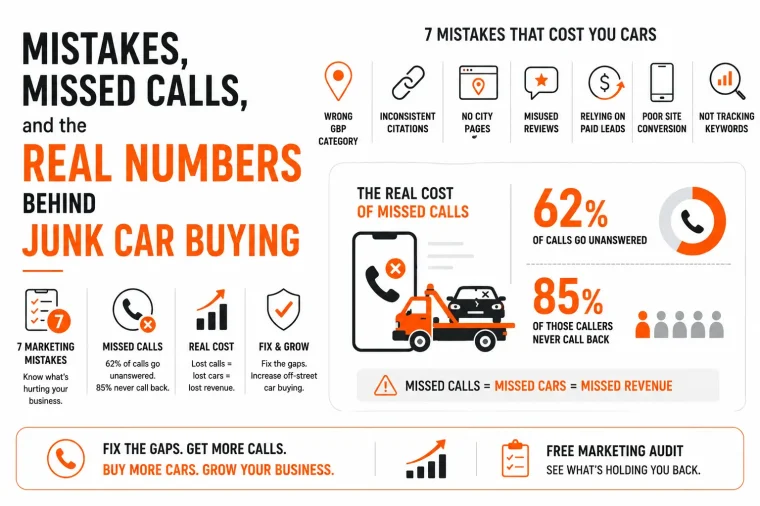
Junk car marketing mistakes are rarely dramatic, they’re small, easy-to-miss gaps that compound quietly over months. If calls feel flat, cost per car keeps climbing, or something just feels off, this guide breaks down the seven most common mistakes by symptom, what to check first, why it’s happening, and what it’s actually costing you, backed by real industry numbers,
not guesswork.
In junk car buying, visibility and conversion are tied together more tightly than most operators realize. A page can rank and still underperform if calls are missed, trust signals are weak, or the next step is hard to take. Strong junk car buying marketing therefore has to do two jobs at once: get sellers to find you and make it easy for them to act. That is why small junk car buying gaps can show up quickly in cost per acquisition and vehicle volume.
These mistakes are only one part of a bigger growth system. If you want the full picture—from Google Business Profile optimization and local SEO to reviews, paid ads, seller trust, and conversion—see our complete junk car buyer marketing guide. It breaks down how each channel works together to generate more calls, more quotes, and more vehicle pickups.
📌 KEY TAKEAWAYS
- Seven marketing mistakes covered symptom-first, match what’s happening in your business to find the likely cause.
- Most businesses have two or three mistakes active at once, not just one; they compound quietly over months.
- Missed calls calculation: your weekly missed calls × average car value × close rate. Run it with your own numbers.
- Industry-wide, 62% of small business calls go unanswered and 85% of those callers never call back.
- Industry stats sourced from ARA where possible; other figures are flagged by confidence level, not all treated as equal.
- Glossary covers every term used across this cluster, built for quick lookup, not sequential reading.
- Free audit shows which mistakes are active in your business and what off-street car buying growth looks like.
7 Marketing Mistakes Killing Junk Car Buyers in 2026
Each one below starts with what you’re actually seeing, then the mistake behind it. Skip to whichever symptom matches what’s happening in your business right now.
1. Your Maps Ranking Looks Fine but Calls Are Still Low
Check your GBP category first. A half-finished or wrong category tells Google you don’t care about the listing, and Google rewards profiles that use every available field. Businesses that pick the closest-sounding category during setup and never revisit it often don’t realize months later that they’ve been invisible for their highest-intent searches the entire time.
2. Your Rankings Fluctuate or Never Break Into the Top Three
Check your citations. Most local businesses have their name, address, or phone number listed slightly differently across directories, and Google reads that inconsistency as a trust signal failure. This is one of the quietest mistakes, since the business itself hasn’t changed, but Google’s confidence in it has.
3. You're Only Ranking in Your Home City
If you’re missing surrounding towns entirely, you’re likely running one generic service page instead of dedicated area pages. For a typical service area, junk car buyers can realistically support 50 to 100 pages of location-specific content, and most companies aren’t building anywhere close to that, which means real SEO visibility is being left on the table for competitors willing to build it out.
4. Your Reviews Look Fine but Calls Don't Match Your Rating
Check how you’re actually using them. Treating reviews as customer service instead of marketing is a common gap. Replies that don’t mention your service area or category miss a real ranking opportunity, since Google reads well-crafted review responses as an ongoing trust signal, not just a courtesy.
5. Your Cost per Car Keeps Climbing
You’re likely relying on purchased leads instead of organic visibility. Vendor leads can run significantly higher per car than organic search traffic once SEO investment compounds, and unlike SEO, that cost never goes down over time. It stays flat or rises as demand for the same leads increases among competitors buying from the same source.
6. Your Site Ranks but Visitors Leave Without Calling
The problem is likely conversion, not visibility. Hidden phone numbers, slow load times, no click-to-call button, and forms that are too long all quietly bleed leads that technically found you. Ranking gets someone to the page. These elements are what get them to actually call once they’re there.
7. You Can't Tell Which Keywords Are Producing Leads
You’re likely not tracking calls back to their source at all. A business can rank for a dozen local keywords and still have no idea which ones create real revenue, which means marketing decisions end up based on guesswork instead of what’s actually converting.
The pattern across all seven:
none of these are dramatic failures. They’re small, easy-to-miss gaps that compound quietly over months, which is exactly why most owners don’t catch them without someone specifically looking for them.
For operators trying to grow junk car buying volume, the priority is not adding more tactics at random. It is removing friction from the path between search and answered call. Better local relevance, stronger trust signals, and cleaner conversion points make junk car buying traffic more valuable before you spend another dollar. That is the difference between simply generating clicks and building a junk car buying system that consistently turns local demand into vehicles.
The Real Cost of Missed Calls for Junk Car Buyers
This continues directly from the mistakes above, since missed calls are usually where those mistakes actually show up as lost money, not just lost visibility.
The Scale of the Problem, Industry-Wide First
Across small service businesses generally, roughly 62% of incoming calls go unanswered, and 85% of those callers never call back. They call the next name on the list instead.
This isn’t a junk car buyer-specific number, it’s the pattern across small service businesses broadly, but the behavior transfers directly. A seller who can’t reach you moves to the next result just as fast as anyone calling a plumber or a salon.
Why This Hits Junk Car Buyers Harder Than Most Industries
A missed call for most local businesses might mean losing a repeat customer relationship worth something over years. A missed call for a junk car buyer means losing the entire transaction outright. There’s no second chance, no follow-up visit; the seller has already moved to a competitor within minutes.
A Real Calculation You Can Run With Your Own Numbers
Missed calls per week × average value per car bought × realistic close rate = weekly revenue lost
For example, if you’re missing 10 calls a week, your average car nets you $300 in profit after costs, and roughly a third of answered calls would have converted, that’s:
10 × $300 × 0.33 = over $1,000 a week walking to competitors.
Over a year, that’s more than $50,000, and this is likely a conservative estimate for a business fielding calls throughout the day without a dedicated answering process.
Run It Yourself
Track missed calls for one week. Check voicemail and call logs, and count anything that rang out or went unanswered during business hours.
Multiply that number by what an average car nets you, then by your honest close rate on calls you do answer. That number is more convincing than any industry statistic, because it’s actually yours.
Where This Money Is Usually Going
Not nowhere—to whichever competitor picked up first.
The pattern across small business missed-call research is consistent: most first-time callers who can’t reach a business will call a competitor immediately rather than wait or try back later.
For a junk car buyer, that’s not a delayed sale. It’s a permanently lost one.
The Fix Isn't Complicated, It's Just Usually Skipped
A dedicated answering process during business hours, a clear after-hours message pointing to a callback window, or simply making sure GBP messaging gets a fast response closes most of this gap without needing to overhaul your entire marketing plan first.
That responsiveness is part of junk car buying marketing, not just operations. The seller’s decision window is short, so speed becomes a conversion factor the moment the phone rings. A business can invest heavily in junk car buying visibility and still lose the transaction at the final step if nobody answers. Improving the handoff from search to conversation is one of the simplest ways to protect the value of junk car buying leads already being generated.
Junk Car Buying Industry Statistics 2026
Last updated: August 2026. Every figure below is sourced, with confidence level noted where data quality varies.
Industry Size and Scale
The automotive recycling industry employs over 140,000 people across more than 9,000 locations in the US, generating an estimated $32 billion in annual sales.
Source: Automotive Recyclers Association (ARA). This is the most authoritative figure available, since ARA is the industry’s own trade association.
Vehicle Volume
Roughly 12 million vehicles reach end-of-life status in the US each year.
Source: Industry reporting compiled from Recycling International and related trade coverage.
Material Recovery
Around 86% of a vehicle’s materials, by weight, are reusable, recyclable, or recoverable for energy once it reaches end-of-life.
Source: Automotive Recyclers Association compiled data. This figure is widely cited across industry sources and considered reliable.
Market Value
The broader vehicle scrapping and recycling market was valued at approximately $75 billion in 2023, with continued growth projected.
Source: Industry market research compilation. Note this is a market-research estimate, not a government figure, and should be treated as directional rather than exact.
Business Size
The automotive recycling industry is highly fragmented and predominantly comprised of small businesses, with more than 75% of professional facilities employing ten or fewer people and a median of four employees.
This data reflects a market dominated by independent, often family-owned operations, though the precise numbers serve as a general industry pattern rather than an exact current headcount.
Search Behavior
One industry source claims roughly 73% of junk car sellers click into the Google Maps 3-pack rather than scrolling to organic results below it.
Source: This figure comes from a competing marketing agency’s own promotional material, not an independent study, so it is worth citing with that caveat rather than presenting it as verified fact.
What This Means in Plain Terms
This is a real, substantial industry, not a niche corner of the auto market: over 140,000 jobs and tens of billions in annual sales, built almost entirely on small, owner-operated businesses rather than large chains.
That combination—a big industry made up of small operators—is exactly why a handful of quiet marketing mistakes can cost so much relative to the size of an individual business, and why even modest improvements in visibility and conversion tend to move the needle meaningfully for an operator competing against dozens of similarly-sized businesses in the same market.
These numbers also explain why junk car buying competition is so local. National industry size matters, but an individual operator wins or loses based on visibility and responsiveness inside a specific service area. The strongest junk car buying strategy connects that local demand to pages, profiles, reviews, and calls that are easy to track. In other words, junk car buying growth is less about chasing one headline metric and more about tightening the entire acquisition path.
A Note on Sourcing
Figures attributed to the Automotive Recyclers Association carry the highest confidence, since they come from the industry’s own trade body. Market-size and search-behavior figures are compiled from secondary sources and should be treated as directional estimates rather than precise counts. This page will be updated as more current data becomes available.
From an SEO standpoint, junk car buying content works best when the phrase sits inside useful explanations rather than being repeated without context. Search visibility is only valuable when the page answers the seller’s intent and gives the business a realistic chance to convert that visit. That is why every junk car buying mention on this page is tied to an operational or marketing point, and why the broader junk car buying topic stays connected to calls, local search, reviews, and vehicle acquisition.
Junk Car Buyer Marketing Glossary
Quick reference for terms used throughout this guide and the rest of our junk car buyer content. Jump to whatever term brought you here, no need to read start to finish.
Close rate.
The percentage of answered calls that actually turn into a booked pickup. Used in the missed-calls calculation above, your own close rate is more useful here than any industry average.
City page.
A dedicated web page targeting one specific town or service area, built to rank for searches like “sell my junk car in [City]” rather than relying on one generic page for your whole service radius.
Click-to-call.
A button or link on a website that lets someone tap once to dial your number directly from their phone, instead of copying a number and switching apps. Missing this quietly costs mobile leads.
GBP (Google Business Profile).
Your free business listing on Google, the thing that shows up in the map pack and local search results. Often the first, and sometimes only, thing a seller sees before calling.
Map pack / 3-pack.
The block of three local business listings Google shows at the top of search results for local queries, above the standard organic results. Most local clicks happen here, not further down the page.
NAP.
Name, Address, Phone number, shorthand for your business’s core identity info. Needs to match exactly across every directory and citation, since inconsistency reads as a trust signal problem to Google.
Organic search.
Unpaid search rankings, earned through SEO rather than paid ads. Slower to build than paid traffic, but doesn’t disappear the moment you stop paying for it.
Prominence.
One of Google’s three core local ranking factors, essentially how trusted and well-known your business appears, built mostly through reviews, consistency, and activity.
Relevance.
Another of Google’s three ranking factors, how closely your profile matches what someone actually searched. A thin profile with vague services gives Google little to match you against.
Review velocity.
How steadily new reviews come in over time, distinct from total review count. Matters more than raw count for junk car buyers, since most transactions are one-time and recency signals active operation.
Schema.
Structured code added to a website that helps search engines understand what a page is about, used for things like FAQ boxes and rich results in search listings.
Service area.
The geographic radius a business serves, set in GBP and reflected in city page coverage. For junk car buyers, this is usually wider than for a walk-in business, since pickup means the business travels, not the customer.
Distance.
The third of Google’s three local ranking factors, how far a business is from the person searching. A strong, complete profile can outrank a closer but weaker competitor.
FAQPage schema.
A specific type of schema markup that helps FAQ content appear directly in search results or AI-generated answers, rather than requiring a click-through to the page.
Frequently Asked Questions
Most businesses have two or three active at once, rarely just one. They tend to compound quietly; a wrong category plus stale reviews plus no city pages adds up faster than any single mistake alone.
It’s a starting formula, not a fixed number. Your actual close rate, average car value, and call volume all shift the result. Run it with your own numbers for an accurate picture, not the industry example.
The ARA-sourced figures carry the highest confidence, since they come from the industry’s own trade body. A few figures are compiled estimates and flagged as such, so check the sourcing notes before citing anything as a hard fact.
Most sellers are one-time transactions, no repeat customers building trust over years. A steady stream of recent reviews signals active, current operation, which matters more here than a large but aging total.
See Where Your Marketing Is Losing You Leads
Small, easy-to-miss mistakes compound fast, and most owners don’t catch them without someone specifically looking. We’ll show you exactly which ones are active in your business and what to fix first. Our junk car buyer clients have seen up to 35% more off-street car buying in 45 days.