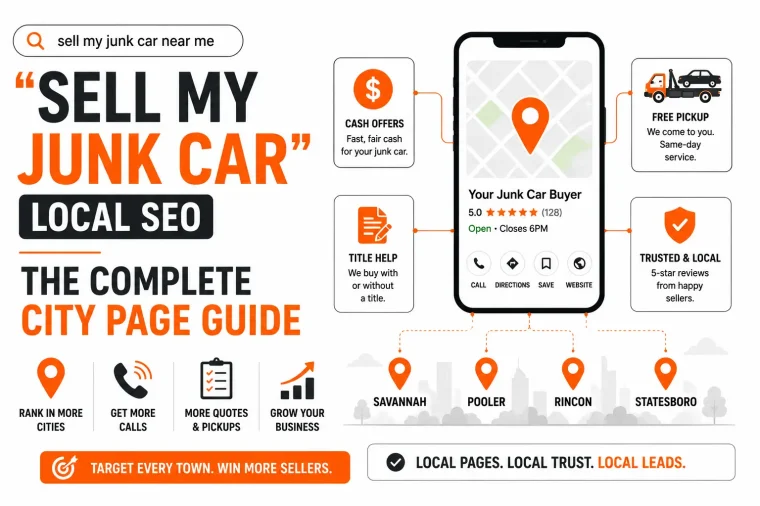
Sell my junk car local SEO isn’t just about ranking, it’s about ranking city by city, with pages built wide enough to cover your whole pickup radius, not just your yard’s zip code. This guide covers what actually belongs on a junk car buyer’s city page, how local pricing content builds trust, and where most junk car buyers lose sellers before the phone even rings. For a broader look at how city pages fit into the overall acquisition strategy, see our junk car buyer marketing guide, which covers local SEO, Google Maps, paid ads, reviews, and trust-building content.
A strong sell my junk car local SEO strategy focuses on matching each seller’s location and search intent with the right page. Instead of relying on one general service page, junk car buyers can capture more local searches by creating pages that answer city-specific questions about pricing, pickup, and paperwork.
📌 KEY TAKEAWAYS
- City pages matter more for junk car buyers than parts yards, pickup means wider service area, more towns to cover
- Each city page needs pricing expectations, title requirements, pickup logistics, not admission fees or tool policy
- “Cash for junk cars near me” content explains what affects pricing, no stale price tables
- Junk car pricing shifts by region, local scrap rates, buyer competition, towing distance, local parts demand
- Junk car buyer and scrap yard aren’t the same, know which one you’re talking to for a better offer
- Pickup day content proves local reach, real driver, real timing per area, not vague “we’ll come get it”
- Free audit shows what off-street car buying growth looks like for your yard
Why City Pages Matter More for a Junk Car Buyer Than a Parts Yard
Self-service part pullers travel to you. Junk car sellers, you travel to them. That single difference changes how many city pages you actually need, and it’s usually far more than a parts yard would ever build.
A self-service yard is bound by how far someone will drive to pull a part, which is why a single-location yard typically needs just three to six city pages covering the towns that actually send walk-in traffic. A junk car buyer isn’t limited that way, pickup means your service radius is only limited by how far your truck will drive, which is often a much wider area, sometimes an entire metro and its surrounding towns.
More service radius means more distinct searches to own. Someone in one suburb searching “sell my junk car” wants to know you’ll actually come to them, not just that you exist somewhere in the region. A single generic page trying to cover an entire metro can’t answer that specifically for every town in it, which means it loses out to any competitor building dedicated pages per area.
This is why junk car buyers typically need a meaningfully larger city page footprint than a parts yard does, not because more pages are automatically better, but because the business model itself covers more ground. The goal isn’t to build a page for every town within driving distance just to claim territory, it’s to build one for every town that realistically sends sellers, which for a pickup-based business is simply a longer list than it is for a walk-in one.
How to Build a "Sell My Junk Car in [City]" Page That Actually Ranks
A self-service city page tells a puller what to expect at the gate, admission fee, tool policy, what’s in stock. A junk car buyer’s city page needs to answer a different set of questions, since the seller isn’t walking through a gate, they’re deciding whether to hand over a car sight unseen.
The foundation of sell my junk car local SEO is creating pages that are genuinely useful for sellers in each market. A city page should not simply replace the city name in a template. It should explain why your junk car buyer serves that location, what sellers can expect, and how the pickup process works in that area.
- Pricing expectations for that area. Sellers want a general sense of what affects their offer before they call, condition, weight, local scrap rates. This doesn’t mean publishing exact numbers that go stale fast, it means giving enough context that a seller feels informed instead of walking in blind.
- Title requirements specific to that state or region. This is one of the biggest hesitation points for a first-time seller, and it varies enough by location that a real answer belongs on the page itself, not buried in a generic FAQ shared site-wide.
- Pickup logistics for that area. How fast can someone actually get to them, what do they need to have ready, does someone need to be present. A seller in a smaller town outside your main service area wants reassurance that pickup there works the same way it would closer to your base.
- Building Junk Car Location Pages That Convert: Junk car location pages should focus on the areas where sellers actually request pickups. Each page should include unique information about the city, local service availability, pickup expectations, and questions sellers commonly ask. The goal is not creating more pages. The goal is creating pages that rank because they provide a better answer for people searching in that specific market.
That’s the real content difference. The mechanics of building the page itself, keeping it genuinely unique instead of a copy-pasted template with the city name swapped, follow the same core principle either business type. Rather than re-explain that here, the short version: give each page real local detail, real reasoning for why that town is served, and a couple of questions specific to sellers in that area, not a shared FAQ block repeated everywhere. What matters most for a junk car buyer specifically is that the page proves you’ll actually show up there, since unlike a walk-in yard, trust in your reach is the whole sale.
Cash for Junk Cars Near Me: How Local Pricing Actually Works
“Cash for junk cars near me” is one of the highest-intent searches a seller can type. It means they’re not researching, they’re ready to find out what their car is worth right now. Content that actually answers this, honestly and in plain terms, earns more trust than a page that dodges the question and just pushes a call to action.
This is also where cash for junk cars local SEO becomes valuable. Sellers searching these terms are usually looking for a nearby buyer who can provide a realistic offer quickly. Pages that explain local pricing factors build more trust than pages that only ask visitors to call.
- Weight and scrap value. A junk car’s baseline worth is tied heavily to its weight and current local scrap metal rates, which shift over time and by region. This is the floor of most offers, not the ceiling.
- Condition and completeness. A car with an intact engine, transmission, and catalytic converter is worth more than a stripped one, since those parts often have resale value beyond scrap weight. Sellers don’t need exact numbers here, just an honest sense of what raises or lowers an offer.
- Local demand and distance. A buyer closer to the seller can usually offer more, since towing cost eats into what’s left for the vehicle itself. This is part of why “near me” matters so much for pricing, not just convenience.
- How offers are actually calculated. Most sellers have never sold a junk car before and don’t know what a fair number even looks like. A short, honest explanation of how a quote gets built, weight plus condition plus local rates minus towing distance, builds far more trust than a vague promise of “top dollar,” which every competitor also claims.
The goal of this content isn’t to publish a price list that goes stale within weeks. It’s to make a seller feel like they understand roughly what to expect before they ever pick up the phone, which makes them trust the actual number they’re given far more when it arrives.
Junk Car Buyer vs Scrap Yard: What's the Difference
These two terms get used interchangeably online, but they’re not always the same business, and knowing the difference helps a seller pick the right one for their situation.
- A junk car buyer purchases whole vehicles for cash, usually with pickup included, and typically pays based on the car’s overall condition and parts value, not just its scrap weight. This is the better option for most sellers, since it usually means a higher offer and less hassle, you’re not the one hauling the car anywhere.
- A scrap yard buys vehicles primarily for their metal weight, often requiring the seller to bring the car in themselves rather than offering pickup. Pricing here is typically tied closer to current scrap metal rates, with less consideration for the vehicle’s condition or any parts still worth something.
- Why this matters for a seller. A car in reasonably good shape, even if it doesn’t run, is often worth meaningfully more to a junk car buyer than a scrap yard, since a junk car buyer can recover value from working parts before the vehicle is scrapped. A truly stripped or heavily damaged vehicle may not see much difference either way, since there’s little left beyond scrap weight regardless of who buys it.
- The simplest way to decide: if the car still has usable parts or runs at all, get a quote from a junk car buyer first. If it’s already stripped down to nearly nothing, a scrap yard’s straightforward weight-based offer may be just as fair.
- Creating SEO Pages for Different Seller Types: Different sellers search differently, which is why a strong local SEO strategy should cover multiple vehicle situations. Someone searching for a damaged vehicle, a non-running car, or a general junk car removal service may have different questions before contacting a buyer.
How Junk Car Pricing Varies by Region
The same junk car can be worth noticeably different amounts depending on where it’s sold, and that’s not random, it comes down to a handful of local factors that shift from one market to the next.
- Local scrap metal rates. Scrap prices are set regionally and move with metal markets, which means a car’s baseline value can differ meaningfully between two nearby cities, let alone across states. A seller checking a national average is often working with a number that doesn’t reflect their actual local market at all.
- Density of local buyers. In areas with more junk car buyers competing for the same vehicles, offers tend to run higher, since buyers have to stay competitive to win the sale. In markets with fewer buyers, there’s less pressure pushing offers up.
- Towing distance within the region. A buyer based closer to a seller can typically offer more, since less of the payout gets absorbed by pickup cost. This is part of why the same car can get a stronger offer from a buyer ten minutes away than one an hour out, even within the same general area.
- Local demand for parts. Some regions see stronger demand for certain makes, models, or parts, often tied to what’s common on the road locally. A car with parts that are in demand nearby can be worth more there than in a market where that demand doesn’t exist.
- What this means for a seller. Getting a number from a national estimator or a friend in another state isn’t a reliable benchmark. The only way to know what a car is actually worth is a quote from a buyer who actually operates in that specific area, since regional rates, competition, and demand all factor into the number in ways a generic estimate can’t capture.
Junk Car Pickup: What to Expect the Day Someone Buys Your Car in [City]
Local angle needed here too, not just generic pickup steps. Tie to city page purpose: proving local reach and reducing local hesitation.
- Pickup timing varies by area. Same-day common near main base, next-day likely for outer towns in service radius. State specific window per city page, sets real expectation not vague “fast pickup” promise.
- Local driver, not dispatched from far away. Seller in outer town wants reassurance real local team comes, not subcontracted stranger from across region. Name area, mention regular routes through that town if true.
- Before truck arrives. Title (or state paperwork if lost), personal items removed, key location known. Confirm upfront by phone, avoid day-of surprise.
- What driver actually does. Inspect car matches description. Confirm VIN. Handle paperwork, sign title over. Load and go, 15-20 min typical.
- Payment moment. Cash or instant transfer, paid on-site once paperwork done, before truck leaves. No “check mailed later,” seller should know that upfront.
- Title requirements, state-specific. Ties back to earlier city-page section, alternate paperwork exists if no title, varies by state, doesn’t always kill sale. Repeat briefly here, reinforce trust at point of action.
- After pickup. Seller keeps signed bill of sale copy, notifies DMV if state requires. Removes lingering liability worry.
Whole point for this cluster: proves buyer actually shows up reliably in that specific town, not just claims service area on paper. Local trust signal, not just process explainer.
Frequently Asked Questions
Sell my junk car local SEO helps junk car buyers appear when sellers search for services in their area. By creating location-focused pages, improving local relevance, and answering seller questions, businesses can attract more qualified leads from nearby markets.
Not every town, only ones sending real sellers. Junk car buyers usually need more pages than a parts yard since pickup covers wider radius, but still prioritize by actual demand not driving distance alone.
Salvage yard page covers admission fee, tool policy, walk-in logistics. Junk car buyer page covers pricing expectations, title requirements, pickup logistics, since seller never visits in person.
No. Exact numbers go stale fast. Explain what affects offer, weight, condition, local rates, towing distance, builds trust without a table needing constant updates.
Local scrap rates, buyer competition, towing distance, and local parts demand all shift regionally. Same car, different city, different offer, real not random.
Junk car buyer purchases whole vehicle, factors condition and parts value, often includes pickup. Scrap yard pays mostly by weight, may require seller to bring car in.
Get Your Free Junk Yard Local SEO Audit
Ready to improve your sell my junk car local SEO strategy, build city pages that rank, and turn local searches into booked pickups? Our junk car buyer clients have seen up to 35% more off-street car buying in 45 days.