
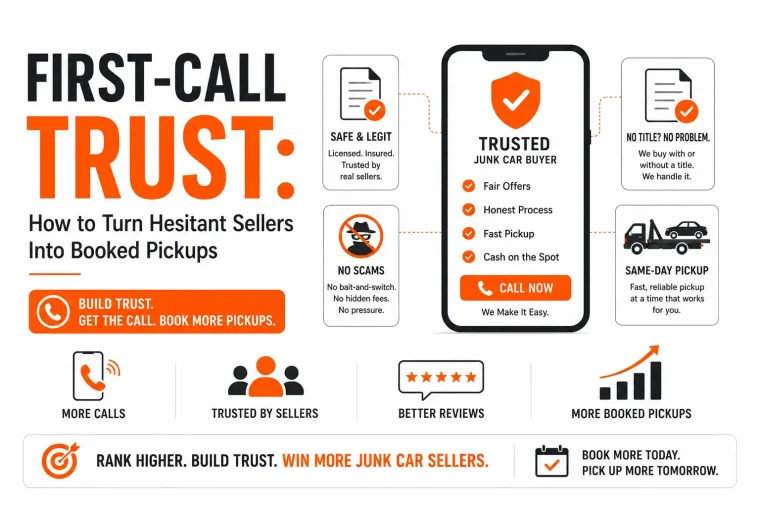
First call trust decides who a seller actually calls, not just who ranks highest. Ranking gets you seen. Trust gets you the phone call. This guide covers how to build content, safety pages, scam-fear content, title objection handling, same-day pickup proof, that turns a hesitant seller into a booked pickup before they even talk to your team. First-call trust is one part of a larger junk car buyer marketing system. For the complete strategy covering local SEO, Google Maps, paid ads, reviews, city pages, and conversion, see our Junk Car Buyer Marketing Guide.
📌 KEY TAKEAWAYS
- Trust content wins the call before the phone even rings, ranking gets seen, trust gets called
- Safety page should show credentials, payment terms, and reviews right at the decision point, not buried
- No-title objection needs a direct, normalizing answer, link back to city page paperwork details instead of repeating them
- Scam content works best paired, name the red flag, then show the opposite as proof
- Same-day pickup claims only work if operationally true, vague promises read as marketing, specific process reads as real
- Every section should carry the same honest, no-pressure tone, so trust builds page to page, not just section to section
- Free audit shows what trust-driven conversion looks like for your yard
Why Trust Content Wins the Call Before Seller Ever Picks Up the Phone
Ranking gets a seller to the page. Trust content decides if they call. Two junk car buyers can rank next to each other on Google, same visibility, same map position, and still get very different call volume, because one site answers a seller’s real fears before they ask, and the other doesn’t.
Seller’s headspace, before calling: is this real, will they lowball me, do I need my title, will they actually show up. Site that answers these upfront wins the call. Site that skips straight to “get a quote” without addressing hesitation loses it, even ranking first.
This matters more for junk car buyers than almost any other local business, since most sellers only do this once. No repeat-customer trust built over time, no brand familiarity. Trust has to be built entirely inside a few minutes of reading, before the first call ever happens.
Rest of this page: how to build that content, section by section, each one targeting a specific fear or hesitation point stopping a seller from calling.
How to Build a "Is It Safe to Sell My Junk Car" Page That Converts
This page does two jobs at once, answers seller’s real question honestly, and quietly proves your business passes every safety test while doing it. Built right, reader finishes thinking “this one’s legit” without the page ever saying “trust us.”
- Credentials, shown not claimed. License, insurance, business registration, display plainly, not buried. Legitimate buyers show this openly, scammers don’t, page should say that directly, then show your own credentials right there as proof.
- Payment terms, stated upfront. Cash or instant payment, on-site, before truck leaves. Naming this explicitly answers the biggest fear (get paid or not) and separates you from bait-and-switch operators who stay vague about timing.
- Review proof, placed at decision point. Not tucked in footer. Real reviews mentioning fair price, showed up on time, paid as promised, placed right where seller is deciding whether to call. Specific review content matters more than star rating alone.
- Address safety concerns directly, don’t dodge them. Page should openly name common fears, bait-and-switch, lowball after inspection, no-show, then state plainly how you avoid each one. Naming fear then answering it beats vague reassurance every time.
- No artificial urgency. Scammers push “decide now.” Page should explicitly say you give real time to think it over, no pressure. Small line, big trust signal, since it’s the opposite of what a scam site does.
Structure: answer honestly like a neutral advice column, but every honest answer happens to describe exactly how your business operates. Reader doesn’t feel sold to. Reader feels informed, and an informed reader trusts the business that gave them clarity.
How to Handle the "No Title" Objection on Your Business's Site
Missing title, one of biggest reasons a seller hesitates to call at all, they assume no title means no sale. It’s not answering a paperwork question, it’s removing the exact fear stopping the call before it happens.
- Lead with the answer, not the process. First line on this section should say plainly: no title doesn’t mean no sale. Most sellers give up before reading further if this isn’t stated immediately.
- Point back to the real requirements, don’t rebuild them. State-specific alternate paperwork, bill of sale, ID verification, replacement title process, already covered in your city page content. Link to it here instead of duplicating, keeps the site consistent and avoids two pages competing for the same search.
- Frame it as normal, not a special exception. Language matters, “many sellers don’t have their title, here’s what we do instead” reads very differently than “if you happen to be missing your title.” First version normalizes it. Second makes seller feel like a problem case.
- Connect it to trust, not just logistics. A seller worried about missing a title is often also worried they’re being taken advantage of because of it. A line reassuring them the process is the same either way, no lower offer just for lacking a title, does double work here, answers the practical question and closes the trust gap in the same breath.
- Keep it short on this page. This section’s job is removing hesitation fast, not re-explaining every state’s paperwork rules. One clear paragraph plus a link to the full breakdown outperforms a long, repeated explanation sitting in two places on the site.
How to Turn Scam Fears Into a Competitive Advantage
This topic is crowded. Plenty of sites already list junk car scams, fake reviews, bait-and-switch, hidden fees, no-show buyers. Repeating that list alone won’t set you apart. What makes this section actually convert is turning that same list into a contrast, every red flag becomes a reason to choose you instead.
- Name the scam, then show the opposite, side by side. Don’t just list “watch out for bait-and-switch.” Follow it immediately with how your business avoids it, a locked-in quote based on the details you’re given, honored on pickup day, not renegotiated at the door. The pairing does more work than either half alone.
- Use the same red flags everyone else lists, but close each one with proof. Fake reviews is a common warning. Close that section with a link to your own verified reviews. Missing license or insurance is another common flag. Close that section by stating your credentials plainly, right there in the same breath.
- Don’t overclaim, undercut yourself if needed. If there’s a legitimate reason a competitor’s low offer might actually be fair, weight, condition, distance, say so. A page that’s honest about nuance reads as more credible than one that paints every competitor as a scammer, and it protects you from looking dishonest yourself.
- End with a plain statement of what a seller should expect from you, specifically. Not a slogan. A short, concrete list, real credentials, honored quote, cash on pickup, no pressure to decide immediately. This becomes the payoff of the whole section, the reader arrives here already primed by the contrast built throughout.
The goal isn’t to scare sellers into calling you. It’s to give them a clear, honest reason to trust you specifically, using the exact fears that are already sending them searching in the first place.
How to Build Same-Day Pickup Content That Matches Seller Urgency
“Same-day pickup” is one of the most overused phrases in this industry, and one of the least trusted, since most sites say it whether it’s actually true or not. The fix isn’t better wording, it’s making the claim concrete enough that it stops sounding like every other site’s marketing copy.
- Don’t promise it unless it’s operationally real. Before writing this section, confirm the actual truth, same-day within your core service area, next-day for outer towns, whichever is accurate. Publishing a claim you can’t consistently deliver damages trust faster than not making the claim at all.
- Replace the vague promise with a specific process. Instead of “we offer same-day pickup,” show what has to happen: call in by a certain time, confirm vehicle details, driver dispatched same day, typical arrival window. A seller reading a real process believes it. A seller reading a slogan doesn’t.
- Match urgency language to the seller’s actual moment. Someone searching “same-day junk car pickup” usually has a reason, a deadline, a tow-away notice, a car blocking their driveway. Content that acknowledges that directly, “car needs to be gone today, here’s exactly how fast we can move,” speaks to the real reason they’re searching, not just the keyword.
- Set honest limits where they exist. If same-day isn’t guaranteed everywhere in your service area, say so plainly rather than letting the promise apply everywhere by omission. A seller who finds out later that same-day only applies near your base loses trust fast, and that loss extends to every other claim on the site.
- Tie it back to the trust content already built. Someone reading this page has likely already seen your safety and scam content elsewhere on the site. Reinforce that same tone here, real process, no pressure, plain language, so the urgency content doesn’t feel like a sudden shift into hype after everything else on the site has been careful and honest.
Frequently Asked Questions
Both. Pages that fully answer a seller’s real questions tend to keep visitors longer and earn more engagement signals, but the bigger impact is conversion, turning a visitor who was already going to find you into one who actually calls instead of leaving to compare.
Separate works better. Each targets a different search intent, “is it safe to sell” is a hesitation question, “junk car buyer scam” is a research question. Splitting them lets each rank for its own keyword instead of competing internally.
Link back to it instead of rebuilding it. The no-title section here should stay short and reassurance-focused, then point to the full state-by-state breakdown already living in the local SEO cluster.
Say so directly. State where same-day applies and where next-day is more realistic. A specific, honest claim converts better than a broad one that turns out to be false for some sellers.
Get Your Free Junk Yard Local SEO Audit
Trust content isn’t just informational, it’s conversion infrastructure. Done right, it turns hesitant sellers into booked pickups before your team ever answers the phone. Our junk car buyer clients have seen up to 35% more off-street car buying in 45 days.