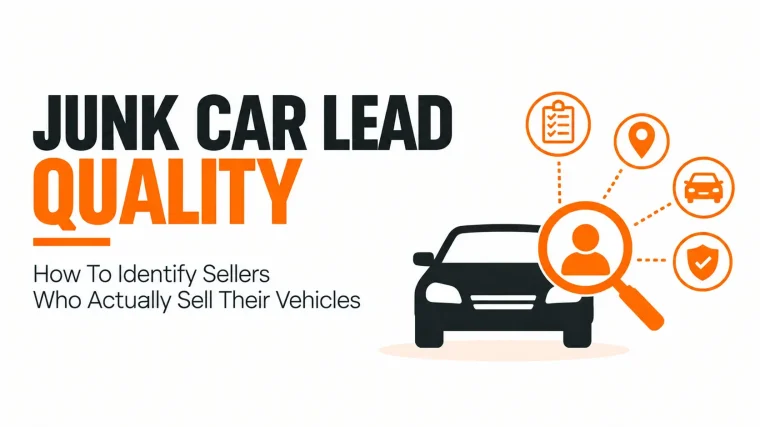
Junk car lead quality determines whether your salvage yard spends time on serious sellers or wastes resources on weak inquiries. A strong qualification process helps identify leads with seller intent, accurate vehicle details, a workable location, and ownership information.
Improving junk car lead quality means focusing on leads that are more likely to become vehicle purchases. By checking seller readiness, vehicle condition, service-area fit, and documentation early, salvage yards can prioritize better opportunities and reduce time spent on unqualified leads.
Need More Junk Car Leads in Your Local Market?
Stop relying on unpredictable seller inquiries. Pull Your Part Accelerator helps junk car buyers and salvage yards reach local vehicle owners through targeted Facebook Ads, local SEO, and organized lead tracking
📌 KEY TAKEAWAYS
- Junk car lead quality measures how likely a seller inquiry is to become a realistic, profitable vehicle acquisition.
- High-quality leads typically have accurate contact details, complete vehicle information, service-area fit, clear ownership, strong seller intent, and recent inquiries.
- Lead quality matters more than lead volume because hundreds of weak inquiries may produce fewer vehicles than a smaller number of qualified sellers.
- Qualification should evaluate seller intent, vehicle fit, location, ownership, freshness, and profitability.
- Important vehicle details include year, make, model, condition, running status, damage, missing parts, and expected value.
- Location matters because long-distance pickups can increase towing, fuel, driver, and acquisition costs.
- Ownership and title information should be verified early to avoid wasting resources on transactions that cannot be completed.
- Fresh, responsive leads should generally receive faster attention because sellers may contact multiple buyers or sell elsewhere.
- Exclusive leads are not automatically higher quality; the seller, vehicle, location, ownership, freshness, and economics still need to be evaluated.
- A simple 0–10 lead scoring system can rate seller intent, vehicle fit, location, ownership, and freshness to prioritize opportunities.
- Low-quality leads often come from broad targeting, weak lead forms, stale/shared leads, poor geographic targeting, and campaigns optimized only for cheap leads.
- Improve lead quality with tighter geographic targeting, higher-intent keywords, better qualification questions, and stronger vehicle-data collection.
- Track qualified lead rate, contactable lead rate, quote rate, lead-to-vehicle acquisition rate, cost per qualified lead, and cost per acquired vehicle.
- Avoid measuring success by lead volume alone; connect marketing performance to actual vehicles purchased and acquisition economics.
- Bottom line: A high-quality junk car lead is one where the seller, vehicle, location, ownership, intent, and profitability all align, creating a realistic opportunity for vehicle acquisition.
What Is Junk Car Lead Quality?
Junk car lead quality describes how likely a seller inquiry is to become a realistic and profitable vehicle acquisition opportunity. A strong lead usually includes accurate contact details, useful vehicle information, a suitable location, clear ownership status, and meaningful intent to sell.
For salvage yards, quality should be judged by how closely the lead matches the yard’s buying criteria-not simply by whether someone submitted a form or made a call.
What Makes A Junk Car Lead High Quality?
A high-quality junk car lead typically has several positive signals:
- The seller can be contacted
- Vehicle details are complete and accurate
- The vehicle is within the service area
- Ownership or title status is clear
- The vehicle fits the yard’s acquisition criteria
- The seller shows genuine interest in selling
- The inquiry is recent rather than outdated
The more of these factors a lead meets, the easier it becomes to determine whether the opportunity deserves immediate attention.
Qualified vs Unqualified Junk Car Leads
A qualified lead matches the salvage yard’s basic buying requirements and has a realistic chance of becoming a purchase.
An unqualified lead may involve problems such as:
- Incorrect contact information
- A vehicle outside the pickup area
- Unclear ownership
- Missing vehicle details
- Little or no selling intent
- A vehicle the yard does not want to purchase
Qualification helps teams prioritize stronger opportunities instead of treating every inquiry equally.
Why Lead Quality Matters More Than Lead Volume
A large number of inquiries can look impressive, but volume alone does not grow inventory.
Fifty well-qualified sellers may create more vehicle purchases than hundreds of poorly targeted leads.
Improving junk car lead quality can help salvage yards:
- Reduce wasted staff time
- Lower acquisition costs
- Focus on better vehicles
- Improve lead-to-purchase rates
- Identify stronger marketing sources
The objective is not to generate the most leads. It is to generate more leads worth pursuing.
Junk Car Lead Quality vs Junk Car Lead Conversion
Lead quality and lead conversion are connected, but they measure different parts of the acquisition process.
Lead quality asks:
Is this seller and vehicle worth pursuing?
Lead conversion asks:
Can we turn this qualified opportunity into a completed vehicle purchase?
Quality comes first. Conversion begins after the yard determines that the seller, vehicle, location, and ownership details make the opportunity worth pursuing.
Keeping these stages separate helps salvage yards diagnose whether poor results come from weak incoming leads or from problems later in the sales process.
What Information Should A Quality Junk Car Lead Include?
Strong junk car lead quality starts with having enough accurate information to decide whether a seller and vehicle are worth pursuing. A useful lead should provide clear seller details, vehicle information, location, ownership status, and readiness to sell.
The more complete the information is upfront, the easier it becomes for a salvage yard to separate qualified opportunities from leads that may waste time or resources.
Seller Name And Verified Contact Information
Every lead should include basic contact information such as:
- Seller name
- Phone number
- Email address, when available
- Preferred contact method
Accurate contact information is essential because even a promising vehicle has little value as a lead if the seller cannot be reached.
Verified contact details are therefore one of the first indicators of junk car lead quality.
Vehicle Year, Make, And Model
The year, make, and model help a salvage yard quickly determine whether the vehicle fits its acquisition needs.
These details can indicate:
- Potential parts demand
- Vehicle popularity
- Possible resale value
- Scrap or inventory potential
Incomplete or inaccurate vehicle information makes it harder to evaluate the opportunity properly.
Vehicle Condition And Whether It Runs
A quality lead should clearly describe the vehicle’s current condition.
Useful information includes:
- Running or non-running status
- Collision damage
- Mechanical problems
- Missing major components
- Overall physical condition
Vehicle condition directly affects pickup requirements, potential value, and whether the car is attractive to the yard.
Vehicle Location And Pickup Distance
Location is a major factor in determining junk car lead quality because transportation can significantly affect acquisition profitability.
The lead should include:
- Vehicle address or ZIP code
- City or service area
- Pickup accessibility
A vehicle may be valuable, but excessive towing distance can make the acquisition less profitable.
Title And Ownership Information
Salvage yards should know whether the seller has the legal authority and required documentation to sell the vehicle.
Important information includes:
- Title availability
- Name on ownership documents
- Known liens
- Other required transfer documentation
Requirements vary by state, so ownership information should be verified according to applicable local rules before completing the purchase.
Seller Timeline And Readiness To Sell
Seller intent is another important indicator of lead quality.
A seller who says:
- “I want it gone today.”
- “When can you pick it up?”
- “Can you make me an offer?”
usually shows stronger intent than someone who is simply checking what their vehicle might be worth.
Knowing the seller’s timeline helps salvage yards prioritize leads that are more likely to move forward.
Ultimately, junk car lead quality depends on having enough accurate information to evaluate the seller, vehicle, location, ownership, and purchase potential before committing acquisition resources.
How To Identify A Qualified Junk Car Lead
A qualified junk car lead is more than a completed form or incoming call. Strong junk car lead quality means the seller, vehicle, location, ownership status, and timing all match the salvage yard’s buying requirements.
The following signals help identify which leads deserve priority.
The Seller Is Actually Ready To Sell
Seller intent is one of the clearest signs of a qualified lead.
Strong intent signals include:
- Asking for a firm offer
- Wanting pickup soon
- Providing vehicle details without hesitation
- Responding quickly to questions
- Clearly stating a reason for selling
A seller who is only checking prices may still become valuable later, but they should not be prioritized the same way as someone ready to complete a transaction.
The Vehicle Fits Your Buying Criteria
Not every vehicle is equally valuable to every salvage yard.
A qualified lead should match factors such as:
- Preferred vehicle types
- Year, make, and model
- Parts demand
- Vehicle condition
- Scrap or resale potential
Matching the vehicle to your buying criteria improves junk car lead quality and prevents teams from spending time on poor-fit opportunities.
The Vehicle Is Inside Your Profitable Service Area
A good lead can quickly become unprofitable if the vehicle is too far away.
Before prioritizing a lead, confirm:
- Vehicle location
- Pickup distance
- Towing requirements
- Transportation cost
A qualified lead should fall within an area where the vehicle can be acquired profitably.
Ownership Can Be Verified
Ownership status should be clear before significant time or resources are committed.
Useful checks include:
- Title availability
- Seller name on documents
- Known liens
- Required transfer paperwork
The exact requirements vary by jurisdiction, but unclear ownership can significantly reduce the value of an otherwise promising lead.
The Seller Provides Complete Vehicle Information
Strong leads usually contain enough information to evaluate the vehicle quickly.
Important details include:
- Year, make, and model
- Running status
- Damage or mechanical issues
- Missing components
- Vehicle location
- Ownership status
Incomplete information does not automatically make a lead bad, but it lowers confidence until the missing details are verified.
The Lead Is Fresh And Reachable
Freshness is another important part of junk car lead quality.
A recent inquiry from a seller who answers calls or messages is generally more valuable than an older lead that has already contacted multiple buyers or stopped responding.
Priority should usually be given to leads that are:
- Recently submitted
- Reachable by phone or text
- Still actively considering a sale
- Not already closed with another buyer
A qualified junk car lead combines strong seller intent, vehicle fit, profitable location, verified ownership, complete information, and timely contactability.
Seller Intent Signals That Indicate A High-Quality Lead
Seller behavior is one of the strongest indicators of junk car lead quality. Even when vehicle details look promising, the lead may still be weak if the seller is not serious about moving forward.
The following signals usually indicate stronger selling intent.
They Request A Specific Offer
A seller asking for an actual price or firm offer usually has more intent than someone only looking for general information.
Questions such as:
- “How much will you pay?”
- “What can you offer for my car?”
- “Can you give me a price today?”
show that the seller is actively evaluating a sale.
They Provide Complete Vehicle Details
Serious sellers are generally willing to provide the information needed to evaluate their vehicle.
This may include:
- Year, make, and model
- Vehicle condition
- Running status
- Location
- Title status
Complete information improves junk car lead quality because it allows the yard to evaluate the opportunity more quickly.
They Ask About Pickup Or Timing
Questions about pickup are strong buying signals.
For example:
- “When can you pick it up?”
- “Can you come today?”
- “How long does pickup take?”
These questions suggest the seller is thinking beyond price and toward completing the transaction.
They Have A Clear Reason For Selling
A clear reason for selling often indicates stronger urgency.
Common reasons include:
- Repair costs are too high
- The vehicle no longer runs
- The car has been sitting unused
- The owner needs space
- The vehicle was damaged
A specific problem gives the seller a stronger reason to act.
They Respond To Calls Or Messages
Reachability is another important sign of junk car lead quality.
Sellers with stronger intent typically:
- Answer calls
- Reply to texts
- Provide requested information
- Stay engaged in the conversation
A lead that repeatedly ignores communication may have lower immediate value.
They Are Ready To Make A Decision
The strongest leads show both intent and urgency.
A seller may indicate readiness by:
- Comparing final offers
- Confirming ownership
- Asking about payment
- Discussing pickup availability
- Agreeing on next steps
The more clearly a seller moves toward a transaction, the stronger the lead becomes.
Overall, junk car lead quality improves when seller behavior shows clear intent, urgency, responsiveness, and readiness to complete the sale.
Red Flags Of A Low-Quality Junk Car Lead
Poor junk car lead quality often shows up through missing information, weak seller intent, location problems, or vehicles that do not match the yard’s buying criteria.
Recognizing these red flags early helps salvage yards avoid wasting time, towing resources, and acquisition budget on opportunities unlikely to become profitable purchases.
Missing Or Incorrect Contact Information
A lead has limited value if the seller cannot be reached.
Warning signs include:
- Invalid phone numbers
- Fake or incomplete names
- Incorrect email addresses
- Repeatedly unanswered contact attempts
Accurate contact information is one of the most basic indicators of strong junk car lead quality.
Incomplete Vehicle Information
A lead becomes harder to evaluate when important vehicle details are missing.
Examples include:
- No year, make, or model
- Unknown condition
- No running status
- Missing damage information
- Unclear vehicle location
Incomplete information does not automatically make a lead worthless, but it reduces confidence until those details are verified.
Vehicle Outside Your Service Area
A legitimate seller can still be a poor acquisition opportunity if the vehicle is too far away.
Long pickup distances can increase:
- Towing costs
- Driver time
- Fuel expenses
- Overall acquisition cost
A high-quality lead should generally fall within a service area where the vehicle can be acquired profitably.
Unclear Ownership Or Title Status
Ownership problems can prevent or delay a transaction.
Common warning signs include:
- Seller is not the documented owner
- Title status is unknown
- Existing liens are unclear
- Required paperwork is unavailable
Because transfer requirements vary by jurisdiction, ownership should be verified according to applicable local rules before acquisition.
Seller Only Wants A Price Estimate
Some sellers are simply researching what their vehicle might be worth.
Signs of weaker immediate intent include:
- Asking only for a rough value
- Refusing to provide vehicle details
- No interest in pickup timing
- No clear intention to sell
These leads may become valuable later, but they typically deserve lower priority than sellers ready to move forward.
Duplicate, Shared, Or Stale Leads
Lead freshness and exclusivity can influence junk car lead quality.
Potential problems include:
- The same lead appearing multiple times
- Several buyers contacting the same seller
- Inquiries that are days or weeks old
- Vehicles that have already been sold
Older or heavily shared leads often create more competition and lower the chance of acquisition.
Vehicle Does Not Match Your Acquisition Criteria
Not every legitimate seller has a vehicle worth pursuing.
A lead may be a poor fit because of:
- Low parts demand
- Unprofitable pickup distance
- Missing major components
- Vehicle type outside your buying criteria
- Acquisition cost exceeding expected value
The strongest junk car lead quality comes from opportunities where the seller is legitimate, the vehicle fits your needs, and the economics make sense for the yard.
How Vehicle Information Affects Junk Car Lead Quality
Vehicle details have a major impact on junk car lead quality because the value of a lead depends partly on the vehicle behind it.
Two sellers may show the same level of intent, but one vehicle may be far more valuable based on its model, condition, parts demand, scrap value, and pickup requirements.
The more accurately a yard evaluates vehicle information, the easier it becomes to prioritize the strongest opportunities.
Why Year, Make, And Model Matter
The year, make, and model help determine whether a vehicle fits the yard’s inventory and profitability goals.
These details can influence:
- Parts demand
- Availability of usable components
- Local market demand
- Scrap value
- Potential resale value
A vehicle with strong parts demand may deserve higher priority than one with limited value, even if both leads appear equally qualified.
Running vs Non-Running Vehicles
Whether a vehicle runs affects both acquisition value and pickup requirements.
A running vehicle may be:
- Easier to transport
- Less expensive to recover
- More likely to contain usable components
A non-running vehicle can still be valuable, but it may require additional towing or handling costs.
For junk car lead quality, running status should be considered alongside overall vehicle value rather than used as a standalone decision factor.
Accident Damage And Vehicle Condition
Vehicle condition helps determine how much usable value remains.
Important details include:
- Collision damage
- Mechanical problems
- Flood or fire damage
- Interior condition
- Major structural damage
A damaged vehicle may still contain high-demand parts, while another vehicle with less visible damage may have limited resale or inventory value.
Condition should therefore be evaluated based on the yard’s actual acquisition goals.
Missing Parts And Incomplete Vehicles
Missing components can significantly change the value of a lead.
Examples include vehicles missing:
- Engine
- Transmission
- Catalytic converter
- Wheels
- Battery
- Major body components
Incomplete vehicles may still be worth acquiring, but their expected value should be adjusted accordingly.
Clear information about missing parts improves junk car lead quality because it helps the yard avoid overestimating the opportunity.
How Vehicle Value Changes Lead Priority
Not all qualified leads deserve the same level of attention.
A salvage yard may prioritize one lead over another based on:
- Expected parts revenue
- Scrap value
- Vehicle demand
- Pickup cost
- Acquisition price
- Overall profit potential
For example, two sellers may both be ready to sell today, but the lead involving a higher-value vehicle within a short pickup distance may deserve faster attention.
Strong junk car lead quality comes from evaluating both the seller and the vehicle. A serious seller is important, but the vehicle must also make financial sense for the yard.
Why Location Verification Matters For Junk Car Leads
Location plays a major role in junk car lead quality because a good seller is not automatically a profitable acquisition opportunity.
Before prioritizing a lead, salvage yards should confirm where the vehicle is located and whether pickup costs still make the purchase worthwhile.
Service Area Fit
A qualified lead should normally fall within the salvage yard’s practical service area.
The right service area depends on factors such as:
- Pickup capacity
- Driver availability
- Local competition
- Vehicle value
- Transportation costs
A seller may be serious and ready to move forward, but the lead becomes less attractive if the vehicle is too far outside the yard’s profitable operating range.
Pickup Distance And Towing Costs
Long-distance pickups can quickly reduce acquisition margins.
Distance can increase:
- Fuel expenses
- Driver time
- Towing costs
- Scheduling complexity
For strong junk car lead quality, the expected vehicle value should justify the cost required to recover it.
Verifying ZIP Code Or Vehicle Location
Location should be verified early in the qualification process.
Useful details include:
- ZIP code
- City
- Exact pickup location when appropriate
- Vehicle accessibility
This helps prevent situations where a yard spends time evaluating a lead only to discover that the vehicle is outside the service area or difficult to recover.
When A Good Seller Becomes A Bad Acquisition Opportunity
A seller can show excellent intent, provide complete information, and have clear ownership documentation while still representing a poor acquisition.
For example, a vehicle may be:
- Too far away
- Expensive to tow
- Difficult to access
- Too low in value to justify transportation
This is why junk car lead quality should be judged by both seller strength and acquisition economics.
A good lead is not simply someone ready to sell. It is an opportunity where the seller, vehicle, location, and expected value all make financial sense for the salvage yard.
Why Ownership And Title Verification Matter
Ownership verification is an important part of junk car lead quality because a vehicle should not move toward acquisition until the yard has reasonable confidence that the seller is authorized to sell it.
Clear title and ownership information also helps prevent wasted time on leads that cannot legally or practically move forward.
Confirm The Seller Has Authority To Sell The Vehicle
Before prioritizing a lead, confirm that the person offering the vehicle has the legal authority to sell it.
Useful checks may include:
- Seller name
- Ownership documents
- Title information
- Known liens
- Any required authorization from another owner
A serious seller with unclear ownership may still represent weak junk car lead quality until those issues are resolved.
Collect Title Status Early In The Process
Title status should be identified before significant resources are committed to the lead.
Ask early whether the vehicle has:
- A valid title
- A lost or missing title
- A lien
- Another ownership complication
Knowing this information upfront helps the yard determine whether the acquisition can proceed under applicable rules.
Identify Documentation Problems Before Scheduling Pickup
Documentation issues are easier to address before dispatching a tow truck.
Potential problems include:
- Seller name not matching the title
- Missing required documents
- Unresolved liens
- Incomplete transfer paperwork
Identifying these issues early protects junk car lead quality by preventing operational resources from being spent on acquisitions that cannot be completed.
Follow State And Local Vehicle Transfer Requirements
Vehicle ownership, title, and junk-car transfer requirements vary by jurisdiction.
Salvage yards should follow the rules that apply in the state and locality where the transaction occurs, including any requirements for titles, identification, bills of sale, lien releases, or vehicle reporting.
For junk car lead quality, the key principle is simple: a strong seller and valuable vehicle are not enough if legal ownership cannot be verified.
Fresh vs Stale Junk Car Leads
Lead freshness has a direct impact on junk car lead quality because seller intent can change quickly. A recent inquiry usually represents an active opportunity, while an older lead may already have contacted other buyers, accepted another offer, or decided not to sell.
For salvage yards, identifying fresh leads early helps prioritize opportunities that still have realistic acquisition potential.
Why Lead Freshness Affects Seller Intent
A seller who submits an inquiry today is generally closer to making a decision than someone who requested an offer several days or weeks ago.
Fresh leads often show:
- Active selling intent
- Current vehicle availability
- Greater responsiveness
- A stronger need for an offer or pickup
As time passes, the likelihood that circumstances have changed increases.
How Quickly Junk Car Leads Lose Value
There is no fixed expiration point for every lead, but junk car opportunities can lose value quickly because sellers often contact multiple buyers.
A delay may mean the seller has already:
- Accepted another offer
- Scheduled pickup elsewhere
- Changed their mind
- Sold the vehicle privately
- Stopped responding
This is why freshness should be considered when evaluating junk car lead quality, alongside vehicle fit, location, and seller intent.
Signs A Lead Has Already Gone Cold
Common indicators of a stale or cold lead include:
- Repeated unanswered calls or messages
- The seller says the vehicle is already sold
- Vehicle details are no longer current
- No response after the initial inquiry
- The seller is no longer interested in receiving an offer
A cold lead is not always permanently lost, but it should usually receive lower priority than a fresh, responsive opportunity.
Why Real-Time Lead Delivery Matters
Real-time lead delivery allows salvage yards to evaluate new inquiries while seller interest is still active.
Receiving leads quickly helps teams:
- Review vehicle details sooner
- Confirm whether the opportunity fits buying criteria
- Identify serious sellers
- Reduce the chance that the lead becomes outdated
Strong junk car lead quality depends not only on who the seller is and what vehicle they have, but also on whether the opportunity is still active when the yard receives it.
Exclusive vs Shared Leads: Does Exclusivity Affect Lead Quality?
Exclusivity can influence junk car lead quality, but an exclusive lead is not automatically a good lead. A salvage yard still needs to evaluate seller intent, vehicle information, location, ownership status, freshness, and acquisition value.
The main difference is simply how many buyers receive the same opportunity.
What Is An Exclusive Junk Car Lead?
An exclusive junk car lead is provided to only one buyer or salvage yard rather than being distributed to several competing businesses.
The main benefit is reduced competition. Your team may have a better opportunity to contact and evaluate the seller without several other buyers pursuing the same vehicle at the same time.
However, exclusivity alone does not determine junk car lead quality. The seller and vehicle must still fit your buying criteria.
For a detailed breakdown, see our guide to Exclusive vs Shared Junk Car Leads.
What Is A Shared Junk Car Lead?
A shared lead is sent to multiple junk car buyers or salvage yards.
The seller may therefore receive:
- Multiple phone calls
- Several offers
- Competing pickup options
- Different price quotes
Shared leads can still produce profitable vehicle purchases, but the increased competition may make them harder to acquire.
Why Shared Leads Create More Competition
When several buyers receive the same seller information, each business is competing for the same vehicle.
This can lead to:
- Faster price competition
- Less time to evaluate the opportunity
- Sellers comparing several offers
- Lower acquisition probability
For this reason, freshness and response speed can become especially important with shared leads.
Lead Exclusivity Does Not Guarantee Lead Quality
An exclusive lead can still be weak.
For example, the vehicle may:
- Be outside your service area
- Have unclear ownership
- Carry limited acquisition value
- Lack important vehicle details
- Come from a seller with little intent to sell
Likewise, a shared lead may still be valuable if the vehicle fits your inventory needs and the seller is ready to move forward.
Strong junk car lead quality should therefore be based on the complete opportunity—not exclusivity alone.
For salvage yards, the better question is not simply, “Is this lead exclusive?” It is, “Does this seller and vehicle represent a realistic, profitable acquisition opportunity?”
How To Score Junk Car Lead Quality
A simple scoring system helps salvage yards evaluate junk car lead quality consistently instead of relying on instinct alone.
The goal is to score each lead based on the factors that matter most to the acquisition:
- Seller intent
- Vehicle value and condition
- Location
- Ownership
- Freshness and contactability
A basic lead score can help teams decide which opportunities need immediate attention and which ones should receive lower priority.
Build A Simple Junk Car Lead Scoring System
One practical approach is to score each category from 0 to 2.
Factor | 0 Points | 1 Point | 2 Points |
Seller intent | Low | Moderate | Ready to sell |
Vehicle fit | Poor | Acceptable | Strong fit |
Location | Unprofitable | Borderline | Ideal service area |
Ownership | Unclear | Partially verified | Verified |
Freshness | Stale/unreachable | Some response | Fresh and reachable |
Maximum score: 10 points
This creates a simple framework for evaluating junk car lead quality without making the process complicated.
Score Seller Intent
Seller intent should measure how serious the owner is about completing a sale.
Higher scores may apply when the seller:
- Requests a firm offer
- Wants pickup soon
- Provides details quickly
- Asks about next steps
Lower scores apply when the person is only researching prices or shows little urgency.
Score Vehicle Value And Condition
The vehicle itself should also affect the score.
Consider:
- Year, make, and model
- Parts demand
- Running condition
- Damage
- Missing components
- Expected acquisition value
A vehicle that fits the yard’s inventory needs should receive a higher score than one with limited value.
Score Location And Pickup Feasibility
Location affects both acquisition cost and profitability.
Higher scores should go to vehicles that are:
- Inside your core service area
- Easy to access
- Economical to tow
Vehicles requiring long-distance or complicated pickups should receive a lower score.
Score Ownership And Documentation
Clear ownership strengthens junk car lead quality because it reduces the risk of delays or failed acquisitions.
A higher score may apply when:
- The seller is the documented owner
- Title status is clear
- Required paperwork is available
- No known ownership issues exist
Unclear documentation should lower the lead’s priority until it is verified.
Score Lead Freshness And Contactability
Fresh and responsive leads deserve higher priority.
Consider:
- When the inquiry was submitted
- Whether the seller answers calls or texts
- Whether the vehicle is still available
- Whether the seller is still actively considering offers
A recent lead from a reachable seller is usually stronger than an older lead that has already gone cold.
High-, Medium-, And Low-Priority Leads
Once the score is calculated, leads can be grouped into simple priority levels.
Score | Priority | Action |
8–10 | High | Prioritize immediately |
5–7 | Medium | Review and qualify further |
0–4 | Low | Lower priority or verify first |
The exact thresholds can be adjusted to match the yard’s buying criteria.
The purpose of the system is not to create a perfect mathematical formula. It is to make junk car lead quality easier to evaluate consistently.
In simple terms:
Seller Intent + Vehicle Fit + Location + Ownership + Freshness = Lead Quality Score
This helps salvage yards focus their time and acquisition resources on the opportunities most likely to become profitable vehicle purchases.
Where Low-Quality Junk Car Leads Usually Come From
Poor junk car lead quality usually starts with weak targeting, incomplete lead capture, or marketing campaigns optimized for volume instead of actual vehicle purchases.
Understanding where low-quality leads come from helps salvage yards fix the problem at the source instead of wasting time trying to qualify every weak inquiry.
Poorly Targeted Paid Advertising
Paid campaigns can generate large lead volumes while still producing weak opportunities.
Common targeting problems include:
- Audiences that are too broad
- Irrelevant search terms
- Poor location targeting
- Ads reaching people with little selling intent
Strong junk car lead quality starts by reaching vehicle owners who actually fit the yard’s buying criteria.
Broad Or Informational Search Traffic
Not every person searching for junk car information is ready to sell.
Searches such as:
- “What is my junk car worth?”
- “How does auto recycling work?”
- “Can I repair my old car?”
may indicate research rather than immediate selling intent.
Traffic from informational searches can still be valuable, but it usually requires more qualification than high-intent searches such as “sell my junk car” or “junk car buyer near me.”
Weak Lead Forms
Lead forms that collect too little information make it harder to judge junk car lead quality.
A weak form may capture only:
- Name
- Phone number
A stronger form should also request useful details such as:
- Year, make, and model
- Vehicle condition
- Location
- Title status
- Selling timeline
Better information upfront makes qualification faster and more accurate.
Purchased Or Shared Lead Lists
Third-party lead sources can vary significantly in quality.
Potential problems include:
- Old inquiries
- Duplicate leads
- Multiple buyers receiving the same seller
- Incomplete vehicle information
- Weak geographic fit
Purchased or shared leads should therefore be evaluated using the same qualification standards as leads generated directly by the yard.
Wrong Geographic Targeting
A lead may be legitimate but still have little value if the vehicle is outside the yard’s profitable pickup area.
Poor geographic targeting can create:
- Long towing distances
- Higher transportation costs
- Lower acquisition margins
- Wasted staff time
Location filters should reflect the yard’s actual service area rather than simply maximizing lead volume.
Campaigns Optimized For Cheap Leads Instead Of Purchased Cars
One of the biggest causes of weak junk car lead quality is optimizing campaigns only for the lowest cost per lead.
Cheap leads may look efficient, but they have little value if they rarely become vehicle purchases.
Salvage yards should compare marketing sources using metrics such as:
- Qualified lead rate
- Vehicles purchased
- Lead-to-purchase rate
- Cost per acquired vehicle
The best lead source is not necessarily the one producing the cheapest inquiries. It is the one producing the strongest acquisition opportunities at a profitable cost.
How To Improve Junk Car Lead Quality
Improving junk car lead quality starts before the seller ever speaks with your team. Better targeting, stronger lead forms, and clearer acquisition criteria help salvage yards attract opportunities that are more likely to become profitable vehicle purchases.
The goal is to improve the quality of incoming leads rather than simply generate more of them.
Tighten Geographic Targeting
Start by limiting marketing to areas where vehicle pickup makes financial sense.
Use:
- Defined service areas
- ZIP code targeting
- City-level targeting
- Distance-based exclusions
Better geographic targeting improves junk car lead quality by reducing inquiries from vehicles that are too expensive or impractical to recover.
Target Higher-Intent Sellers
Marketing should focus on people who show clear signs that they want to sell.
Higher-intent searches and messages may include:
- Sell my junk car
- Junk car buyer near me
- Cash for junk cars
- Remove my old vehicle
These users are generally more valuable than people searching only for information or price estimates.
Collect Better Vehicle Information Upfront
The more information collected at the beginning, the easier it becomes to evaluate a lead.
Useful fields include:
- Year, make, and model
- Running status
- Vehicle condition
- Location
- Title status
- Missing major components
Better vehicle data improves junk car lead quality by allowing the yard to filter poor-fit opportunities earlier.
Add Qualification Questions To Lead Forms
Lead forms should do more than collect a name and phone number.
Consider asking:
- Is the vehicle running?
- Where is it located?
- Do you have the title?
- Are you the owner?
- When are you looking to sell?
- Are any major parts missing?
These questions help identify serious sellers before staff time is invested in the lead.
Track Which Sources Produce Purchased Vehicles
Different lead sources can produce very different results.
Track each source based on:
- Qualified lead rate
- Vehicles purchased
- Lead-to-purchase rate
- Cost per acquired vehicle
A source generating fewer but stronger leads may be more valuable than one producing large volumes of weak inquiries.
Adjust Campaigns Based On Acquisition Data
Use acquisition results to improve future targeting.
For example:
- Reduce spend on sources producing poor-fit leads
- Increase investment in channels producing purchased vehicles
- Exclude unprofitable locations
- Refine targeting around stronger seller intent
- Improve forms when important information is frequently missing
A data-driven approach improves junk car lead quality over time by aligning marketing with the vehicles and sellers that actually create value for the salvage yard.
Junk Car Lead Quality Metrics Salvage Yards Should Track
Improving junk car lead quality requires measuring more than total inquiries. Salvage yards should track how many leads are qualified, reachable, quoted, and ultimately converted into purchased vehicles.
Qualified Lead Rate
Qualified lead rate shows what percentage of incoming leads meet your basic acquisition criteria.
Qualified Leads ÷ Total Leads × 100 = Qualified Lead Rate
A higher rate usually indicates better targeting and stronger lead sources.
Contactable Lead Rate
This measures how many leads can actually be reached by phone, text, or another contact method.
Low contactability may indicate:
- Incorrect phone numbers
- Duplicate leads
- Stale inquiries
- Poor-quality lead sources
Contactability is an important indicator of junk car lead quality.
Quote Rate
Quote rate measures how many leads provide enough valid information for the yard to make an offer.
A low quote rate may point to:
- Missing vehicle information
- Poor location fit
- Ownership issues
- Weak seller intent
Lead-To-Vehicle Acquisition Rate
This shows how many leads actually become purchased vehicles.
Vehicles Purchased ÷ Total Leads × 100 = Acquisition Rate
This is one of the strongest indicators of whether your lead sources are generating real business value.
Cost Per Qualified Lead
Cost per qualified lead measures how much marketing spend is required to produce a lead worth pursuing.
Marketing Spend ÷ Qualified Leads = Cost Per Qualified Lead
This is often more useful than standard cost per lead because it removes weak inquiries from the calculation.
Cost Per Acquired Vehicle
Cost per acquired vehicle measures the marketing investment required to produce an actual purchase.
Marketing Spend ÷ Vehicles Purchased = Cost Per Acquired Vehicle
A campaign with expensive leads may still perform well if those leads consistently become profitable acquisitions.
Vehicles Purchased By Lead Source
Track how many vehicles come from each source, such as:
- Google Ads
- Facebook Ads
- Organic search
- Referrals
- Third-party leads
This helps identify which channels consistently produce the strongest junk car lead quality and actual vehicle purchases.
Common Junk Car Lead Quality Mistakes
Poor junk car lead quality is often caused by how leads are evaluated rather than the number generated. Avoiding a few common mistakes can help salvage yards focus on stronger opportunities.
Treating Every Lead As Equally Valuable
Not every seller deserves the same priority.
Vehicle value, seller intent, location, ownership, and freshness can make one lead significantly stronger than another.
Use qualification or lead scoring to prioritize the best opportunities.
Measuring Volume Instead Of Quality
High lead volume can create the appearance of strong marketing performance.
But 200 weak leads may create fewer purchases than 50 highly qualified leads.
Measure:
- Qualified lead rate
- Acquisition rate
- Cost per acquired vehicle
rather than lead volume alone.
Ignoring Vehicle Economics
A serious seller does not automatically make a profitable lead.
Consider:
- Vehicle value
- Acquisition price
- Towing cost
- Parts demand
- Scrap value
Strong junk car lead quality requires the economics of the vehicle to make sense.
Failing To Verify Location
Location should be checked early.
A vehicle outside the profitable pickup area can create:
- Higher towing costs
- Longer driver time
- Lower acquisition margins
Verify the ZIP code or pickup location before giving the lead high priority.
Collecting Too Little Seller Information
Forms that collect only a name and phone number make qualification difficult.
Important information should include:
- Vehicle details
- Condition
- Location
- Ownership status
- Seller timeline
Better data improves lead evaluation before staff resources are committed.
Assuming Cheap Leads Are Better Leads
Low cost per lead does not necessarily mean high junk car lead quality.
Cheap leads may have:
- Lower seller intent
- Poor geographic fit
- Incomplete information
- Lower acquisition rates
The better comparison is how much each source costs per qualified lead and per purchased vehicle.
Junk Car Lead Quality Checklist
Before prioritizing an opportunity, use this quick checklist to determine whether the seller and vehicle are worth pursuing.
Seller Verification
Confirm:
- Seller name is valid
- Contact information works
- Seller can be reached
- Seller appears legitimate
Vehicle Verification
Check:
- Year, make, and model
- Running status
- Vehicle condition
- Damage
- Missing major components
Location Verification
Confirm:
- Vehicle location
- ZIP code
- Pickup distance
- Service-area fit
- Expected towing cost
Ownership Verification
Check:
- Seller authority to sell
- Title status
- Known liens
- Required ownership documentation
Requirements should be confirmed according to applicable state and local rules.
Intent Verification
Look for signals such as:
- Requesting an actual offer
- Asking about pickup
- Providing complete information
- Responding promptly
- Having a clear selling timeline
Stronger intent usually means higher junk car lead quality.
Profitability Check
Before prioritizing the lead, ask:
- Does the vehicle fit our buying criteria?
- Is the pickup economically practical?
- Does expected vehicle value justify the acquisition cost?
- Is this opportunity stronger than other available leads?
A high-quality junk car lead should ultimately pass all six checks:
Seller + Vehicle + Location + Ownership + Intent + Profitability
When these factors align, the lead has a much stronger chance of becoming a worthwhile vehicle acquisition.
Frequently Asked Questions
A good junk car lead includes a reachable seller, accurate vehicle details, a workable location, clear ownership information, and genuine intent to sell.
Strong junk car lead quality means the opportunity fits the salvage yard’s buying criteria and has a realistic chance of becoming a profitable vehicle acquisition.
Qualify a lead by checking:
- Seller intent
- Vehicle year, make, and model
- Vehicle condition
- Location
- Ownership or title status
- Pickup feasibility
- Expected acquisition value
The goal is to determine whether the lead is worth pursuing before significant time or resources are committed.
A useful junk car lead should include:
- Seller name
- Valid contact information
- Vehicle year, make, and model
- Running status and condition
- Vehicle location
- Title or ownership information
- Seller timeline
Complete information makes junk car lead quality easier to evaluate.
Exclusive leads can reduce competition because the same opportunity is not distributed to multiple buyers.
However, exclusivity does not automatically mean better junk car lead quality. The seller, vehicle, location, ownership status, freshness, and economics still need to meet the yard’s requirements.
Low-quality leads often come from:
- Poor targeting
- Broad search traffic
- Weak lead forms
- Incorrect geographic targeting
- Stale or duplicate inquiries
- Campaigns optimized only for cheap leads
Reviewing where purchased vehicles actually come from can help identify which sources are producing stronger opportunities.
Salvage yards can improve junk car lead quality by:
- Tightening service-area targeting
- Focusing on higher-intent sellers
- Collecting better vehicle information
- Adding qualification questions
- Tracking qualified lead rates
- Measuring cost per acquired vehicle
The objective is to improve the quality of incoming opportunities rather than simply increase volume.
A simple scoring system can evaluate five areas:
- Seller intent
- Vehicle fit
- Location
- Ownership
- Freshness
Each factor can be scored from 0 to 2, producing a total score out of 10.
Higher-scoring leads can then receive greater priority, while lower-scoring opportunities can be reviewed or verified before resources are committed.
In most cases, yes.
A large number of weak inquiries can consume staff time without producing many vehicle purchases. A smaller group of well-qualified sellers may generate better acquisition results.
For salvage yards, the most useful measure of junk car lead quality is not how many leads arrive, but how many become profitable vehicle purchases.