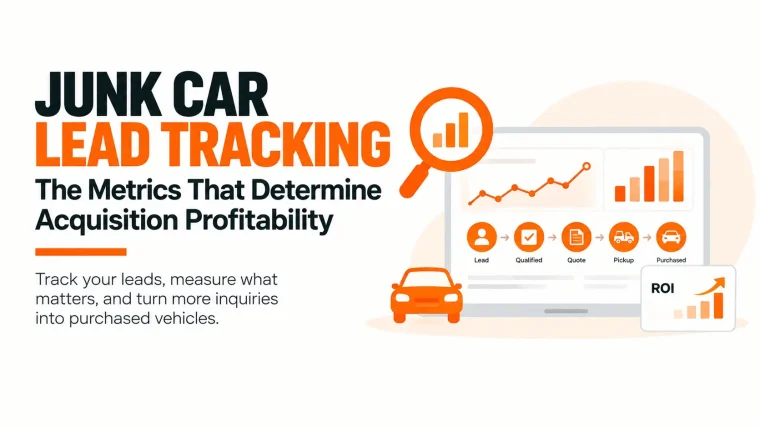
Junk car lead tracking helps salvage yards understand which leads and marketing channels actually turn into profitable vehicle purchases. Instead of measuring success by calls or form submissions alone, yards can connect every inquiry to qualification, quotes, pickups, acquisitions, and revenue.
Effective junk car lead tracking reveals cost per lead, cost per acquired vehicle, conversion performance, and ROI by source. This gives salvage yards the data needed to reduce wasted marketing spend and invest more in channels that consistently produce profitable inventory.
Need More Junk Car Leads in Your Local Market?
Stop relying on unpredictable seller inquiries. Pull Your Part Accelerator helps junk car buyers and salvage yards reach local vehicle owners through targeted Facebook Ads, local SEO, and organized lead tracking
📌 KEY TAKEAWAYS
- Junk car lead tracking connects each seller inquiry to qualification, quotes, pickups, vehicle purchases, and revenue.
- Lead volume alone does not measure success; focus on qualified leads and actual vehicles acquired. Pasted text
- Track the full journey: Lead Source → Lead → Qualified → Quote → Pickup → Vehicle Purchased → Revenue.
- Key metrics include total leads, qualified lead rate, lead-to-pickup rate, acquisition rate, CPL, cost per acquired vehicle, revenue, and gross profit.
- Cost per acquired vehicle is often more useful than cost per lead because it connects marketing spend directly to purchased vehicles.
- Cheap leads are not necessarily better; a higher CPL can still produce better results if those leads generate more vehicle purchases.
- Track every marketing source separately, including Google Ads, Facebook Ads, organic search, Google Business Profile, referrals, and third-party leads.
- Use call tracking, UTM parameters, CRM source fields, landing-page tracking, and form attribution to preserve the original lead source. Pasted text
- Connect each purchased vehicle back to its original source to measure vehicles purchased, acquisition cost, revenue, gross profit, and marketing ROI.
- Review performance weekly for operational metrics and monthly for acquisition costs, profitability, and ROI.
- Avoid vanity metrics such as impressions, clicks, and traffic when evaluating profitability; focus on vehicles purchased and acquisition economics.
- Use tracking to identify where leads are being lost, improve qualification and follow-up, reduce acquisition costs, and adjust marketing budgets.
- Compare performance over meaningful time periods instead of reacting to one unusually good or bad week.
- A simple CRM pipeline can track New Lead → Qualified → Quote → Pickup → Vehicle Purchased → Lost/Not Qualified.
- Bottom line: Effective lead tracking shows which marketing channels consistently turn seller inquiries into profitable vehicle acquisitions, giving salvage yards the data to improve and scale their acquisition strategy. Pasted text
What Is Junk Car Lead Tracking?
Junk car lead tracking is the process of following each seller inquiry from its original source through qualification, quoting, pickup, vehicle purchase, and revenue.
The goal is to understand which leads and marketing channels actually create profitable acquisitions- not just which ones generate the most calls or forms.
Why Lead Volume Alone Does Not Measure Success
A high number of leads can look positive without producing strong business results.
For example:
- 100 leads may produce only 5 purchased vehicles
- 40 better-qualified leads may produce 15 purchases
Lead volume does not show:
- Lead quality
- Conversion rate
- Acquisition cost
- Vehicle profitability
- Marketing ROI
Strong junk car lead tracking measures what happens after the inquiry arrives.
Track The Entire Journey From Lead To Purchased Vehicle
Every lead should be connected to its final outcome.
A simple tracking path is:
Lead Source → Inquiry → Qualified → Quote → Pickup → Vehicle Purchased → Revenue
This allows salvage yards to answer important questions such as:
- Which channel generated the lead?
- Did the seller qualify?
- Was an offer made?
- Was pickup scheduled?
- Was the vehicle purchased?
- How much value did the acquisition generate?
Tracking the complete journey helps identify where leads are being lost and which sources produce the strongest results.
Junk Car Lead Tracking vs Lead Conversion Tracking
The two are closely related but serve different purposes.
Junk car lead tracking focuses on recording where leads come from, how they move through the pipeline, and what financial outcome they produce.
Lead conversion tracking focuses more specifically on whether a lead moves from one stage to the next, such as:
- Lead to contact
- Contact to quote
- Quote to pickup
- Pickup to purchase
In simple terms:
Lead Tracking: Where did the opportunity come from, and what happened to it?
Conversion Tracking: How effectively did the opportunity move through each stage?
Both are important, but junk car lead tracking provides the broader view needed to measure acquisition profitability.
The Junk Car Lead Metrics Every Salvage Yard Should Track
Effective junk car lead tracking requires measuring more than calls, clicks, or form submissions. Salvage yards should track the metrics that show whether leads are becoming qualified opportunities, scheduled pickups, purchased vehicles, and profitable inventory.
Total Leads Generated
Total leads show how many seller inquiries each marketing source produces.
Track leads from:
- Phone calls
- Website forms
- Google Ads
- Facebook Ads
- Organic search
- Referrals
- Third-party lead providers
Lead volume provides useful context, but it should never be used alone to judge performance.
Qualified Lead Rate
Qualified lead rate shows what percentage of incoming inquiries actually meet your buying criteria.
Qualified Leads ÷ Total Leads × 100 = Qualified Lead Rate
For example, if 100 inquiries produce 60 qualified sellers, the qualified lead rate is 60%.
This metric helps junk car lead tracking separate useful opportunities from raw lead volume.
Lead-To-Pickup Rate
Lead-to-pickup rate measures how many seller inquiries progress to a scheduled vehicle pickup.
Scheduled Pickups ÷ Total Leads × 100 = Lead-To-Pickup Rate
A low pickup rate may indicate problems with:
- Lead quality
- Pricing
- Follow-up
- Seller communication
- Scheduling
This metric shows how efficiently leads move toward acquisition.
Lead-To-Vehicle Acquisition Rate
This measures how many leads ultimately become purchased vehicles.
Vehicles Purchased ÷ Total Leads × 100 = Acquisition Rate
This is one of the most important junk car lead tracking metrics because it connects marketing directly to inventory growth.
A channel generating fewer leads may still be more valuable if a higher percentage become acquired vehicles.
Cost Per Lead
Cost per lead shows how much marketing spend is required to generate one inquiry.
Marketing Spend ÷ Total Leads = Cost Per Lead
For example:
$2,000 advertising spend ÷ 100 leads = $20 cost per lead
CPL helps compare marketing efficiency, but it does not show whether those leads actually become vehicles.
Cost Per Acquired Vehicle
Cost per acquired vehicle measures how much marketing spend is required to generate an actual vehicle purchase.
Marketing Spend ÷ Vehicles Purchased = Cost Per Acquired Vehicle
If a yard spends $2,000 and acquires 20 vehicles:
$2,000 ÷ 20 = $100 per acquired vehicle
For salvage yards, this often provides more useful insight than CPL alone.
Revenue And Gross Profit Per Acquired Vehicle
Revenue shows how much value an acquired vehicle generates, while gross profit provides a clearer picture of what remains after relevant direct costs.
Depending on the yard’s operation, value may come from:
- Used parts sales
- Scrap value
- Core value
- Vehicle resale
- Other recoverable components
Strong junk car lead tracking connects the original lead source with both acquisition cost and vehicle profitability.
That allows a salvage yard to determine not simply which channel generates the most leads, but which channel consistently produces the most profitable vehicles.
Cost Per Lead vs Cost Per Acquired Vehicle
A strong junk car lead tracking system should measure both cost per lead and cost per acquired vehicle, but they answer very different questions.
Cost per lead shows how much it costs to generate an inquiry. Cost per acquired vehicle shows how much it costs to generate an actual purchase.
For salvage yards, the second metric is usually more useful for judging profitability.
How To Calculate Cost Per Lead
Cost per lead measures the average marketing spend required to generate one seller inquiry.
Use:
Marketing Spend ÷ Total Leads = Cost Per Lead
Example:
- Marketing spend: $3,000
- Leads generated: 150
$3,000 ÷ 150 = $20 cost per lead
This tells you how efficiently a campaign produces inquiries, but it does not show whether those leads are qualified or become vehicle purchases.
How To Calculate Cost Per Acquired Vehicle
Cost per acquired vehicle measures how much marketing spend is required to produce one completed vehicle purchase.
Use:
Marketing Spend ÷ Vehicles Purchased = Cost Per Acquired Vehicle
Example:
- Marketing spend: $3,000
- Vehicles purchased: 20
$3,000 ÷ 20 = $150 per acquired vehicle
For junk car lead tracking, this metric gives a much clearer picture of whether a marketing channel is actually producing inventory at an acceptable cost.
Why Cheap Leads Can Still Be Expensive
A low cost per lead can be misleading if most of those inquiries never become purchases.
For example:
Campaign A
- $20 cost per lead
- 100 leads
- 5 vehicles purchased
Campaign B
- $50 cost per lead
- 40 leads
- 12 vehicles purchased
Campaign B has a higher lead cost but may deliver a much lower cost per acquired vehicle.
That is why junk car lead tracking should never stop at CPL.
The better question is:
How much did we spend to acquire each actual vehicle?
A campaign with more expensive leads can still be the better investment if those leads are more qualified, convert at a higher rate, and produce more profitable vehicles.
How To Track Junk Car Leads By Marketing Channel
Effective junk car lead tracking should show not only how many leads arrive, but exactly which marketing channel produced them and whether those leads became purchased vehicles.
Each lead should be tagged with its original source so the yard can compare lead quality, acquisition rate, and profitability by channel.
For a deeper comparison of paid channels, read our Ads For Junk Car Leads guide
Google Ads Leads
Google Ads leads usually come from people actively searching for a junk car buyer.
Track:
- Campaign
- Search keyword
- Landing page
- Phone call or form submission
- Qualified lead status
- Vehicle purchased
Good junk car lead tracking connects the original ad click to the final acquisition instead of stopping at the form submission.
Facebook Ads Leads
Facebook Ads may generate leads through:
- Lead forms
- Website campaigns
- Retargeting
- Local audience campaigns
Tag these leads separately from Google because seller intent and conversion behavior may be different.
Compare Facebook performance using:
- Cost per lead
- Qualified lead rate
- Acquisition rate
- Cost per acquired vehicle
This helps determine whether lower-cost social leads actually create profitable purchases.
Organic Search And Google Business Profile Leads
Organic leads may come from:
- Google Search
- Local landing pages
- Blog content
- Google Business Profile
- Google Maps
These inquiries should still receive a source label in your CRM.
Without proper junk car lead tracking, organic leads can easily be grouped as “direct” or “unknown,” making it difficult to measure SEO and local search performance accurately.
Referral And Third-Party Leads
Referral and third-party lead sources should also be tracked separately.
Examples include:
- Towing companies
- Repair shops
- Previous customers
- Lead providers
- Local partnerships
Record the exact source rather than using a generic “referral” label whenever possible.
This makes it easier to identify which partnerships or providers consistently generate valuable vehicles.
Track Phone Calls And Form Leads Back To Their Source
Phone calls and website forms should both retain the original marketing source.
Useful tracking methods can include:
- Call tracking numbers
- UTM parameters
- CRM source fields
- Landing-page tracking
- Form attribution
- Campaign IDs
The tracking path should look like:
Marketing Channel → Lead → Qualified → Quote → Pickup → Vehicle Purchased
This allows junk car lead tracking to answer the most important question:
Which marketing source actually produced the vehicle?
Once that connection is clear, salvage yards can compare channels based on real acquisition profitability instead of traffic or lead volume alone.
Measure Junk Car Lead ROI By Channel
The real value of junk car lead tracking is knowing which marketing channels produce profitable vehicles—not simply the most inquiries.
A channel may generate fewer leads but outperform another source if those leads produce more purchased vehicles, better inventory, or stronger gross profit.
For each channel, connect:
Marketing Spend → Leads → Vehicles Purchased → Vehicle Gross Profit → Channel ROI
Calculate Revenue Generated By Each Channel
Start by connecting purchased vehicles back to their original lead source.
For example:
- Google Ads → 18 vehicles purchased
- Facebook Ads → 8 vehicles purchased
- Organic search → 14 vehicles purchased
- Referrals → 10 vehicles purchased
Then track the value those vehicles generate according to the yard’s normal accounting process.
Depending on the operation, value may come from:
- Parts sales
- Scrap recovery
- Core value
- Vehicle resale
- Other recoverable components
This allows junk car lead tracking to show which channels create actual economic value rather than just activity.
Compare Acquisition Cost Against Vehicle Profitability
Revenue alone does not tell you whether a channel is profitable.
Compare the marketing cost required to acquire vehicles with the gross profit those acquisitions generate.
For example:
Channel A
- Marketing spend: $4,000
- Vehicles acquired: 40
- Cost per acquired vehicle: $100
- Average gross profit per acquired vehicle: $350
Channel B
- Marketing spend: $2,000
- Vehicles acquired: 10
- Cost per acquired vehicle: $200
- Average gross profit per acquired vehicle: $280
Channel B may generate cheaper leads, but Channel A creates stronger acquisition economics.
This is why industry competitors increasingly emphasize cost per acquired car against vehicle margin rather than CPL alone.
Identify Your Most Profitable Lead Sources
A profitable lead source should consistently produce vehicles whose value justifies the cost required to acquire them.
Compare each channel using:
- Qualified lead rate
- Vehicles purchased
- Cost per acquired vehicle
- Average gross profit per vehicle
- Total gross profit generated
You can also calculate marketing ROI:
(Gross Profit Attributed To Channel − Marketing Spend) ÷ Marketing Spend × 100 = Marketing ROI
Using the same measurement method across channels makes junk car lead tracking much more useful for budget decisions.
Avoid choosing a “best” channel from lead volume alone. Google Ads, organic search, Facebook, referrals, and third-party leads may perform differently by market and yard. Current industry guidance also distinguishes between fast paid acquisition and organic channels that can compound over time.
Know When To Increase, Reduce, Or Reallocate Budget
Tracking should ultimately influence where the next marketing dollar goes.
Consider increasing investment when a channel:
- Consistently produces qualified sellers
- Maintains an acceptable acquisition cost
- Generates profitable vehicles
- Has capacity to produce additional volume
Review or reduce investment when a channel:
- Produces many leads but few purchases
- Has rising acquisition costs
- Generates low-value vehicles
- Consistently produces poor geographic or seller fit
Do not react to one unusually good or bad week. Compare performance over a meaningful period and account for channels such as SEO that may take longer to produce measurable returns.
The purpose of junk car lead tracking is not simply creating reports. It is giving salvage yards enough information to move budget toward channels that consistently produce profitable vehicle acquisitions.
Build A Simple Junk Car Lead Tracking System
A useful junk car lead tracking system does not need to be complicated. The goal is to capture where each lead came from, follow it through the acquisition process, and connect the final vehicle purchase back to its original source.
A simple tracking flow is:
Source → Lead → Qualified → Quote → Pickup → Purchased Vehicle → Revenue
Capture The Lead Source
Every new inquiry should have a clear source attached to it.
Examples include:
- Google Ads
- Facebook Ads
- Organic search
- Google Business Profile
- Referral partner
- Third-party lead provider
- Direct website visit
Avoid using vague labels such as “online” or “other” whenever a more specific source is available.
Accurate source data is the foundation of junk car lead tracking because it allows the yard to compare channels later.
Track Each Lead Through Your CRM
Once the lead enters the system, update its status as it moves through the acquisition process.
Useful stages include:
- New lead
- Qualified
- Quote provided
- Pickup scheduled
- Vehicle purchased
- Lost or not qualified
The CRM should also record important information such as vehicle details, seller location, lead owner, and communication history.
This creates one record that follows the opportunity from first inquiry to final outcome.
Record Quotes, Pickups, And Vehicle Purchases
Do not stop tracking once the seller becomes a qualified lead.
Record whether:
- An offer was provided
- The seller accepted or declined
- Pickup was scheduled
- Pickup actually occurred
- The vehicle was purchased
For example:
120 Leads → 80 Qualified → 55 Quotes → 32 Pickups → 28 Vehicles Purchased
This makes it much easier to see where opportunities are being lost.
Strong junk car lead tracking should distinguish scheduled pickups from completed acquisitions because not every scheduled vehicle actually becomes inventory.
Connect Purchased Vehicles Back To The Original Lead Source
The final step is linking each acquired vehicle back to the marketing channel that produced the seller.
For example:
Google Ads → Lead #184 → Qualified → $650 Quote → Pickup → Vehicle Purchased → $1,400 Gross Profit
or:
Referral Partner → Lead #219 → Qualified → $500 Quote → Pickup → Vehicle Purchased → $1,050 Gross Profit
This connection allows the yard to calculate:
- Vehicles purchased by source
- Cost per acquired vehicle
- Revenue by channel
- Gross profit by channel
- Marketing ROI
Without this final connection, junk car lead tracking shows activity but not acquisition profitability.
The system does not need dozens of fields or complicated reporting. If your yard can reliably trace each purchased vehicle back through:
Revenue → Vehicle Purchase → Pickup → Quote → Qualified Lead → Original Source
you have the core data needed to make smarter acquisition decisions.
Junk Car Lead Tracking Dashboard
A simple dashboard turns junk car lead tracking data into information managers can actually use. Instead of reviewing individual leads one by one, the dashboard should show whether acquisition performance is improving, declining, or shifting between channels.
The goal is to answer three questions:
- Are we generating enough qualified opportunities?
- Are those opportunities becoming purchased vehicles?
- Which channels are producing the best financial results?
Metrics To Review Weekly
Weekly reviews should focus on operational performance and problems that require quick action.
Track:
- Total leads
- Qualified leads
- Qualified lead rate
- Quotes provided
- Pickups scheduled
- Vehicles purchased
- Lead-to-acquisition rate
- Leads still waiting for action
Weekly junk car lead tracking can reveal problems such as falling lead quality, missed opportunities, or a sudden decline in purchases before they become larger issues.
Metrics To Review Monthly
Monthly reporting should focus more heavily on acquisition economics.
Review:
- Marketing spend
- Cost per lead
- Cost per qualified lead
- Cost per acquired vehicle
- Vehicles purchased by channel
- Revenue per acquired vehicle
- Gross profit per acquired vehicle
- ROI by marketing source
Monthly data provides a clearer view of whether marketing activity is actually contributing to profitable inventory growth.
Compare Performance By Channel
Do not combine every lead into one overall number.
Compare channels such as:
Channel | Leads | Vehicles Purchased | Cost Per Acquisition | Gross Profit |
Google Ads | — | — | — | — |
Facebook Ads | — | — | — | — |
Organic Search | — | — | — | — |
Referrals | — | — | — | — |
Channel-level junk car lead tracking helps identify whether a source is producing high volume, strong conversion, profitable vehicles—or simply expensive activity.
Watch Trends Instead Of Single Numbers
One unusually strong or weak week should not automatically change your marketing strategy.
Instead, monitor trends over time.
Look for:
- Rising cost per acquired vehicle
- Improving qualified lead rates
- Falling pickup rates
- Changes in vehicle profitability
- Channels consistently gaining or losing efficiency
Comparing several weeks or months gives salvage yards a more reliable picture than reacting to one isolated result.
A useful junk car lead tracking dashboard should ultimately show whether the acquisition system is becoming more efficient over time—not simply whether lead volume increased.
Common Junk Car Lead Tracking Mistakes
Poor junk car lead tracking can make weak campaigns look successful and hide where acquisition problems actually exist.
The biggest mistakes usually happen when yards measure activity instead of connecting leads to purchased vehicles and profitability.
Tracking Leads But Not Purchased Vehicles
Lead volume alone does not show whether marketing is working.
A yard may generate hundreds of inquiries while purchasing very few vehicles.
Tracking should continue through:
Lead → Qualified → Quote → Pickup → Vehicle Purchased
The final purchase is what connects marketing activity to inventory growth.
Treating Every Lead Source As Equal
Different lead sources can produce very different results.
For example:
- Google Ads may generate higher-intent sellers
- Facebook Ads may generate more top-of-funnel inquiries
- Referrals may convert differently
- Organic search may produce lower long-term acquisition costs
Good junk car lead tracking keeps these sources separate so each can be measured accurately.
Measuring CPL Without Lead Quality
Cost per lead can be misleading when lead quality varies.
A low CPL may still produce:
- Poor geographic fit
- Weak seller intent
- Low-value vehicles
- Few completed purchases
Track qualified lead rate and cost per acquired vehicle alongside CPL.
This gives a more realistic picture of acquisition performance.
Failing To Track Calls
Many junk car sellers prefer calling rather than submitting forms.
If calls are not tracked, the yard may underestimate the performance of:
- Google Ads
- Google Business Profile
- Organic search
- Local landing pages
Call tracking should connect incoming calls back to their original source whenever possible.
Losing The Original Lead Source In The CRM
The original marketing source should remain attached to the lead throughout the entire pipeline.
A common tracking problem is changing the source to generic labels such as:
- Phone
- Website
- Direct
- Unknown
This breaks attribution.
Strong junk car lead tracking preserves the original source from first contact through vehicle purchase.
Focusing On Vanity Metrics Instead Of Acquisition Profitability
Metrics such as:
- Impressions
- Clicks
- Website traffic
- Form submissions
can be useful, but they do not prove profitability.
The more important questions are:
- How many vehicles were purchased?
- What did each acquisition cost?
- Which channel produced the vehicle?
- How much gross profit did that vehicle generate?
Effective junk car lead tracking should ultimately help the yard understand acquisition profitability, not just marketing activity.
How Lead Tracking Improves Your Junk Car Acquisition Strategy
Strong junk car lead tracking does more than report numbers. It helps salvage yards understand where opportunities are being lost, which channels produce profitable vehicles, and where acquisition resources should be focused.
Tracking allows yards to optimize their acquisition system instead of relying on assumptions.
For the full framework, read our Junk Car Acquisition Strategy guide.
Find Where Leads Are Being Lost
A complete tracking system shows where leads drop out of the acquisition funnel.
For example:
Lead → Qualified → Quote → Pickup → Vehicle Purchased
If many leads are qualified but few receive quotes, the problem may be operational.
If many quotes are given but few pickups are scheduled, the issue may involve pricing, follow-up, or seller expectations.
Effective junk car lead tracking helps identify the exact stage that needs improvement.
Improve Marketing Budget Allocation
Tracking makes it easier to compare channels based on actual vehicle purchases.
Instead of asking:
“Which channel generated the most leads?”
ask:
“Which channel produced the most profitable acquisitions?”
Budget decisions should consider:
- Qualified lead rate
- Cost per acquired vehicle
- Vehicle profitability
- ROI by source
This helps move spending toward channels that create stronger business results.
Lower Cost Per Acquired Vehicle
Better tracking can expose wasted marketing spend.
For example, a channel may generate inexpensive leads but produce very few purchases.
Once that becomes visible, the yard can:
- Improve targeting
- Reduce weak campaigns
- Shift budget
- Improve qualification
- Strengthen follow-up
Over time, junk car lead tracking can help reduce the amount spent to acquire each vehicle.
Scale Channels That Produce Profitable Cars
The strongest channels are not simply those generating the most inquiries.
They are the ones that consistently produce:
- Qualified sellers
- Purchased vehicles
- Acceptable acquisition costs
- Strong vehicle profitability
When a channel performs well over time, the yard can consider increasing investment while continuing to monitor results.
This is where tracking directly supports the broader acquisition strategy.
A strong Junk Car Acquisition Strategy uses data to decide where to generate leads, how to qualify them, how to follow up, and which channels deserve more budget.
Ultimately, junk car lead tracking gives salvage yards the information needed to make the acquisition system more predictable, efficient, and profitable.
Frequently Asked Questions
Salvage yards should track total leads, qualified leads, quotes, scheduled pickups, purchased vehicles, cost per lead, cost per acquired vehicle, and revenue or gross profit by source. Good junk car lead tracking connects every inquiry to its final outcome.
Use this formula:
Marketing Spend ÷ Total Leads = Cost Per Lead
For example, if you spend $2,000 and generate 100 leads, your cost per lead is $20.
How do you calculate cost per acquired vehicle?
Use:
Marketing Spend ÷ Vehicles Purchased = Cost Per Acquired Vehicle
If you spend $3,000 and purchase 20 vehicles, your acquisition cost is $150 per vehicle.
There is no single conversion rate that applies to every salvage yard. Performance depends on lead source, market, lead quality, pricing, and follow-up. Use junk car lead tracking to compare your conversion rate by channel and against your own historical performance.
Record the original lead source in your CRM and keep it attached throughout the full journey:
Source → Lead → Quote → Pickup → Vehicle Purchased
Tools such as call tracking, UTM parameters, CRM source fields, and form attribution can help preserve the original source.
Cost per acquired vehicle is usually more useful for measuring acquisition profitability because it shows how much marketing spend was required to produce an actual purchase.
Cost per lead is still useful, but effective junk car lead tracking should connect CPL with vehicle acquisitions and profitability.