Facebook ads for junk car leads can do more than fill your pipeline with form submissions. When the campaign, qualification process, follow-up, and tracking work together, Facebook can become a reliable way to reach local vehicle owners and turn seller interest into actual cars bought.
In this guide, we’ll break down 7 practical steps to turn Facebook junk car leads into purchased vehicles-from the first ad impression to qualification, quoting, follow-up, pickup, and final acquisition.
For a broader look at how salvage yards can generate more seller calls, quotes, and pickups across multiple channels, see our complete guide to Junk Car Leads.
📌 KEY TAKEAWAYS
- Facebook ads can generate cheap junk-car leads, but a lead is only an opportunity—not a purchased car.
- A $2 lead is valuable only if the yard acts quickly and has a strong process for contacting, qualifying, quoting, and following up.
- Don’t measure success by Cost Per Lead (CPL) alone. Track the full funnel:
Lead → Contacted → Qualified → Quote → Accepted → Pickup → Car Bought. - Facebook creates demand differently than Google: Google captures people already searching for junk-car buyers, while Facebook can reach vehicle owners before they actively search.
- The best Facebook ads speak to real seller problems, such as:
- Car won’t start
- Repairs cost too much
- Failed inspection
- Need driveway space
- Moving soon
- Don’t want to pay for towing
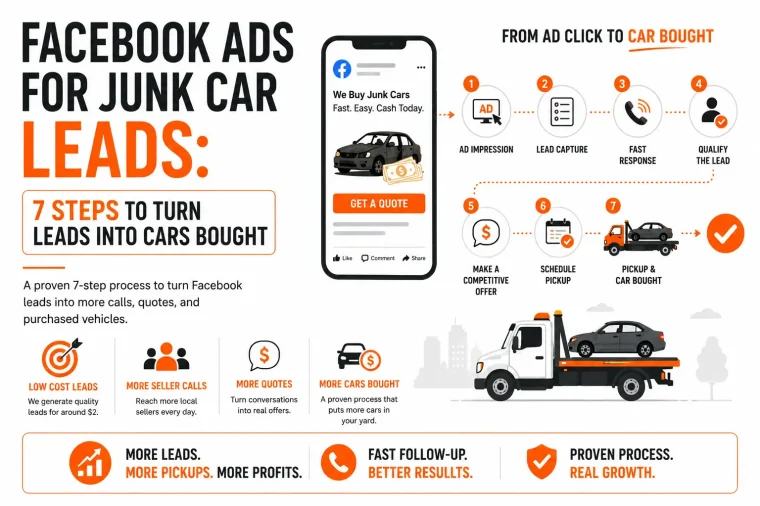
- The 7-step process is:
- Put the right Facebook ad in front of local vehicle owners.
- Make it easy for them to become a lead.
- Contact them fast before another buyer does.
- Qualify the vehicle and seller.
- Make a serious, competitive quote.
- Follow up and make accepting the offer easy.
- Complete pickup and turn the lead into a purchased car.
- Key takeaway: The goal isn’t simply to generate more leads. It’s to create a repeatable system that turns affordable Facebook leads into actual vehicles entering the yard.
Stop Measuring Leads Alone. Track What Happens After the Lead
With Facebook ads for junk car leads, getting leads at a low cost is a major advantage. Pull Your Part campaigns are built to help junk yards reach local vehicle owners efficiently and generate a steady flow of seller opportunities.
But generating the lead is only the first part of the process.
Once that lead reaches the yard, conversion depends heavily on what happens next. How quickly does someone call the seller? How seriously is the inquiry handled? Is the vehicle qualified properly? Is a competitive quote given? Does the team follow up if the seller does not answer the first time?
A strong Facebook campaign can put opportunities in front of your team at a very low cost. The yard still has to turn those opportunities into inventory.
A $2 Lead Is an Opportunity, Not the Final Result
If your yard is receiving junk car leads for around $2, that gives your acquisition team more opportunities to speak with local vehicle owners without spending heavily just to start the conversation. The mistake is not generating cheap leads.
The mistake is paying for those leads and then responding too slowly, making one call, failing to follow up, or treating the seller like just another form submission. A seller who requested an offer may also be talking to other buyers. The yard that responds quickly, builds trust, gives a serious quote, and makes the process easy has a much better chance of buying the vehicle.
That is why the performance of Facebook ads for junk car leads should be judged across two parts:
Lead Generation:
PYP generates seller opportunities efficiently.
Lead Conversion:
The yard contacts, qualifies, quotes, follows up, and closes those sellers.
Cost Per Lead Still Matters
Cost per lead absolutely matters. If two campaigns can generate similar-quality seller opportunities and one produces them for $2 while another costs $10 or $15 per lead, the lower-cost campaign gives the yard significantly more opportunities from the same advertising budget.
But CPL should not be the last number you look at.
After the lead comes in, yards should also track:
Lead → Contacted → Qualified → Quote → Accepted → Pickup → Car Bought
This makes the responsibility clear.
PYP helps create the opportunity.
The yard’s speed, process, offer, and follow-up determine how much value they extract from it.
This positioning is much stronger for PYP because it protects the $2 lead advantage while naturally leading us into the 7 steps of converting those leads into cars bought.
How Facebook Ads for Junk Car Leads Create Street-Buy Opportunities
For Pull Your Part, Facebook ads for junk car leads are not just another source of form submissions. They are a way to create new street-buy opportunities by putting a cash-for-cars offer in front of local vehicle owners before those sellers actively start searching for a buyer.
That is where PYP Accel has a strong position. Instead of competing only for people already searching on Google, Facebook allows yards to reach vehicle owners earlier and create demand that may not have existed yet and when PYP Accel is capable of generating leads at around the $2 level, that gives a yard a very efficient way to keep new seller opportunities entering the acquisition pipeline. What happens after that lead comes in depends heavily on how the yard handles it.
Google Captures Demand. Facebook Can Create Demand.
Google is powerful because it reaches people who already know what they want. Someone searches:
- sell my junk car
- junk car buyer near me
- cash for junk cars
- sell damaged car
That seller already has intent.
Facebook works differently.
The vehicle owner might not be searching for a junk car buyer at all. Their car may have been sitting in the driveway for months. Repairs may no longer make financial sense. They may need more space, be preparing to move, or simply be tired of dealing with a vehicle they no longer use.
A well-positioned Facebook ad can put the idea in front of that owner at the right moment:
“We can buy that vehicle and take it off your hands.”
That is why PYP Accel does not need to position Facebook as a replacement for Google. The stronger position is that Google captures existing seller demand while Facebook can create an additional seller pipeline. That distinction is central to the PYP Accel strategy.
Reaching Junk Car Sellers Before They Start Searching
One of the biggest advantages of Facebook ads for junk car leads is timing. A yard does not always have to wait until a vehicle owner decides to search for a junk car buyer. Facebook allows junk car buyer to reach local owners while the problem is still sitting in front of them.
- The car will not start.
- The repair estimate is higher than the car is worth.
- The vehicle failed inspection.
- The owner needs driveway space.
- They are moving soon.
- They do not want to pay for towing.
These are real seller situations that can create the motivation to act. The PYP Accel strategy already identifies this kind of seller psychology as a stronger creative framework than generic advertising advice.
The ad creates the opportunity. From there, PYP Accel can help deliver that seller lead to the yard at an efficient acquisition cost as low as $2. The yard then needs to respond quickly and handle the opportunity seriously.
If the lead sits untouched for hours, the seller may speak with another buyer first. If the team calls quickly, understands the vehicle, gives a serious offer, and follows up properly, the same lead has a much better chance of becoming a purchased car.
Why Facebook Fits a Street-Buy Strategy
Street buying depends on a consistent flow of vehicle owners who may be willing to sell directly to the yard. That makes Facebook particularly useful because it gives local junk car buyers a way to proactively generate those opportunities rather than relying entirely on search demand.
The goal is not simply:
Facebook Ad → Lead
The stronger system is:
Facebook Ad → Seller Lead → Contact → Qualification → Quote → Accepted Offer → Pickup → Car Bought
PYP Accel is not just trying to reduce the number beside cost per lead. It is building a predictable flow of seller opportunities that yards can work into actual vehicle purchases. And when those opportunities are being generated at a very low CPL, the upside becomes even stronger. The yard gets more chances to buy inventory from the same advertising budget.
The key is making sure the acquisition team does its part after PYP Accel has generated the opportunity.
The Facebook Junk Car Lead-to-Purchase Funnel
Generating Facebook ads for junk car leads is only the beginning of the acquisition process.
Pull Your Part Accelerator is built to help yards create a consistent flow of local seller opportunities at an efficient cost. In some campaigns, that can mean leads as low as $2. But once those leads reach the yard, the next part of the process depends on how quickly and effectively the yard’s team works them.
That is why it helps to look at Facebook lead generation as a complete acquisition funnel:
Facebook Ad → Lead → Contacted → Qualified → Quote → Accepted → Pickup → Car Purchased
PYP Accel creates the opportunity at the top of the funnel. The yard’s response speed, buying process, offer, follow-up, and pickup operation determine how many of those opportunities eventually become vehicles in inventory. This lead-to-purchase view is also central to PYP’s broader strategy, which recommends tracking the seller beyond the initial form submission and all the way through the final vehicle purchase.
step 1: Put the Right Facebook Ad in Front of Local Vehicle Owners
Everything starts with the ad. The purpose of a Facebook junk car campaign is not simply to get clicks. It is to reach vehicle owners who have a reason to consider selling their car.
That could include someone whose vehicle:
- has been sitting for months
- no longer starts
- needs repairs that cost more than the car is worth
- failed inspection
- is taking up driveway space
- needs to be gone before a move
This is where PYP Accel’s understanding of seller psychology matters.
Instead of relying on generic ads, campaigns can speak directly to the situations that make a vehicle owner consider selling. The strategy identifies these seller states as a particularly strong opportunity for the Facebook content and creative approach. The stronger the match between the seller’s situation and the message they see, the better the opportunity to start a real conversation.
Step 2: Turn Interest Into a Junk Car Lead
Once the ad gets someone’s attention, the next goal is to make it easy for that vehicle owner to raise their hand.
A seller should be able to provide enough information for the yard to begin evaluating the opportunity without making the process unnecessarily complicated. Efficient Facebook campaigns can produce a high volume of local seller opportunities without forcing the yard to depend entirely on people searching for junk car buyers on Google and when PYP Accel is generating leads at a very low CPL, the yard gets more chances to speak with potential sellers from the same marketing budget.
But the form submission itself is not the finish line. It is the handoff.
Now the yard has a real person who has shown interest in selling a vehicle. What happens next matters considerably.
Step 3: Contact the Seller Fast
A fresh junk car lead should be treated like a live buying opportunity. The seller may have filled out your form, but that does not mean they are going to wait around for your yard to call.
They may submit another form. They may search for another junk car buyer. They may answer the first company that reaches them with a reasonable offer. This is why response speed is so important.
PYP Accel can generate the lead efficiently, but a strong acquisition team needs to act on it while the seller’s interest is still fresh.
The objective is simple:
Get the conversation started before another buyer does.
That does not mean rushing through the call. It means taking the opportunity seriously. Call quickly. If there is no answer, follow up. Use text where appropriate. Give the seller a clear reason to continue the conversation. A lead that costs only a few dollars can become very valuable when the yard has a disciplined process for working it.
Step 4: Qualify the Vehicle and the Seller
Not every Facebook lead should receive the same offer or the same level of attention. Once contact is made, the yard needs to understand what it is actually dealing with.
Qualification may include information such as:
- year, make, and model
- vehicle condition
- whether it runs
- location and ZIP code
- title or ownership situation
- towing requirements
- seller readiness
- price expectations
Good qualification protects the yard’s time while helping the buyer identify the opportunities worth pursuing. It also makes the next step much stronger. Instead of making a generic offer based on incomplete information, the yard can make a serious buying decision based on the actual vehicle.
Step 5: Make a Serious Quote
Once the vehicle is qualified, the conversation moves from lead generation into actual buying. This is where the yard’s expertise matters most. The seller wants to know:
“What will you give me for my car?”
A strong quote needs to make sense for the yard while still giving the seller a reason to move forward. At this point, PYP Accel has already done its part by creating the opportunity and getting that seller into the acquisition pipeline. Now the yard’s buying team needs to turn the opportunity into a deal.
That means understanding the vehicle’s value, towing economics, local market conditions, and the margin the yard needs to make the purchase worthwhile. A cheap Facebook lead becomes valuable only when a capable buying team turns the conversation into a sensible acquisition.
Step 6: Get the Seller to Accept and Follow Through
A quote does not automatically equal a purchased vehicle. Some sellers accept immediately. Others hesitate. Some want to compare offers. Some stop answering.
Others may have questions about towing, payment, paperwork, title issues, or what actually happens when the vehicle is picked up. This is why follow-up is part of the buying process, not an optional extra.
The yard should make the next step clear and easy for the seller. If they are interested but not ready immediately, keep the conversation alive. If they have concerns, address them. If they miss a call, try again instead of assuming the lead is dead.
The strategy highlights seller concerns such as scam fears, payment, paperwork, title questions, and uncertainty before commitment. The easier and more trustworthy the process feels, the easier it becomes for a seller to say yes.
Step 7: Complete the Pickup and Turn the Lead Into a Car Bought
The final step is where the marketing result becomes a yard result. The seller has accepted the offer. The vehicle has been qualified. The pickup is arranged. Now the transaction needs to actually happen.
That means confirming the details, coordinating towing or pickup, completing the necessary paperwork, honoring the agreed process, and getting the vehicle into the yard. Only at this point has the Facebook lead completed the full journey.
Facebook Ad → Lead → Contacted → Qualified → Quote → Accepted → Pickup → Car Purchased
This is why PYP Accel should be judged on more than whether Facebook can produce leads, because PYP Accel’s strength is creating a large, affordable flow of seller opportunities. The yard then needs an equally strong process for turning those opportunities into inventory.
When both sides work well together, low-cost Facebook ads for junk car leads can become much more than a lead-generation channel. They can become a repeatable street-buy acquisition system. And that is the number that ultimately matters:
Not just how many leads came in, but how many cars came through the gate.
Frequently Asked Questions
The cost of Facebook ads for junk car leads depends on the market, targeting, creative, competition, and campaign setup. Pull Your Part has been able to generate junk car leads at very low costs, including around the $2 level in efficient campaigns. But yard owners should look beyond CPL alone. A low-cost lead gives your team an affordable opportunity to speak with a seller. The real value comes from how well your team contacts, qualifies, quotes, and follows up with that lead.
They can be, especially when the campaign is built around the right local audience, seller situations, and qualification process. Facebook reaches people who may own an unwanted, damaged, non-running, or unused vehicle before they actively search for a junk car buyer. That means the campaign can create new street-buy opportunities instead of competing only for existing search demand. Lead quality also depends on what information you collect, such as vehicle condition, ZIP code, ownership, title status, towing distance, and seller readiness.
As quickly as your team reasonably can. A seller who submits a Facebook lead form may also contact other junk car buyers. The longer the lead sits untouched, the more opportunity another buyer has to start the conversation first.
Pull Your Part Accelerator can generate the lead, but the yard’s response process plays a major role after that handoff. A fast call, serious conversation, clear quote, and consistent follow-up can make a major difference in how many leads become purchased vehicles.
Do not stop at collecting the lead. Use a consistent process:
Lead → Contacted → Qualified → Quote → Accepted → Pickup → Car Purchased
Your team should contact the seller quickly, gather the right vehicle information, make a serious offer, address seller concerns, follow up when necessary, and make pickup simple.
That is why PYP Accel’s strategy focuses on the complete seller-to-car pipeline instead of treating the Facebook form submission as the final result.
Get More Qualified Junk Car Leads
More junk car leads only matter when they turn into vehicles your team can buy profitably. Build the right campaigns, respond fast, track what closes, and scale the sources that consistently put more cars in your yard.