
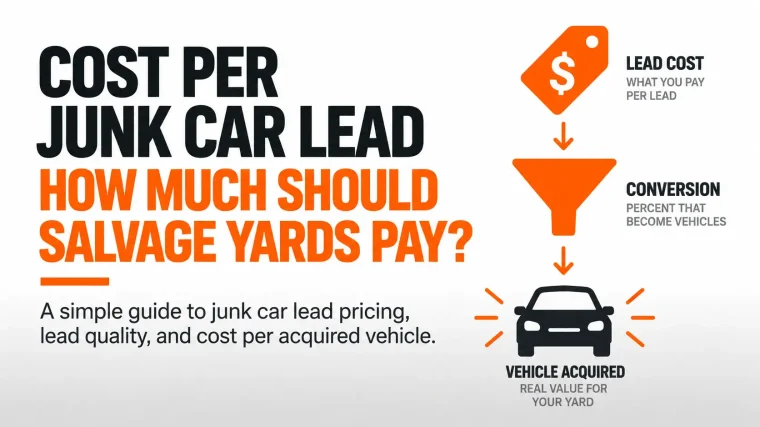
Most salvage yards ask the same question when they start investing in lead generation:
How much does a junk car lead cost?
That matters, but it is not the most important number. The better question is:
How much should you pay for a lead that actually turns into a vehicle?
A low cost per junk car lead can look attractive on paper, but cheap leads are not always profitable. A $5 lead that never converts into a purchased vehicle is less valuable than a $25 lead that consistently produces cars for your yard. That is why salvage yards need to look beyond lead price alone.
There are two metrics that matter:
Cost Per Lead (CPL)
How much you spend to generate one seller inquiry.
Cost Per Acquired Vehicle (CPA)
How much you spend, on average, to turn leads into actual vehicles purchased.
For salvage yards, CPA is usually the stronger business metric because it connects marketing directly to inventory acquisition. In this guide, we will break down cost per junk car lead, explain what affects junk car lead pricing, compare different lead sources, and show how to determine whether your marketing is generating profitable vehicle acquisitions.
Deep dive to our full guide of “How to get more Junk Car Leads” for the most effective strategies to get more junk car leads, improve your vehicle acquisition process, and build a system that helps your salvage yard grow consistently.
Need More Junk Car Leads in Your Local Market?
Stop relying on unpredictable seller inquiries. Pull Your Part Accelerator helps junk car buyers and salvage yards reach local vehicle owners through targeted Facebook Ads, local SEO, and organized lead tracking
📌 KEY TAKEAWAYS
- Cost per junk car lead (CPL) matters, but the more important metric is cost per acquired vehicle.
- A cheap lead is not necessarily valuable if it does not convert into a purchased vehicle.
- Google Ads can generate high-intent seller leads, while Facebook Ads can create lower-cost, direct seller opportunities.
- SEO can require more upfront investment but may reduce long-term lead costs as organic traffic grows.
- Exclusive leads generally cost more than shared leads but can offer less competition and stronger conversion potential.
- Lead pricing depends on market competition, marketing channel, lead quality, lead type, and conversion rate.
- Salvage yards can lower effective lead costs by improving website conversion, ad targeting, follow-up, and lead qualification.
- Building an owned system with Facebook Ads, SEO, Google Ads, local pages, and quote funnels gives yards greater control over lead generation.
- Marketing budgets should be based on inventory needs, acquisition goals, vehicle value, market competition, and operational capacity.
- Bottom line: The best lead is not the cheapest one- it is the lead that consistently turns into a profitable vehicle acquisition.
What Is The Cost Per Junk Car Lead?
Cost per junk car lead is the amount a salvage yard spends to generate one seller inquiry from a marketing campaign. In simple terms, it tells you how much money is required to create one opportunity to buy a vehicle.
The basic formula is:
Marketing Spend ÷ Number of Leads Generated = Cost Per Junk Car Lead
For example:
$1,000 marketing investment
÷
50 seller inquiries generated
$20 cost per junk car lead
This means the salvage yard spent $20 to generate each potential seller opportunity.
However, this number alone does not determine whether a campaign is successful.
A lower cost per junk car lead does not always mean better results.
For example:
- Campaign A generates leads at $5 each but only produces 1 vehicle purchase.
- Campaign B generates leads at $20 each but produces 10 vehicle purchases.
Campaign B may be far more profitable because the goal is not simply generating inquiries.
The real goal is acquiring vehicles. That is why salvage yards should also measure:
Cost Per Acquired Vehicle
This metric considers the entire process:
Lead Cost → Conversion Rate → Vehicle Purchased → Acquisition Cost
A lead only creates value when it moves through the acquisition process and becomes inventory for your yard. Understanding junk car lead pricing is important, but the best marketing decision is based on the return those leads generate, not just how much each inquiry costs.
What Is The Average Cost Per Junk Car Lead?
The average cost per junk car lead depends on several factors, including your location, competition, marketing channel, targeting, and lead quality.
There is no single fixed price for a junk car lead because different channels attract sellers at different stages of the buying process.
A lead from someone actively searching for a buyer will usually have different value compared to someone who responds to an advertisement while browsing online.
The main factors that influence junk car lead pricing include:
- Buyer competition in your market
- Advertising platform
- Lead quality
- Exclusive vs shared lead type
- Conversion rate
- Vehicle acquisition value
Below is how the major lead sources compare.
Google Ads Junk Car Leads
Google Ads often produces some of the highest-intent junk car leads because it reaches people who are already searching for a solution.
Examples of high-intent searches include:
- “sell my junk car”
- “junk car buyer near me”
- “cash for cars”
Someone searching these terms is usually closer to making a decision because they are actively looking for a buyer.
However, this higher intent often comes with higher competition. Multiple salvage yards, cash-for-car companies, and auto buyers may compete for the same searches.
Factors that influence Google Ads lead costs include:
- City competition
- Keyword demand
- Ad quality
- Landing page conversion rate
- Targeting settings
In competitive markets, Google Ads leads can become more expensive, but they often provide strong seller intent because the person is already looking for a service.
Facebook Ads Junk Car Leads
Facebook Ads can create lower-cost seller opportunities because they work differently from search advertising.
Instead of waiting for someone to search “sell my junk car,” Facebook allows salvage yards to reach local vehicle owners and encourage them to request a quote.
Common Facebook lead strategies include:
- Local audience targeting
- Lead generation forms
- Retargeting campaigns
- Seller-focused messaging
One advantage of Facebook Ads is that salvage yards can create their own direct seller pipeline instead of competing for the same third-party lead.
PYP’s Facebook Ads strategy focuses on helping salvage yards generate exclusive seller opportunities through targeted campaigns and then converting those inquiries into vehicle acquisitions.
The important metric is not only the Facebook lead cost. The real measurement is how many of those leads become purchased vehicles.
SEO Junk Car Leads
SEO leads have a different cost structure compared to paid advertising. With SEO, the initial investment is usually higher because it requires:
- Website optimization
- Content creation
- Local SEO work
- Service pages
- Authority building
However, once pages begin ranking, organic traffic can continue generating seller inquiries without paying for every individual click.
This means the long-term cost per junk car lead can decrease over time. SEO is especially valuable for salvage yards that want to build a long-term acquisition asset instead of relying only on paid campaigns.
Purchased Lead Services
Third-party lead services provide another option for salvage yards looking to access seller inquiries quickly. However, junk car lead pricing from providers can vary significantly depending on:
- Exclusive vs shared leads
- Lead quality
- Market demand
- Provider targeting methods
Exclusive leads generally cost more because fewer buyers compete for the same seller opportunity.
Shared leads may cost less but often involve more competition because multiple buyers receive the same inquiry.
The right option depends on your acquisition goals, but salvage yards should always evaluate leads based on one key metric:
How many vehicles does this lead source help you acquire profitably?
The cheapest cost per junk car lead is not always the best investment. The best lead source is the one that consistently produces vehicles for your yard.
Factors That Affect Junk Car Lead Pricing
The cost per junk car lead is not the same for every salvage yard. Lead pricing changes depending on several factors, including your market, competition, lead source, and the quality of the seller opportunities being generated.
Understanding these factors helps salvage yards avoid focusing only on cheap leads and instead invest in opportunities that have a higher chance of becoming profitable vehicle acquisitions.
Market Competition
One of the biggest factors affecting junk car lead pricing is the level of competition in your market. Large cities and competitive markets usually have higher lead costs because:
- More salvage yards are competing for sellers
- More companies are running advertisements
- Demand for junk car buyers is higher
- Advertising platforms become more competitive
For example, generating leads in a major metropolitan area may cost more than generating leads in a smaller market with fewer buyers.
However, higher competition does not always mean poor results. A more competitive market can also mean more vehicle owners actively looking for solutions.
The key is making sure your marketing targets the right sellers and your acquisition process converts those opportunities efficiently.
Lead Type: Exclusive vs Shared Leads
The type of lead you purchase or generate also impacts pricing. Exclusive junk car leads usually cost more because the inquiry is provided to one buyer instead of multiple companies.
Benefits include:
- Less competition
- More control over the seller conversation
- Better opportunity to build trust
- Higher potential conversion rates
Shared leads are generally less expensive because the same inquiry is distributed among multiple buyers.
However, shared leads often create more competition because several salvage yards may contact the same seller.
Marketing Channel
Different marketing channels have different costs because they reach sellers at different stages of the buying journey.
Google Ads
Google Ads often has higher lead costs because it captures people with strong buying intent.
Someone searching:
- “sell my junk car”
- “cash for cars near me”
is already looking for a buyer.
Higher intent often creates higher competition.
Facebook Ads
Facebook Ads can often generate lower-cost seller inquiries because they create demand instead of only capturing existing searches.
The challenge is that Facebook leads require stronger follow-up and conversion systems because sellers may not be actively searching yet.
PYP’s Facebook Ads strategy helps salvage yards generate direct seller opportunities and build a more controlled lead pipeline.
SEO
SEO usually requires a higher upfront investment because it involves:
- Content creation
- Website optimization
- Local rankings
- Authority building
However, once rankings improve, organic traffic can generate leads without paying for every click.
This can reduce your long-term cost per junk car lead.
Lead Quality
Lead quality is one of the most important factors affecting the true value of a lead. A cheap lead is not valuable if it does not have realistic acquisition potential.
Problems with low-quality leads include:
- Seller is outside your service area
- Vehicle information is incomplete
- Seller has low intent
- Vehicle value does not justify pickup costs
- Acquisition is not profitable
The goal is not simply getting the lowest junk car lead pricing. The goal is generating qualified seller opportunities that turn into vehicles. The best salvage yards evaluate leads based on:
Lead Cost → Conversion Rate → Cost Per Acquired Vehicle
because the final result is not the number of inquiries received. The final result is how many profitable vehicles those leads help your yard acquire.
Cost Per Lead vs Cost Per Acquired Vehicle
Many salvage yards make the mistake of optimizing their marketing based only on cost per junk car lead. A lower lead cost may look better, but it does not always create better business results. The real goal of marketing is not generating the cheapest inquiries. The goal is acquiring vehicles at a profitable cost.
This is why salvage yards should measure two different numbers:
Cost Per Lead (CPL)
Cost per lead tells you how much you spend to generate one seller inquiry.
Formula:
Marketing Spend ÷ Number Of Leads Generated = Cost Per
Lead
Example:
$1,000 marketing investment
÷
100 seller inquiries
$10 cost per lead
This metric helps measure marketing efficiency, but it does not tell you whether those leads are valuable. A lead only creates value when it becomes a purchased vehicle.
Cost Per Acquired Vehicle (CPA)
Cost per acquired vehicle measures how much marketing investment is required to purchase one vehicle.
Formula:
Total Marketing Cost ÷ Number Of Vehicles Acquired = Cost
Per Acquired Vehicle
This is the metric that matters most for salvage yards because inventory growth comes from vehicles, not inquiries.
Example: Why Cheaper Leads Are Not Always Better
Imagine two different marketing campaigns.
Campaign A
100 junk car leads
Cost per lead: $10
Total marketing cost:
100 × $10 = $1,000
Vehicles purchased:
2 cars
Cost per acquired vehicle:
$1,000 ÷ 2 = $500 per vehicle
Campaign B
40 junk car leads
Cost per lead: $25
Total marketing cost:
40 × $25 = $1,000
Vehicles purchased:
10 cars
Cost per acquired vehicle:
$1,000 ÷ 10 = $100 per vehicle
Campaign B has a higher cost per junk car lead, but it produces a much better acquisition result. The cheaper lead source is actually the more expensive option because fewer leads turn into vehicles.
The Goal Is Profitable Acquisition, Not Cheap Leads
When evaluating junk car lead pricing, salvage yards should look beyond the initial lead cost. Important metrics include:
- Lead quality
- Conversion rate
- Vehicles acquired
- Cost per acquired vehicle
- Revenue generated from acquired vehicles
A $5 lead that produces no vehicles has little value.A $25 lead that consistently produces profitable inventory may be a much better investment. This is why successful salvage yards focus on building a complete acquisition system:
Lead Generation → Fast Response → Qualification → Offer → Pickup → Vehicle Acquisition
The best marketing strategy is not the one that generates the cheapest leads. It is the one that consistently turns leads into vehicles at a profitable acquisition cost.
How Salvage Yards Can Lower Their Cost Per Junk Car Lead
Reducing the cost per junk car lead is not only about spending less money on advertising. The biggest opportunity is improving the efficiency of your entire acquisition system.
A salvage yard can lower lead costs by generating more qualified inquiries from the same marketing investment, improving conversion rates, and reducing wasted opportunities. The goal is not simply cheaper leads. The goal is getting more valuable seller opportunities at a profitable acquisition cost.
Improve Website Conversion
One of the easiest ways to lower your effective cost per junk car lead is improving the conversion rate of your existing website traffic.
Many salvage yards spend money driving visitors to their website but lose potential sellers because the site does not clearly guide them toward requesting a quote.
A conversion-focused website should include:
Simple Quote Forms
Make it easy for vehicle owners to submit their information. Avoid long forms that create unnecessary friction. Collect important details such as:
- Vehicle make and model
- Year
- Location
- Condition
- Contact information
Strong Calls-To-Action
Visitors should immediately understand what action to take.
Examples:
- Get Your Free Junk Car Quote
- Sell Your Vehicle Today
- Request An Offer
Clear calls-to-action help convert more visitors into leads, which lowers your overall acquisition cost.
Mobile Optimization
Many junk car sellers search and request quotes from their phones. A website that loads slowly or creates difficulty on mobile devices can lose valuable opportunities. Improving mobile experience can increase conversions without increasing advertising spend.
Improve Ad Targeting
Poor targeting is one of the biggest reasons salvage yards pay too much for leads. If your campaigns reach the wrong audience, you spend money generating inquiries from people who are unlikely to sell a vehicle.
Better targeting focuses on:
Better Locations
Target areas where:
- Pickup is profitable
- Vehicle demand is strong
- Transportation costs make sense
Better Keywords
For search campaigns, focus on high-intent searches such as:
- Sell my junk car
- Junk car buyer near me
- Cash for junk cars
Avoid spending heavily on broad searches that create low-quality traffic.
Better Audiences
For platforms like Facebook Ads, focus on reaching local vehicle owners with messaging designed around selling unwanted vehicles.
Better targeting improves lead quality and helps reduce wasted advertising spend.
Relying only on purchased leads can limit control over pricing, quality, and availability.
Building your own junk car lead generation system allows your salvage yard to create a more predictable flow of seller opportunities.
Your owned system can include:
- Facebook Ads
- SEO
- Google Ads
- Local service pages
- Website quote funnels
For example, Facebook Ads allow salvage yards to create direct seller opportunities instead of competing for the same shared inquiry.
PYP’s Facebook Ads approach focuses on generating exclusive seller opportunities and building a process that moves leads from initial inquiry to completed vehicle acquisition.
Build Your Own Junk Car Lead Generation System
Improve Follow-Up
A missed lead increases your effective cost per junk car lead. If you spend money generating inquiries but fail to convert them into conversations and purchases, the true cost of each acquired vehicle increases.
Strong follow-up systems include:
Faster Response Times
Contact sellers as quickly as possible after they submit a request. The longer you wait, the higher the chance they contact another buyer.
SMS Follow-Up
Text messages can help reconnect with sellers who do not answer calls immediately.
Examples:
- Quote reminders
- Pickup scheduling
- Follow-up messages
Call Tracking
Tracking calls helps you understand:
- Which campaigns generate inquiries
- Which leads become vehicles
- Where opportunities are being lost
The best salvage yards do not lower their lead costs by simply spending less. They lower their costs by creating a system where more leads become profitable vehicle acquisitions.
When evaluating cost per junk car lead, many salvage yards focus on finding the lowest possible price. However, the cheapest lead is not always the most profitable lead.
A $5 lead may seem attractive, but if it rarely becomes a vehicle purchase, the actual acquisition cost can become much higher.
A higher-priced lead can provide more value when it offers:
- Better seller intent
- Higher qualification
- Less competition
- Higher conversion potential
For example, exclusive junk car leads may cost more than shared leads because fewer buyers compete for the same seller opportunity. However, the real measurement should not be:
“How cheap is this lead?”
The better question is:
“How many vehicles does this lead source help my salvage yard acquire?”
A lead source should be evaluated based on:
- Cost per acquired vehicle
- Conversion rate
- Vehicle profitability
- Long-term acquisition value
A more expensive lead source can outperform cheaper alternatives when it consistently produces vehicles that generate revenue for your yard.
The goal of lead generation is not collecting more inquiries. The goal is building a predictable system that turns seller opportunities into profitable inventory.
Are Expensive Junk Car Leads Worth It?
There is no universal budget that works for every salvage yard. The right investment depends on several factors:
- Current inventory needs
- Vehicle acquisition goals
- Market competition
- Average vehicle value
- Operational capacity
A yard that wants to acquire 10 vehicles per month will have a different budget requirement than a multi-location operation trying to scale hundreds of acquisitions.
How Much Should Salvage Yards Budget For Junk Car Lead Generation?
Small Salvage Yard: Testing The Market
Smaller yards or businesses entering a new market should focus on testing. The goal is understanding:
- How much demand exists
- Which channels produce quality sellers
- What lead costs look like in the area
A smaller budget can help identify which marketing channels are worth expanding before increasing investment.
Growing Salvage Yard: Building Consistent Acquisition
Growing yards that need a more predictable vehicle supply should invest in consistent lead generation.
This often includes:
- Facebook Ads
- Google Ads
- SEO
- Website optimization
- Follow-up systems
At this stage, the focus should shift from simply generating leads to improving the entire acquisition process. The goal is creating a repeatable system where marketing investment produces consistent vehicle purchases.
Multi-Location Salvage Yard: Scaling Systems
Larger operations need scalable acquisition systems.
This requires:
- Multiple marketing channels
- Location-based campaigns
- Tracking and reporting
- Conversion optimization
- Consistent lead management processes
At scale, small improvements in cost per junk car lead can create significant savings and increase acquisition volume.
The right budget depends on your acquisition goals, but the principle remains the same:
Do not focus only on how much you spend. Focus on what that spending produces.
The cost per junk car lead is an important metric, but it is not the final measurement of success.
The complete equation is:
Marketing Spend → Leads → Vehicles Purchased → Profit
A salvage yard does not grow by collecting the most inquiries. It grows by converting quality seller opportunities into vehicles entering the yard. The yards that achieve consistent growth are not always the ones finding the cheapest leads.
They are the ones building systems that generate quality opportunities, convert them efficiently, and create predictable vehicle acquisition.
Final Thoughts: The Best Lead Is The One That Produces A Vehicle
Frequently Asked Questions
The cost of a junk car lead depends on several factors, including the marketing channel, location, competition, and lead quality.
A lead generated through Google Ads may have a different cost compared to a Facebook Ads lead, SEO-generated lead, or purchased lead from a third-party provider.
Factors that influence cost per junk car lead include:
- Market competition
- Advertising platform
- Exclusive vs shared lead type
- Seller intent
- Lead qualification
- Conversion rate
However, the most important measurement is not only the cost of the lead.
Salvage yards should also track:
Cost Per Lead → Conversion Rate → Cost Per Acquired Vehicle
A lead is only valuable when it helps your yard purchase vehicles profitably.
There is no fixed average cost per junk car lead because pricing varies significantly between markets and acquisition channels.
Typical factors that change lead pricing include:
- City size
- Number of competing buyers
- Advertising costs
- Lead source
- Quality of seller inquiries
For example:
- Google Ads leads may cost more because they capture sellers actively searching for buyers.
- Facebook Ads leads can often be generated at lower costs by targeting local vehicle owners.
- SEO leads may have higher upfront costs but can become more affordable over time.
- Exclusive leads usually cost more because fewer buyers compete for the same opportunity.
Instead of focusing only on average lead price, salvage yards should evaluate how many vehicles each lead source produces.
No. The cheapest junk car leads are not always the most profitable.
A low-cost lead may have problems such as:
- Low seller intent
- Incorrect information
- Poor vehicle fit
- Unprofitable pickup location
- Low conversion potential
For example, a $5 lead that never becomes a vehicle acquisition may cost more than a $25 lead that consistently produces profitable inventory.
The better metric is:
Cost per acquired vehicle
Successful salvage yards focus on the value created by the lead, not just the price paid to generate it.
The right marketing budget depends on the salvage yard’s goals, location, vehicle demand, and acquisition capacity.
A smaller yard testing a market may start with a lower budget to understand:
- Lead quality
- Seller demand
- Conversion rates
A growing yard may invest more heavily in:
- Facebook Ads
- Google Ads
- SEO
- Website optimization
- Follow-up systems
Larger operations often require scalable systems across multiple locations.
The best approach is not choosing a random budget.
It is setting a target based on:
- Number of vehicles needed
- Average vehicle profitability
- Acceptable acquisition cost
Exclusive junk car leads can be worth the higher cost because they reduce competition around each seller opportunity.
With exclusive leads:
- One buyer receives the inquiry
- There is less seller competition
- Your team has more control over the conversation
However, higher pricing only makes sense if your salvage yard can convert those opportunities into vehicles.
Exclusive leads still require:
- Fast response times
- Proper qualification
- Strong offers
- Effective follow-up
A higher-priced lead source is valuable when it produces a lower cost per acquired vehicle.
Salvage yards can reduce their cost per junk car lead by improving the efficiency of their entire marketing system.
Effective strategies include:
Improve Website Conversion
Turn more visitors into quote requests with:
- Better forms
- Clear calls-to-action
- Mobile-friendly pages
Improve Advertising Targeting
Reduce wasted spend by focusing on:
- Profitable service areas
- High-intent keywords
- Relevant seller audiences
Build Owned Lead Generation Channels
Creating your own lead sources through:
- Facebook Ads
- SEO
- Google Ads
can provide more control over lead quality and acquisition costs.
Improve Lead Conversion
Faster responses and better follow-up help turn more inquiries into vehicles.
Lowering lead cost is not just about spending less.
It is about getting more value from every marketing dollar.
A good cost per acquired vehicle depends on your salvage yard’s economics, including:
- Vehicle purchase value
- Scrap value
- Parts revenue
- Resale potential
- Transportation costs
- Processing expenses
A useful calculation is:
Total Marketing Cost ÷ Number Of Vehicles Purchased = Cost Per Acquired Vehicle
For example:
$2,000 marketing spend
÷
20 vehicles acquired
$100 marketing cost per vehicle
The ideal number varies by business model, but the goal is always the same:
Generate vehicles at a cost that allows your yard to remain profitable. The best salvage yards do not optimize only for cheaper leads. They optimize for profitable vehicle acquisition.