
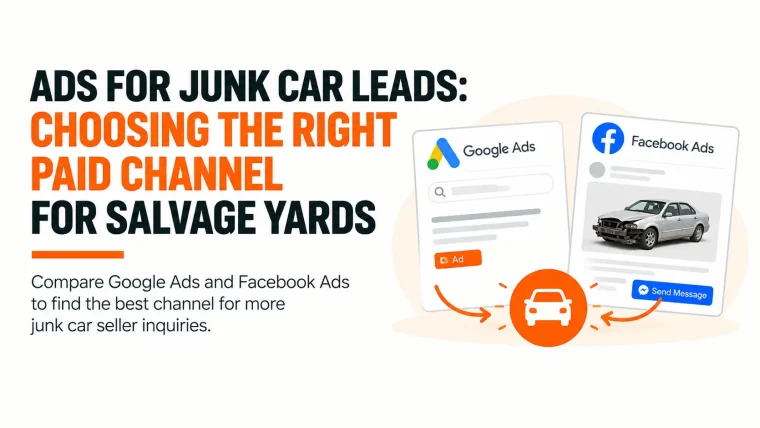
Ads For Junk Car Leads can help salvage yards create a more predictable flow of vehicle sellers, but choosing the right advertising channel depends on how and when potential sellers make decisions. Google Ads and Facebook Ads both generate opportunities, but they work in completely different ways.
Google Ads captures existing demand from people who are already searching for solutions such as selling an unwanted vehicle, while Facebook Ads helps salvage yards reach vehicle owners before they actively search for a buyer.
The biggest mistake salvage yards make is judging paid advertising only by the number of leads generated. A low-cost lead does not always create a purchased vehicle. The real goal of Ads For Junk Car Leads is building a system that turns advertising spend into qualified seller conversations, scheduled pickups, and completed acquisitions.
A strong paid advertising approach should work as part of a broader Junk Car Acquisition Strategy, where each channel has a specific role. Google can capture high-intent sellers, while Facebook can create additional opportunities through awareness, local targeting, and retargeting.
In this guide, we will compare Google Ads and Facebook Ads for salvage yards, explain the difference between search intent and social discovery, compare costs and lead quality, and show when each platform should be used to generate better junk car leads.
Need More Junk Car Leads in Your Local Market?
Stop relying on unpredictable seller inquiries. Pull Your Part Accelerator helps junk car buyers and salvage yards reach local vehicle owners through targeted Facebook Ads, local SEO, and organized lead tracking
📌 KEY TAKEAWAYS
- Google Ads: Target sellers actively searching for junk car buyers to generate high-intent leads.
- Facebook Ads: Build local awareness, reach potential sellers, and retarget interested visitors.
- Use both platforms: Google captures immediate demand, while Facebook creates and recovers opportunities.
- Optimize landing pages: Use clear offers, service areas, simple quote forms, and visible phone numbers.
- Follow up quickly: Qualify sellers by vehicle condition, location, ownership, and selling timeline.
- Track real results: Measure qualified leads, completed purchases, and cost per acquired vehicle—not just clicks or cheap leads.
- Bottom line: Combine Google and Facebook Ads to generate quality leads and acquire more profitable vehicles.
Why Paid Ads Matter For Junk Car Lead Generation
Paid advertising has become an important part of a modern Junk Car Acquisition Strategy because it allows salvage yards to reach vehicle owners faster and create a more predictable flow of seller opportunities.
While organic channels such as SEO and Google Business Profile can generate valuable traffic over time, paid ads allow yards to appear in front of potential sellers immediately. The key difference is control.
With paid advertising, salvage yards can control:
- Who sees their offer
- Which locations they target
- When campaigns appear
- How much they invest
- Which channels generate results
However, successful Ads For Junk Car Leads are not measured only by clicks or form submissions. The real goal is turning advertising opportunities into qualified seller conversations, scheduled pickups, and purchased vehicles.
The Difference Between Getting Clicks And Buying More Vehicles
One of the biggest mistakes salvage yards make with paid advertising is focusing on activity instead of outcomes. A campaign may generate:
- Website visits
- Phone calls
- Form submissions
but those numbers do not automatically create more inventory.
The real acquisition journey looks like:
Ad → Lead → Contact → Qualification → Quote → Pickup → Vehicle Purchased
A click is only the beginning of the process. For example, a salvage yard may generate hundreds of clicks from an advertising campaign, but if:
- The seller is not contacted quickly
- The vehicle does not meet buying criteria
- Follow-up is inconsistent
- The offer process is unclear
those clicks will not translate into vehicle acquisitions. A successful Junk Car Acquisition Strategy evaluates ads based on the number of vehicles purchased, not just the number of leads generated.
How Paid Advertising Fits Into A Junk Car Acquisition Strategy
Paid ads are one part of a complete acquisition system. They help solve one important challenge:
Finding more potential vehicle sellers.
Within a broader Junk Car Acquisition Strategy, paid channels work alongside:
- Search visibility
- Local SEO
- Google Business Profile
- Website conversion systems
- Seller follow-up processes
- Tracking and optimization
Different platforms serve different purposes.
– Google Ads
Google Ads captures existing demand.
A person searching:
- “sell my junk car”
- “junk car buyer near me”
- “cash for junk cars”
already has an active problem and is looking for a solution.
– Facebook Ads
Facebook Ads can create demand by reaching vehicle owners before they actively search.
A person may have:
- An unused vehicle sitting in their driveway
- A car that needs expensive repairs
- A vehicle they no longer want
The right advertisement can introduce the opportunity to sell.
Why Salvage Yards Cannot Rely Only On Organic Traffic
Organic traffic is valuable, but relying only on SEO and unpaid visibility can limit growth. SEO requires:
- Time to build rankings
- Continuous content creation
- Technical optimization
- Local authority signals
While organic search can create long-term value, salvage yards often need immediate opportunities to maintain vehicle flow. Paid advertising provides additional advantages:
- Faster visibility
- Precise location targeting
- Ability to test offers
- Faster market feedback
- More control over acquisition volume
A balanced Ads For Junk Car Leads strategy combines paid and organic channels. Organic channels help build long-term visibility. Paid channels help capture immediate opportunities and expand reach.
Google Ads vs Facebook Ads For Junk Car Leads: Understanding The Difference
When comparing Google Ads vs Facebook Ads for junk car leads, the biggest difference is not the platform itself – it is the mindset of the person seeing the advertisement.
Google Ads and Facebook Ads both help salvage yards generate seller opportunities, but they capture different stages of the buying journey.
Google Ads reaches people who are already searching for a solution, while Facebook Ads reaches people who may have a vehicle to sell but have not actively started searching yet.
Understanding this difference helps salvage yards decide where to invest their advertising budget and how each channel fits into their overall Junk Car Acquisition Strategy.
Google Ads Capture Existing Seller Intent
Google Ads is built around existing demand.
When someone searches terms like:
- “sell my junk car”
- “cash for junk cars near me”
- “junk car buyer near me”
- “get rid of my old car”
they are actively looking for a solution.
This makes Google Ads valuable for salvage yards because the user has already identified a need and is closer to making a decision.
Within Ads For Junk Car Leads, Google Search campaigns are often used to capture high-intent sellers who are ready to take action.
People Actively Searching Have Stronger Purchase Intent
A person searching for a junk car buyer is usually experiencing a specific problem:
- They have an unwanted vehicle
- Their car is no longer worth repairing
- They need to remove a non-running vehicle
- They want to sell quickly
Because the search begins with a problem, the seller is often further down the decision process.
The challenge for salvage yards is not creating awareness — it is being visible when that search happens.
High-Intent Keywords Drive Better Acquisition Opportunities
The effectiveness of Google Ads depends heavily on targeting the right keywords.
High-intent examples include:
- “sell my junk car”
- “junk car removal near me”
- “cash for old cars”
- “junk car buyer [location]”
These searches indicate stronger seller intent compared with broad informational searches.
A well-optimized Google Ads campaign focuses on attracting people who are more likely to become actual vehicle acquisitions.
Facebook Ads Create Seller Awareness
Facebook Ads work differently from Google Ads. Instead of capturing existing searches, Facebook helps salvage yards introduce their service to potential sellers who may not currently be looking for a buyer.
Many vehicle owners have cars that are:
- Sitting unused
- Damaged
- Expensive to repair
- Taking up space
They may not search for a junk car buyer until someone reminds them that selling is an option.
This makes Facebook Ads useful for creating additional demand.
Facebook Reaches A Passive Audience
Unlike Google users, Facebook users are usually browsing content rather than actively searching for a service. The advertising goal is to create interest by showing:
- A simple selling process
- Local buying availability
- Convenience of pickup
- Value of removing unwanted vehicles
This makes Facebook useful for expanding reach beyond people already searching.
Local Targeting Helps Salvage Yards Reach Nearby Sellers
For salvage yards, location matters because transportation costs directly affect profitability. Facebook Ads allow businesses to focus on:
- Specific cities
- Service areas
- Local communities
- Nearby vehicle owners
This makes the platform useful for building awareness in markets where the yard wants more acquisition opportunities.
Search Intent vs Social Discovery: The Biggest Difference
The main difference between Google Ads and Facebook Ads comes down to user intent.
Factor | Google Ads | Facebook Ads |
User mindset | Searching for a solution | Discovering an opportunity |
Intent level | Higher | Lower |
Decision speed | Usually faster | Usually requires more nurturing |
Best use | Capturing ready sellers | Creating awareness and future sellers |
Main goal | Immediate acquisition opportunities | Expanding seller reach |
Which Channel Fits Better Into A Junk Car Acquisition Strategy?
Neither platform replaces the other. The best choice depends on the acquisition goal.
Google Ads works best when:
- You need sellers actively looking for buyers
- You want higher-intent inquiries
- You need faster acquisition opportunities
- You are targeting specific search terms
Facebook Ads works best when:
- You want to reach more vehicle owners
- You are expanding local awareness
- You want additional lead volume
- You are using retargeting campaigns
Using Both Channels Together
The strongest Ads For Junk Car Leads strategy often combines both platforms.
Google Ads captures immediate demand.
Facebook Ads helps create additional opportunities and reconnect with people who previously interacted with your business.
Together, they support a broader Junk Car Acquisition Strategy by covering both active sellers and future sellers.
Google Ads For Junk Car Leads: When Salvage Yards Should Use Them
Google Ads can be one of the most effective paid channels for salvage yards because it captures people who are already searching for a way to sell their vehicles.
Unlike awareness-based advertising, Google Search Ads place your salvage yard in front of potential sellers at the exact moment they are looking for a solution.
Within a complete Junk Car Acquisition Strategy, Google Ads works as a demand-capture channel that helps salvage yards connect with high-intent vehicle owners and create more acquisition opportunities.
However, successful Ads For Junk Car Leads campaigns depend on more than simply running advertisements. The right keywords, landing pages, tracking systems, and follow-up processes determine whether advertising spend turns into actual vehicle purchases.
Target High-Intent Junk Car Keywords
The success of Google Ads depends heavily on targeting keywords that show strong seller intent. Not every search related to junk cars represents an immediate acquisition opportunity.
For example:
Lower-intent searches:
- What is a junk car worth?
- How does car recycling work?
- Junk car information
Higher-intent searches:
- Sell my junk car
- Junk car buyers near me
- Cash for junk cars
- Get rid of my old car
- Junk car removal near me
High-intent keywords indicate that the person is closer to contacting a buyer. A strong Google Ads strategy focuses budget on searches where users are actively looking for a solution.
Why Google Search Ads Usually Produce Stronger Seller Intent
The biggest advantage of Google Ads is intent. When someone searches for a junk car buyer, they are usually responding to a current situation:
- They have an unwanted vehicle
- Their car needs expensive repairs
- They want to remove a non-running vehicle
- They need a convenient selling option
This creates a shorter decision cycle compared with channels where users are only discovering a service. For salvage yards, this means Google Ads can help capture sellers who are already closer to making a decision.
Existing Demand Makes Google Ads Different
Google Search Ads do not need to create the initial need. The seller already has a problem. The advertisement simply connects that person with a solution.
Example: A vehicle owner searches:
“junk car buyer near me”
A local salvage yard advertisement appears. The searcher already understands what they need, making the conversation easier to start.
Immediate Problems Create Faster Acquisition Opportunities
Many junk car sellers are motivated by immediate needs:
- Removing an unwanted vehicle
- Freeing driveway space
- Avoiding repair costs
- Getting rid of damaged cars
Because of this urgency, Google Ads can often generate faster opportunities compared with platforms based mainly on awareness.
Creating Google Ads Landing Pages That Convert
Driving traffic is only one part of generating successful Ads For Junk Car Leads.
The landing page determines whether visitors become actual seller inquiries.
A high-converting junk car landing page should include:
Dedicated Junk Car Landing Pages
Sending paid traffic to a general homepage often reduces conversions.
Instead, create dedicated pages focused on:
- Selling junk cars
- Cash offers
- Vehicle pickup
- Local service areas
The page should immediately answer:
- Who buys vehicles?
- What areas are served?
- How does the process work?
- How can the seller request an offer?
Clear Offer And Simple Messaging
Vehicle owners should understand the value proposition immediately.
Effective landing pages communicate:
- We buy unwanted vehicles
- We provide pickup services
- We serve your local area
- Getting an offer is simple
Avoid unnecessary information that creates friction.
Simple Quote Forms And Strong Phone CTAs
Many junk car sellers prefer calling directly.
Landing pages should include:
- Visible phone numbers
- Click-to-call buttons
- Short quote forms
- Vehicle information fields
The easier it is for sellers to start the conversation, the stronger the acquisition opportunity.
Service Area Targeting
Local relevance is important for salvage yards.
Landing pages should clearly mention:
- Cities served
- Pickup areas
- Local availability
This improves user confidence and helps connect paid traffic with actual acquisition areas.
Google Ads Mistakes Salvage Yards Should Avoid
Many salvage yards waste advertising budgets because of mistakes that reduce lead quality and increase acquisition costs.
Avoid these common problems:
Sending Paid Traffic To The Homepage
A homepage usually serves many purposes. Paid visitors need a focused page designed around selling a vehicle. Dedicated landing pages usually provide a clearer path from click to inquiry.
Targeting Broad Keywords
Broad keywords can attract people who are researching rather than selling. Poor targeting can lead to:
- Lower-quality inquiries
- Wasted clicks
- Higher acquisition costs
Focus budget on searches showing strong seller intent.
Not Tracking Conversions
Clicks and impressions do not show whether advertising is working. Salvage yards should track:
- Calls generated
- Quote requests
- Qualified sellers
- Vehicles purchased
- Cost per acquired vehicle
A successful Junk Car Acquisition Strategy measures business outcomes, not only advertising activity.
Ignoring Negative Keywords
Negative keywords help prevent ads from appearing for irrelevant searches. Examples may include searches related to:
- Jobs
- Parts shopping
- Vehicle information
- DIY topics
Proper keyword filtering improves lead quality and protects advertising budgets.
Poor Follow-Up After Leads Arrive
Even strong Google Ads campaigns can fail if inquiries are not handled properly. A fast response process helps:
- Contact sellers before competitors
- Improve conversion rates
- Increase completed acquisitions
Paid advertising creates opportunities, but follow-up turns those opportunities into vehicles.
Google Ads For Junk Car Leads: When Salvage Yards Should Use Them
Google Ads can be one of the most effective paid channels for salvage yards because it captures people who are already searching for a way to sell their vehicles.
Unlike awareness-based advertising, Google Search Ads place your salvage yard in front of potential sellers at the exact moment they are looking for a solution.
Within a complete Junk Car Acquisition Strategy, Google Ads works as a demand-capture channel that helps salvage yards connect with high-intent vehicle owners and create more acquisition opportunities.
However, successful Ads For Junk Car Leads campaigns depend on more than simply running advertisements. The right keywords, landing pages, tracking systems, and follow-up processes determine whether advertising spend turns into actual vehicle purchases.
Target High-Intent Junk Car Keywords
The success of Google Ads depends heavily on targeting keywords that show strong seller intent. Not every search related to junk cars represents an immediate acquisition opportunity.
For example:
Lower-intent searches:
- What is a junk car worth?
- How does car recycling work?
- Junk car information
Higher-intent searches:
- Sell my junk car
- Junk car buyers near me
- Cash for junk cars
- Get rid of my old car
- Junk car removal near me
High-intent keywords indicate that the person is closer to contacting a buyer. A strong Google Ads strategy focuses budget on searches where users are actively looking for a solution.
Why Google Search Ads Usually Produce Stronger Seller Intent
The biggest advantage of Google Ads is intent.
When someone searches for a junk car buyer, they are usually responding to a current situation:
- They have an unwanted vehicle
- Their car needs expensive repairs
- They want to remove a non-running vehicle
- They need a convenient selling option
This creates a shorter decision cycle compared with channels where users are only discovering a service.
For salvage yards, this means Google Ads can help capture sellers who are already closer to making a decision.
Existing Demand Makes Google Ads Different
Google Search Ads do not need to create the initial need.
The seller already has a problem.
The advertisement simply connects that person with a solution.
Example:
A vehicle owner searches:
“junk car buyer near me”
A local salvage yard advertisement appears.
The searcher already understands what they need, making the conversation easier to start.
Immediate Problems Create Faster Acquisition Opportunities
Many junk car sellers are motivated by immediate needs:
- Removing an unwanted vehicle
- Freeing driveway space
- Avoiding repair costs
- Getting rid of damaged cars
Because of this urgency, Google Ads can often generate faster opportunities compared with platforms based mainly on awareness.
Creating Google Ads Landing Pages That Convert
Driving traffic is only one part of generating successful Ads For Junk Car Leads.
The landing page determines whether visitors become actual seller inquiries.
A high-converting junk car landing page should include:
Dedicated Junk Car Landing Pages
Sending paid traffic to a general homepage often reduces conversions.
Instead, create dedicated pages focused on:
- Selling junk cars
- Cash offers
- Vehicle pickup
- Local service areas
The page should immediately answer:
- Who buys vehicles?
- What areas are served?
- How does the process work?
- How can the seller request an offer?
Clear Offer And Simple Messaging
Vehicle owners should understand the value proposition immediately.
Effective landing pages communicate:
- We buy unwanted vehicles
- We provide pickup services
- We serve your local area
- Getting an offer is simple
Avoid unnecessary information that creates friction.
Simple Quote Forms And Strong Phone CTAs
Many junk car sellers prefer calling directly.
Landing pages should include:
- Visible phone numbers
- Click-to-call buttons
- Short quote forms
- Vehicle information fields
The easier it is for sellers to start the conversation, the stronger the acquisition opportunity.
Service Area Targeting
Local relevance is important for salvage yards.
Landing pages should clearly mention:
- Cities served
- Pickup areas
- Local availability
This improves user confidence and helps connect paid traffic with actual acquisition areas.
Google Ads Mistakes Salvage Yards Should Avoid
Many salvage yards waste advertising budgets because of mistakes that reduce lead quality and increase acquisition costs.
Avoid these common problems:
Sending Paid Traffic To The Homepage
A homepage usually serves many purposes.
Paid visitors need a focused page designed around selling a vehicle.
Dedicated landing pages usually provide a clearer path from click to inquiry.
Targeting Broad Keywords
Broad keywords can attract people who are researching rather than selling.
Poor targeting can lead to:
- Lower-quality inquiries
- Wasted clicks
- Higher acquisition costs
Focus budget on searches showing strong seller intent.
Not Tracking Conversions
Clicks and impressions do not show whether advertising is working.
Salvage yards should track:
- Calls generated
- Quote requests
- Qualified sellers
- Vehicles purchased
- Cost per acquired vehicle
A successful Junk Car Acquisition Strategy measures business outcomes, not only advertising activity.
Ignoring Negative Keywords
Negative keywords help prevent ads from appearing for irrelevant searches.
Examples may include searches related to:
- Jobs
- Parts shopping
- Vehicle information
- DIY topics
Proper keyword filtering improves lead quality and protects advertising budgets.
Poor Follow-Up After Leads Arrive
Even strong Google Ads campaigns can fail if inquiries are not handled properly.
A fast response process helps:
- Contact sellers before competitors
- Improve conversion rates
- Increase completed acquisitions
Paid advertising creates opportunities, but follow-up turns those opportunities into vehicles.
Facebook Ads For Junk Car Leads: When They Work Best
Facebook Ads can be a valuable part of an Ads For Junk Car Leads strategy because they allow salvage yards to reach vehicle owners before they actively search for a buyer.
Unlike Google Ads, where users usually have an immediate need, Facebook Ads introduce the opportunity to sell a vehicle while people are already browsing content.
For salvage yards, this makes Facebook useful for creating awareness, expanding local reach, and generating additional seller opportunities that may not have been captured through search alone.
However, Facebook leads often require a stronger qualification and follow-up process because users may not have the same immediate buying intent as people searching on Google.
A successful Junk Car Acquisition Strategy uses Facebook Ads as a demand-generation channel, supported by proper lead handling and conversion systems.
Using Facebook Ads To Reach Vehicle Owners Before They Search
One of the biggest advantages of Facebook Ads is reaching potential sellers before they actively search for a junk car buyer.
Many vehicle owners may have:
- An old vehicle sitting unused
- A damaged car they no longer want
- A vehicle that is expensive to repair
- A car taking up valuable space
These owners may not search for a buyer immediately, but a well-targeted advertisement can introduce the idea of selling.
This creates an opportunity for salvage yards to build a relationship before competitors appear in search results.
Facebook Creates Demand Instead Of Capturing Existing Demand
The biggest difference between Facebook Ads and Google Ads is user intent.
Google:
- User has a problem
- User searches for a solution
- Buyer captures existing demand
Facebook:
- User may not be actively searching
- Advertisement creates awareness
- Buyer creates a future opportunity
This makes Facebook valuable for expanding the top of the acquisition funnel.
Best Facebook Campaign Types For Salvage Yards
Different Facebook campaign types support different stages of a Junk Car Acquisition Strategy. The best approach depends on whether the goal is generating new inquiries, increasing awareness, or reconnecting with previous visitors.
Facebook Lead Form Ads
Lead form ads allow vehicle owners to submit their information directly through Facebook.
Advantages include:
- Simple submission process
- Lower friction for users
- Ability to collect vehicle details
- Easy local targeting
Useful information to collect:
- Vehicle make and model
- Location
- Vehicle condition
- Seller contact details
However, because the process is easier than a traditional search journey, these leads often require additional qualification.
Local Awareness Campaigns
Local awareness campaigns help salvage yards increase visibility within their service area.
These campaigns can be useful for:
- Introducing buying services
- Increasing brand recognition
- Reaching local vehicle owners
- Supporting long-term acquisition efforts
For local businesses, repeated visibility can help keep the salvage yard in mind when someone decides to sell.
Retargeting Campaigns
Retargeting is one of the strongest uses of Facebook Ads for salvage yards.
Many visitors may:
- Visit a quote page
- Check vehicle requirements
- Start a form but not complete it
- Research selling options
Retargeting allows businesses to reconnect with these potential sellers.
This helps recover opportunities that were not converted during the first visit.
Lookalike Audiences
Lookalike audiences allow advertisers to reach people who share characteristics with existing customers or leads.
For salvage yards, this can help expand campaigns beyond existing audiences.
Examples:
- Previous vehicle sellers
- Qualified leads
- Website visitors
- Customer lists
The goal is to find more people who are likely to have similar selling behavior.
Why Facebook Leads Require Strong Follow-Up
Facebook Ads can generate valuable opportunities, but the conversion process is often different from Google Ads. Because Facebook users may not have immediate purchase intent, salvage yards need stronger follow-up systems.
A good process includes:
- Quick response after submission
- Vehicle qualification questions
- Multiple contact attempts
- Clear next steps
- Pickup scheduling
Within an Ads For Junk Car Leads strategy, generating inquiries is only the first step. The ability to convert those inquiries determines whether advertising creates actual vehicle acquisitions.
Lower Immediate Intent Requires Better Qualification
A person filling out a Facebook form may be interested in selling but may not be ready immediately.
They may still need to:
- Confirm vehicle details
- Compare options
- Discuss pricing
- Arrange pickup
This means salvage yards should focus on identifying serious sellers rather than treating every lead equally.
Important qualification factors include:
- Vehicle location
- Condition
- Ownership status
- Selling timeline
Speed-To-Lead Is Critical For Facebook Campaigns
Fast response is especially important because Facebook users can easily move on to other activities after submitting a form.
Quick follow-up helps:
- Confirm seller interest
- Build trust
- Reduce lost opportunities
- Increase conversion rates
A strong follow-up process turns Facebook inquiries into real acquisition opportunities.
Common Facebook Ads Mistakes
Many salvage yards struggle with Facebook Ads because they focus only on generating cheap leads instead of building a complete acquisition system.
Common mistakes include:
Targeting Too Broadly
Overly broad targeting can generate many inquiries but reduce lead quality.
Better targeting considers:
- Service area
- Local vehicle owners
- Market conditions
- Previous customer data
The goal is reaching people who are more likely to become sellers.
Choosing Cheap Leads Over Quality Leads
A low-cost lead does not always create a profitable acquisition.
Some inexpensive leads may have:
- Wrong locations
- Low-value vehicles
- No immediate selling intent
A stronger Junk Car Acquisition Strategy measures success by purchased vehicles, not just lead volume.
Using Weak Ad Creatives
The advertisement needs to clearly communicate why someone should sell.
Effective messaging usually highlights:
- Easy selling process
- Local pickup
- Convenience
- Removing unwanted vehicles
The creative should make the selling opportunity obvious within seconds.
Ignoring Retargeting
Many salvage yards focus only on acquiring new traffic and forget previous visitors.
Without retargeting, businesses lose opportunities from people who already showed interest.
Retargeting helps keep the salvage yard visible during the seller’s decision process.
Google Ads vs Facebook Ads Cost Comparison For Junk Car Leads
The cost of Ads For Junk Car Leads depends on multiple factors, including location, competition, targeting, campaign quality, and how effectively a salvage yard converts inquiries into vehicle purchases.
When comparing Google Ads and Facebook Ads, many salvage yards focus only on cost per lead. However, the lowest-cost lead is not always the most valuable lead.
A successful paid advertising strategy evaluates:
- Cost per click
- Cost per lead
- Lead quality
- Conversion rate
- Cost per acquired vehicle
The true goal is finding the advertising channel that produces profitable vehicle acquisitions.
Cost Per Lead Comparison
Cost per lead (CPL) measures how much a salvage yard spends to generate a seller inquiry.
Both Google Ads and Facebook Ads can generate junk car leads, but the cost structure and lead intent are different.
Google Ads Cost Per Lead
Google Ads often has higher costs because businesses are competing for searches from people with immediate intent.
A person searching:
- “sell my junk car”
- “junk car buyer near me”
- “cash for junk cars”
is already looking for a solution.
This stronger intent can result in:
- Higher click costs
- Higher competition
- Fewer but more valuable inquiries
For salvage yards, the higher cost may be justified if those leads convert into more vehicle purchases.
Facebook Ads Cost Per Lead
Facebook Ads can often generate leads at a lower initial cost because the platform reaches a broader audience.
However, lower cost does not always mean better results.
Facebook leads may require:
- More qualification
- More follow-up
- More seller education
Because users may not have been actively searching for a buyer, the conversion process can take longer.
CPC vs CPL: Understanding The Difference
When evaluating Ads For Junk Car Leads, salvage yards should understand the difference between CPC and CPL.
Cost Per Click (CPC)
CPC measures how much you pay when someone clicks your advertisement.
A lower CPC can increase traffic, but it does not guarantee better leads.
Cost Per Lead (CPL)
CPL measures how much you spend to generate an inquiry.
A lower CPL may look attractive, but the quality of those inquiries matters.
For example:
Campaign A:
- 100 leads
- $20 cost per lead
- 5 vehicles purchased
Campaign B:
- 40 leads
- $50 cost per lead
- 15 vehicles purchased
Campaign B costs more per lead but creates better acquisition results.
Why The Cheapest Lead Is Not Always The Best Lead
One of the biggest mistakes salvage yards make is optimizing for the cheapest leads instead of the most valuable acquisitions.
A cheap lead may not become a vehicle purchase because:
- The seller is not ready
- The vehicle is outside your service area
- The vehicle has low acquisition value
- The seller is only researching options
A strong Junk Car Acquisition Strategy focuses on lead quality and profitability.
The important question is not:
“How many leads did we generate?”
The better question is:
“How many profitable vehicles did these leads produce?”
Measuring Cost Per Acquired Vehicle Instead Of Cost Per Lead
The most important metric for salvage yards is cost per acquired vehicle.
This measures how much investment is required to purchase an actual vehicle.
Formula:
Total Advertising Cost ÷ Number Of Vehicles Purchased = Cost Per Acquired Vehicle
Example:
A salvage yard spends:
- $3,000 on ads
- Acquires 30 vehicles
Cost per acquired vehicle:
$3,000 ÷ 30 = $100 per vehicle
This measurement gives a clearer picture of whether an advertising channel is actually helping grow inventory.
Internal link:
→ “Junk Car Acquisition Strategy”
A complete acquisition system tracks the entire journey:
Ad → Lead → Qualification → Pickup → Vehicle Purchase
Which Channel Produces Better Junk Car Leads?
There is no single winner between Google Ads and Facebook Ads for every salvage yard.
The better channel depends on the acquisition goal, market, budget, and sales process.
Google Ads and Facebook Ads serve different purposes within an Ads For Junk Car Leads strategy.
Choose Google Ads When:
Google Ads is usually a stronger choice when your goal is capturing immediate seller demand.
Choose Google Ads when:
You Need Immediate Sellers
Search ads reach people already looking for a junk car buyer.
You Target High-Intent Searches
Google works well for keywords that show clear selling intent.
Examples:
- Sell my junk car
- Junk car buyers near me
- Cash for old cars
You Want Faster Acquisition Opportunities
Because searchers already have a need, Google Ads can often create faster conversations with potential sellers.
Choose Facebook Ads When:
Facebook Ads are useful when your goal is expanding reach and creating additional seller opportunities.
Choose Facebook Ads when:
– You Want Additional Reach
Facebook helps reach vehicle owners who may not be actively searching yet.
– You Need Retargeting
Facebook is valuable for reconnecting with:
- Website visitors
- Previous leads
- People who interacted with your ads
– You Want To Build Local Awareness
For salvage yards expanding their market presence, Facebook can help increase visibility among nearby vehicle owners.
Use Both Channels Together For Maximum Results
The strongest Ads For Junk Car Leads strategy often combines Google Ads and Facebook Ads instead of treating them as competitors.
Each channel plays a different role.
– Google Ads:
Captures existing demand
- Finds sellers already searching
- Targets high-intent keywords
- Creates immediate opportunities
– Facebook Ads:
Creates and recovers demand
- Reaches new audiences
- Builds awareness
- Retargets interested users
Together, they create a stronger acquisition funnel:
Facebook Ads → Awareness → Website Visit → Retargeting → Google Search → Seller Conversion
or:
Google Ads → Lead → Facebook Retargeting → Follow-Up → Vehicle Purchase
Which Channel Produces Better Junk Car Leads?
When comparing Ads For Junk Car Leads, the better platform depends on what a salvage yard is trying to achieve.
Google Ads and Facebook Ads generate different types of opportunities because users are in different stages of the selling journey.
Google Ads reaches people who are already searching for a solution, while Facebook Ads helps salvage yards discover and influence potential sellers before they actively search.
For most salvage yards, the strongest approach is not choosing one channel over the other. It is understanding how each platform contributes to a complete Junk Car Acquisition Strategy.
Choose Google Ads When You Need Immediate Seller Opportunities
Google Ads is usually the stronger option when a salvage yard wants to capture people who are actively looking to sell a vehicle. Because users are searching for specific solutions, these leads often have stronger immediate intent. Choose Google Ads when:
– You Need Sellers Who Are Ready To Take Action
Google Search Ads connect with people who already have a reason to sell.
Examples:
- A vehicle is no longer worth repairing
- A car has been sitting unused
- The owner wants to remove an unwanted vehicle
- Someone needs a quick selling option
The search itself shows that the person has already identified a problem and is looking for a solution.
– You Target High-Intent Junk Car Searches
Google Ads performs best when campaigns focus on keywords that indicate seller intent.
Examples:
- Sell my junk car
- Junk car buyers near me
- Cash for junk cars
- Remove my old car
These searches are valuable because the user is not just learning about junk cars — they are actively looking for a buyer.
For salvage yards focused on acquiring vehicles, high-intent searches can create stronger acquisition opportunities.
– You Want Faster Acquisition Results
Because Google Ads captures existing demand, it can often generate seller conversations faster than awareness-based advertising.
A well-optimized campaign can help salvage yards:
- Reach sellers immediately
- Generate direct calls
- Receive quote requests
- Schedule pickups faster
However, results still depend on landing pages, response speed, qualification, and follow-up processes.
Choose Facebook Ads When You Want Additional Seller Reach
Facebook Ads serve a different purpose within an Ads For Junk Car Leads strategy.
Instead of capturing people already searching, Facebook helps salvage yards reach vehicle owners who may not have considered selling yet.
Choose Facebook Ads when:
– You Want To Reach More Vehicle Owners
Many people have vehicles they no longer need but have not actively searched for a buyer.
Examples:
- Old cars sitting in driveways
- Damaged vehicles
- Non-running vehicles
- Cars waiting for repair decisions
Facebook Ads allow salvage yards to introduce the selling opportunity before the person starts searching.
– You Need Retargeting Opportunities
Not every visitor becomes a lead immediately.
Some people may:
- Visit your website
- Check your buying process
- Look at your offer
- Leave without contacting you
Retargeting allows salvage yards to reconnect with these potential sellers.
This keeps the business visible during the decision process and helps recover missed opportunities.
– You Want To Build Local Awareness
For salvage yards expanding their market presence, Facebook Ads can help create stronger local recognition.
Local campaigns can help businesses:
- Reach nearby vehicle owners
- Promote buying services
- Increase brand familiarity
- Support future acquisition opportunities
Facebook works especially well when combined with strong follow-up systems.
Use Both Channels Together For Maximum Results
The strongest Ads For Junk Car Leads strategy often combines Google Ads and Facebook Ads because each platform supports a different stage of the acquisition process.
Instead of viewing them as competitors, salvage yards should use them together.
– Google Ads Captures Existing Demand
Google Ads helps capture sellers who are already searching.
The process looks like:
Search → Click → Quote Request → Follow-Up → Vehicle Purchase
Google is strongest at finding people who already know they want to sell.
– Facebook Ads Creates And Recovers Demand
Facebook Ads helps create additional opportunities.
The process looks like:
Ad Exposure → Website Visit → Retargeting → Follow-Up → Future Seller
Facebook is strongest at reaching people earlier in the decision journey.
– Combining Both Creates A Complete Paid Acquisition Funnel
A powerful Junk Car Acquisition Strategy uses both channels together:
Stage 1: Create Awareness
Facebook Ads introduce the salvage yard to local vehicle owners.
↓
Stage 2: Capture High Intent
Google Ads captures people actively searching for junk car buyers.
↓
Stage 3: Recover Lost Opportunities
Facebook retargeting reconnects with previous visitors and leads.
↓
Stage 4: Convert Leads Into Vehicles
Follow-up systems turn inquiries into completed acquisitions.
Summary: The Best Channel Depends On Your Acquisition Goal
There is no single winner between Google Ads and Facebook Ads for every salvage yard.
The right choice depends on the goal:
Goal | Better Channel |
Capture sellers ready to sell | Google Ads |
Reach more local vehicle owners | Facebook Ads |
Generate immediate inquiries | Google Ads |
Build awareness | Facebook Ads |
Recover previous visitors | Facebook Retargeting |
Create a complete acquisition system | Both |
The most successful salvage yards use Ads For Junk Car Leads as part of a broader system, where Google captures active demand and Facebook expands opportunities.
When combined with strong qualification, follow-up, and tracking, both platforms can contribute to a predictable Junk Car Acquisition Strategy.
How To Combine Google Ads And Facebook Ads Into A Junk Car Lead Funnel
The most effective Ads For Junk Car Leads strategy does not treat Google Ads and Facebook Ads as competing platforms. Each channel plays a different role in moving potential sellers through the acquisition process.
Google Ads captures people who are already searching for a junk car buyer, while Facebook Ads helps create awareness, reconnect with interested users, and bring more potential sellers into the funnel.
When combined correctly, both platforms create a complete paid acquisition system:
Awareness → Search Intent → Lead Capture → Follow-Up → Vehicle Purchase
This approach allows salvage yards to capture immediate opportunities while continuing to build a larger pipeline of future sellers.
Stage 1: Capture Demand With Google Ads
The first stage of the funnel focuses on capturing people who are already looking for a solution.
Google Ads works well at this stage because users are actively searching for services such as:
- Junk car buyers near me
- Sell my junk car
- Cash for junk cars
- Remove my old vehicle
These searches indicate that the person has already recognized a need and is looking for a company that can help.
Use High-Intent Keywords To Find Ready Sellers
The goal of Google Ads is not generating random traffic.
It is reaching people who are closer to selling.
Salvage yards should focus on keywords that indicate:
- Immediate selling intent
- Vehicle ownership
- Local buying needs
- Pickup requirements
High-intent keywords usually create stronger acquisition opportunities because the seller is already looking for a buyer.
Send Traffic To Conversion-Focused Landing Pages
A successful Junk Car Acquisition Strategy does not end when someone clicks an advertisement.
The landing page should make the next step simple.
Important elements include:
- Clear junk car buying offer
- Service area information
- Simple quote form
- Visible phone number
- Vehicle information fields
- Strong call-to-action
The goal is converting paid traffic into seller conversations.
Track More Than Clicks
Many businesses measure Google Ads performance using:
- Clicks
- Impressions
- Traffic
However, salvage yards should focus on acquisition metrics:
- Qualified seller inquiries
- Scheduled pickups
- Vehicles purchased
- Cost per acquired vehicle
The purpose of Ads For Junk Car Leads is not more website activity — it is more vehicles entering the yard.
Stage 2: Retarget Visitors With Facebook Ads
Not every visitor who clicks a Google Ad will immediately submit their information.
Some sellers may:
- Compare different buyers
- Leave to think about the offer
- Need more time before selling
- Forget about the website
This is where Facebook retargeting becomes valuable.
Facebook Ads can bring previous visitors back into the acquisition process.
Reconnect With Interested Sellers
Retargeting allows salvage yards to advertise specifically to people who have already shown interest.
Examples:
- Website visitors
- Quote page visitors
- Previous leads
- People who interacted with ads
These audiences are more valuable than completely cold audiences because they already know the business.
Use Retargeting To Build Trust
Many vehicle sellers need confidence before completing a transaction.
Retargeting ads can reinforce:
- Local buying availability
- Easy selling process
- Free pickup options
- Customer reviews
- Simple quote process
The goal is keeping the salvage yard visible until the seller is ready to act.
Expand Reach With Similar Audiences
Once a salvage yard has enough conversion data, Facebook can help identify people with similar characteristics.
These audiences can help reach more potential sellers who are likely to respond to the offer.
This creates additional acquisition opportunities beyond existing website traffic.
Stage 3: Follow Up And Convert Leads Into Vehicles
Advertising creates opportunities, but follow-up creates acquisitions. A complete Junk Car Acquisition Strategy requires a process that moves leads from initial inquiry to completed vehicle pickup.
Without proper follow-up, even high-quality paid traffic can be wasted.
Respond Quickly To New Leads
Speed matters because many vehicle sellers contact multiple buyers.
Fast responses help salvage yards:
- Reach sellers before competitors
- Confirm vehicle details quickly
- Build trust
- Schedule pickups faster
Qualify Leads Before Scheduling Pickup
Not every inquiry becomes a profitable acquisition.
Salvage yards should collect important details:
- Vehicle make and model
- Condition
- Location
- Ownership status
- Pickup requirements
This helps teams prioritize opportunities that match their acquisition goals.
Track The Complete Acquisition Journey
The final stage is measuring whether advertising creates real business results.
Track:
Ad Spend → Leads → Qualified Sellers → Pickups → Vehicles Purchased
This allows salvage yards to understand:
- Which channel produces better vehicles
- Which campaigns are profitable
- Where leads are being lost
- How to improve acquisition costs
Tracking Paid Ads Performance For Salvage Yards
Running Ads For Junk Car Leads without proper tracking makes it difficult to know whether advertising is actually helping your salvage yard acquire more vehicles.
Clicks, impressions, and form submissions can show campaign activity, but they do not reveal the full business impact. Salvage yards should connect advertising performance with qualified sellers, completed pickups, and vehicles purchased.
The most useful paid advertising metrics include:
- Leads generated
- Qualified sellers
- Lead-to-purchase conversion rate
- Vehicles acquired
- Cost per acquired vehicle
Tracking these numbers helps determine whether Ads For Junk Car Leads are producing profitable acquisitions rather than simply increasing traffic.
Track Leads Generated
Start by measuring how many seller inquiries each advertising channel produces.
Track leads from:
- Phone calls
- Quote forms
- Facebook lead forms
- Landing pages
- Other tracked contact methods
Lead volume helps measure campaign reach, but it should never be evaluated alone.
A campaign generating 100 leads may perform worse than one generating 40 if the smaller campaign produces more purchased vehicles.
Track Qualified Sellers
The next step is measuring how many leads meet your acquisition criteria.
A qualified seller may have:
- A vehicle within your service area
- Appropriate ownership documentation
- A vehicle your yard wants to purchase
- Clear selling intent
- Realistic pickup requirements
Tracking qualified leads gives salvage yards a more accurate view of Ads For Junk Car Leads performance.
If one channel consistently generates cheap but poorly qualified inquiries, its low cost per lead may be misleading.
Track Vehicles Purchased
Vehicles purchased is one of the most important advertising metrics for a salvage yard.
Connect every completed acquisition back to its original source whenever possible:
Google Ads → Seller Lead → Quote → Pickup → Vehicle Purchased
or:
Facebook Ads → Lead → Follow-Up → Pickup → Vehicle Purchased
This attribution helps identify which campaigns are contributing directly to inventory growth.
Rather than asking, “Which platform generated more leads?” ask:
“Which platform helped us purchase more profitable vehicles?”
That question keeps Ads For Junk Car Leads aligned with actual business goals.
Track Lead-To-Purchase Conversion Rate
Lead-to-purchase conversion rate shows how effectively advertising inquiries become acquired vehicles.
Use:
Vehicles Purchased ÷ Leads Generated × 100 = Lead-to-Purchase Conversion Rate
For example, if a campaign generates 50 leads and 10 become completed vehicle purchases, the conversion rate is 20%.
Comparing conversion rates between Google Ads and Facebook Ads can reveal differences in seller quality and intent.
Track Cost Per Acquired Vehicle
Cost per acquired vehicle provides a stronger profitability metric than cost per lead.
Use:
Advertising Spend ÷ Vehicles Purchased = Cost Per Acquired Vehicle
For example:
- Advertising spend: $2,500
- Vehicles acquired: 25
Cost per acquired vehicle = $100
This allows salvage yards to compare advertising channels based on real inventory results.
A higher-cost Google lead, for example, may still be more valuable if it converts into purchased vehicles more consistently than lower-cost leads from another channel.
Use Tracking Data To Improve Campaign Decisions
Performance data should guide future advertising investments.
If a campaign produces:
High lead volume + low vehicle purchases
→ Review targeting, qualification, and follow-up.
Low lead volume + strong acquisition rates
→ Consider increasing exposure or budget.
High acquisition cost + low vehicle profitability
→ Reevaluate targeting and campaign economics.
Consistent profitable vehicle purchases
→ Consider scaling the channel carefully.
The strongest Ads For Junk Car Leads strategy continually shifts resources toward campaigns that generate profitable vehicle acquisitions.
Paid Ads Mistakes That Prevent Salvage Yards From Growing
Even well-funded Ads For Junk Car Leads can underperform when campaigns are optimized around the wrong goals. For salvage yards, the objective is not simply generating clicks or inexpensive inquiries. Paid advertising should contribute to qualified sellers, completed pickups, and profitable vehicle acquisitions.
Avoiding the following mistakes can improve both lead quality and acquisition performance.
Optimizing For Leads Instead Of Vehicles
A low cost per lead can look impressive, but it does not necessarily mean the campaign is profitable. A campaign generating 100 inexpensive leads may perform worse than one generating 30 qualified sellers if the smaller campaign produces more purchased vehicles.
Instead of optimizing only for:
- Clicks
- Form submissions
- Cost per lead
salvage yards should also measure:
- Qualified leads
- Scheduled pickups
- Vehicles purchased
- Cost per acquired vehicle
The best Ads For Junk Car Leads campaigns are optimized around actual acquisitions, not lead volume alone.
Ignoring Lead Follow-Up
Paid advertising creates opportunities, but follow-up determines how many of those opportunities become vehicles.
Vehicle owners may contact several buyers before choosing one. Delayed responses can allow competitors to secure the acquisition first.
A strong follow-up process should include:
- Fast initial contact
- Missed-call callbacks
- SMS follow-up
- Quote reminders
- Pickup confirmation
Improving follow-up can increase the return from existing advertising without increasing ad spend.
Running Ads Without Conversion Tracking
Without conversion tracking, it becomes difficult to know which campaigns are producing business results.
Salvage yards should connect advertising activity with:
Ad → Lead → Qualified Seller → Pickup → Vehicle Purchased
Tracking should identify whether acquisitions came from Google Ads, Facebook Ads, retargeting, or another source.
This gives salvage yards the data needed to reduce wasted spending and improve their Ads For Junk Car Leads strategy.
Using The Wrong Channel For The Goal
Google Ads and Facebook Ads solve different acquisition problems. Using the wrong platform for the objective can lead to unrealistic expectations.
Use Google Ads primarily when the goal is to:
- Capture active seller demand
- Reach high-intent searches
- Generate immediate opportunities
Use Facebook Ads when the goal is to:
- Expand local reach
- Create seller awareness
- Retarget interested visitors
- Generate additional demand
The strongest paid strategy assigns each channel a clear role inside the broader acquisition process.
Frequently Asked Questions
Neither platform is automatically better for every salvage yard.
Google Ads is generally better suited to capturing people already searching for a junk car buyer, while Facebook Ads can help reach vehicle owners before they actively begin searching.
The best Ads For Junk Car Leads strategy depends on your goals, market, budget, and ability to follow up with sellers.
Yes, Facebook Ads can work for salvage yards when they are used to reach local vehicle owners, generate seller interest, and retarget people who have already interacted with the business.
Because Facebook users often have lower immediate intent than Google searchers, strong qualification and follow-up are especially important.
The cost of junk car advertising varies based on:
- Location
- Competition
- Targeting
- Platform
- Keyword demand
- Campaign quality
Instead of judging campaigns only by cost per click or cost per lead, salvage yards should calculate cost per acquired vehicle to understand whether their advertising is profitable.
Better lead quality usually comes from combining accurate targeting with strong qualification.
Salvage yards can improve lead quality by:
- Targeting high-intent search terms
- Limiting campaigns to profitable service areas
- Collecting detailed vehicle information
- Filtering low-intent inquiries
- Tracking which campaigns produce purchased vehicles
A successful Ads For Junk Car Leads strategy focuses on qualified sellers rather than simply increasing lead volume.
Using both platforms can create a stronger acquisition funnel.
Google Ads can capture vehicle owners who are actively searching, while Facebook Ads can create awareness and retarget people who have already interacted with the business.
Together, the process can look like:
Facebook Awareness → Google Search → Lead → Retargeting → Follow-Up → Vehicle Purchase
This makes both channels valuable components of a broader Junk Car Acquisition Strategy.