
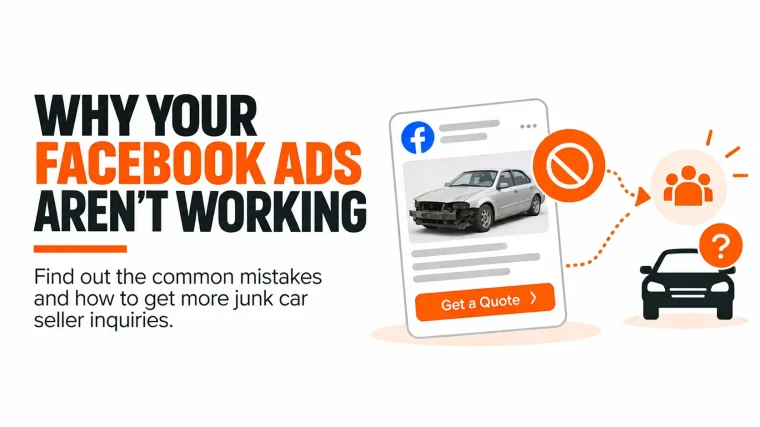
Running Facebook Ads but not receiving enough junk car seller inquiries? The problem may not be Facebook advertising itself. Poor audience targeting, generic vehicle imagery, unclear buying offers, or a complicated response process can prevent interested vehicle owners from contacting your business.
Successful campaigns require more than impressions, clicks, and engagement. They need to reach relevant local sellers, communicate a clear vehicle-buying opportunity, and make starting a conversation easy.
At Pull Your Part Accelerator (PYP), we specialize in Facebook advertising for junk car buyers and salvage yards. Our approach focuses on generating direct seller inquiries through targeted campaigns, whether through messaging conversations, calls, or other supported response methods. The buyer then handles qualification, quoting, follow-up, and vehicle purchasing.
In this guide, we’ll explain why Facebook campaigns struggle to generate junk car seller inquiries, how to identify the issues affecting performance, and what to fix to attract more relevant vehicle sellers.
Need More Junk Car Leads in Your Local Market?
Stop relying on unpredictable seller inquiries. Pull Your Part Accelerator helps junk car buyers and salvage yards reach local vehicle owners through targeted Facebook Ads, local SEO, and organized lead tracking
📌 KEY TAKEAWAYS
- An ad getting attention is only the beginning. What matters is whether that attention turns into real conversations with local vehicle sellers.
- Better audience targeting is not always about reaching fewer people. It’s about directing campaign delivery toward markets where relevant seller conversations can become realistic acquisition opportunities.
- If your ads receive attention but produce few junk car seller inquiries, examine whether the creative attracts people who want to sell vehicles—or simply people who find the advertisement interesting
- If your Facebook Ads are receiving attention but generating few seller conversations, check whether the campaign is optimized for the action you actually want. Better results begin with aligning the campaign objective, performance goal, advertising message, and response method.
- If your Facebook Ads attract interest but produce too few junk car seller inquiries, review the entire response experience. A clear CTA, simple contact process, and responsive buying team can help prevent valuable seller opportunities from being lost.
- An effective offer doesn’t need to make the biggest promise. It needs to show the right seller that their vehicle may qualify, the buyer serves their area, and contacting the business is a worthwhile next step.
- When junk car seller inquiries decline, diagnose the specific stage that’s underperforming before making changes. A structured review of delivery, creative, response methods, and inquiry quality provides a stronger foundation for improving campaign results.
- Fix the cause of poor performance before increasing spend. A structured approach to campaign delivery, creative testing, response experience, and inquiry quality can help turn underperforming Facebook Ads into more relevant seller-acquisition opportunities.
- Refresh the creative when the message appears to be losing effectiveness. Review targeting when inquiries come from the wrong sellers or locations. Diagnose the problem before changing both.
- Pull Your Part Accelerator generates seller opportunities through Facebook advertising. The junk car buyer handles qualification, quotes, follow-up, pickup, and purchases. Both stages influence the final acquisition results.
Why Facebook Ads Can Get Attention but No Junk Car Seller Inquiries
Facebook Ads can generate thousands of impressions, clicks, and reactions without producing meaningful junk car seller inquiries. This often happens when the advertising attracts attention but fails to connect with vehicle owners who have a genuine reason to sell.
At Pull Your Part Accelerator, we focus on separating general engagement from actual seller interest. Understanding where potential sellers stop responding is the first step toward improving campaign performance.
Impressions and Clicks Don't Always Indicate Seller Intent
Impressions show how often an ad appears, while clicks indicate that someone interacted with it. Neither automatically means the person owns a vehicle they want to sell.
For example, an eye-catching damaged car image might generate curiosity without encouraging anyone to contact the buyer.
To generate more junk car seller inquiries, the creative should clearly communicate the vehicle-buying offer, identify relevant seller situations, and encourage a direct response.
Engagement Is Different From a Genuine Acquisition Opportunity
Likes, comments, and shares can indicate that an ad is attracting interest, but they are not the same as seller inquiries.
A genuine acquisition opportunity begins when someone contacts the buyer about a vehicle they may want to sell.
For Facebook junk car campaigns, useful response indicators include:
- Messaging conversations: Potential sellers starting direct conversations.
- Phone inquiries: Vehicle owners contacting the buying team.
- Relevant seller messages: Inquiries involving vehicles the yard may be interested in purchasing.
Not every inquiry will become a qualified opportunity, but these actions are more closely connected to seller acquisition than general engagement.
Identify Where the Campaign Is Losing Potential Sellers
When Facebook Ads are not generating enough junk car seller inquiries, examine where interest stops turning into action.
For example:
- Impressions but few clicks: The creative or buying message may not be attracting the right attention.
- Clicks but few messages or calls: The offer, CTA, or response process may be creating friction.
- Many conversations but few relevant sellers: The creative or audience may be attracting people who do not match the buyer’s acquisition needs.
Each situation points toward a different problem, so changing the entire campaign without identifying the cause can waste time and advertising budget.
At Pull Your Part Accelerator, our approach is to evaluate how campaign delivery, seller-focused messaging, and response methods work together. The goal is not simply to increase Facebook engagement but to create more relevant junk car seller inquiries that the buying team can evaluate and potentially convert into purchased vehicles.
Your Facebook Ads Are Reaching the Wrong Audience
Even well-designed Facebook Ads can struggle to generate junk car seller inquiries when they reach people who are unlikely to sell a vehicle or live outside the buyer’s service area.
For junk car buyers and salvage yards, effective targeting means reaching potential sellers in locations where acquiring their vehicles makes operational and financial sense.
Your Audience Is Too Broad
A broad audience can generate impressions and engagement without attracting enough relevant vehicle sellers.
For example, reaching people interested in cars does not necessarily mean reaching people who want to sell unwanted, damaged, or non-running vehicles.
What to check: Review which locations, audience settings, and advertising messages are producing actual seller conversations. Avoid assuming that automotive interests automatically indicate selling intent.
At Pull Your Part Accelerator, we approach Facebook campaigns around seller acquisition rather than generic automotive engagement.
Your Ads Are Reaching People Outside the Buying Area
A campaign may generate messages from vehicle owners who live too far away for the yard to purchase or collect their vehicles profitably.
These inquiries can increase response volume without creating useful acquisition opportunities.
What to check: Compare the locations reported by sellers with the yard’s actual buying territory. Review Meta’s geographic targeting settings and whether the ad clearly communicates the service area.
The objective is to generate junk car seller inquiries from locations the buyer can realistically serve, not simply reach the largest possible audience.
Your Targeting Doesn't Reflect Actual Acquisition Opportunities
Not every location or vehicle type offers the same acquisition value.
Towing distance, pickup expenses, vehicle condition, and the buyer’s purchasing criteria all influence whether a seller inquiry is worth pursuing.
A campaign targeting a large geographic area without considering these factors may produce conversations that rarely become viable purchases.
What to check: Identify which service zones generate relevant inquiries and, when the yard provides purchase data, which locations contribute to actual vehicle acquisitions.
At Pull Your Part Accelerator, we focus on aligning advertising reach with the buyer’s local acquisition opportunities. The goal is to connect salvage yards with relevant vehicle sellers rather than simply increase Facebook traffic.
Your Ad Creative Isn't Connecting With Junk Car Sellers
Your Facebook Ads may be reaching the right locations but still failing to generate junk car seller inquiries because the images, headlines, or offers don’t connect with people who actually want to sell a vehicle.
Effective ad creative should immediately communicate that the business buys unwanted vehicles and give interested sellers a clear reason to respond.
The Images Don't Reflect Unwanted or Damaged Vehicles
Generic dealership photos, luxury cars, or unrelated automotive graphics may attract attention without communicating the buyer’s actual service.
Someone with a damaged or non-running vehicle should be able to recognize that the ad is relevant to their situation.
What to check: Review whether your images reflect the types of vehicles the yard wants to purchase. Test realistic photos of older, damaged, unwanted, or non-running cars instead of relying on generic automotive visuals.
The Headline Doesn't Address a Seller's Problem
A headline such as “Your Trusted Automotive Partner” may sound professional, but it doesn’t tell vehicle owners why they should respond.
Seller-focused headlines work differently because they connect with an existing problem.
For example:
- “Got a Car You Don’t Want?”
- “Have a Non-Running Vehicle?”
- “Looking to Sell Your Junk Car?”
What to check: Determine whether the headline clearly addresses a seller’s situation or simply promotes the business.
The Buying Offer Isn't Immediately Clear
If the ad doesn’t clearly explain that the business purchases vehicles, potential sellers may misunderstand the service or ignore the message.
Unclear offers can prevent Facebook campaigns from generating relevant junk car seller inquiries, even when the advertisement receives attention.
What to check: Make sure the image, headline, and primary text consistently communicate what vehicles the buyer purchases, where it operates, and how sellers can make contact.
Avoid promises about prices, pickup times, or vehicle eligibility that the yard cannot consistently fulfill.
Your Creative Generates Curiosity Instead of Selling Intent
An eye-catching image can produce clicks, reactions, and comments without attracting people who genuinely want to sell a vehicle.
For example, a dramatic wrecked-car photo may generate engagement because it looks unusual, not because viewers are interested in contacting a junk car buyer.
What to check: Compare individual ads by messaging conversations, calls, and relevant seller inquiries rather than engagement alone.
At Pull Your Part Accelerator, our approach to Facebook ad creative focuses on matching vehicle imagery, seller-focused messaging, and clear response actions. The objective is not simply to make advertisements more noticeable but to encourage relevant local vehicle owners to contact the buyer.
For practical image concepts, headline examples, messaging approaches, and creative testing ideas, explore our guide to Facebook Ad Creative for Junk Car Buyers (Coming Soon)
Your Campaign Isn't Optimized for Seller Inquiries
A Facebook campaign can generate impressions, clicks, and engagement while producing very few junk car seller inquiries. One possible reason is that the campaign is optimized for actions that don’t match the buyer’s actual goal.
For salvage yards, the objective should be to encourage relevant vehicle owners to contact the business—not simply interact with an advertisement.
The Campaign Objective Doesn't Match the Desired Response
Meta uses campaign objectives and performance goals to guide ad delivery. If a campaign is optimized primarily for website traffic or post engagement, it may reach people likely to click or interact rather than start a conversation about selling a vehicle.
What to check: Review the campaign objective, conversion location, and performance goal in Meta Ads Manager. Make sure they align with the desired response, such as messaging conversations or calls, where those options are supported.
At Pull Your Part Accelerator, we focus on connecting campaign setup with the actual seller-acquisition objective.
You're Measuring Clicks Instead of Messaging Conversations or Calls
A high click-through rate may look promising, but clicks alone do not confirm that vehicle owners are interested in selling.
For Facebook Ads designed to generate junk car seller inquiries, more relevant indicators include:
- Messaging conversations started.
- Total contacts generated.
- Phone inquiries attributable to advertising.
- Cost per seller inquiry.
What to check: Compare advertising engagement with actual conversations and calls. Identify whether campaign activity is producing direct contact with potential vehicle sellers.
These measurements provide a clearer picture of acquisition opportunities than clicks alone.
The Campaign Is Attracting Engagement Without Meaningful Contact
Some ads generate likes, shares, or comments because the creative is interesting, even when viewers have no intention of selling a vehicle.
For example, an unusual damaged-car image may attract attention without encouraging anyone to contact the junk car buyer.
What to check: Review whether the campaign’s creative, buying message, CTA, and optimization settings work together to encourage relevant seller responses.
At Pull Your Part Accelerator, we approach Facebook advertising as a direct-response channel for vehicle acquisition. That means evaluating campaigns based on their ability to generate meaningful junk car seller inquiries rather than relying on engagement metrics alone.
Your Response Method Is Creating Friction
Even when Facebook Ads reach interested vehicle owners, an unclear or complicated contact process can prevent them from responding. If sellers cannot easily message or call the buyer, potential junk car seller inquiries may be lost before a conversation begins.
At Pull Your Part Accelerator, we focus on making the transition from advertisement to direct seller contact as straightforward as possible.
The CTA Doesn't Match the Contact Method
A call to action (CTA) should clearly communicate what happens when someone responds to the ad.
For example, an advertisement encouraging sellers to “Call Now” should not unexpectedly direct them into a messaging conversation. This mismatch can confuse potential sellers and discourage further action.
What to check: Make sure the CTA, advertising message, and selected response destination are aligned. Messaging campaigns should encourage conversations, while call-focused campaigns should make calling the obvious next step.
Sellers Encounter Unnecessary Steps Before Contacting the Buyer
Every additional step between seeing an advertisement and contacting the business can create opportunities for potential sellers to leave.
If interested vehicle owners must navigate multiple pages, search for contact information, or figure out how to reach the buyer, the campaign may struggle to generate junk car seller inquiries.
What to check: Test the complete response experience from a seller’s perspective. Confirm that the contact destination works correctly and that the next action is immediately understandable.
The Business Isn't Prepared to Handle the Selected Response Channel
Choosing the right response method also depends on the buying team’s ability to manage incoming inquiries.
For example, a messaging campaign may generate conversations, but delayed replies can cause interested sellers to lose interest. Similarly, call-focused advertising may underperform when incoming calls frequently go unanswered.
What to check: Confirm that the yard actively monitors the selected communication channel and has a reliable process for responding to potential sellers.
This is where responsibilities must remain clear. Pull Your Part Accelerator develops and manages advertising campaigns designed to generate seller inquiries, while the junk car buyer handles incoming conversations, qualification, quoting, follow-up, and purchases.
The goal is to ensure the advertising creates a clear path to contact and that the buyer is prepared to continue the acquisition process.
Your Offer Isn't Giving Sellers a Reason to Respond
Even with the right audience and attractive ad creative, Facebook campaigns can struggle to generate junk car seller inquiries when the buying offer is unclear or unconvincing.
Vehicle owners need to understand what the business offers, whether their vehicle may qualify, and why contacting the buyer is worth their time.
The Message Is Too Generic
Broad statements such as “We Buy Cars” may not connect strongly with people trying to sell unwanted, damaged, or non-running vehicles.
Generic messaging can also make it difficult for sellers to understand how the business differs from a dealership or traditional used-car buyer.
What to check: Review whether the ad addresses a specific seller problem. Test clearer messages such as “Have a Non-Running Car?” or “Looking to Sell Your Junk Vehicle?” to make the buying opportunity more relevant.
Sellers Don't Understand What Vehicles You Buy
If the advertisement doesn’t clearly communicate which vehicles the yard purchases, potential sellers may assume their cars don’t qualify.
Someone with a wrecked or non-running vehicle might overlook an ad featuring only clean, roadworthy cars.
What to check: Make sure the imagery and copy reflect the buyer’s actual acquisition criteria. Highlight relevant vehicle categories, such as junk, damaged, unwanted, or older cars, without promising to purchase every vehicle.
Clear vehicle-buying messages can help attract more relevant junk car seller inquiries while reducing confusion about the service.
The Offer Lacks Credibility or Local Relevance
Vehicle owners may hesitate when an advertisement looks generic, makes exaggerated promises, or doesn’t establish that the buyer operates nearby.
Claims such as “Guaranteed Highest Cash” or “Instant Pickup Anywhere” can create unrealistic expectations if the business cannot consistently fulfill them.
What to check: Use recognizable business branding, accurate service-area references, realistic vehicle imagery, and straightforward buying offers. Where applicable, communicate genuine benefits such as local pickup availability or direct contact with a buyer.
At Pull Your Part Accelerator, we focus on presenting each junk car buyer’s actual services and acquisition priorities through relevant Facebook advertising. Rather than relying on exaggerated promotions, our approach emphasizes clear seller-focused messages that encourage local vehicle owners to start a conversation.
How to Diagnose an Underperforming Junk Car Facebook Campaign
When Facebook Ads aren’t generating enough junk car seller inquiries, the first step shouldn’t be increasing the budget or replacing every advertisement. It’s identifying where the campaign is losing potential sellers.
At Pull Your Part Accelerator, we approach campaign troubleshooting by examining delivery, creative performance, seller responses, and the quality of opportunities being generated. Different performance problems require different solutions.
Facebook Ads Troubleshooting Checklist
What You Observe | Possible Problem | What to Investigate |
Low impressions | Limited campaign delivery | Budget, audience size, ad approval status, and delivery settings |
Impressions but few clicks | Weak creative relevance | Vehicle imagery, headline, buying offer, and seller-focused messaging |
Clicks but few conversations | Response friction | CTA, messaging destination, call setup, and contact experience |
Many messages but few genuine sellers | Weak seller intent | Ad copy, vehicle-buying criteria, geographic targeting, and offer clarity |
Rising cost per inquiry | Declining campaign efficiency | Ad frequency, creative fatigue, audience performance, and competition |
Inquiries but few vehicles purchased | Lead qualification or conversion issues | Seller response time, vehicle evaluation, quoting, follow-up, and acquisition process |
Start With the First Metric That Looks Wrong
The key is to follow the seller’s journey rather than making random campaign changes.
For example, if an advertisement receives plenty of impressions but very few clicks, review the creative and offer before changing the response method.
If users are clicking but junk car seller inquiries remain low, investigate whether the selected CTA and contact destination make it easy to start a conversation. Keep in mind that not every Meta ad click represents an attempt to contact the buyer.
If the campaign generates messaging conversations but few relevant vehicle sellers, examine whether the advertising is attracting the wrong audience or communicating an unclear buying offer.
Separate Advertising Problems From Buying-Team Problems
Not every unsuccessful acquisition indicates a Facebook advertising failure.
A campaign may generate legitimate seller inquiries, but the yard may struggle to turn them into purchases because of delayed responses, vehicle valuation disagreements, pickup limitations, or inconsistent follow-up.
Those issues belong to the buyer’s acquisition process.
For a deeper explanation, see our guide on Junk Car Lead Conversion.
Pull Your Part Accelerator focuses on generating seller inquiries through advertising. The junk car buyer handles qualification, quotes, follow-up, and vehicle purchases.
Fix the Actual Problem Before Scaling
Once the likely issue is identified, test a focused improvement and monitor the results.
For example:
- Delivery problem: Review campaign status, budget limitations, and audience settings.
- Creative problem: Test a more relevant vehicle image or seller-focused headline.
- Response problem: Make the messaging or calling process clearer.
- Inquiry-quality problem: Refine the offer and local relevance.
- Conversion problem: Review how the buying team handles incoming opportunities.
Avoid changing targeting, creative, budget, and campaign objectives simultaneously. Making too many changes can make it difficult to identify what improved or weakened performance.
At Pull Your Part Accelerator, the goal of troubleshooting isn’t simply to make Facebook metrics look better. It’s to identify what prevents advertising activity from becoming meaningful local seller opportunities.
How to Fix Facebook Ads That Aren't Generating Junk Car Leads
When Facebook Ads aren’t producing enough junk car seller inquiries, the solution isn’t always to spend more money or launch an entirely new campaign. Often, improving the existing campaign starts with identifying which part of the advertising process isn’t working.
At Pull Your Part Accelerator, we approach Facebook campaign optimization by reviewing delivery, creative performance, seller response methods, and inquiry quality before making changes.
Check Campaign Delivery Before Changing Creative
Before assuming the advertisement is the problem, confirm that Meta is delivering it properly.
Review the campaign’s delivery status, impressions, budget, audience size, and any advertising restrictions.
If an ad isn’t receiving sufficient delivery, changing its headline or image may not solve the underlying problem.
What to fix: Resolve delivery limitations first, then evaluate how the creative performs once it reaches potential sellers.
Review Your Strongest and Weakest Ads
Compare individual advertisements to understand which messages attract relevant vehicle owners.
Look beyond clicks and reactions. Examine messaging conversations, phone inquiries, cost per response, and available information about seller quality.
For example, an ad featuring a non-running vehicle might generate fewer clicks than a general automotive image but produce more relevant junk car seller inquiries.
What to fix: Identify the images, headlines, and offers associated with stronger seller responses, then test variations of those successful elements.
Make the Vehicle-Buying Offer Clearer
An unclear offer can prevent interested vehicle owners from contacting the business.
The advertisement should immediately communicate that the buyer purchases unwanted, damaged, junk, or non-running vehicles.
For example, instead of using a generic headline such as “Your Local Automotive Solution,” test a direct message like “Have a Non-Running Car? We Buy Junk Vehicles.”
What to fix: Make the buying intent obvious, highlight vehicle types the yard actually purchases, and use realistic local messaging.
Remove Unnecessary Response Friction
Even a relevant advertisement can lose potential sellers if contacting the buyer is confusing.
Check whether the call to action matches the selected response method and whether sellers can easily start a messaging conversation or phone call.
For messaging campaigns, confirm that the correct business conversation opens. For call-focused campaigns, verify that the contact option directs users to the intended phone number.
What to fix: Make the journey from seeing the advertisement to contacting the buyer as straightforward as possible.
Test One Meaningful Change at a Time
Changing the creative, targeting, budget, and campaign objective simultaneously makes it difficult to understand which adjustment affected performance.
A more controlled approach is to test a specific improvement, such as a different vehicle image, clearer headline, or revised seller-focused offer.
Allow enough delivery and response data to evaluate the variation before making further decisions.
What to fix: Prioritize the most likely problem, test a relevant adjustment, and compare the results against the previous campaign performance.
Evaluate Actual Seller Inquiries Before Scaling
Increasing advertising spend doesn’t automatically produce better acquisition opportunities.
Before scaling, review whether the campaign is generating relevant junk car seller inquiries from locations the buyer can realistically serve.
Useful indicators include messaging conversations, calls, cost per inquiry, and, when the yard shares this information, qualified opportunities and purchased vehicles.
What to fix: Increase budget only when performance and seller quality support expansion—not simply because an advertisement is receiving inexpensive clicks.
At Pull Your Part Accelerator, our focus is on making Facebook advertising more effective at connecting junk car buyers with local vehicle sellers. We develop and optimize the advertising campaigns, while the buying team handles vehicle qualification, quotes, follow-up, and purchases.
When Should You Refresh Creative Instead of Changing Targeting?
When Facebook Ads stop generating consistent junk car seller inquiries, it’s important to determine whether the problem comes from the advertisement itself or the audience receiving it.
Changing creative may help when sellers are no longer responding to the message, while targeting adjustments may be necessary when ads reach locations that don’t match the yard’s acquisition needs.
At Pull Your Part Accelerator, we focus on identifying the likely cause before recommending campaign changes.
Signs the Ad Itself May Be the Problem
Your Facebook ad creative may need refreshing when it continues reaching people but generates fewer meaningful responses.
Common warning signs include:
- Declining click-through rates while impressions remain steady.
- Rising ad frequency accompanied by fewer seller inquiries.
- Increasing cost per messaging conversation or call.
- Previously successful headlines or vehicle images losing effectiveness.
What to check: Compare current creative performance with earlier results under similar conditions. If delivery remains consistent but engagement and junk car seller inquiries decline, test a fresh vehicle image, seller-focused headline, or buying message.
Signs the Audience or Location May Be the Problem
Sometimes the advertisement is relevant, but the campaign reaches people who aren’t realistic vehicle acquisition prospects.
Warning signs include:
- Messages coming from outside the yard’s buying area.
- Inquiries involving vehicles the business doesn’t purchase.
- Strong engagement but few relevant local sellers.
- Certain service zones consistently producing poor-quality inquiries.
What to check: Review geographic performance, seller locations, and available qualification feedback. Determine whether the campaign is reaching areas where the yard can realistically purchase vehicles.
Keep in mind that Meta’s location targeting is not a guarantee that every person reached currently lives in the selected area.
Why Changing Everything Simultaneously Makes Diagnosis Harder
When creative, targeting, budget, and campaign settings change at the same time, it becomes difficult to identify what caused performance to improve or decline.
For example, if junk car seller inquiries increase after changing both the audience and the advertisement, you may not know which adjustment produced the improvement.
What to do instead: Start with the strongest performance signal, test one meaningful change where practical, and compare results using sufficient campaign data.
At Pull Your Part Accelerator, our approach is to make advertising adjustments based on campaign evidence rather than assumptions. The objective is to improve relevant seller responses while avoiding unnecessary changes to elements that are already performing well.
For a deeper breakdown of creative fatigue, testing frequency, and performance signals, our upcoming guide on How Often Should Junk Car Buyers Refresh Facebook Ad Creatives? will explain when to update advertisements and when to keep successful creative running.
What if Facebook Ads Generate Inquiries but Few Cars Are Purchased?
If your Facebook Ads are generating junk car seller inquiries but few vehicles are being purchased, the problem may not be the advertising itself. It could be happening during the buyer’s qualification, quoting, or follow-up process.
Generating seller interest and completing vehicle purchases are two different stages of junk car acquisition.
At Pull Your Part Accelerator, our role is to create advertising campaigns that connect local vehicle owners with junk car buyers. Once an inquiry reaches the business, the yard takes responsibility for:
- Seller qualification: Confirming vehicle details, condition, location, and ownership status.
- Vehicle evaluation: Determining whether the vehicle meets the yard’s purchasing criteria.
- Quoting: Making an appropriate offer based on the vehicle’s value to the business.
- Follow-up: Staying in contact with interested sellers who haven’t made a decision.
- Pickup and purchase: Arranging vehicle collection and completing the transaction.
For example, a campaign may generate relevant junk car seller inquiries, but slow responses or uncompetitive offers can prevent those opportunities from becoming purchases.
That’s why campaign performance should be evaluated alongside the buyer’s acquisition process rather than assuming every unsuccessful purchase is an advertising failure.
For a deeper explanation of what happens after an inquiry arrives, read our guide on Junk Car Lead Conversion.
How Pull Your Part Accelerator Approaches Underperforming Junk Car Campaigns
At Pull Your Part Accelerator (PYP), we understand that running Facebook Ads is not the same as generating meaningful junk car seller inquiries. A campaign can receive impressions, clicks, and engagement while still failing to connect salvage yards with vehicle owners who actually want to sell.
That’s why our approach focuses on identifying what’s preventing advertising activity from turning into relevant seller conversations.
Reviewing Seller-Focused Ad Creative
Generic automotive advertisements don’t always connect with people trying to sell unwanted, damaged, or non-running vehicles.
PYP focuses on creative that addresses real seller problems, communicates a clear vehicle-buying offer, and encourages potential sellers to respond.
We evaluate whether the images, headlines, and advertising messages are attracting the right type of attention—not simply generating engagement.
Aligning Campaigns With Local Acquisition Markets
Generating inquiries from outside a yard’s practical buying area can waste advertising spend and create unnecessary work for the acquisition team.
We consider the buyer’s service area, vehicle acquisition priorities, and local market when developing and refining campaign strategies.
The goal is to attract junk car seller inquiries from locations where the business can realistically purchase vehicles.
Making the Response Method Clear
Even an effective advertisement can lose interested sellers when the next step is confusing.
PYP focuses on aligning the ad message and call to action with the intended response method, whether that involves Facebook Messenger, phone calls, or another supported contact channel.
The easier it is for relevant vehicle owners to understand how to contact the buyer, the fewer unnecessary obstacles exist between advertising interest and a seller conversation.
Evaluating Performance Beyond Clicks
Clicks and engagement are useful diagnostic indicators, but they don’t reveal the full value of a junk car acquisition campaign.
We focus on campaign metrics such as messaging conversations, seller contacts, and cost per inquiry. When the buying team provides additional feedback, qualified opportunities and vehicle acquisition outcomes can also help inform advertising improvements.
Rather than changing campaigns based on assumptions, the objective is to understand which advertising elements are contributing to useful seller responses
Get Facebook Advertising Built Around Seller Acquisition
At Pull Your Part Accelerator, we specialize in advertising designed around the needs of junk car buyers and salvage yards—not generic social media engagement.
Our responsibility is to generate seller inquiries through targeted advertising. Your buying team handles vehicle qualification, pricing, follow-up, pickup, and purchases.
If your current Facebook campaigns are producing plenty of activity but not enough relevant vehicle seller conversations, explore our Junk Car Lead Generation Services to learn how PYP can help build a more focused seller-acquisition strategy.
The goal isn’t simply to make your Facebook Ads perform better on paper. It’s to connect your business with more relevant local vehicle sellers who have a genuine reason to contact your buying team.
Frequently Asked Questions
Facebook ad clicks don’t always indicate seller intent. Unclear offers, irrelevant audiences, weak calls to action, or complicated contact methods can prevent clicks from becoming junk car seller inquiries. Review your creative, campaign objective, and response process.
Your ads may be reaching people outside your service area or attracting users who don’t intend to sell a vehicle. Review geographic targeting, vehicle imagery, and buying offers to attract more relevant local sellers.
Change creative first when the ads reach the right audience but generate few responses. Review targeting when inquiries come from the wrong locations or sellers. Use campaign data to identify the likely problem before making adjustments.
Yes. Campaigns optimized for traffic or engagement may attract clicks and reactions rather than seller conversations. Choose a Meta campaign objective and performance goal that support messaging conversations, calls, or the intended contact action.
There is no fixed testing period. Allow enough delivery and seller-response data to identify meaningful patterns. Avoid making frequent changes based on only a few clicks, impressions, or inquiries.
Increase your budget when campaigns consistently generate relevant junk car seller inquiries at an acceptable cost and the buying team can handle additional opportunities. Scale gradually while monitoring inquiry quality, costs, and vehicle acquisition outcomes.