
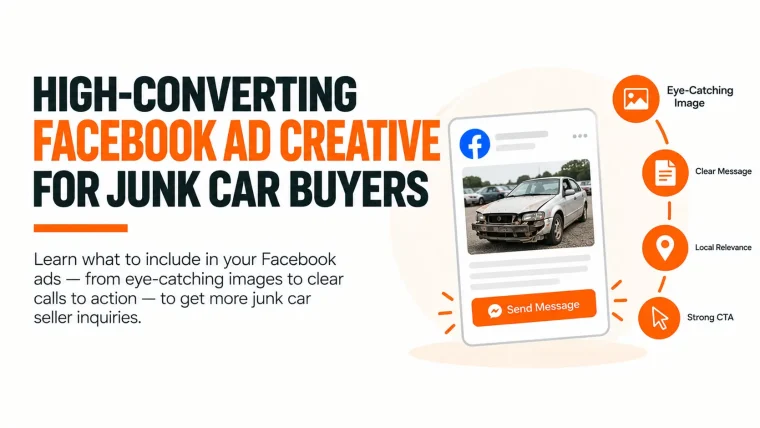
Facebook ad creative for junk car buyers needs to do more than look good or stop someone from scrolling. It should quickly help the right vehicle owner recognize that the ad is relevant, understand that a local buyer wants their vehicle, and know exactly how to start a conversation.
Effective Facebook ad creative combines the image or video, headline, primary text, offer, local relevance, and call to action into one clear seller-focused message. When those elements work together, the campaign has a better chance of generating genuine seller inquiries instead of clicks, reactions, or engagement that never turns into an acquisition opportunity.
At Pull Your Part Accelerator, we approach Facebook ad creative specifically from the perspective of junk car and salvage-yard acquisition. The goal is not generic automotive advertising. We want the creative to reach vehicle owners with unwanted, damaged, older, wrecked, or non-running cars and give the right sellers a clear reason to respond.
In this guide, we’ll break down practical Facebook ad creative examples for junk car buyers, including images, videos, headlines, ad copy, offers, local messaging, and calls to action that can be tested in seller-acquisition campaigns.
Need More Junk Car Leads in Your Local Market?
Stop relying on unpredictable seller inquiries. Pull Your Part Accelerator helps junk car buyers and salvage yards reach local vehicle owners through targeted Facebook Ads, local SEO, and organized lead tracking
📌 KEY TAKEAWAYS
- Focus on sellers: Target owners of unwanted, damaged, wrecked, older, or non-running vehicles.
- Use relevant visuals: Show real junk cars, damaged vehicles, and pickup scenes instead of generic dealership photos.
- Write clear headlines: Use direct messages like “We Buy Junk Cars” or “Sell Your Damaged Car Locally.”
- Keep ad copy simple: Explain what vehicles you buy, where you operate, and how sellers can contact you.
- Make realistic offers: Avoid exaggerated promises about prices or instant pickup.
- Highlight local service: Target areas where your yard can actually purchase and collect vehicles.
- Use one clear CTA: Match the call to action with the response method—Messenger, phone, or WhatsApp.
- Test 3–5 creative variations: Experiment with different images, headlines, and seller-focused messages.
- Refresh ads when needed: Watch for declining inquiries, rising costs, increasing frequency, or changes in acquisition priorities.
- Track meaningful results: Measure qualified inquiries, cost per lead, quotes, and vehicles purchased—not just clicks and engagement.
- Bottom line: Effective Facebook ads should attract genuine local vehicle sellers and turn their interest into real vehicle purchases.
What Makes Facebook Ad Creative Work for Junk Car Buyers?
Effective Facebook ad creative for junk car buyers should make the right seller understand the message almost immediately. The strongest creative is not simply visually attractive—it connects the seller’s situation with a clear vehicle-buying offer and gives them one obvious way to respond.
At Pull Your Part Accelerator, we look at Facebook ad creative as part of the acquisition process. Every element should help move a relevant local vehicle owner closer to becoming a real seller inquiry.
Immediate Seller Relevance
The creative should quickly feel relevant to someone with an unwanted, damaged, older, wrecked, or non-running vehicle.
If the seller cannot immediately tell that the ad applies to their situation, even strong design may fail to generate meaningful response.
This is why Facebook ad creative for junk car buyers should use realistic vehicle imagery and seller-focused messaging instead of generic automotive visuals.
A Clear Vehicle-Buying Message
The ad should make it obvious that the business buys vehicles.
The seller should not have to guess whether the company repairs cars, sells parts, provides towing, or actually purchases vehicles.
Clear language such as buying junk, damaged, or unwanted vehicles helps remove that confusion and keeps the message aligned with the campaign objective.
A Simple Offer
The offer should be easy to understand.
The seller needs to know what the buyer is offering and why responding may be worthwhile. Avoid overcomplicated wording or exaggerated promises.
For Facebook ad creative, clarity usually matters more than trying to make the offer sound overly promotional.
Local Credibility
Local relevance can make the ad feel more trustworthy.
References to the service area, local market, or nearby pickup coverage can help sellers understand that the buyer actually operates in their area.
At PYP, local credibility is important because the goal is not national attention. The goal is to generate seller inquiries from areas the buyer can realistically serve.
One Obvious Next Step
Every ad should make the next action clear.
If the campaign is designed for messaging, encourage the seller to send a message. If the campaign is call-focused, make calling the buyer the obvious next step.
Strong Facebook ad creative for junk car buyers should not create uncertainty after earning attention.
The formula is simple: relevant seller problem + clear buying message + realistic offer + local trust + one direct action. That combination gives the creative a much better chance of generating real seller inquiries instead of passive engagement.
Best Images for Junk Car Buyer Facebook Ads
The image is often the first part of the ad a seller notices, so it needs to make the vehicle-selling context obvious. For Facebook ad creative aimed at junk car sellers, realistic and situation-specific imagery usually communicates more than polished generic automotive graphics.
At Pull Your Part Accelerator, the goal is not to make the ad look like a car dealership promotion. The goal is to help the right seller immediately recognize, “This ad is for someone with a vehicle like mine.”
Junk and Unwanted Vehicles
Images of older, unwanted, parked, or neglected vehicles can work well because they reflect the exact situation many sellers are dealing with.
The strongest Facebook ad creative usually shows vehicles that look realistically sellable to a junk car buyer—not extreme or unusual examples that make the ad feel irrelevant to the average seller.
Damaged or Non-Running Cars
Damaged, wrecked, or non-running vehicles can make the message even clearer when the campaign targets sellers who assume their vehicle has little value.
These images can help reinforce that the buyer is interested in vehicles that may no longer be suitable for normal resale.
Tow-Ready Vehicles
A vehicle being loaded onto a tow truck or prepared for pickup can visually communicate the next step without requiring a long explanation.
This type of image can be especially useful when pickup is part of the buyer’s real process because it shows the seller that the vehicle can be removed, not just evaluated.
Real-World Local Imagery
Real photos from the buyer’s service area can add credibility.
Examples include actual vehicles, yard surroundings, pickup scenes, or familiar local environments. This makes Facebook ad creative feel less like a generic national ad and more like a real local buying operation.
Whenever possible, authentic imagery can also support the seller’s trust before they respond.
When Branded Graphics Make Sense
Branded graphics can work when they improve clarity rather than cover the image with excessive design.
A simple brand mark, short headline, service-area reference, or direct message such as “We Buy Junk Cars” can reinforce the offer quickly.
The visual should still remain easy to understand on a mobile screen. Too much text or too many design elements can weaken the main message.
Images Junk Car Buyers Should Avoid
Some visuals may attract attention but send the wrong signal.
Avoid relying heavily on:
- polished dealership-style vehicle photos,
- luxury or new-car imagery,
- generic automotive stock photography,
- unrelated towing images,
- overcrowded promotional graphics,
- images with too much small text,
- unrealistic before-and-after concepts.
The best Facebook ad creative for junk car buyers should look relevant to the seller’s real situation, make the buying intent clear, and support one simple next step. Visual quality matters, but relevance matters more.
Best Video Creative for Junk Car Seller Campaigns
Video can make Facebook ad creative feel more immediate and believable, especially when it shows real vehicle situations instead of generic automotive footage.
Short Seller-Problem Videos
Keep the opening focused on a problem the seller already understands: an unwanted, damaged, non-running, or unused vehicle. The first few seconds should make the ad’s purpose clear.
Vehicle Pickup or Tow Footage
Real pickup or tow footage can help show that the business actually buys and removes vehicles. This type of Facebook ad creative can also make the process feel more tangible to the seller.
Vehicle Walkaround Clips
Simple walkaround videos of damaged, older, or non-running vehicles can work well because they closely match what potential sellers may have sitting at home.
Simple Talking-Head or Voiceover Ads
A short explanation from the buyer, or a clear voiceover over vehicle footage, can add trust without overcomplicating the ad.
The message should stay direct: what vehicles are being purchased, where the buyer operates, and how the seller can respond.
Design for Sound-Off Viewing
Many users may first see the ad without sound. Use clear on-screen text, captions, or visual cues so the message still makes sense immediately.
For junk car seller campaigns, the best video creative is usually short, realistic, locally relevant, and easy to understand without requiring a long explanation.
Facebook Ad Headline Examples for Junk Car Buyers
Strong headlines should be easy to understand at a glance and speak directly to the seller’s situation. For Facebook ad creative, the headline should support the image or video and make the buying intent obvious.
Got a Car You Don’t Want?
This works because it starts with the seller’s problem rather than the buyer’s service.
It is broad enough to fit unwanted, older, damaged, or unused vehicles while still feeling personal and direct.
Sell Your Junk Car Locally
This headline combines the seller’s intent with local relevance.
It is especially useful when the campaign targets a defined service area and the buyer wants to reinforce that the seller is dealing with a nearby business.
We Buy Damaged Vehicles
This is simple and specific.
It immediately tells owners of wrecked or damaged vehicles that the ad may apply to them, which can improve the relevance of Facebook ad creative for that seller segment.
Have a Non-Running Car?
This headline works well because it identifies a very specific seller problem.
Someone with a vehicle that no longer starts may assume it is difficult to sell, so the headline can quickly capture attention from that audience.
Looking to Sell an Unwanted Vehicle?
This is slightly softer and works well when the campaign targets more than severely damaged or junk vehicles.
It can include older cars, unused vehicles, and vehicles taking up space while keeping the message focused on seller intent.
A Few More Headline Variations
- Need to Get Rid of an Old Car?
- Sell Your Damaged Car Locally
- Have a Car Taking Up Space?
- Ready to Sell Your Junk Vehicle?
- We Buy Unwanted Cars in Your Area
The best headline depends on the creative, offer, market, and response method. Pull Your Part Accelerator uses headline variations as part of the overall Facebook ad creative strategy, testing different seller problems and messages instead of relying on one generic “We Buy Cars” headline.
Facebook Ad Copy Examples for Junk Car Sellers
Strong Facebook ad creative needs copy that matches the seller’s situation, explains the offer quickly, and makes the next step obvious. The examples below are written for different campaign goals and seller types rather than using the same generic message everywhere.
Messaging-Focused Ad Example
Primary Text:
Got an unwanted or damaged vehicle sitting around? We buy junk cars from local sellers. Send us a message with your vehicle details and our buying team can let you know the next step.
Headline:
Sell Your Junk Car Locally
CTA:
Send Message
Intended Seller Type:
Vehicle owners who prefer messaging before speaking on the phone.
Why it works:
The copy is simple, local, and low-friction. It makes the response method clear and gives the seller an easy way to start the conversation.
Call-Focused Ad Example
Primary Text:
Have a junk, damaged, or non-running vehicle you want to sell? Speak directly with a local junk car buyer and tell us what you have. Call today to start the conversation.
Headline:
Have a Car You Want to Sell?
CTA:
Call Now
Intended Seller Type:
Sellers who are ready to speak directly with a buyer.
Why it works:
This Facebook ad creative removes unnecessary steps and moves high-intent sellers directly into a phone conversation.
Damaged Vehicle Seller Example
Primary Text:
Wrecked or damaged car taking up space? Your vehicle may still be worth selling. Contact a local buyer and tell us the year, make, model, condition, and location.
Headline:
We Buy Damaged Vehicles
CTA:
Send Message / Contact Us
Intended Seller Type:
Owners of wrecked, accident-damaged, or heavily damaged vehicles.
Why it works:
The message addresses a specific seller problem and reassures the owner that a damaged vehicle may still be relevant to a buyer.
Non-Running Vehicle Seller Example
Primary Text:
Car won’t start anymore? A non-running vehicle does not always have to sit in the driveway. Tell us what you have and connect with a local junk car buyer.
Headline:
Have a Non-Running Car?
CTA:
Send Message
Intended Seller Type:
Owners of vehicles that no longer start or drive.
Why it works:
This copy focuses on a very recognizable seller situation and gives the owner a clear reason to respond without making unrealistic promises.
Local-Market Seller Example
Primary Text:
Looking to sell an unwanted vehicle in [City/Service Area]? We connect local vehicle sellers with a junk car buyer serving your area. Message us with your vehicle details to get started.
Headline:
Sell Your Junk Car in [City]
CTA:
Send Message
Intended Seller Type:
Local sellers within the buyer’s actual acquisition area.
Why it works:
Local relevance can make Facebook ad creative feel more credible and helps the seller understand that the buyer operates in their market.
At Pull Your Part Accelerator, we do not treat these examples as copy-and-paste formulas for every account. The strongest Facebook ad creative is adapted to the buyer’s market, acquisition criteria, response method, and seller type. The goal is always the same: create a clear message that turns the right local vehicle owner into a real seller inquiry.
What Offer Should a Junk Car Facebook Ad Communicate?
The offer in Facebook ad creative should be clear enough that a vehicle owner immediately understands what the buyer wants and why it may be worth responding. For junk car campaigns, vague promises usually create weaker intent than a simple, realistic buying message.
Make the Buying Intent Obvious
The seller should know within seconds that the business wants to buy vehicles.
Facebook ad creative for junk car buyers should make that purpose unmistakable. If the ad sounds too much like a towing service, repair shop, or general automotive business, the wrong people may respond—or the right seller may ignore it.
Focus on the Seller’s Problem
A stronger offer connects with what the seller is already trying to solve.
That might be:
- a non-running car,
- a damaged vehicle,
- an unwanted older car,
- a vehicle taking up space,
- a car the owner no longer wants to deal with.
The ad should show how contacting the buyer can move that problem toward a solution.
Avoid Vague or Exaggerated Promises
Claims such as “highest cash guaranteed” or “best price anywhere” may sound aggressive, but they can weaken trust if the business cannot consistently support them.
For Facebook ad creative, credibility matters more than hype. The offer should be strong enough to encourage a response while remaining accurate and defensible.
Match the Ad to What the Yard Can Actually Deliver
The best offer is one the junk car buyer can reliably fulfill.
If the yard provides local pickup, say so. If it buys certain vehicle types, make that clear. If the buying team responds through messaging or phone calls, the ad should point sellers toward that process.
At Pull Your Part Accelerator, we focus on making the offer align with the yard’s real acquisition operation. The goal is not to attract every possible click—it is to generate seller inquiries the buyer can realistically handle and turn into vehicle purchases.
What Offer Should a Junk Car Facebook Ad Communicate?
The offer in Facebook ad creative should immediately tell vehicle owners what the buyer wants, how the business can help, and why they should respond. A clear, realistic offer can attract more relevant junk car seller inquiries than vague advertising promises.
At Pull Your Part Accelerator, we focus on connecting the advertising message with the salvage yard’s actual vehicle-buying capabilities.
Make the Buying Intent Obvious
The ad should clearly communicate that the business buys junk, damaged, unwanted, or non-running vehicles.
Avoid messaging that makes the company look like a repair shop, dealership, or general towing service. Effective Facebook ad creative should help potential sellers recognize the buying opportunity immediately.
Focus on the Seller’s Problem
A compelling offer addresses something the vehicle owner already wants to resolve, such as:
- An unwanted car taking up driveway space.
- A damaged vehicle that is difficult to sell privately.
- A non-running car sitting unused.
- An older vehicle the owner no longer needs.
The message should show that contacting a local junk car buyer is a practical next step.
Avoid Vague or Exaggerated Promises
Claims such as “Guaranteed Highest Cash” or “We Pay More Than Anyone” may attract attention, but they can create unrealistic expectations.
Instead, Facebook ad creative should emphasize genuine benefits such as local vehicle buying, convenient communication, and available pickup services when the buyer actually offers them.
A believable offer builds trust before the first seller conversation begins.
Match the Ad to What the Yard Can Actually Deliver
Every promise in the ad should reflect the buyer’s actual operation.
If the yard purchases non-running vehicles, highlight that. If pickup is available within certain locations, communicate the service area accurately. If sellers can contact the buyer through Messenger or phone, make that response method clear.
At Pull Your Part Accelerator, our approach to Facebook ad creative focuses on promoting what makes each buyer relevant to local vehicle sellers. Rather than advertising unrealistic benefits to generate more clicks, we aim to create direct seller inquiries that the yard has a genuine opportunity to turn into vehicle purchases.
The strongest offer is not necessarily the biggest promise. It is the clearest reason for the right seller to contact the right buyer.
How to Make Facebook Ad Creative Feel Local
Local relevance can make Facebook ad creative more effective by helping vehicle owners recognize that the buyer actually serves their area. For junk car buyers, the goal is not to reach everyone—it is to attract sellers from locations where the yard can realistically purchase and pick up vehicles.
At Pull Your Part Accelerator, we approach local messaging with the buyer’s actual acquisition area in mind, ensuring the advertising speaks to relevant vehicle sellers rather than attracting unnecessary inquiries from distant markets.
Mention the Actual Service Area
Including a city, county, or recognizable service-area reference can make the ad immediately more relevant.
For example, “We Buy Junk Cars in Columbus” communicates a more specific local offer than simply saying “We Buy Junk Cars.”
However, the location mentioned in the Facebook ad creative should always fall within the buyer’s actual service area.
Use Local Market Language
Effective local messaging should sound natural to the people the campaign is trying to reach.
References to nearby cities, local vehicle pickup, or serving surrounding communities can help establish relevance.
The objective is not to fill the ad with city names. It is to help sellers quickly understand that a buyer operates near them.
Avoid Fake Personalization
Adding a city name does not automatically make an ad trustworthy.
Avoid using misleading local claims, generic images presented as actual yard locations, or promises of immediate pickup when the business cannot provide that service.
For Facebook ad creative, authentic local messaging is more valuable than artificial personalization because it helps establish realistic expectations before the seller contacts the buyer.
Keep Local Relevance Tied to Real Acquisition Areas
Not every nearby market is equally valuable for junk car acquisition.
A location may generate seller interest but still be difficult to serve because of towing distance, pickup costs, or the buyer’s operational limitations.
That’s why Pull Your Part Accelerator emphasizes aligning local advertising messages with the areas where the buyer can realistically acquire vehicles.
The objective is not simply more local impressions—it is more relevant seller inquiries from markets the yard can actually serve.
Match the Creative to the Response Method
Effective Facebook ad creative should make it easy for interested vehicle owners to take the next step. Whether a campaign encourages messaging conversations or phone calls, the ad’s wording, visual message, and call to action (CTA) should support the same response method.
At Pull Your Part Accelerator, we focus on making that transition from ad engagement to seller inquiry as clear and straightforward as possible.
Messaging Campaigns
For Facebook or Instagram messaging campaigns, the creative should encourage sellers to start a conversation directly with the junk car buyer.
Simple CTAs such as “Send Us a Message About Your Car” or “Message Us to Sell Your Vehicle” make the next step obvious.
The message should also help sellers understand what information they may need to provide, such as their vehicle’s year, make, model, and condition.
Call-Focused Campaigns
When the campaign is designed to generate phone calls, Facebook ad creative should encourage sellers to speak directly with the buyer.
Headlines such as “Have a Junk Car? Call a Local Buyer” can communicate both the service and the desired action.
Call-focused advertising is particularly relevant when the yard has staff available to answer inquiries and discuss vehicle details immediately.
WhatsApp or Direct Messaging
WhatsApp and other supported messaging channels can provide an additional way for potential sellers to contact the business.
When these options are available, the creative should clearly communicate that sellers can start a conversation without navigating a complicated contact process.
The response method should reflect the communication channels the buyer actively monitors and can manage consistently.
Why CTA Mismatch Can Reduce Inquiries
A mismatch between the ad’s message and its actual response method can create unnecessary friction.
For example, an ad saying “Call Now” that directs users into a messaging conversation may confuse sellers who expected to speak with someone immediately.
Similarly, encouraging sellers to send a message while directing them to an unrelated website can interrupt their interest.
For Facebook ad creative, the principle is simple: the message should set the expectation, and the CTA should deliver the expected action.
Pull Your Part Accelerator builds seller-focused advertising around this alignment. The goal is to help interested local vehicle owners move from seeing an ad to contacting the junk car buyer, who then handles qualification, quoting, follow-up, and vehicle purchasing.
Common Facebook Ad Creative Mistakes Junk Car Buyers Make
Even well-designed ads can struggle to generate seller inquiries when the message, visuals, or call to action fail to connect with the right vehicle owners. Effective Facebook ad creative should prioritize seller relevance and clear buying intent over unnecessary design elements or engagement metrics.
At Pull Your Part Accelerator, we approach creative development with one goal: attracting local vehicle sellers who have a genuine reason to contact the buyer.
Using Generic Automotive Stock Photos
Polished dealership images, luxury vehicles, and unrelated automotive graphics may look professional, but they often fail to represent the vehicles junk car buyers actually want.
What to do instead: Use realistic images of unwanted, damaged, older, or non-running vehicles that help potential sellers immediately recognize the ad’s purpose.
Making the Ad About the Business Instead of the Seller
Ads that focus entirely on the company’s experience, equipment, or reputation may overlook the seller’s immediate problem.
A vehicle owner is usually more interested in finding someone to buy their unwanted car than learning about every detail of the business.
What to do instead: Lead with the seller’s situation, explain the buying opportunity, and use the company’s credibility to support the offer.
Using Unclear Headlines
Vague headlines such as “Your Automotive Solution” do not clearly communicate that the business purchases vehicles.
For Facebook ad creative targeting junk car sellers, the headline should make the buying intent obvious.
What to do instead: Use direct language such as “We Buy Junk Cars,” “Have a Non-Running Vehicle?” or “Sell Your Damaged Car Locally.”
Showing an Offer the Yard Cannot Support
Promises about guaranteed prices, immediate pickup, or purchasing every vehicle can attract responses that the buyer may not be able to fulfill.
This creates unrealistic expectations and may waste the buying team’s time.
What to do instead: Match every advertised benefit to the yard’s actual purchasing criteria, service area, and available services.
Using the Wrong CTA
A strong Facebook ad creative can lose potential inquiries when the next step is confusing.
For example, asking sellers to call while directing them to a messaging conversation creates a mismatch between the advertised action and the actual experience.
What to do instead: Align the CTA with the campaign’s response method, whether that means “Send Message,” “Call Now,” or another supported contact option.
Designing for Clicks Instead of Seller Inquiries
Eye-catching visuals and clever headlines can generate engagement without attracting people who actually want to sell vehicles.
High click-through rates or inexpensive engagement do not necessarily translate into useful acquisition opportunities.
What to do instead: Evaluate creative based on the seller inquiries it generates and, where the buyer shares downstream results, the quality of those inquiries and their contribution to vehicle purchases.
This is the distinction behind Pull Your Part Accelerator’s approach to Facebook advertising. Our focus is not simply producing attractive ads or generating random clicks. It is developing seller-focused campaigns that connect local vehicle owners with junk car buyers.
For salvage yards looking to build a more consistent vehicle acquisition pipeline, explore our Junk Car Lead Generation Services to learn how PYP approaches local seller acquisition through targeted marketing.
The best Facebook ad creative does more than attract attention. It makes the right seller recognize the opportunity and take the next step.
How Many Ad Creatives Should a Junk Car Buyer Test?
Testing multiple Facebook ad creative variations helps junk car buyers understand which messages and visuals generate the most relevant seller inquiries. Instead of relying on one ad, a practical starting point is to test 3–5 distinct creative concepts, depending on the campaign budget and audience size.
Start With Different Creative Angles
Each variation should test a meaningful difference in how the offer is presented. For example:
- Creative 1: An unwanted vehicle with a “Sell Your Junk Car” message.
- Creative 2: A damaged vehicle highlighting the buyer’s interest in wrecked cars.
- Creative 3: A non-running vehicle with a seller-focused problem headline.
- Creative 4: A local-market ad emphasizing the buyer’s service area.
These variations help identify which seller situations and messages generate stronger responses.
Compare Seller Inquiry Quality, Not Just Engagement
A Facebook ad creative with more clicks or reactions is not necessarily the best performer.
Compare messaging conversations, calls, cost per inquiry, and, where available, qualified seller opportunities. The goal is to identify creative that attracts vehicle owners the yard can realistically buy from.
Avoid Changing Too Many Variables at Once
If the image, headline, offer, audience, and CTA all change simultaneously, it becomes difficult to understand what influenced performance.
Where practical, test one major creative element at a time and give each variation enough delivery to produce meaningful results before making decisions.
At Pull Your Part Accelerator, the focus is on using creative testing to improve seller acquisition—not simply finding the ad with the highest engagement.
The goal is not to test the most ads. It is to identify which creative consistently generates useful local seller inquiries and build on what works.
When Should Junk Car Buyers Refresh Facebook Ad Creative?
Facebook ad creative can lose effectiveness over time as audiences become familiar with the same images, headlines, and offers. However, junk car buyers should not replace ads simply because they have been running for several weeks.
At Pull Your Part Accelerator, we focus on identifying meaningful performance changes before deciding when a creative needs to be refreshed.
Response Volume Starts Falling
If an ad previously generated consistent seller inquiries but starts producing fewer messages or calls, it may be time to evaluate the creative.
Compare response volume with impressions, reach, and campaign delivery before assuming the ad itself is the problem.
Cost per Inquiry Increases
A rising cost per seller inquiry can indicate that the campaign is becoming less efficient.
However, higher costs are not always caused by creative fatigue. Competition, audience changes, and delivery conditions can also influence performance.
Refreshing the image, headline, or seller-focused message may help when the existing creative is losing effectiveness.
Frequency Rises
Ad frequency shows how often people see an advertisement on average.
As frequency increases, the same audience may repeatedly encounter the creative without responding. If rising frequency is accompanied by declining inquiries or engagement, testing a fresh variation may be worthwhile.
The Same Concept Has Been Running Too Long
Even successful Facebook ad creative can eventually become less noticeable.
Rather than replacing a proven concept completely, junk car buyers can test new vehicle images, seller-problem headlines, or messaging angles while preserving the elements that previously generated useful inquiries.
There is no universal refresh schedule. Performance trends should guide the decision.
Market or Offer Changes
Creative should also be updated when the buyer’s acquisition priorities change.
For example, a yard may expand its service area, begin targeting different vehicle conditions, or change its pickup availability.
Facebook ad creative should always reflect the buyer’s current purchasing criteria and the services it can actually deliver.
At Pull Your Part Accelerator, creative refreshing is about maintaining relevance and improving seller acquisition performance—not changing advertisements simply for the sake of something new.
The best time to refresh Facebook ad creative is when performance data or changes in the buying operation provide a clear reason to test something different.
How Should Creative Performance Be Measured?
The success of Facebook ad creative should be measured by the seller inquiries it generates—not just impressions, clicks, or engagement. For junk car buyers, the real value comes from connecting advertising responses with potential vehicle acquisitions.
At Pull Your Part Accelerator, we emphasize evaluating creative based on meaningful seller activity and, where available, the acquisition outcomes reported by the yard.
Seller Inquiries
Start by tracking how many people contact the business after interacting with an ad. Depending on the campaign, this may include Facebook Messenger conversations, Instagram messages, phone calls, or other direct inquiries.
Compare which creative variations generate the most relevant responses.
Cost per Seller Inquiry
Cost per seller inquiry shows how efficiently each ad generates contact opportunities.
Cost per inquiry = Ad spend ÷ Seller inquiries
Lower costs are useful, but they should be evaluated alongside inquiry quality rather than treated as the only measure of success.
Qualified Opportunities
Not every inquiry represents a vehicle the yard can realistically purchase.
When qualification information is available, compare which ads attract sellers with relevant vehicles, workable locations, and genuine selling intent.
Quotes Generated
Tracking how many inquiries progress to actual vehicle quotes helps determine whether the creative is attracting sellers worth pursuing.
This information comes from the buyer’s acquisition process rather than Meta’s engagement metrics alone.
Vehicles Purchased
The strongest outcome measure is how many vehicles are ultimately purchased from advertising-generated inquiries.
When the yard shares acquisition results, those records can help connect creative performance with actual business outcomes.
At Pull Your Part Accelerator, the goal is to develop Facebook ad creative that does more than generate attention. We focus on attracting relevant local vehicle sellers while the junk car buyer handles qualification, quoting, follow-up, and purchases.
A successful creative is not necessarily the one generating the cheapest response—it’s the one contributing to valuable seller opportunities.
How Pull Your Part Accelerator Approaches Junk Car Ad Creative
At Pull Your Part Accelerator (PYP), we don’t approach Facebook advertising like a general marketing agency. Our focus is on helping junk car buyers and salvage yards reach local vehicle owners who may be ready to sell.
That industry specialization shapes how we develop Facebook ad creative—from the vehicles we feature and the messages we write to the response methods we promote.
Creative Built Specifically for Junk Car Sellers
Generic automotive advertising often focuses on selling vehicles, promoting dealerships, or attracting service customers. Junk car acquisition requires a different approach.
PYP develops seller-focused creative around unwanted, damaged, wrecked, older, and non-running vehicles. Each ad is designed to help the right vehicle owner recognize the buying opportunity and take action.
A Seller-Acquisition Approach, Not Generic Advertising
Our objective is not simply to increase impressions, clicks, or social media engagement.
We focus on generating direct seller inquiries that give salvage yards opportunities to purchase vehicles.
That means considering the buyer’s acquisition criteria, local service area, and the types of vehicles they actually want before developing the advertising message.
Aligning the Message, Creative, and Response Method
Effective Facebook ad creative requires more than an attractive image.
The vehicle imagery, headline, offer, and call to action should communicate one consistent message.
Whether the campaign encourages Messenger conversations, phone calls, or another supported response method, PYP focuses on making the next step clear to potential sellers.
Built Around Real Local Markets
A junk car buyer’s advertising needs can vary based on location, service coverage, and vehicle acquisition priorities.
PYP considers those differences when developing creative for local campaigns rather than relying on the same generic advertising message across every market.
The goal is to reach sellers in areas where the buyer can realistically acquire vehicles.
Measuring What Matters Beyond Engagement
Clicks and engagement can help evaluate advertising performance, but they do not tell the entire story.
We focus on generating relevant seller inquiries and evaluating campaign response data. When buyers provide information about qualified opportunities, quotes, and purchased vehicles, those outcomes can also help inform advertising decisions.
PYP creates the advertising opportunities. The junk car buyer handles vehicle qualification, pricing, follow-up, and the final purchase.
Turn Facebook Advertising Into More Seller Opportunities
Creating Facebook ads is one thing. Developing a seller-acquisition strategy around the right vehicles, markets, messages, and response methods requires a deeper understanding of the junk car buying industry.
That’s where Pull Your Part Accelerator’s specialized approach comes in.
If your salvage yard wants Facebook advertising built around attracting local vehicle sellers rather than generic automotive traffic, explore our Junk Car Lead Generation Services to see how PYP can support your vehicle acquisition goals.
The goal isn’t simply better-looking Facebook ads. It’s advertising that gives the right sellers a reason to contact your buying team.
Frequently Asked Questions
A junk car Facebook ad should clearly state that the business buys unwanted, damaged, or non-running vehicles. Effective Facebook ad creative uses a seller-focused message, a clear offer, and a direct call to action such as “Send Message” or “Call Now.”
Realistic images of junk, damaged, older, or non-running vehicles are good starting points. The best Facebook ad creative makes the vehicle-buying offer immediately recognizable and reflects the types of cars the buyer actually purchases.
Yes, video ads are worth testing alongside images. Short clips showing unwanted vehicles, actual pickups, or a local buyer explaining the service can help attract sellers. Use captions so the message works without sound.
Yes. Mentioning the actual city or service area can help attract relevant local sellers and establish credibility. Location references should accurately reflect where the buyer purchases vehicles.
There is no fixed schedule. Refresh Facebook ad creative when seller inquiries decline, costs rise, or ad frequency increases alongside weaker performance. Avoid replacing successful ads solely because they have been running for several weeks.
Track messaging conversations, calls, cost per inquiry, and qualified seller opportunities. When purchase data is available, also compare quotes and vehicles acquired. Pull Your Part Accelerator focuses on generating relevant inquiries rather than engagement alone.