Running a self-service salvage yard is different from running a full-service junk car lot, and your SEO needs to reflect that. Local SEO for salvage yards is not about copying what full-service recyclers do online. Your customers are DIY mechanics and parts pullers searching for specific parts near them, plus local sellers looking to sell their car off-street for cash, not just people calling a chain for a tow-away quote.
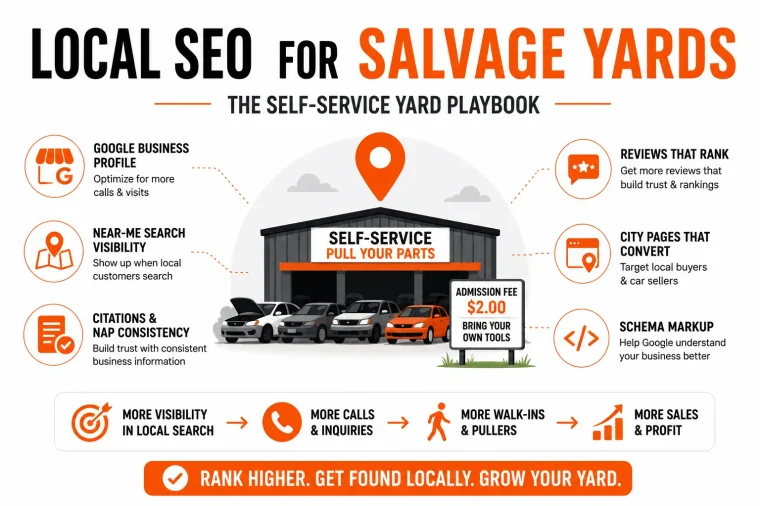
This playbook covers everything you need to rank locally as a self-service yard. Google Business Profile setup built for your model, city pages that speak to both parts buyers and car sellers, citations that keep your NAP consistent, schema markup, reviews, and the local ranking factors that actually move the needle. Use this as your hub, then dig into each linked guide for the full breakdown. For the broader approach, see our SEO for salvage yards.
📌 KEY TAKEAWAYS
- Local SEO for salvage yards is different from full-service recycler SEO, self-service yards serve two customers, DIY mechanics pulling parts and sellers looking for cash, and most SEO content only speaks to one of them.
- Google Business Profile setup that fits – Salvage Yard as primary category, Used Auto Parts Store and Junkyard as secondary, plus admission fee and yard hours called out clearly.
- Near-me search intent is the highest-converting search type there is – most people act within hours, and a yard that doesn’t show up in that moment loses the customer to whoever does.
- City pages, citations, and NAP consistency compound over time – one mismatched address or phone number across directories quietly suppresses rankings without ever explaining why.
- Reviews that work harder – ones mentioning specific parts found outrank generic praise, and review velocity (steady, ongoing reviews) matters more than total count sitting still.
- Schema markup and the local algorithm – LocalBusiness schema plus understanding proximity, relevance, and prominence rounds out the technical side.
- Ends with a full local SEO checklist to self-audit your yard’s setup before you call it done.
What Is Local SEO for Salvage Yards
Local SEO for salvage yards means showing up when people nearby search for what your yard offers. That’s Google Maps, the map pack, and local organic results. It covers your Google Business Profile, your website, your citations, and your reviews. All of it working together so your yard shows up first when someone in your service area searches.
But here’s where most SEO advice falls apart for self-service yards. It’s built for one customer type. The junk car seller. That works fine for full-service recyclers who tow cars away and pay cash. It does not work for you.
- Build a Salvage Yard Local SEO Strategy Around the Full Search Journey
A strong salvage yard local SEO strategy should connect every local search touchpoint instead of treating Google Maps, the website, citations, reviews, and location content as separate projects. The goal is to help nearby parts buyers and vehicle sellers find the right salvage yard information, trust it, and take the next step.
Start with the two customer journeys. Parts buyers may search for a salvage yard, used auto parts, a specific vehicle, or a yard near them. Vehicle sellers may search for junk car buyers, cash for cars, or a local place to sell an unwanted vehicle. Salvage yard local search optimization works best when each intent leads to the page or profile experience built for that customer.
Then align the core signals. Keep the Google Business Profile accurate, make the website clearly explain the salvage yard model, build useful location content, maintain correct business information across important directories, and earn genuine reviews from real customers. Internal links should connect local informational pages to inventory, vehicle-selling, pricing, directions, and contact pages.
Measure the system by outcomes, not rankings alone. Track local visibility alongside calls, direction requests, inventory searches, seller leads, and yard visits where attribution is practical. If one channel improves while customer actions stay flat, investigate the conversion path before adding more pages.
This keeps local SEO for salvage yards focused on qualified local demand rather than simply increasing keyword coverage.
- Why Self-Service Yards Need a Different Playbook Than Full-Service Recyclers
Full-service recyclers have one job. Buy the car, pay the seller, move on. Their SEO only needs to target one search intent: “sell my junk car near me.”
Self-service yards run two businesses under one roof. You buy cars off the street, same as they do. But you also sell admission to your yard so DIY mechanics and parts pullers can walk the rows and pull their own parts. That’s two completely different customers, searching two completely different ways, and most SEO agencies never build for the second one.
A parts puller searching “used engine near me” has nothing in common with someone searching “cash for my junk car.” Different intent, different page, different content. When your SEO strategy only speaks to sellers, you’re invisible to half your foot traffic. That’s the real pain point self-service yards run into online. Not weak rankings. Rankings that only work for one side of the business.
Self-Service vs Full-Service Salvage Yard SEO
- Different Buyer, Different Keywords, Different Intent
The difference between self-service and full-service isn’t a footnote, it’s the whole reason your SEO can’t copy a full-service recycler’s playbook. At a full-service yard, staff pull the part, clean it, test it, and often back it with a warranty. That convenience costs more. At a self-service yard, the customer brings their own tools, walks the rows, and pulls the part themselves. No labor cost, no warranty, and the price reflects that. Admission is usually a few dollars at the gate.
That operational difference creates two completely different searchers. A full-service customer searches to buy a finished result: “used engine Savannah” expecting a cleaned, tested part waiting at the counter. A self-service customer searches to buy access: “self-service junkyard near me,” “u-pull-it yard,” “what tools do I need for a salvage yard.” They’re not looking for a part on a shelf. They’re looking for a yard to walk, a fee to pay at the gate, and inventory to hunt through themselves.
If your content only answers the full-service question, half your searchers land on a page that doesn’t match what they came for. They bounce, and Google reads that bounce as a bad match, not just a lost customer.
- Why Most SEO Agencies Get This Wrong
Most SEO agencies serving this industry built their playbook around the full-service, cash-for-cars model because that’s where the bigger, more standardized budgets are. Their content answers questions full-service yards get: “sell my junk car,” “cash for cars near me.” It never touches the questions self-service customers are actually typing into Google: what’s the entry fee, do I need my own tools, is there a warranty on parts I pull myself, how do I know what’s in the yard before I drive out there.
That gap isn’t a small oversight. It’s the entire self-service customer journey missing from the content. An agency that doesn’t understand the self-service model will write you a page that talks about your yard, but never answers the questions your actual walk-in customer has before they show up.
Google Business Profile Setup for Self-Service Yards
Start with Set up and optimize your Google Business Profile before reviewing the rest of your local presence, and ranking lever. This section stays focused on what’s different for a self-service model.
But here’s where most SEO advice falls apart for self-service yards. It’s built for one customer type. The junk car seller. That works fine for full-service recyclers who tow cars away and pay cash. It does not work for you.
- Categories and Attributes That Fit a Pull-Your-Part Model
Set “Salvage Yard” as your primary category. That stays the anchor since it’s the broadest, highest-recognition term and matches what’s already live on your GBP. Add “Used Auto Parts Store” as a secondary category to capture parts-buyer searches, and “Junkyard” as a third to cover the casual search term people still use.
In your business description, say plainly that customers pull their own parts. People searching “u-pull-it near me” or “self-service junkyard” want that confirmed fast. Don’t make them guess from a generic description.
This matches the category setup already live on your GBP and keeps every blog post consistent with it.
- Yard Hours vs Office Hours (Why Both Matter)
Self-service yards often have two different schedules. The yard itself may close earlier than the front office, or the office may open later than the yard for parts pulling. If your GBP only lists one set of hours, someone shows up at the wrong time and leaves annoyed. Worse, Google may flag your listing as inaccurate if customers report wrong hours.
List both clearly. Use the GBP hours field for your main access hours, and add the office or checkout hours in your description or Q&A section. If your hours change by season, update them. An outdated GBP hurts trust with both Google and the customer standing outside your gate.
- Admission Fee, Tool Policy, and Inventory Info in Your Profile
This is the detail full-service SEO guides never mention, because full-service yards don’t have it. Most self-service yards charge a small admission fee, usually two to five dollars, sometimes with an age minimum like sixteen or eighteen. Some yards supply basic tools like engine hoists or wheel carts. Others expect you to bring everything yourself.
Put this in your GBP description and in your Q&A section. People search this exact thing before they drive out: “does the junkyard charge to get in,” “do I need my own tools.” Answering it upfront in your profile removes friction before the visit and matches what they were already searching for.
On-Page SEO for Parts-Buyer Search Intent
- Ranking for "Used Auto Parts Near Me"
Ranking locally is only the first step. To win buyers searching for a specific part nearby, your website also needs clear donor-vehicle fitment language, fast inventory answers, and part-level content that turns visibility into calls. Read our complete guide on how to rank for “used auto parts near me” to learn how to capture these high-intent searches and convert more DIY parts buyers.
- Writing Content for DIY Mechanics, Not Just Junk Car Sellers
Most salvage yard content is written for one person: someone trying to sell a junk car for cash. That leaves out the DIY mechanic, and that’s a mistake, because parts buyers are just as valuable and they read completely differently.
A junk car seller wants speed and reassurance. Quote in minutes, free tow, cash on the spot. A DIY mechanic wants specifics. Which makes and models are in the yard right now, whether the part is likely to fit their vehicle, what tools they’ll need, and what it’s going to cost them in admission and pull time.
Write pages that speak to both, but don’t blend them into one vague paragraph. Give parts buyers their own section, their own heading, their own language. Talk about inventory, fitment, interchange, and the pull-it-yourself process. That’s what a mechanic is scanning the page for. If all they find is seller-focused copy about towing and cash offers, they’ll leave and try the next yard’s site instead.
This is also where your inventory or “what’s in stock” page earns its keep. If a DIY mechanic can search or browse by make, model, and year before they even drive out, you’ve answered their real question before they had to ask it.
"Salvage Yard Near Me" and Near-Me Search Behavior
- How people search for "salvage yard near me"
Most people don’t type a full sentence. They type something short and act fast. “Salvage yard near me,” “junkyard near me,” “u-pull-it near me.” Google already knows where the phone is, so it skips straight to nearby results without the person needing to add a city name.
- What drives near-me searches for salvage yards
Two things push someone to search this way. Their car broke down or got wrecked and they need a part fast, or they’re mid-repair and just found out they’re missing something. Either way, they’re not browsing. They already decided they need a yard, they just need to know which one is closest and open right now.
- Salvage yard local search behavior and intent
Near-me searches carry the highest intent of any search type there is. A person adding “near me” to a search isn’t researching, they’re deciding. For salvage yards specifically, that intent splits two ways: DIY mechanics hunting a part, and local sellers looking to unload a car fast. Both search “near me,” both act within hours, not days.
- Why near-me searches matter for salvage yard leads
The numbers back this up. 76% of mobile users who search locally visit a business within 24 hours, and 72% of people who search for a local business visit one within five miles. If your yard doesn’t show up in that near-me moment, that customer doesn’t wait around. They call the next yard on the list.
- How to optimize for salvage yard near me searches
Near-me ranking isn’t really about the words “near me” on your page, Google adds that automatically based on location. It’s about proximity, relevance, and prominence: how close you are, how well your listing matches the search, and how much trust signal (reviews, citations, activity) you’ve built. We cover the full ranking mechanics in our Google Maps local SEO guide — this section is the intent layer behind it, the checklist post covers the tactics.
City Pages for Self-Service Salvage Yards
- What Belongs on a City Page (and What Doesn't)
A city page for a self-service yard needs to answer one question fast: does this yard serve my area, and what’s actually different about visiting here versus another location. That means real content, not a copy-pasted template with the city name swapped out.
What belongs: your address and embedded map, hours (yard hours and office hours both), admission fee, what makes that specific location’s inventory different if you run more than one yard, and directions or landmarks locals would recognize. To support relevant nearby searches, Build useful city pages for your service area with information specific to each location. where you’ll learn exactly what every location page should include, how to make each page unique, and how city-specific pages support stronger local rankings.
What doesn’t belong: generic city trivia, filler paragraphs about “serving the greater [city] area” with no specifics, or content copied from another location page with only the city name changed. Google can tell, and so can the person reading it.
- Avoiding Thin, Templated Location Pages
This is the mistake that kills city page rankings before they start. A yard with three locations that publishes three pages using the same paragraph structure, same stock photos, and just a swapped city name isn’t building three ranking assets, it’s building duplicate content that competes with itself.
Every city page needs something the others don’t: real photos of that yard, that location’s specific hours if they differ, local landmarks or cross-streets, and ideally a note about what’s currently in stock there if inventory varies by location.
- Salvage Yard Local Landing Pages: When a Location Deserves Its Own URL
A salvage yard local landing page should exist because it gives a specific local customer useful information, not because another city name can be added to a title tag. Create a dedicated page when the salvage yard has a real location, a distinct market, or enough location-specific information to make the page meaningfully different.
For a physical yard, include the address, hours, phone number, map, admission details, services, directions, real photos, and links to inventory or vehicle-selling information. If multiple salvage yard locations operate differently, explain those differences instead of repeating the same copy across every page.
For nearby cities served from one salvage yard, be more selective. A page may make sense when there is genuine local demand and you can add useful service-area information, driving context, customer questions, or other details specific to that market. Do not create dozens of near-identical pages that only swap city names.
Use each salvage yard local landing page as a destination within the wider local SEO structure. Link it to the relevant inventory, pricing, junk-car selling, contact, and directions pages, and link back from useful supporting content where the connection is natural.
The test is simple: if the location name were removed, would the page still contain information that is genuinely useful and distinct? If not, strengthen the page before asking it to compete in local search.
Local Citations, NAP, and Trust Signals
- Where to List Your Yard
A citation is any place online that lists your yard’s name, address, and phone number, even without a link back to your site. Think Yelp, Yellow Pages, car-part.com, Facebook, Apple Maps, Bing Places, and industry-specific automotive directories. Each one is a small vote of confidence telling Google your yard is a real, established business at a real location.
Start with the big general directories (Google Business Profile, Yelp, Bing, Apple Maps, Facebook), then move to automotive-specific ones (car-part.com, LKQ Pick Your Part directories if applicable, local Chamber of Commerce, salvage industry associations). We touched on citation building as one piece of prominence in our Google Business Profile guide, this section goes deeper into the full list and how to manage it.
- NAP Consistency for Salvage Yards: Keep Core Business Data Accurate
NAP consistency for salvage yards means keeping the core business identity accurate wherever customers are likely to find it. Review the salvage yard name, street address, primary phone number, website, and hours across the Google Business Profile, website, major maps platforms, important directories, and relevant automotive listings.
Focus first on errors that can confuse a customer or point Google and other platforms to the wrong business information. Old phone numbers, former addresses, duplicate listings, incorrect map locations, and outdated hours deserve priority. Minor formatting differences such as “Street” versus “St.” are not the same problem as genuinely conflicting business details.
Create one approved record for each salvage yard location and use it when updating listings. If the yard changes its phone number, address, or hours, update the website and primary profiles first, then work through directories that generate real visibility or referral traffic.
Do not turn citation cleanup into a hunt for hundreds of low-value directory links. The objective is accurate local business information and a consistent customer experience across the places that matter.
Treat NAP consistency for salvage yards as ongoing data maintenance. Check the most important listings after relocations, rebrands, phone changes, seasonal-hour updates, or ownership changes so outdated information does not remain visible for months.
- Why trust signals matter for Google Maps visibility
NAP consistency is one piece of a bigger picture called prominence, Google’s measure of how well-known and trustworthy your yard is. Citations, reviews, and consistent business data all feed into that score. A yard with clean, consistent citations across 20 directories will out-rank a yard with the same review count but scattered, inconsistent listings, because Google trusts the first one more.
Reviews and Reputation for Self-Service Yards
- Getting Reviews That Mention Specific Parts Found
Not all reviews carry the same weight with Google. A generic “great service” review helps a little. A review that says “found a used alternator for my 2014 Civic here, worked perfectly” helps a lot more, because Google’s algorithm reads review text for keywords and location details, and reviews that mention specific parts and vehicle makes carry more local SEO weight than vague praise.
This is a self-service yard’s natural advantage. Full-service recyclers get reviews about towing speed and payout amounts. Your customers walk out with an actual part in hand, which means they can be specific. Ask for it. When a customer checks out, a simple prompt like “mind leaving a quick review mentioning what you found today” gets you reviews that double as keyword-rich content Google can match against real searches like “used alternator Savannah.”
- Response Strategy and Review Velocity
Review velocity, meaning how often new reviews come in, matters more to Google than your total count sitting still. A yard with 200 reviews from two years ago and nothing recent sends a weaker signal than a yard with 60 reviews and a steady trickle of new ones every week. Google reads that ongoing activity as proof you’re still operating, still serving customers, still worth recommending today.
Response speed matters just as much now. 19% of consumers expect a same-day reply to their review, up from just 6% the year before, and 89% expect a response at all. Yet most businesses still don’t respond to any of their reviews. Businesses that respond to 80% or more of their reviews see measurably stronger local pack presence and can boost conversion by double digits.
Build both into a habit, not a one-time push. Ask every customer at checkout, respond to every review within a day or two, and mention specifics in your reply the same way you want customers mentioning specifics in theirs. That steady rhythm, asking and responding week after week, is what actually moves the needle. A single push for 50 reviews in one month, then silence, doesn’t carry the same weight as 5 new reviews every week for a year.
How Google's Local Algorithm Ranks Salvage Yards
- Proximity, Relevance, and Prominence Explained
Google ranks local results on three factors: proximity (how close you are to the searcher), relevance (how well your profile matches what they searched), and prominence (how well-known and trusted you are based on reviews, citations, and activity). Proximity is out of your control, you can’t move your yard. Relevance and prominence are entirely in your control, and that’s where your SEO effort should go.
- What You Can Actually Control
The proximity, relevance, and prominence framework becomes much more useful when you apply it to the competitors already occupying the Google Map Pack. Our guide on how independent salvage yards win local search against chains explains the gaps national brands leave open—from generic location content and weak per-location review activity to real inventory and local content they cannot reproduce at scale.
Salvage Yard Local SEO Audit: What to Check Before You Optimize Further
A salvage yard local SEO audit should identify the specific reason local visibility or customer actions are underperforming before the business adds more content or changes its Google Business Profile.
Start with visibility. Check whether the salvage yard appears for local searches that match its real services, including parts-buyer, self-service, and vehicle-seller intent. Compare Maps and organic visibility by query and location rather than relying on one search from the yard office.
Next, review the Google Business Profile. Confirm the primary category, additional categories, address, phone number, hours, website, services, photos, reviews, and other customer-facing information are accurate. Then compare that information with the salvage yard website and the major local listings customers actually use.
Audit the website around local intent. Check that the correct salvage yard location pages are indexable, important pages can be reached through internal links, titles and headings accurately describe each page, and inventory, seller, pricing, and contact paths work properly on mobile. Look for thin local pages, duplicated city content, broken links, and multiple URLs competing for the same local intent.
Finally, connect visibility to business outcomes. Review calls, direction requests, inventory searches, seller forms, acquired vehicles, and yard admissions where tracking is available. A salvage yard local SEO audit is most useful when it tells you whether the next priority is visibility, accuracy, content, conversion, or measurement.
Use the audit to create a short priority list instead of changing everything at once. Fix the issues most likely to affect customers and local search performance, measure the result, and then move to the next gap.
Get Your Free Local SEO Audit
Every yard’s local search situation is different, and the fastest way to know where yours stands is a real audit, not a guess. Get a free local SEO audit and find out exactly what’s holding your rankings back, and what it’ll take to fix it.
[Get My Free Audit]
Frequently Asked Questions
Local SEO for salvage yards is the process of optimizing your Google Business Profile, website, citations, and reviews so your yard shows up when nearby customers search for salvage yards, used parts, or junk car buyers in your area.
Self-service yards serve two customer types, DIY mechanics pulling their own parts and local sellers looking for cash for their car, while full-service recyclers only serve sellers. SEO built only for sellers misses half the self-service customer base.
Salvage Yard as the primary category, with Used Auto Parts Store and Junkyard as secondary categories, gives Google the clearest signal of what your yard offers and who searches for it.
Near-me searches carry high buying intent. Most people who search this way act within hours, not days, so a yard that doesn’t appear in that moment loses the customer to whichever yard does show up.
Citations are online listings of your business name, address, and phone number. When that information doesn’t match exactly across every directory, Google treats it as a trust problem and can quietly suppress your local rankings.