Writing a SEO title and meta description is easy. Writing one that actually gets clicked is harder, especially for a salvage yard where most searches come down to “near me” and “for sale.” Generic titles blend in, and vague descriptions get skipped over for the next result. This guide gives you real SEO title and meta description examples for every page type your yard needs, homepage, inventory, location pages, and more, so you can copy the formula and stop guessing.
📌 KEY TAKEAWAYS
- A salvage yard SEO title and meta description is your only shot at turning a search into a click, even a page one ranking gets skipped if the title is weak.
- Character limits – keep titles to 50-60 characters and descriptions to 150-160 characters so nothing gets cut off in search results.
- Examples by page type – homepage, inventory, junk car buying, used parts, location, vehicle make/model, and blog post each need their own title and description built around a specific intent, not a generic copy-paste.
- Common mistakes – vague titles with no location or service, descriptions missing a call to action, and duplicate titles across inventory pages all quietly kill click-through rate.
- Repeatable formula – Title: Keyword + Location/Service + Brand. Description: Keyword + Benefit + Call to Action, use this on every page to stay consistent.
- Ends with a 9-point checklist to self-audit your own titles and descriptions before you publish.
Why SEO Titles and Meta Descriptions Matter
- How They Affect Click-Through Rate
Your title and description are the only thing standing between a search and a phone call. Even if you rank on page one, a weak title gets skipped for the listing right above or below it. Every click you lose to a better-written title is a customer who calls a competitor instead, not because they had a better yard, but because they had a better headline. A clear, specific title that matches what someone is actually searching for turns rankings into real calls, not just impressions sitting in Search Console.
Strong titles are only one piece of the puzzle. Learn the complete process in our guide to SEO for Salvage Yards.
- Character Limits to Stick To
Stick to these limits so your title and description show up fully in search results, not cut off with “…”.
- Title tag: 50-60 characters
- Meta description: 150-160 characters
- Put your main keyword as close to the front as possible
- Keep your brand name at the end of the title, not the start
- Avoid stuffing multiple keywords, pick one focus per page
SEO Title and Meta Description Examples by Page Type
- Homepage
Your homepage title should cover what you do and where you are in one line, since this is usually the page that ranks for your broadest, highest-volume searches. The description should hit your two main services (parts and junk car buying) so visitors know exactly what you offer before they click.
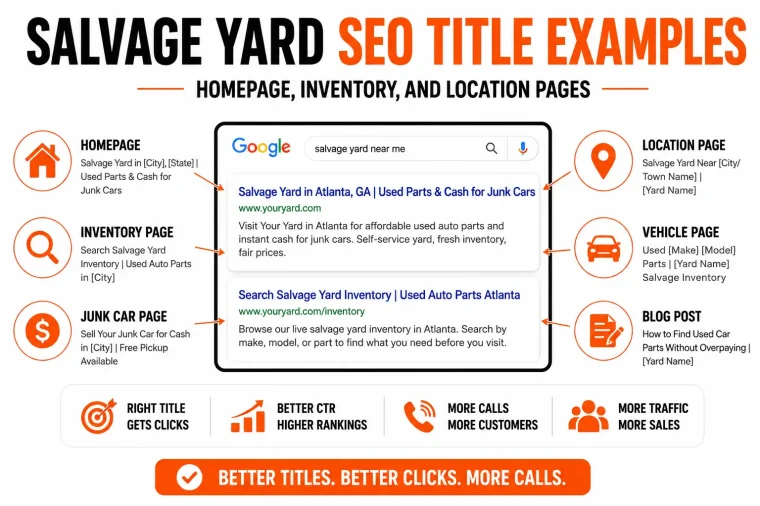
SEO Title: Salvage Yard in [City], [State] | Used Parts & Cash for Junk Cars
Meta Description: Visit [Yard Name] in [City] for affordable used auto parts and instant cash for junk cars. Self-service yard, fresh inventory, fair prices.
- Inventory/Search Page
This page should make it obvious that visitors can search live stock, not just read about your yard. Lead with the action (search) and back it with location, since this is what separates you from a static “about us” style page.
SEO Title: Search Salvage Yard Inventory | Used Auto Parts in [City]
Meta Description: Browse our live salvage yard inventory in [City]. Search by make, model, or part to find what you need before you visit.
- Junk Car Buying Page
This title needs to speak directly to someone ready to sell, fast. Include the action (sell), the payoff (cash), and your location. The description should remove friction by mentioning pickup and speed, since hesitation is what kills this conversion.
SEO Title: Sell Your Junk Car for Cash in [City] | Free Pickup Available
Meta Description: Get cash for your junk car in [City] today. Free towing, fast quotes, and same-day pickup, no title needed in most cases.
- Used Parts Page
This is your money page for long-tail searches like “used auto parts in [city].” Title should match that exact phrasing, and the description should reinforce affordability and the self-service angle if that applies to your yard.
SEO Title: Used Auto Parts in [City], [State] | Search Salvage Yard Inventory
Meta Description: Find affordable used auto parts in [City]. Search our salvage yard inventory, pull your own parts, and save money on car repairs.
- Location Page
If you serve multiple towns, each location page needs its own title built around that specific area, not a copy-paste of your homepage. The description should reassure visitors they are close by and make it easy to take the next step (directions).
SEO Title: Salvage Yard Near [City/Town Name] | [Yard Name]
Meta Description: Looking for a salvage yard near [City/Town]? [Yard Name] offers used parts and junk car buying, just minutes from [Town]. Get directions.
- Vehicle Make/Model Page
These pages target specific searches like “used Honda Civic parts.” Title should include the exact make and model, and the description should point to checking live availability, since these searches are highly specific and intent-driven.
SEO Title: Used [Make] [Model] Parts | [Yard Name] Salvage Inventory
Meta Description: Shop used [Make] [Model] parts at [Yard Name]. Check live inventory, prices, and availability before you make the trip.
- Blog Post
Blog titles should answer a real question or solve a real problem, not just repeat your business name. The description should promise a quick takeaway, since blog clicks come from curiosity, not direct buying intent.
SEO Title: How to Find Used Car Parts Without Overpaying | [Yard Name]
Meta Description: Learn how to find quality used car parts at a fair price. Tips from [Yard Name], your local self-service salvage yard.
Common Mistakes Salvage Yards Make With Titles and Descriptions
- Vague Titles With No Location or Service
A title like “Welcome to [Yard Name]” tells Google and searchers nothing about what you actually do or where you are. Salvage yard searches are almost always local and specific, “junk car buyer near me” or “used parts in [city]”, so a vague title gets buried under competitors who actually named their service and location. Every title should answer two questions fast: what do you offer, and where are you.
- Missing Call-to-Action in Description
A description that just states facts misses the chance to actually move someone to click. “We sell used auto parts” tells a visitor nothing they could not guess from the title. Adding a clear next step, “search inventory now” or “get a free quote today”, gives searchers a reason to choose your result over the one above it. The description is your one shot at a pitch, do not waste it on a flat summary.
- Duplicate Titles Across Inventory Pages
If every vehicle or part page on your site uses the same generic title, Google cannot tell which page should rank for which search, and you end up competing against yourself. This is common on inventory-heavy sites where pages get created automatically without unique titles. Each page needs its own title built around the specific make, model, or part it features, even if the format stays the same across pages.
Quick Formula for Writing Your Own
- Title Formula: Keyword + Location/Service + Brand
Use this simple structure for any page on your site:
[Keyword] in [Location/Service] | [Brand Name]
Example: Used Auto Parts in Dallas, TX | [Yard Name]
Start with the exact term your customer is searching, follow with location or service detail to narrow intent, then close with your brand name so it still feels like a real business and not a generic listing.
Before writing a title, choose keywords for each page intent so the snippet matches the page content.
- Description Formula: Keyword + Benefit + Call to Action
Use this structure to keep every description focused and clickable:
[Keyword] + [What’s in it for them] + [Clear next step]
Example: Search our salvage yard inventory in Dallas and save on quality used auto parts. Find your part today.
Lead with the keyword so it matches the search, follow with the benefit that answers “why should I click,” then close with an action that tells them exactly what to do next.
Quick Reference: Title and Description Checklist
- Title is 50-60 characters
- Description is 150-160 characters
- Main keyword appears near the start of the title
- Location or service included in the title
- Brand name placed at the end of the title
- Description includes a clear benefit
- Description ends with a call to action
- No two pages share the same title
- Title and description match what the page actually offers
Frequently Asked Questions
The SEO title is the clickable blue headline that shows up in search results and browser tabs, it tells Google and searchers what the page is about in a few words. The meta description is the short summary underneath it, giving more detail and a reason to click. Both work together, but only the title has a direct impact on rankings.
Keep your SEO title between 50 and 60 characters and your meta description between 150 and 160 characters. Anything longer gets cut off with “…” in search results, which can hide your most important words or call to action.
Not directly. Google has confirmed meta descriptions are not a ranking factor on their own, but they strongly influence click-through rate. A higher click-through rate can signal to Google that your result is relevant, which can help rankings over time.
Yes, every page needs its own unique title and description. Reusing the same title across inventory or vehicle pages confuses Google about which page should rank for which search, and you end up competing against your own pages instead of competitors.
Place your main keyword as close to the beginning as possible in both the title and description. Search engines give slightly more weight to the first few words, and searchers scanning results are more likely to notice a keyword that matches their search right away.
Tired of guessing what to put in your titles and descriptions?
You don't have to
This is exactly the kind of work PYP Accel handles for self-service salvage yards every day. We don’t just hand you a template and walk away, we write, test, and refine every title and description across your entire site, from your homepage down to every vehicle make and model page. While you focus on running your yard, we make sure every page is built to get found and get clicked. See how our salvage yard marketing services help yards generate more traffic, calls, and vehicle sales.