
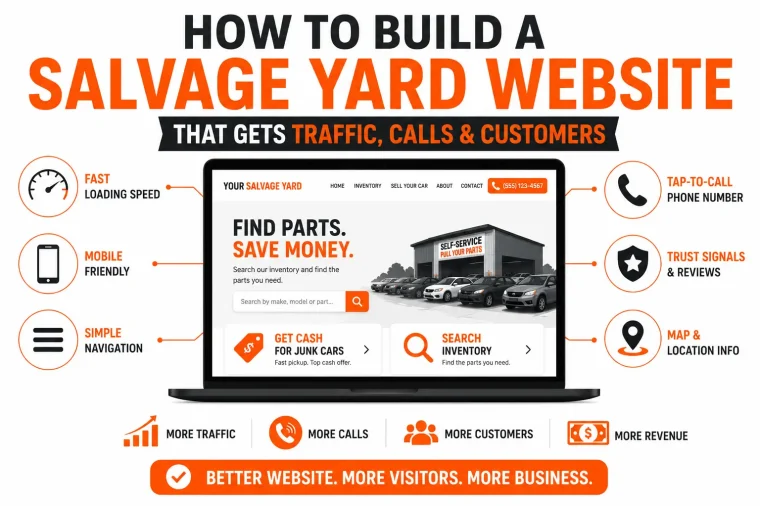
Your salvage yard website is either bringing in calls or losing them. There is no middle ground. Most independent yards have a site that looks fine but does not actually work, slow to load, hard to navigate, and missing the basics that turn a visitor into a customer. The good news is you do not need a fancy redesign to fix this. You need the right pieces in the right place. This guide breaks down exactly what a salvage yard website needs to get found on Google, get clicked, and get the phone ringing.
📌 KEY TAKEAWAYS
- Most salvage yard sites look fine but quietly lose calls, slow load times, buried phone numbers, and confusing navigation send visitors straight to the next yard on Google.
- Design basics – fast loading speed, mobile-first layout, and a simple menu with five items or less, customers should know where to click in three seconds.
- Conversion elements – a tap-to-call phone number on every page, a big “Search Inventory” button, a separate “Get Cash for Junk Cars” CTA, and a visible map and address.
- Trust signals – real Google reviews placed near your CTAs, and real photos of your yard instead of stock images, this is what makes visitors actually believe you’re legit.
- Inventory updates – stale listings hurt both Google rankings and customer trust, update at least once or twice a week to stay relevant.
- Local SEO setup – a fully optimized Google Business Profile, consistent NAP across every listing, and LocalBusiness schema markup so Google understands exactly who you are.
- The system – rankings bring traffic, design turns that traffic into calls, treat them as one connected system, not two separate jobs.
- Yards that fix these basics have seen +40% more admissions and +35% more off-street car buying in as little as 45 days.
- Ends with a 12-point checklist to self-audit your site, plus a free audit call offer if you’d rather have it checked for you.
Why Your Salvage Yard Website Matters
- The Cost of a Bad Website
A bad website does not just look unprofessional, it costs you real money. Every visitor who lands on a slow page, gets confused trying to find your phone number, or cannot tell if you are even open is a lost sale. They do not call you to ask for help finding what they need. They just leave and call the next yard on Google. Multiply that by every visitor your site gets in a month, and a bad website is quietly bleeding admissions and car buys you never even see happen.
- Website as Your 24/7 Salesman
Your yard closes at the end of the day. Your website does not. While you are home, your website is still answering questions, showing your inventory, and telling people why they should choose you over the yard down the road. A visitor searching “junk cars for cash near me” at 9pm is ready to call, but only if your site makes that easy. Every missed call from a confusing or slow site is a sale your actual salesman never got the chance to make. Think of your website as the first person a customer talks to, even before they pick up the phone.
Salvage Yard Website Design Basics
- Fast Loading Speed
If your site takes more than 3 seconds to load, you are losing visitors before they even see your homepage. People searching for parts or looking to sell a car are usually in a hurry, sitting in their driveway with a dead car, trying to find someone fast. A slow site feels like a closed door. They will not wait around, they will hit back and call the next yard that loaded faster. Speed is not just a ranking factor for Google, it is the first test every visitor runs on your business without even realizing it
- Mobile-Friendly Design
Most people searching for a salvage yard are doing it from their phone, often standing next to a broken-down car or scrolling while on the go. If your site is hard to read, buttons are too small to tap, or text runs off the screen, you lose them in seconds. A mobile-friendly design means your phone number is easy to tap, your search bar is easy to use, and nothing requires pinching or zooming. If your site was not built mobile-first, you are turning away the majority of the people searching for you.
- Simple Navigation
A confused visitor does not call. Your homepage should make it obvious in three seconds where to go: search inventory, sell a car, or call now. Stick to these basics to keep navigation simple.
- Limit your main menu to five items or less
- Put the most important action (search inventory or sell a car) in the first screen visitors see
- Use clear labels, not clever ones (“Search Inventory” beats “Find Your Part”)
- Make sure every page has a way back to the homepage and a way to call
- Test it yourself on your phone, if you have to think about where to click, your customer will too
If you want to go deeper than navigation, use this breakdown of the 12 pages every salvage yard website needs to make sure your site is not missing important money pages.
- Design Around the Two Customer Journeys That Matter
Good salvage yard website design starts with the two actions that produce revenue: helping parts buyers find inventory and helping vehicle sellers request an offer. The homepage should make both paths obvious within the first screen instead of forcing every visitor through the same generic menu.
For parts buyers, the main route should lead to Search Inventory, vehicle information, pricing, yard rules, directions, and a visible phone number. For vehicle sellers, the route should lead to Sell Your Junk Car, a short quote form, pickup information, required vehicle details, and a clear next step. A salvage yard website should not make either audience guess where to go.
Design the mobile experience first. Keep tap targets large, forms short, and key actions visible without excessive scrolling. Use real salvage yard photos near important calls to action so customers can see the location, inventory rows, counter, and team before they visit.
Strong salvage yard website design also reduces friction. Avoid sliders, oversized animations, vague menu labels, and decorative sections that push Search Inventory, Call Now, or Get a Quote below the fold. Every major page should help the visitor answer a question or take an action.
The best salvage yard website is not necessarily the one with the most features. It is the one that makes the next step obvious, works quickly on a phone, and moves both buyers and sellers toward a measurable business action.
Conversion Elements Every Yard Site Needs
- Clear Phone Number Placement
Your phone number should never be something a visitor has to hunt for. Put it at the top of every page, in a spot that does not move when they scroll, and make it tap to call on mobile. Some yards bury their number in a “Contact Us” page, which means a customer ready to call has to dig for it first. By the time they find it, they have already called someone else. The rule is simple, if a visitor cannot find your number in two seconds, it is in the wrong place.
- Big "Search Inventory" Button
This is the button most yards underestimate. Customers come to your site to answer one question, do you have the part they need. If that button is small, hidden in a menu, or buried below other content, you lose them before they even search. Put it front and center on your homepage, big enough to notice immediately, with wording that says exactly what it does. “Search Inventory” works better than vague labels like “Browse” or “Shop,” because it tells the visitor exactly what is about to happen when they click.
- "Get Cash for Junk Cars" CTA
Not every visitor is looking to buy parts, some are looking to sell their car. This CTA needs its own spot on the homepage, separate from the search button, because it is a different customer with a different goal. Make it easy to spot, use direct language like “Get Cash for Junk Cars” instead of something vague like “Sell to Us,” and link it straight to a simple form or your phone number. The easier you make it to take that next step, the more cars you buy.
- Location Clearly Visible (map embed + address)
A visitor deciding whether to drive to your yard wants to know two things fast, where you are and how far that is from them. Embed a live map on your homepage or contact page, not just a typed address buried in the footer. Pair it with your full address and a note on hours, so they do not have to click around to confirm you are open. A visible location builds trust too, it tells customers you are a real, established business and not just a listing.
Trust Signals That Turn Visitors Into Customers
- Reviews and Star Ratings
A visitor deciding between two yards almost always checks reviews first. If your site has no reviews visible, you look newer or less trustworthy than the yard down the road with stars showing on their homepage. Pull your Google reviews and display them where people actually look, near your CTA buttons or right under your hero section, not buried on a separate page. Even 10 to 15 solid reviews with real names builds more trust than a perfect star rating with no reviews at all. Update this section regularly so it never looks abandoned.
- Real Photos of Your Yard
Stock photos and generic graphics tell a visitor nothing about your business. Real photos of your actual yard, your inventory rows, your counter, your team, show customers exactly what to expect before they ever show up. This matters even more for self-service yards, where people want to know if the yard is organized, safe, and worth the drive. A few honest photos do more for trust than any amount of polished copy, because they prove you are a real operation, not just a website.
Keep Inventory Updated (SEO + Trust Combo)
- Why Stale Inventory Hurts Rankings
Google pays attention to how often your site changes. A page that has not been touched in months signals to Google that your business might not be active, and that hurts your rankings over time. Stale inventory hurts customers too, if someone calls about a part your site lists but you sold it three weeks ago, you have wasted their time and your own. Updating inventory regularly does two jobs at once, it keeps Google crawling your site as fresh and relevant, and it keeps customers seeing accurate information when they search.
Watch the full video on why updating your inventory helps your website rank on Google
- How Often to Update Listings
You do not need to update every single day, but you do need a consistent rhythm. Aim to add new inventory or remove sold items at least once or twice a week, more often if you are pulling cars in fast. Even small updates count, a new vehicle added, a sold tag removed, a price adjusted. Consistency matters more than volume here, Google and customers both respond better to a site that updates often in small ways than one that goes quiet for months and dumps a big batch of changes all at once.
Local SEO Setup for Salvage Yards
- Google Business Profile Optimization
Your Google Business Profile is often the first thing a customer sees, before they even click your website. Make sure your categories are accurate (auto parts, salvage yard, used auto parts), your hours are correct, and your photos are real shots of your yard. Add posts regularly, answer questions in the Q&A section, and respond to every review, good or bad. A fully optimized profile is what gets you into the local map pack, and the map pack is where most of your calls will come from before anything else.
For the full ranking strategy behind Google Maps, local search, and walk-in traffic, read our guide to SEO for salvage yards.
- NAP Consistency
NAP stands for name, address, and phone number, and it needs to match exactly everywhere your business appears online. Your website, Google Business Profile, Facebook page, and any directory listing should all show the same details, down to abbreviations like “St” versus “Street.” When this information does not match across the web, Google gets confused about which details are correct, and that confusion can quietly hurt your local rankings. Pick the correct version of your NAP and use it everywhere, no exceptions.
- Schema Markup for Local Business
Schema markup is code added to your website that tells Google exactly what your business is, where it is located, and what it offers, in a format search engines understand clearly. For a salvage yard, this means Local Business schema with your name, address, phone number, hours, and service area clearly defined. This does not change what visitors see on the page, but it helps Google understand your site faster and can improve how you show up in search results, sometimes even pulling in extra details like star ratings directly on the search page.
Website + SEO Working Together (The System)
- How Rankings Bring Traffic
SEO gets you in front of people who are already searching for what you offer, “junk cars for cash near me” or “used engine for sale” are searches with real intent behind them. Ranking higher means more of those searches end with someone landing on your site instead of a competitor’s. But rankings alone do not pay the bills, traffic is just the first half of the equation. Getting found is only valuable if what happens next actually works.
- How Design Turns Traffic Into Calls
This is where most yards lose the value of their SEO work. They rank well, traffic shows up, but the site is slow, confusing, or missing a clear next step, so visitors leave without calling. Good design takes that traffic and turns it into action, a fast page, a clear phone number, a big search button, all working together to move a visitor toward picking up the phone. SEO and design are not two separate jobs, they are one system. Rankings bring people to the door, design gets them to walk through it.
- Turn Your Salvage Yard Website Into a Lead Generation System
A salvage yard website lead generation system connects traffic to a trackable action. That action may be a parts call, an inventory search, a direction request, a junk car quote form, or another step that can eventually be tied to a visit, vehicle acquisition, or sale.
Start by giving each high-intent page one primary conversion goal. Inventory pages should move parts buyers toward finding a vehicle or visiting the yard. Seller pages should move vehicle owners toward submitting details or calling for an offer. Location and contact pages should make it easy to call, get directions, and confirm hours.
For salvage yard website lead generation, track the salvage yard action that happens after the pageview. Use form source data, tagged campaign URLs, call tracking where appropriate, and analytics events for important buttons and submissions. Then compare lead volume with qualified inquiries, yard visits, acquired vehicles, and other real outcomes.
Do not judge a salvage yard website only by sessions or rankings. If organic traffic increases but calls, quote requests, inventory searches, and visits remain flat, the problem may be conversion rather than visibility. Review the landing page, message, mobile experience, form friction, and next step before assuming the site simply needs more traffic.
The strongest salvage yard website lead generation setup creates a clear loop: attract the right local visitor, send that person to the right page, make the next action easy, track the action, and use the results to improve the site.
Real Results Example
This system is not theory, it is what we have seen play out for real yards. When SEO and website design work together the right way, yards have seen results like:
- +40% increase in yard admissions
- +35% increase in off-street car buying
- Results showing up in as little as 45 days
These numbers come from fixing the exact issues covered in this guide, faster load times, clear CTAs, updated inventory, and a local SEO setup that actually works.
Ready to see what this could look like for your yard? Book a free website audit call and we will walk through your site together, no pressure, just real fixes you can act on.
Salvage Yard Website Checklist: 12 Essentials to Review
Use this as a fast gut check on your own site.
- Site loads in under 3 seconds
- Fully usable on mobile, no pinching or zooming
- Phone number visible on every page, tap to call
- Big, clear “Search Inventory” button on homepage
- Separate “Get Cash for Junk Cars” CTA
- Map and address clearly visible
- Reviews and star ratings displayed
- Real photos of your yard, not stock images
- Inventory updated at least once or twice a week
- Google Business Profile fully optimized
- NAP consistent across web
- LocalBusiness schema markup installed
- Test the Customer Journey, Not Just the Features
Use the existing checklist as a starting point, then test whether each item actually works from a customer’s point of view. A salvage yard website can technically have a phone number, inventory search, map, reviews, and a quote form and still lose leads if those elements are hard to find or difficult to use.
Run the salvage yard website checklist on both mobile and desktop. Start from the homepage as a first-time parts buyer and try to find inventory, pricing, hours, rules, directions, and the phone number. Then repeat the process as a vehicle seller and try to request an offer without using knowledge you already have about the site.
Add these checks to the current list:
- Can a parts buyer reach searchable inventory in one or two obvious steps?
- Can a vehicle seller find the quote path immediately?
- Are phone buttons tap-to-call on mobile?
- Do forms ask only for information needed at that stage?
- Do inventory, hours, pricing, and yard policies match current operations?
- Are important calls to action still visible on smaller screens?
- Do confirmation pages tell the customer what happens next?
- Are broken links, empty pages, and outdated offers removed?
- Can calls, forms, inventory searches, and other important actions be measured?
Repeat the salvage yard website checklist after major site changes and during regular performance reviews. The purpose is not to collect green checkmarks. It is to find the places where a salvage yard visitor gets confused, stops, or leaves before taking the next step.
Frequently Asked Questions
A simple site can be live in a few weeks, while a more custom build with inventory search and SEO setup can take longer. Speed depends on how much content, design work, and technical setup is needed.
Pricing varies based on features, but most independent yards spend anywhere from a few hundred to a few thousand dollars depending on whether they need a custom build, inventory search, and ongoing SEO support. A simple, well-built site costs less than one month of lost calls from a bad one.
Most yards start seeing movement within 60 to 90 days, with stronger results building from there. Local SEO especially can show faster wins, like map pack visibility, within the first couple months.
Yes, if you want customers to find parts without calling first. A search feature lets visitors check if you have what they need before they ever pick up the phone, which saves time for both sides and increases the chance they choose you.
You can build a basic site yourself with website builders, but a developer or specialist ensures the technical SEO, speed, and mobile setup are done right. For most yards, getting these basics correct from the start saves money compared to fixing problems later.