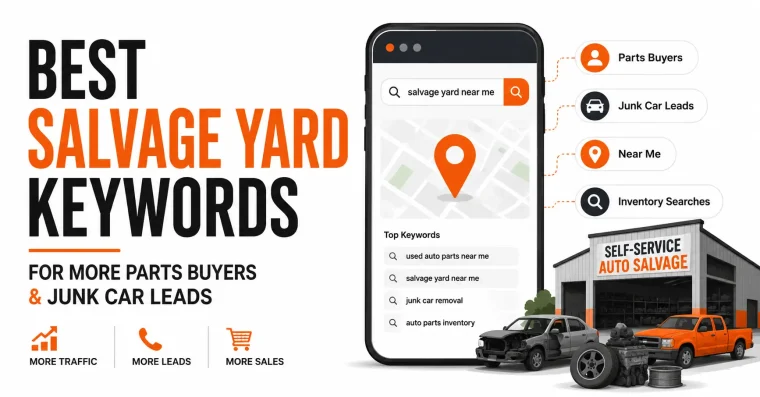
Most salvage yards focus on ranking for terms like “salvage yard near me.” The problem is that buyers and sellers search for much more specific keywords.
Parts buyers look for used auto parts, vehicle inventory, and pull-your-own-part options. Vehicle sellers search for cash for cars, junk car removal, and local pickup services. This guide covers the salvage yard keywords that help attract both types of customers and how to use them on your website.
Buyers in your area are searching right now. They pick the yard that looks active, has real photos, and has reviews from people who actually called. If that is not your yard, those calls are going somewhere else. This guide gives you 9 field-tested ways to fix your Google Maps presence and start getting more calls this week. No ad spend. No agency. Just the stuff that actually works for independent salvage yards. For the broader approach, see our SEO for salvage yards.
📌 KEY TAKEAWAYS
- Salvage yard keywords are not normal auto parts keywords because one yard has to attract pullers, parts buyers, junk car sellers, inventory searchers, and local customers ready to visit
- The biggest keyword mistake most salvage yards make is targeting broad terms like “salvage yard near me” while ignoring the specific searches that bring sellers, pullers, calls, and direction requests
- Search intent matters more than search volume because a smaller keyword with buyer, seller, or visit intent is often more valuable than a broad keyword that brings the wrong traffic
- A parts buyer is not the same as a junk car seller, which means used auto parts pages and junk car buying pages should never be forced to carry the same message
- Pull-your-own-parts keywords need their own page because self-service customers search differently from people researching repairs or comparing normal auto parts stores
- Your homepage should support the main local salvage yard terms, but it should not be expected to rank for every part, city, inventory, pricing, seller, and puller keyword at once
- The strongest salvage yard keyword strategy separates keywords into clear groups: local visibility, used auto parts, pull-your-own-parts, vehicle inventory, year-make-model searches, junk car leads, pricing, rules, and FAQs
- Inventory keywords are powerful because many pullers search by vehicle first, not by yard name, which means fresh arrivals and searchable inventory can directly influence yard visits
- Junk car seller keywords are money keywords because they help bring vehicles into the yard, and without inventory coming in, every other part of the business gets weaker
- Pricing, rules, and yard visit keywords may look simple, but they remove hesitation and help turn searchers into prepared customers who are more likely to show up
- Thin city pages and weak vehicle pages are not a shortcut to rankings; they usually create low-value content that gives Google and customers no real reason to trust the site
- The 30-day keyword plan works because it starts with intent, maps keywords to the right pages, builds missing money pages, and connects the site with internal links that support real business outcomes
- A salvage yard keyword strategy should never be built around vanity rankings; it should be built around more pullers, more seller calls, more parts demand, more direction requests, and more yard admissions
Most Salvage Yards Are Targeting Keywords the Wrong Way
Most salvage yards do not struggle with keywords because they chose the wrong phrase. They struggle because they build their SEO strategy around how they describe their business instead of how customers actually search. A person searching “salvage yard near me,” “pull your own parts near me,” “used transmission near me,” or “sell my junk car near me” may all end up at the same business, but they have completely different goals. Google ranks pages based on search intent, not industry terminology, which is why trying to make one page rank for every service, part, and location often leads to weaker rankings and lower conversions.
Effective keyword targeting separates searches by business outcome. Seller-intent keywords attract vehicle sellers, puller-intent keywords drive yard visits, part-intent keywords capture buyers looking for specific inventory, and location keywords connect the business to nearby searches. Each audience needs different information. Someone selling a junk car wants to know how quickly they can get paid, while someone looking for parts wants inventory details, yard access information, and confidence that the trip is worthwhile. When all of these intents are mixed together, both Google and customers receive unclear signals.
The most successful salvage yards treat keywords as customer intent rather than an SEO checklist. They create clear pages for sellers, parts buyers, self-service customers, and local markets, making it easier for Google to understand the business and easier for customers to take action. Their strategy is focused on generating seller leads, parts sales, yard traffic, calls, and direction requests—not simply ranking for broad salvage-related terms.
Why Salvage Yard Keywords Are Different from Normal Auto Parts Keywords
Salvage yard keywords are not the same as normal auto parts keywords because the customer journey is different. A regular auto parts store usually targets people looking for a specific part, a replacement item, or a brand-new product. A salvage yard has to target several different types of intent at the same time: people trying to sell unwanted vehicles, pullers looking for used parts today, buyers searching for specific components, and local customers deciding which yard is worth visiting. Treating all of these searches like standard auto parts traffic is one of the easiest ways to build content that ranks poorly, converts weakly, and fails to support the actual business model of the yard.
- A parts buyer is not the same as a junk car seller
A parts buyer and a junk car seller may both search for a salvage yard, but they are not looking for the same thing. A parts buyer wants access to inventory. They care about whether the yard has vehicles they can pull from, what types of parts are available, how the process works, and whether the trip is worth their time. Their search is usually driven by need, price, availability, and convenience.
A junk car seller has a different problem. They are not trying to visit the yard to remove parts. They are trying to get rid of a vehicle. That customer wants to know if the yard buys damaged cars, non-running cars, wrecked vehicles, old cars, or unwanted vehicles. They care about payment, pickup, speed, paperwork, and whether the process is simple. If your content speaks only to parts buyers, you lose seller leads. If it speaks only to sellers, you weaken your puller traffic.
This is why one generic page cannot properly serve both audiences. The language, questions, objections, and calls to action are different. A parts buyer needs confidence that the yard has useful inventory. A seller needs confidence that the yard will make the removal and payment process easy. Mixing both into the same vague message gives Google weaker relevance signals and gives customers less reason to act.
- A puller searching today has different intent than someone researching repairs
A puller searching today is usually close to making a decision. They are not casually learning about car repairs. They are looking for a place to go, a part to pull, or a yard that is open right now. Their search behavior is local, urgent, and action-focused. Searches like “pull your own parts near me,” “used car parts near me,” or “self service auto parts near me” are not informational searches. They are visit-driven searches.
Someone researching repairs has a slower intent. They may be comparing symptoms, watching videos, checking repair costs, or deciding whether they need a part at all. That traffic can be useful, but it does not behave the same way as a puller who is ready to come through the gate. If your content is written like a repair guide when the searcher wants a yard, you are answering the wrong question. You may get traffic, but the traffic will not always turn into yard admissions.
For salvage yards, this distinction matters because local search rewards relevance. A page targeting pullers should make the next step obvious. It should support yard visits, directions, hours, available vehicle types, part categories, and the self-service process. A repair research page can educate, but a puller-intent page has to move people toward action. Confusing those two intents is how yards end up with content that brings readers but not revenue.
- Your homepage should not target every keyword
The homepage is important, but it should not be forced to carry the entire SEO strategy. Many salvage yards try to make the homepage rank for every service, every part category, every city, every seller keyword, and every self-service search. That usually creates a page that says a little about everything but does not strongly rank for anything. Google needs clarity. Customers need clarity. A homepage overloaded with mixed intent gives neither.
The homepage should explain who the yard is, where it is located, what core services it offers, and why customers should choose it. It can support the main local salvage yard keyword, but it should not replace dedicated pages for junk car buying, used auto parts, pull-your-own-parts, specific part categories, or nearby service areas. Those pages exist because each search intent deserves its own focused answer.
A stronger structure gives every keyword group a proper home. Seller keywords should point to seller-focused pages. Puller keywords should point to self-service and yard visit pages. Part-specific keywords should point to inventory or category pages. Location keywords should be supported by local pages and consistent business signals. When the homepage tries to do all of that alone, the site becomes shallow. When each page has a clear job, the entire SEO system becomes easier for Google to understand and easier for customers to use.
How to Do Salvage Yard Keyword Research the Right Way
Salvage yard keyword research does not start with a tool. It starts with the four types of people searching for your yard: pullers, parts buyers, junk car sellers, and local visitors comparing options. Before opening a keyword tool, list what each of those searchers is actually trying to do, then use tools to find the exact phrases they use to do it.
Start broad, then narrow by intent. A search for “salvage yard” tells you almost nothing about what the person wants next. Layer in modifiers, part names, vehicle makes, city names, and action words like “sell,” “buy,” “near me,” and “price” to surface the real long-tail searches your yard should be targeting. This is where most of the useful keyword research for a self-service salvage yard actually happens, in the long tail, not the head term.
Cross-check every keyword against a page before adding it to your list. A phrase with real search volume is worthless if you don’t have a page built to answer it. Salvage yard keyword research that stops at the spreadsheet never turns into calls, visits, or sold cars.
The 7 Keyword Types Every Self-Service Salvage Yard Should Target
A self-service salvage yard cannot build its keyword strategy around one broad phrase and expect consistent traffic from Google. The business serves different searchers at different stages: people looking for a nearby yard, pullers trying to find used parts, buyers searching by vehicle type, and sellers trying to get rid of unwanted cars. Each of those searches has a different intent, and each one needs to be targeted with the right page, wording, and call to action. The yards that win local search are not guessing at keywords. They are building visibility around the exact ways customers search before they call, visit, sell, or pull parts. Finding keywords is only step one; the real SEO win comes when you turn salvage yard keywords into website pages that match buyer, seller, inventory, pricing, and location intent. Once each page has a clear purpose, write page-specific SEO titles and descriptions that accurately describe it.
1- Local “Near Me” Keywords
Local “near me” keywords are some of the most important searches for a self-service salvage yard because they usually come from people who are ready to take action. Someone searching “salvage yard near me,” “used auto parts near me,” or “pull your own parts near me” is not looking for a national article. They want a nearby place they can call, visit, or get directions to. These keywords should be supported by a complete Google Business Profile, accurate hours, consistent local citations, clear location information, and website pages that confirm where the yard is located and what customers can do there. If Google cannot clearly connect your yard to the local search area, competitors with stronger location signals will take the visibility.
Local visibility depends heavily on how your business is structured on Google Maps. This guide explains how to optimize your Google Business Profile for salvage yards.
2- Used Auto Parts Keywords
Used auto parts keywords target customers who need a replacement part but may not yet know which yard to choose. These searches include terms around used engines, transmissions, headlights, bumpers, doors, mirrors, wheels, alternators, batteries, and other high-demand components. The mistake many yards make is only targeting the broad phrase “used auto parts” while ignoring the specific parts people actually search for. A stronger strategy builds content around the parts customers need most often and connects those pages back to the yard’s self-service model, inventory access, and local availability. This helps the yard capture people who search for the part first and the business second.
3- Pull-Your-Own-Parts Keywords
Pull-your-own-parts keywords are different from general used parts searches because they attract customers who understand the self-service model or are actively looking for it. These searchers want to know if they can enter the yard, bring tools, remove parts themselves, and save money compared to buying from a counter-service parts supplier. Keywords like “pull your own parts,” “self service auto parts,” and “u pull it parts” should lead to pages that clearly explain how the yard works, what customers should bring, how pricing is handled, and why visiting the yard is worth their time. If this intent is not clearly supported, Google may treat the yard like a generic auto parts business instead of a self-service destination.
4- Vehicle Inventory Keywords
Vehicle inventory keywords help bring in pullers who search by the type of vehicle they want to find in the yard. These searches may include trucks, SUVs, sedans, vans, imports, domestics, or specific vehicle categories. A customer may not search for a single part first. They may search for yards with Ford trucks, Honda cars, Chevy SUVs, or older vehicles they can pull parts from. This is where inventory-focused content becomes valuable. A yard that regularly shows vehicle availability, incoming inventory, and vehicle categories gives Google and customers a stronger reason to connect those searches to the business
5- Year, Make, and Model Keywords
Year, make, and model keywords are high-intent searches because they come from people looking for parts from a specific vehicle. Someone searching “2012 Honda Accord parts,” “2008 Ford F-150 used parts,” or “Chevy Impala parts near me” already knows what they need or at least what vehicle they need it from. These searches should not be ignored because they often sit closer to a real yard visit than broad traffic does. A self-service salvage yard can use vehicle inventory pages, fresh arrivals, category pages, and internal linking to capture this demand. The more clearly the site connects vehicles to parts and location, the easier it becomes for searchers to see the yard as a useful option.
6- Junk Car Seller Keywords
Junk car seller keywords bring a completely different type of customer to the business. These people are not trying to pull parts. They are trying to sell a damaged, unwanted, non-running, wrecked, or old vehicle. Keywords like “sell my junk car,” “who buys junk cars near me,” “cash for junk cars,” and “sell non-running car” should be handled separately from parts and puller content. The page needs to answer seller concerns around pickup, payment, vehicle condition, title requirements, and how fast the process works. If these keywords are buried inside general salvage yard content, the yard loses seller leads to businesses that make the selling process clearer.
7- Pricing, Rules, and Yard Visit Keywords
Pricing, rules, and yard visit keywords help convert people who are already close to visiting. These searches often come from customers looking for admission cost, part prices, yard rules, required tools, hours, return policies, or whether the yard is open today. This content may not always look exciting on a keyword report, but it removes friction from the customer’s decision. A puller who understands the rules, pricing, and visit process is more likely to show up prepared instead of choosing another yard. Clear pages around pricing, yard rules, hours, and visit expectations also strengthen trust signals because they show Google and customers that the business is active, organized, and useful.
Best Salvage Yard Keywords by Search Intent
The best salvage yard keywords are not always the ones with the highest search volume. The best keywords are the ones that reveal what the customer is trying to do next. A person looking for a nearby yard, a buyer searching for a used part, a puller planning a visit, and a seller trying to get rid of a junk car all use different language because they have different goals. If every keyword is treated the same, the content becomes generic. If keywords are grouped by search intent, each page can speak to the right customer, answer the right question, and move that person toward a call, visit, quote request, or direction click.
- Keywords for Local Yard Visibility
Local yard visibility keywords are the searches that help a salvage yard show up when people are looking for a nearby option. These include terms like “salage yard near me,” “auto salvage near me,” “used auto parts near me,” and “car salvage yard near me.” These keywords should be supported by the homepage, Google Business Profile, location page, and service area content because they tell Google where the yard is located and which local searches it should compete for. The mistake is treating these keywords like normal website keywords only. Local visibility depends on the full local search system, including accurate business information, reviews, photos, hours, citations, and clear location signals across the web.
- Keywords for Parts Buyers
Parts buyer keywords come from people who need a replacement part and are looking for a place that can help them find it. These searches usually include phrases like “used car parts,” “used engines,” “used transmissions,” “used tires,” “used wheels,” “used headlights,” “used bumpers,” or “used auto body parts.” This traffic is valuable because the customer already has a need, but the page has to make the next step clear. A parts buyer wants to know what types of parts are commonly available, how inventory works, whether they can search by vehicle, and why visiting the yard may save them money compared to buying new. If the page only says “we sell used auto parts” without giving useful part-specific context, it does not do enough to win the search.
- Keywords for Pull-Your-Part Customers
Pull-your-part keywords target people who are not just looking for parts but are specifically looking for a self-service yard experience. These searches include terms like “pull your own parts,” “u pull it parts,” “self service auto parts,” “pull a part near me,” and “pick your own auto parts.” This intent is different because the customer expects to visit the yard, bring tools, remove the part themselves, and pay less than they would through a full-service parts seller. A page targeting these keywords should clearly explain the process, yard rules, admission details, tools, part removal expectations, and why the self-service model is worth the trip. Without that clarity, the yard blends into every other used parts business instead of standing out as a place pullers can actually visit.
- Keywords for Junk Car Leads
Junk car lead keywords attract vehicle sellers, not parts buyers. These searches include phrases like “sell my junk car,” “cash for junk cars,” “junk car buyer near me,” “sell my wrecked car,” “sell non-running car,” and “who buys junk cars near me.” This is a different revenue channel and it needs its own message. A seller wants to know whether the yard buys damaged vehicles, how payment works, whether pickup is available, what paperwork is needed, and how fast the process can happen. If these keywords are buried inside a general salvage yard page, the message becomes too weak. A serious seller needs a dedicated path that makes the offer clear and removes hesitation before they call.
- Keywords for Inventory Searches
Inventory search keywords come from customers looking for specific vehicles or vehicle categories inside the yard. These may include searches for “Ford truck parts,” “Honda Accord parts,” “Chevy Impala parts,” “Toyota Camry parts,” “SUV parts,” “pickup truck parts,” or “new cars in salvage yard.” This type of search matters because many pullers think in terms of the vehicle first and the part second. They want to know if the yard has the type of vehicle that could contain the part they need. Inventory pages, fresh arrival posts, vehicle listing content, and internal links can help capture this demand. A yard that keeps inventory signals active gives both Google and customers more confidence that the trip may be worth making.
- Keywords for Price-Sensitive Searchers
Price-sensitive keywords come from customers who are comparing cost before deciding where to go. These searches may include “cheap used auto parts,” “used auto parts prices,” “salvage yard admission fee,” “pull your own parts price list,” “used engine cost,” or “used transmission price.” These people are not always ready to call immediately, but they are close enough to care about value. A yard does not need to publish every exact price if pricing changes often, but it should give enough information to reduce friction. Clear pricing guidance, admission details, part category examples, and value-based messaging can turn a cautious searcher into a visitor. If competitors make pricing easier to understand, they will often win the decision before the customer ever arrives
- Keywords for Trust and Process Questions
Trust and process keywords come from people who are interested but still uncertain. These searches include questions like “how does a self service salvage yard work,” “what tools do I need at a pull a part yard,” “can I return used auto parts,” “do salvage yards buy cars without title,” “how to sell a junk car,” or “what should I bring to a salvage yard.” These keywords may not look as aggressive as high-volume commercial terms, but they remove objections that stop people from taking action. A yard that answers process questions clearly appears more organized, more transparent, and easier to deal with. That trust matters because local customers often choose the business that makes the next step feel simple, not the business that uses the most keywords.
Keyword-to-Page Map for Salvage Yard Websites
A salvage yard website should not be a pile of pages competing against each other for the same broad keywords. Every important page needs a clear keyword role. The homepage should support the main local business identity. Inventory pages should capture vehicle and availability searches. Parts pages should target buyers looking for used components. Seller pages should target people trying to get rid of unwanted vehicles. When keywords are mapped to the right pages, Google gets cleaner relevance signals and customers land on pages that match what they actually searched for. When everything is forced onto one page, the site becomes harder to rank and easier for customers to abandon. Before publishing new content, map target keywords to the right website pages so different search intents have a clear destination.
- Homepage Keywords
The homepage should target the main local identity of the salvage yard, not every keyword the business wants to rank for. Keywords like “salvage yard,” “auto salvage yard,” “self-service salvage yard,” “used auto parts yard,” and local variations should be supported here because the homepage is usually the strongest page on the site. Its job is to clearly explain who the yard is, where it is located, what it offers, and what customers can do next. The mistake is turning the homepage into a dumping ground for every parts, seller, pricing, rules, and city keyword. A strong homepage gives Google the main business context and then points users toward more specific pages.
- Search Inventory Page Keywords
The search inventory page should target customers who want to know what vehicles are currently available before they visit. Keywords like “salvage yard inventory,” “used car parts inventory,” “auto salvage inventory,” “search salvage yard vehicles,” and vehicle-specific inventory searches belong here. This page matters because many pullers do not want to waste a trip. They want to know if the yard has vehicles that match the parts they need. If the inventory page is thin, outdated, or hard to find, the yard loses high-intent visitors who were already close to showing up. Inventory keywords should make the page feel active, useful, and connected to real yard visits.
- Used Auto Parts Page Keywords
The used auto parts page should target buyers looking for replacement parts, not people trying to sell vehicles or understand yard rules. Keywords like “used auto parts,” “used car parts,” “used truck parts,” “used engines,” “used transmissions,” “used wheels,” “used headlights,” and “used body parts” belong on this page. The content should explain what types of parts customers can commonly find, how the self-service process affects availability, and why used parts can be a practical option for cost-conscious buyers. This page should not be vague. It needs to show Google and customers that the yard is relevant for parts demand, not just general salvage searches.
- Pull-Your-Own-Parts Page Keywords
The used auto parts page should target buyers looking for replacement parts, not people trying to sell vehicles or understand yard rules. Keywords like “used auto parts,” “used car parts,” “used truck parts,” “used engines,” “used transmissions,” “used wheels,” “used headlights,” and “used body parts” belong on this page. The content should explain what types of parts customers can commonly find, how the self-service process affects availability, and why used parts can be a practical option for cost-conscious buyers. This page should not be vague. It needs to show Google and customers that the yard is relevant for parts demand, not just general salvage searches.
- Sell My Junk Car Page Keywords
The sell my junk car page should target vehicle sellers, not parts buyers. Keywords like “sell my junk car,” “cash for junk cars,” “junk car buyer near me,” “sell my damaged car,” “sell my wrecked car,” and “sell non-running car” belong here. This page has a different job from the rest of the site because the customer is trying to get rid of a vehicle, not visit the yard for parts. The content should answer seller concerns about payment, pickup, vehicle condition, title requirements, and how the process works. If seller keywords are mixed into general parts content, the message becomes weak and the yard loses leads to competitors with clearer offers.
- Pricing Page Keywords
The pricing page should target customers who are comparing cost before deciding whether to visit. Keywords like “salvage yard price list,” “used auto parts prices,” “pull your own parts prices,” “yard admission fee,” “used engine price,” and “used transmission price” belong here. This page does not have to overpromise exact pricing if prices change, but it should reduce uncertainty. Customers want to know whether the yard is affordable, whether there is an admission charge, how pricing is handled, and what kind of savings they can expect compared to buying new. Clear pricing content removes friction and helps turn searchers into visitors.
- Yard Rules Page Keywords
The yard rules page should target customers who are interested in visiting but need to understand how the yard works before they arrive. Keywords like “salvage yard rules,” “self-service yard rules,” “what to bring to a salvage yard,” “tools needed for pull your own parts,” “salvage yard safety rules,” and “yard admission rules” belong here. This page is not just a policy page. It is a conversion page for cautious customers. When people know what tools to bring, what is allowed, what is not allowed, and how to prepare for the visit, they are more likely to show up ready instead of choosing another yard with clearer instructions.
- Location and City Page Keywords
Location and city pages should target nearby searches that the homepage cannot properly cover on its own. Keywords like “salvage yard in [city],” “used auto parts in [city],” “pull your own parts in [city],” and “junk car buyer in [city]” belong on properly built local pages. The mistake is creating thin city pages that only swap the city name and repeat the same generic content. A useful location page should explain the yard’s relevance to that area, driving distance, services available, parts demand, seller options, and why customers from that market choose the yard. Local pages work best when they create real geographic relevance instead of fake keyword stuffing.
- FAQ Page Keywords
The FAQ page should target trust, process, and objection-based searches that customers ask before calling or visiting. Keywords and questions like “how does a self-service salvage yard work,” “do I need to bring my own tools,” “can I return used auto parts,” “do salvage yards buy cars without title,” “how much do used auto parts cost,” and “what should I bring to a salvage yard” belong here. These searches may not always be the biggest traffic drivers, but they support conversion. A strong FAQ page removes confusion, strengthens internal linking, supports long-tail search visibility, and gives customers the confidence to take the next step.
Salvage Yard Keyword Examples You Can Use
Keyword examples are only useful when they are tied to the right page and the right customer intent. A salvage yard should not grab a random list of phrases and scatter them across the website. That is how pages become messy, repetitive, and weak. The goal is to use each keyword group where it belongs so Google understands the page and customers land on content that matches what they searched for.
These examples can be used for homepage content, service pages, inventory pages, Google Business Profile updates, FAQs, blog topics, and local landing pages. The point is not to use every keyword at once. The point is to build a cleaner keyword system where each page has a clear job.
- “Near Me” keyword examples: Use these for local searches from people ready to visit or call.
- salvage yard near me
- auto salvage near me
- used auto parts near me
- self-service salvage yard near me
- pull your own parts near me
- car salvage yard near me
- auto recycler near me
- Used auto parts keyword examples: Use these on parts and inventory-related pages.
- used auto parts
- used car parts
- used truck parts
- used engines
- used transmissions
- used tires
- used wheels
- used headlights
- used bumpers
- used doors
- used mirrors
- used alternators
- Pull-your-part keyword examples: Use these for self-service and DIY parts pages.
- pull your own parts
- pull your own auto parts
- self-service auto parts
- self-service salvage yard
- u pull it parts
- pick your own parts
- pull a part yard
- bring your own tools auto parts
- Junk car buyer keyword examples: Use these on pages focused on buying unwanted vehicles.
- sell my junk car
- cash for junk cars
- junk car buyer near me
- sell my damaged car
- sell my wrecked car
- sell my non-running car
- who buys junk cars near me
- get cash for unwanted car
- Vehicle inventory keyword examples: Use these for inventory and vehicle listing pages.
- salvage yard inventory
- used car parts inventory
- auto salvage inventory
- search salvage yard vehicles
- cars in salvage yard
- trucks in salvage yard
- new arrivals salvage yard
- Ford parts inventory
- Chevy parts inventory
- Honda parts inventory
- Toyota parts inventory
- City-based keyword examples: Use these on location and service area pages.
- salvage yard in [city]
- used auto parts in [city]
- pull your own parts in [city]
- auto salvage yard in [city]
- junk car buyer in [city]
- cash for junk cars in [city]
- self-service auto parts in [city]
- Long-tail blog keyword examples: Use these for blog posts and FAQ content.
- how does a self-service salvage yard work
- what tools do you need at a salvage yard
- how to find used auto parts
- how to pull parts from a salvage yard
- how much do used auto parts cost
- can you return used auto parts
- what to bring to a salvage yard
- how to sell a junk car
Common Salvage Yard Keyword Mistakes
Most salvage yard keyword mistakes do not happen because the owner is lazy. They happen because the website is built around broad SEO thinking instead of real yard behavior. A self-service salvage yard is not a simple local business with one service and one customer type. It has pullers, parts buyers, vehicle sellers, price-sensitive visitors, and people checking inventory before they drive across town. When the keyword strategy does not separate those searchers, the website becomes vague, the Google signals get weaker, and competitors with cleaner pages win the calls, clicks, and direction requests.
- Targeting only “salvage yard near me”
While this is an important keyword, relying on it alone limits your visibility. Customers also search for specific parts, inventory availability, pull-your-own-parts options, and junk car selling services. A broader keyword strategy captures more high-intent searches throughout the customer journey. - Sending every searcher to the homepage
Different searchers have different goals, and the homepage cannot effectively serve them all. Directing users to dedicated pages for parts, inventory, pricing, or junk car sales improves user experience and helps Google better understand your website’s relevance. - Ignoring junk car seller keywords
Searches like “sell my junk car” and “cash for junk cars” bring valuable inventory into the yard. Without dedicated pages targeting these terms, potential sellers may choose competitors who provide clearer information about the selling process. - Not creating pages for inventory and pricing
Customers want to know what vehicles are available and how pricing works before visiting. Inventory and pricing pages answer these questions, reduce uncertainty, and increase the likelihood that searchers will become paying customers. - Using generic SEO keywords instead of yard-specific language
Generic phrases often fail to match how real customers search. Using terms related to self-service salvage yards, pulling parts, inventory searches, and junk car sales helps attract more qualified traffic and improves search relevance. - Building too many thin city or vehicle pages
Creating multiple pages with nearly identical content provides little value to users or search engines. Effective city and vehicle pages should contain unique, useful information that connects local demand, inventory availability, and customer needs.
Salvage Yard Keyword Clustering and Competitor Keywords
Once you have a keyword list, group it into clusters instead of a flat list. Salvage yard keyword clustering means bundling closely related searches, like “used engines,” “used transmissions,” and “used auto parts prices,” under one page instead of spreading them thin across several weak ones. A cluster gives Google a stronger relevance signal than a dozen scattered single-keyword pages ever will.
Competitor keywords fill the gaps your own list misses. Look at what nearby salvage yards and national platforms are actually ranking for, then check which of those searches your site has no page for at all. Salvage yard competitor keywords are most useful when they expose a missing page, not when they get copied word for word. If a competitor ranks for “used Honda parts near me” and you have no equivalent page, that is your next content gap to close, not theirs to keep.
Simple 30-Day Keyword Plan for a Self-Service Salvage Yard
A keyword strategy only matters if it turns into pages, links, calls, direction requests, seller leads, and yard visits. Most salvage yards do not need a complicated six-month SEO plan to start fixing the problem. They need a clear 30-day push that separates search intent, maps keywords to the right pages, fills the obvious gaps, and starts tracking whether the work is helping real business outcomes. The goal is not to build a perfect website in one month. The goal is to stop letting valuable searches land on weak pages, missing pages, or the wrong message entirely.
Week 1: Build the keyword list by intent
The first week should be used to separate keywords into clear groups instead of dumping everything into one spreadsheet. Local keywords, used parts keywords, pull-your-own-parts keywords, junk car seller keywords, inventory keywords, pricing keywords, and FAQ keywords all need their own buckets. This step matters because it shows what each searcher actually wants. A person searching for “cash for junk cars” should not be treated like someone searching for “used transmission near me.” If the keyword list is not separated by intent from the beginning, the rest of the strategy will be built on confusion.
Week 2: Map keywords to existing pages
The second week should focus on assigning every important keyword group to the page that should rank for it. The homepage can support the main local salvage yard terms, but it should not carry every keyword. Used parts keywords should go to a used auto parts page. Puller keywords should go to a self-service or pull-your-own-parts page. Seller keywords should go to a junk car buying page. Pricing, rules, inventory, and location keywords should each have a clear destination. This step exposes the truth quickly: most yard websites either have too many keywords pointing to one page or no proper page for some of their most valuable searches.
Week 3: Create missing money pages
The third week is where the yard should build the pages that directly support revenue. These are the pages that bring in seller leads, puller visits, parts demand, and local action. A sell my junk car page, used auto parts page, pull-your-own-parts page, inventory page, pricing page, yard rules page, and strong location pages are not optional if the yard wants to compete seriously in search. These pages do not need empty marketing fluff. They need clear answers, local relevance, process details, calls to action, and language that matches how customers actually search before they call or visit.
Week 4: Add internal links and track results
The fourth week should be used to connect the pages together and start tracking what happens. Internal links help Google understand which pages are important and help customers move from general information to action. The homepage should link to the major money pages. Blog posts and FAQs should link to service pages. Inventory content should connect to parts and puller pages. Seller content should point toward the junk car buying page. After that, the yard should track calls, direction requests, form submissions, inventory page visits, Google Business Profile activity, and rankings for priority keywords. If the only thing being tracked is traffic, the yard is still thinking too small.
A strong keyword system only works when it connects directly to real SEO execution. Read the full breakdown of how this works inside a complete salvage yard SEO strategy guide.
Frequently Asked Questions
The best salvage yard keywords are the ones tied to real business outcomes: local visibility, parts demand, puller traffic, junk car leads, inventory searches, pricing questions, and yard visit intent. A strong keyword strategy should target more than “salvage yard near me.” It should also include used auto parts keywords, pull-your-own-parts keywords, vehicle inventory keywords, junk car seller keywords, and location-based searches that match how customers actually look for a yard before they call or visit.
A salvage yard should usually target “salvage yard near me” as the cleaner primary keyword, but it should not completely ignore “junkyard near me” if customers in that market still search that way. The smart move is to use “salvage yard,” “auto salvage,” and “used auto parts” as the main business language, while handling “junkyard near me” carefully in FAQs, supporting copy, or search-intent content. Do not make the whole brand sound cheap just because one keyword has search volume.
Junk car leads usually come from seller-intent keywords such as “sell my junk car,” “cash for junk cars,” “junk car buyer near me,” “sell my wrecked car,” “sell my damaged car,” “sell non-running car,” and “who buys junk cars near me.” These keywords should lead to a dedicated junk car buying page, not a general salvage yard page. The searcher wants payment, pickup, title guidance, and a simple process, not information about pulling parts.
Used auto parts buyers usually search for parts, vehicle types, or part categories. Good examples include “used auto parts,” “used car parts near me,” “used engines,” “used transmissions,” “used tires,” “used wheels,” “used headlights,” and “used truck parts.” These keywords should be supported by used parts pages, inventory pages, part category content, and internal links that help buyers move from search to yard visit.
No. Every vehicle in inventory does not automatically deserve its own SEO page. That creates thin content fast, especially if the page only has a year, make, model, and no useful information. Vehicle pages make sense when they support real search demand, popular makes and models, fresh inventory, part availability, or internal linking. A smaller number of useful inventory pages is stronger than hundreds of weak pages that exist only to hold keywords.
One page should target one main search intent, supported by closely related keywords. A used auto parts page can target used parts terms. A junk car buying page can target seller keywords. A pull-your-own-parts page can target self-service yard searches. The mistake is trying to rank one page for parts buyers, vehicle sellers, pullers, pricing searches, inventory searches, and every nearby city at once. One page can support several related keywords, but it should not try to serve every customer type.
Ready to Turn Salvage Yard Keywords Into Pullers, Sellers, and Calls?
Every day your yard targets the wrong keywords is a day a seller calls someone else, a puller checks another inventory page, and a parts buyer drives to a competitor. The searches are already happening in your market. The question is whether your website and Google presence are built to capture them.
We build keyword strategies for independent self-service salvage yards around the searches that actually move the business. Seller keywords. Puller keywords. Used auto parts keywords. Inventory searches. Pricing intent. City pages. Internal links. Google Business Profile alignment. Everything your yard needs to turn search visibility into calls, direction requests, yard admissions, and off-street vehicle buying.
The guarantee is the same across everything we do.
Plus 40% yard admissions.
Plus 35% off-street car buying.
In 45 days or you pay nothing.