Most salvage yard owners build a website, slap up a homepage and contact page, and call it done. But salvage yard website SEO is not about having a site, it’s about having the right pages on it. Miss the wrong ones and Google has nothing to rank, your customers have nowhere to click, and your phone stays quiet.
📌 KEY TAKEAWAYS
- Most salvage yard sites stop at 3 pages, homepage, about, contact, and that’s exactly why they lose customers to yards with a fuller site.
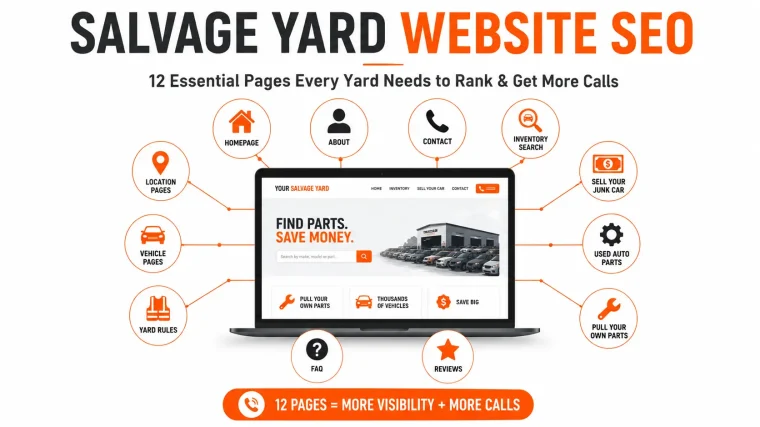
- Salvage yard website seo comes down to having the right 12 pages, not just any pages. Here’s what each one needs:
- Homepage – tell visitors in five seconds whether you buy cars, sell parts, or both, with a clear path for each.
- About – a real founding story and real photos build more trust than generic “trusted provider” copy.
- Contact – phone, map, hours, and a before-you-visit checklist that cuts down repeat calls.
- Search Inventory – a real searchable table with stock numbers and row locations, not a static PDF.
- Sell Your Junk Car – an instant offer tool plus a simple 3-step process sellers can trust.
- Used Auto Parts – city-specific page targeting long-tail part searches, savings claim up front.
- Pull-Your-Own-Parts – a plain explainer on what self-service actually means, plus what to bring.
- Vehicle Inventory Pages – individual listings with real photos and live status, not guesswork.
- Location/City Pages – separate pages per town you serve instead of fighting for one city name.
- FAQ – real customer questions with schema markup to win expandable search results.
- Yard Rules – entry, safety, and tool policy spelled out before anyone shows up.
- Pricing – real itemized numbers with core charges explained, not “call for pricing.”
- Bonus section on Blog/Resource pages, plus how all 12 should link together so no page is a dead end.
- Ends with a quick audit to check what your own site is missing, and a free audit offer if you’d rather have it done for you.
Why Most Salvage Yard Sites Stop at 3 Pages (And Why That Hurts You)
Most salvage yard owners launch a website with three pages, a homepage, an about page, and a contact form. Then they stop. It feels like enough, until you realize a homepage cannot rank for every search term your customers type into Google.
Here’s the real cost. Every page you skip is a chance you hand straight to a competitor. No search inventory page means visitors leave to check a yard that has one. No pricing page means people call confused or do not call at all. No yard rules page means visitors show up without gloves or cash and walk off annoyed.
Website optimization doesn’t stop with page speed and metadata. After defining the structure, connect your website pages with useful internal links that help buyers and sellers take the next step.
This is the part most salvage yard website SEO advice skips. It is not just keywords on a page. It is having enough pages, each built around something your customer actually wants to do. For the bigger strategy behind rankings, traffic, and lead flow, start with our guide on SEO for salvage yards.
Salvage Yard Website Optimization: Build the Structure Before You Optimize Individual Pages
Salvage yard website SEO works best when the site is organized around the two actions that matter most: helping parts buyers find inventory and helping vehicle sellers request an offer. Before optimizing titles, headings, or individual keywords, make sure each customer has a clear path through the website.
A strong salvage yard website structure usually starts with the homepage, then separates the buyer and seller journeys. Parts buyers should be able to move from Used Auto Parts to Search Inventory, Vehicle Pages, Pricing, Yard Rules, and Contact without returning to Google. Vehicle sellers should be able to move from the homepage to Sell Your Junk Car, understand the process, submit their details, and contact the yard.
This structure also makes salvage yard website optimization easier because every important page has a defined purpose. The inventory page answers what is in the yard. Vehicle pages answer questions about a specific make and model. Location pages help nearby customers understand which yard or service area is relevant. Pricing and rules remove friction before a visit.
For a salvage yard, each important URL should have a clear job in the customer journey. Keep page roles separate instead of forcing one page to rank for every version of “used parts,” “junk cars,” “inventory,” and every nearby city. When two pages address almost the same customer need with nearly identical content, decide which page should be the main destination and strengthen that one.
Use navigation and internal links to connect the structure. Every high-value salvage yard page should be reachable through a logical path, and supporting content should point visitors toward the next commercial action. That gives the site a clear hierarchy instead of a collection of isolated pages.
The goal of salvage yard website SEO is not simply to publish more URLs. It is to build a website where each page has one clear search purpose, one clear customer purpose, and a natural connection to the rest of the site.
The 12 Pages Your Site Needs
1. Homepage
Your homepage has one job: tell visitors in five seconds whether you buy junk cars, sell parts, or both. Most salvage yard homepages fail because they try to be everything at once and end up saying nothing clear.
What it needs:
- Click-to-call number in the header. Visible the second the page loads, not buried in a menu.
- Two clear paths above the fold. One button for people who want to sell a car, one for people searching for parts. Do not make visitors guess which side of your business they landed on.
- A headline that states the offer, not the brand. “Fast cash, free towing, same-day pickup” tells a visitor more in three seconds than a slogan ever will.
- Quick links to your core pages. Inventory search, parts catalog, pricing, and contact, all one click away from the homepage. Buried navigation is one of the biggest reasons salvage yard sites lose visitors before they convert.
- Trust signals near the top. Years in business, number of cars processed, or review count. People hand over a car title and personal info, they want proof you are legit before they scroll further.
- A simple “how it works” section. Three steps, no more. Tell them, pick up, get paid. Buyers and sellers both want to know what happens next before they commit.
- Local schema markup in the background. LocalBusiness schema with your name, address, phone, and hours, so Google understands exactly what you are and where you operate before a human even reads the page.
Skip the stock photos of generic junkyards. Real photos of your actual lot build more trust and rank better in image search too. Alongside page structure, improve your salvage yard website conversion so visitors can find inventory, call, or request a quote.
2. About Page
A salvage yard’s about page does more SEO work than people think. It signals to Google and to visitors that a real business with a real history runs this site, not some directory listing. Skip it or fill it with filler text, and you lose both trust and rankings.
What it needs:
- A real founding story, not a generic blurb. When did the yard open, who started it, and why. “Two generations in business” lands better than “trusted provider of automotive solutions.” Specific beats vague every time.
- A clear statement of what you actually do. Most salvage yards run two sides of the business, buying junk cars and selling used parts. Say both plainly. Visitors searching salvage yard website seo best practices will tell you the same thing, an about page that buries half your services loses half your potential traffic.
- A “what makes us different” section. Three or four short points work best. Fast payment, no pressure, local and reachable, honest pricing, whatever is actually true for your yard. Keep each point to a sentence or two.
- Real photos of your team and your lot. Stock illustrations do not build trust. A photo of the owner, the sales team, or the actual yard does. If your yard sponsors a local team or shows up at community events, mention it. That kind of local tie helps with local search too.
- Numbers that back up the story. Years in business, cars processed, reviews collected. Pick two or three real numbers and let them speak instead of adjectives.
- A closing CTA that points two directions. One link for sellers, one for buyers. The about page should never dead-end.
What’s commonly missing, and what to add instead: most about pages for this niche skip licensing or environmental compliance info entirely. A line about being a licensed, insured salvage operation builds more trust than another paragraph about customer service.
3. Contact Page
A salvage yard contact page does more than list a phone number. Done right, it answers half the questions a visitor has before they ever pick up the phone, and it gives Google clear local signals at the same time.
What it needs:
- Phone number, clickable, at the top. Most visitors on mobile want to tap and call, not scroll for an address first.
- Embedded Google map with directions link. Do not just list the address. Drop a real map so visitors can confirm the location and get directions in one tap.
- Yard hours, broken out by day. “Open daily” is not enough. List Monday through Sunday separately, especially if weekend hours differ, which they usually do for self-service yards.
- A “before you visit” checklist. This is one of the strongest things a contact page can have and most salvage yards skip it entirely. A short list, check inventory first, bring your own tools, wear closed-toe shoes, call ahead with questions, saves your staff time answering the same questions on the phone and gives visitors a reason to trust you know your business.
- Email option alongside the phone number. Some visitors will not call. Give them a way to reach out anyway.
- Quick links back to inventory and pricing. A contact page that dead-ends at a phone number wastes a visit. Send people back into the site if they are not ready to call yet.
What’s missing on most yard contact pages, and should not be: an actual contact form. Plenty of salvage yard website seo setups assume a phone number is enough, but a simple name, email, message form catches the visitors who browse after hours or just prefer typing over talking.
4. Search Inventory Page
A salvage yard inventory page should help customers answer one question fast: does this yard have a vehicle that could contain the part I need? Good salvage yard inventory page SEO starts by making the inventory useful to customers before creating additional pages for search engines.
Keep important vehicle information visible in the page content, including year, make, model, arrival date, stock number, row location, and current status. Use real photos when available and make the inventory searchable on mobile without forcing customers to download a PDF or call simply to confirm basic information.
Give the main salvage yard inventory page a clear title and heading that describe what customers can search. If the yard serves one physical market, include the real location naturally. Then link the inventory page to pricing, yard rules, used auto parts, and relevant vehicle pages so a buyer can move from search to visit without hitting a dead end.
Be careful with filters. A year, make, model, or part filter can improve usability, but not every filter combination needs its own indexable URL. If the system creates hundreds of thin or nearly identical pages, keep the main inventory experience clean and reserve dedicated landing pages for vehicle groups or searches that have enough unique information and real customer demand.
For salvage yard inventory page SEO, freshness should mean accuracy rather than cosmetic edits. Add new vehicles when they arrive, update status when inventory changes, and remove or clearly mark listings that are no longer useful.
This keeps the salvage yard inventory trustworthy for both search visitors and repeat pullers. A customer should not drive across town for inventory the website still presents as available when the vehicle has already left the usable inventory.
A useful, current inventory page supports both rankings and conversions because it gives parts buyers a direct path from search intent to a real vehicle in the salvage yard.
5. Sell Your Junk Car Page
This page exists for one type of visitor only, someone who wants cash for a car and wants it fast. Mixing this with your parts-buying content confuses both audiences. Keep it separate, keep it focused.
What it needs:
- An instant offer tool above the fold. A short form, year, make, model, mileage, condition, that spits out a real number fast. People comparing junkyards in the same afternoon will pick whoever gives them an answer first.
- A simple 3-step process breakdown. Get an offer, schedule pickup, get paid. Spell out exactly what happens at each step so there’s no mystery about timing or what to expect.
- A clear answer to “do I need a title.” This is one of the most common questions sellers have and one of the most common reasons calls drag on. Answer it directly on the page.
- Free towing called out explicitly. If you offer free pickup, say it loud. It is one of the biggest deciding factors between yards in the same area.
- A short comparison block. Selling to a yard versus selling privately versus selling to another junkyard. A few honest points here build more trust than any sales copy could, because you’re naming real friction points sellers already feel.
- Reviews specific to selling, not general reviews. A seller deciding whether to trust you with their car wants to hear from other sellers, not from someone who bought a part once.
What’s commonly missing, worth adding: a line on accepted conditions. Non-running, no title, flood damaged, accident totaled, whatever you actually accept. Vague “we buy any car” copy makes sellers nervous they’ll get rejected after wasting time on a form.
6. Used Auto Parts Page
This page targets a different buyer than your inventory or sell pages, someone hunting a specific part, not a whole car. Treat it that way and it pulls real long-tail traffic.
What it needs:
- A city-specific H1. “Used Auto Parts in [Your City], [State]” beats a generic title every time for local search. Bake the location right into the headline.
- A savings claim up front. Something like “save up to 70% versus new parts.” Price comparison is the number one reason people choose used parts over new, say it early.
- A simple 3-step process. Search inventory or visit the yard, find the vehicle, pull the part and check out. Short, scannable, removes any confusion for first-time visitors.
- A parts category list. Engines, transmissions, doors and body panels, headlights, electronics, dash components, whatever categories actually move at your yard. This single block captures dozens of long-tail searches like “used transmission near me” without needing separate pages for each. Use your highest-intent salvage yard keywords to decide which part categories, service pages, and city pages deserve priority first.
- An embedded map and quick NAP block. Address, phone, hours, right on the page. Local intent searches convert better when the location info is impossible to miss.
- A link to your price list. Buyers comparing yards want to know cost before they drive over. Hiding pricing behind a phone call loses impatient shoppers.
What’s commonly missing, worth adding: a short FAQ on part quality and warranty. “Are parts tested before sale,” “can I return a part that doesn’t fit,” these questions stop a lot of buyers from calling and stop a lot of buyers from leaving too. Answering them on the page builds trust salvage yard website seo content alone can’t always deliver.
7. Pull-Your-Own-Parts Page
This page exists to answer one question new visitors always have: what does self-service actually mean here. Skip it and first-timers either don’t show up or show up confused and frustrated.
What it needs:
- A plain explanation of the model. You walk the yard, find your vehicle, remove the part yourself, pay at checkout. Spell it out in one or two short lines so nobody arrives expecting a counter clerk to hand them a part.
- A “what to bring” list. Tools, gloves, safety glasses, cash or card, whatever applies. This single section saves your staff from answering the same question all day and sets correct expectations before someone drives over for nothing.
- Safety basics, kept short. Closed-toe shoes required, no kids unattended, watch for sharp edges. A few lines, not a wall of legal text.
- A note on what’s included and what’s not. Do you supply tools to borrow, or is it bring-your-own only. Sellers searching pull your own parts near me want this answered before they show up empty handed.
- A link straight into search inventory. Once someone understands the model, the natural next step is checking what’s actually on the lot. Don’t make them hunt for that link.
What’s commonly missing, worth adding: a quick FAQ block on core charges, refunds for parts that don’t fit, and whether parts come with any kind of guarantee. These are the exact questions that turn a curious visitor into someone who calls instead of just leaving the page.
8. Vehicle Inventory Pages
This is different from your main search inventory page. That page is the master list. This is about giving individual vehicles their own page, or at least the option to, so each one can rank on its own for specific searches like “2015 Honda Civic parts Savannah.”
What it needs:
- A unique page or URL slot per vehicle, where it makes sense. Not every car needs its own page, but high-demand makes and models do. A 2018 F-150 gets searched a lot more than a 1998 Buick, prioritize accordingly.
- Photos of the actual vehicle, not stock images. A real photo of the car on your lot tells a buyer it is genuinely available and builds trust a stock photo never will. It also feeds image search, which most salvage yards completely ignore.
- Parts likely available from that vehicle listed out. Engine, transmission, doors, electronics, whatever is commonly pulled from that make and model. This turns one page into multiple search opportunities instead of one generic listing.
- Stock number and row location front and center. Same reason as the main inventory table, it saves time once someone is standing in your yard.
- A status field. Available, partially picked, sold out. Nothing kills trust faster than driving over for a car the listing never updated.
What’s commonly missing, worth adding: basic structured data on these pages, Product or Vehicle schema with condition, price range, and availability. Search engines reward this kind of detail with richer listings, and almost nobody in this niche bothers setting it up.
9. Location/City Pages
Most self-service yards only operate in one spot, but customers come from a dozen towns around it. Location pages let you rank in each of those towns separately instead of fighting for one broad city name.
What it needs:
- A page per service-area city, not just your home city. If your yard sits in one town but pulls customers from five surrounding towns, each of those towns deserves its own page, “Used Auto Parts Near [Nearby Town],” built around that specific search.
- Proximity language that actually orients the visitor. A line like “just 15 minutes from downtown, off Highway X” tells someone unfamiliar with the area exactly where you sit relative to them. Generic distance claims do nothing, specific roads and drive times do.
- The same core info repeated per page, but never copy-pasted word for word. Hours, address, phone, and a short paragraph on what that town’s customers usually search for. Thin duplicate pages get filtered out of search results fast, so each one needs its own real content.
- A local map embed on every page. Visitors checking from a different town want to see the actual route before they decide to drive over.
- If you run multiple physical yards, give each its own dedicated page. Mixing locations on one page confuses both visitors and Google about which yard has which inventory. A real example worth following, separate yard pages even under one brand, each with its own hours, address, and yard-specific rules.
What’s commonly missing, worth adding: a quick note on what makes that specific yard or service area different, closer for one town, bigger inventory for another, whatever applies. Without it, every location page looks like a copy of the last one, and that hurts more than helps.
10. FAQ Page
A dedicated FAQ page pulls in question-based searches your other pages don’t cover, and it cuts down repeat phone calls.
What it needs:
- Real questions customers actually ask, not generic filler. Pull them straight from your phone calls and DMs.
- Group by topic, buying parts, selling cars, visiting the yard. Easier to scan, easier to expand later.
- FAQ schema markup on the page. This is what gets you those expandable question boxes in Google results.
- Short, direct answers. Two to three sentences max per question.
What’s missing on most yard FAQ pages: questions about warranty, returns, and core charges. These get asked constantly and rarely get answered anywhere on the site.
11. Yard Rules Page
This page sets expectations before someone shows up and gets turned away or hurt.
What it needs:
- Entry requirements. Age minimum, entry fee if you charge one, waiver if required.
- Safety basics. Closed-toe shoes, no kids unsupervised, watch for sharp metal.
- What’s not allowed. No torches, no jacks if cars are already lifted, no weapons or alcohol.
- Tool policy. Bring your own, or do you rent or loan any out.
- Hours the yard floor is open, separate from office hours if they differ.
What’s missing on most yard rules pages: a line on what happens if a rule gets broken, refused entry, asked to leave, whatever your actual policy is. Vague rules with no stated consequence don’t get followed.
12. Pricing Page
A pricing page does double duty. It builds trust with people comparing yards, and it kills the most common reason for an unanswered phone call, “how much for X.”
What it needs:
- A real itemized price list, not a vague “call for pricing.” Part name, price, and unit, each or per foot. Specific numbers beat a contact form every time for comparison shoppers.
- Core charge explained, not just listed. Most first-time visitors have no idea what a core charge is or why they’d get money back for returning the old part. One short line clears this up and stops a recurring question at the counter.
- Any flat fees called out separately. Gate fee, pull fee, restocking fee, whatever applies. Hiding these in the fine print feels like a bait and switch once someone’s already at the register.
- A simple explainer above the table. Visit, find your part, pull it yourself, pay the listed price. Sets expectations before anyone scrolls through hundreds of line items.
- A note on price matching, if you offer it. This is a real differentiator buyers compare yards on, say it clearly if it’s true for you.
What’s commonly missing, worth adding: a last-updated date on the page. Prices on a static list can drift from what’s charged at the counter, and a visible update date protects trust on both sides. Also worth adding, a payment methods line. Cash only or cards accepted changes whether someone brings the right form of payment salvage yard website seo content alone can’t fix once they’re standing at your register annoyed.
Bonus: Blog/Resource Section
This is the page type that keeps bringing new visitors in long after launch. The 12 pages above cover what visitors need to convert, the blog covers what brings them in the door in the first place.
What it needs:
- Real author byline on every post. A named writer, even just a first name and title, signals a real business behind the content, not a content farm.
- Visible published and updated dates. Google and visitors both reward freshness. A post that’s never been touched since 2024 reads as stale even if the info still holds up.
- A table of contents on longer posts. Jump links to each section make long guides scannable and tend to earn featured snippet real estate in search results.
- Related posts at the end of every article. Keeps visitors moving deeper into the site instead of bouncing after one read.
- Internal links from every post back to a commercial page. A blog post about checking inventory before a visit should link straight to the search inventory page, not just sit there as a standalone article.
What’s commonly missing, worth adding: clear content separation. Job postings, press releases, and actual blog content sometimes get lumped into the same feed. Keep categories clean so visitors and Google both know what they’re looking at.
How These Pages Work Together (Internal Linking Note)
None of these 12 pages should exist in isolation. The real salvage yard website seo win comes from how they link to each other, not just from each page ranking on its own.
Think of it as two paths running side by side. The buying path: Homepage to Used Auto Parts to Search Inventory to Pricing to Contact. The selling path: Homepage to Sell Your Junk Car to How It Works to Contact. Every page on one path should also cross-link to the other, since plenty of visitors arrive wanting one thing and leave doing the other.
Location and FAQ pages sit underneath both paths, feeding traffic up into whichever path matches the visitor’s intent. Blog posts sit on top, pulling in new visitors through informational searches, then funneling them down into Search Inventory or Sell Your Junk Car depending on what the post was about.
A simple rule covers most of it. Every page should link to at least one page further down the funnel, and at least one page back up toward the homepage. No page should be a dead end.
Stop Guessing Where You're Losing Customers
If your pages are ranking but visitors are not calling, searching inventory, requesting offers, or getting directions, the problem may be conversion rather than page coverage. Use our salvage yard website conversion optimization guide to review mobile layout, call buttons, inventory CTAs, trust signals, speed, and the paths that turn organic traffic into real customer actions.
Every page covered in this guide is a place visitors either convert or quietly leave. Most yard owners never find out which one’s costing them the most, they just notice calls are slower than they should be and can’t pinpoint why.
A free audit fixes that. We’ll go through your site page by page, the same way this guide just walked through yours, and show you exactly where customers are dropping off before they ever pick up the phone or drive over.
Want to know where your yard is leaking customers? Book your free audit with PYP Accelerator and find out before your next competitor does.
Visual Summary: Salvage Yard Website SEO: 12 Pages Every Yard Needs to Rank
