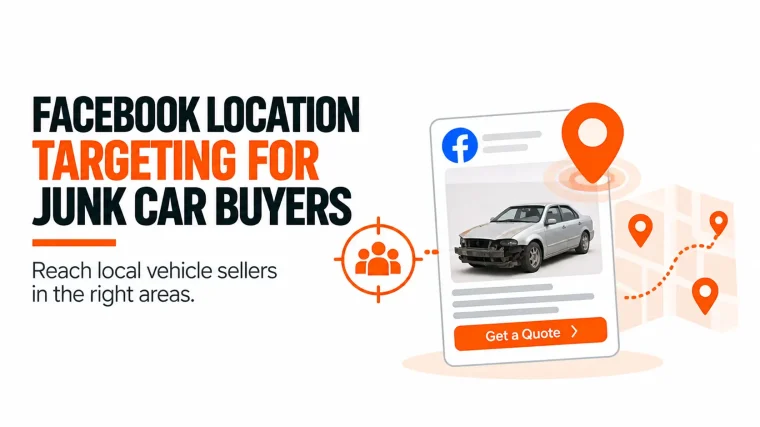
Facebook location targeting helps junk car buyers reach potential vehicle sellers within specific geographic areas. But selecting the largest possible radius doesn’t automatically generate better acquisition opportunities. The real goal is to reach sellers in locations where the yard can realistically purchase vehicles while keeping towing, pickup, and transportation costs manageable.
Effective Facebook location targeting starts with defining the yard’s actual buying territory, choosing appropriate geographic settings, and evaluating where relevant seller inquiries originate. A smaller, well-aligned service area may produce more useful opportunities than a broad campaign that attracts sellers too far away.
At Pull Your Part Accelerator (PYP), we approach Facebook advertising specifically around junk car and salvage-yard acquisition. Our focus is on aligning local advertising reach with the buyer’s service area, vehicle purchasing priorities, and acquisition goals—not simply maximizing impressions or clicks.
In this guide, we’ll explain how Facebook location targeting works, how to choose between city and radius targeting, what to consider when expanding into nearby markets, and how to evaluate which locations generate useful junk car seller inquiries.
Need More Junk Car Leads in Your Local Market?
Stop relying on unpredictable seller inquiries. Pull Your Part Accelerator helps junk car buyers and salvage yards reach local vehicle owners through targeted Facebook Ads, local SEO, and organized lead tracking
📌 KEY TAKEAWAYS
- Facebook location targeting for junk car buyers helps salvage yards reach potential vehicle sellers in geographic areas where they can realistically purchase and collect vehicles.
- Define your actual buying territory: Start with cities and communities where the yard already acquires vehicles before expanding into new markets.
- Choose the right targeting method: City targeting works well for specific buying markets, while radius targeting can suit yards serving surrounding communities.
- Consider towing and acquisition costs: Distance, transportation expenses, vehicle condition, purchase price, and pickup capacity all influence whether an acquisition is profitable.
- Prioritize relevant local sellers: A larger audience or wider radius does not automatically generate better seller inquiries or more profitable vehicle purchases.
- Understand Meta’s location targeting limitations: Geographic settings do not guarantee that every person reached lives within the selected area or has a vehicle available for pickup there.
- Use accurate local ad messaging: Mention the actual service area, clearly explain which vehicles you buy, and avoid misleading claims about location, pricing, or pickup availability.
- Structure campaigns around meaningful markets: Group similar locations together and create separate geographic ad sets when different markets require distinct budgets, messaging, or performance tracking.
- Avoid common targeting mistakes: Don’t target unnecessarily large areas, ignore pickup limitations, fragment small budgets across too many locations, or expand before evaluating seller quality.
- Test new geographic markets gradually: Start with established buying areas, test nearby locations with controlled budgets, and compare results before expanding.
- Track meaningful performance metrics: Monitor seller inquiries, cost per inquiry, actual vehicle locations, qualified opportunities, and completed vehicle purchases—not just impressions and clicks.
- Use buyer feedback to improve targeting: The buying team can help identify which locations generate suitable vehicles and realistic acquisition opportunities.
- Separate advertising from vehicle acquisition: Pull Your Part Accelerator (PYP) generates seller inquiries through targeted advertising, while the junk car buyer handles qualification, vehicle evaluation, quotes, follow-up, pickup, and purchases.
- Bottom line: Effective Facebook location targeting focuses on reaching the right junk car sellers in areas where vehicles can be acquired economically. The goal is not to advertise in more locations, but to generate relevant inquiries that can lead to sustainable vehicle purchases.
Why Location Targeting Matters for Junk Car Buyers
Facebook location targeting plays an important role in generating relevant seller inquiries for junk car buyers and salvage yards. Unlike businesses that can serve customers nationwide, junk car acquisition depends heavily on where vehicles are located and whether the buyer can purchase and transport them economically.
At Pull Your Part Accelerator (PYP), we focus on connecting local advertising reach with real vehicle acquisition opportunities rather than simply maximizing impressions across a large geographic area.
Junk Car Acquisition Is a Local Business
Junk car buyers typically operate within defined service areas because vehicle purchases often involve towing, pickup coordination, and transportation back to the yard.
A seller located 10 miles away may be easier and less expensive to serve than someone located 70 miles away.
That’s why Facebook location targeting should reflect the buyer’s actual purchasing territory, including cities and surrounding communities where vehicle acquisition is practical.
The goal is to reach vehicle owners in locations the yard can realistically serve.
Not Every Nearby Seller Is a Profitable Opportunity
A seller may live within the campaign’s geographic area but still be too expensive to serve profitably.
For example, a vehicle requiring a long-distance tow may generate additional transportation expenses that reduce its acquisition value.
When evaluating local junk car seller opportunities, buyers should consider:
- Distance from the yard or pickup operation.
- Towing and transportation expenses.
- Vehicle condition and potential acquisition value.
- Available pickup capacity.
- Whether the location fits the yard’s buying criteria.
Effective Facebook location targeting should support these operational realities instead of treating every nearby inquiry as equally valuable.
More Reach Doesn't Always Mean More Useful Seller Inquiries
Expanding a Facebook campaign across a larger area may increase potential audience size, but that doesn’t guarantee more qualified sellers or profitable vehicle purchases.
A broad campaign can attract inquiries from locations where pickup is difficult, expensive, or outside the buyer’s preferred acquisition territory.
What matters is not simply how many people see the ad, but whether relevant vehicle owners respond from areas the buyer can serve.
At Pull Your Part Accelerator, our seller-acquisition approach emphasizes aligning Facebook location targeting with local market relevance and the buyer’s actual operational coverage.
The objective is to generate meaningful local seller inquiries that give the yard realistic opportunities to purchase vehicles.
How Facebook Location Targeting Works
Facebook location targeting allows junk car buyers to define the geographic areas where Meta should deliver their advertisements. Through Meta Ads Manager, advertisers can select locations such as cities, regions, or geographic areas around a selected point.
However, geographic targeting is not perfectly precise. Meta uses location-related signals to determine who may be eligible to see an ad, meaning some inquiries can still come from outside the buyer’s actual service area.
At Pull Your Part Accelerator (PYP), we focus on aligning these targeting settings with the locations where salvage yards can realistically acquire vehicles.
Geographic Targeting Options in Meta Ads Manager
Facebook location targeting is generally configured within the audience settings at the ad set level.
Depending on the campaign, country, and available account settings, advertisers may be able to select:
- Cities: Reach people associated with selected cities and surrounding areas.
- States or regions: Cover broader geographic markets.
- Radius targeting: Define an area around a city, address, or map pin.
- ZIP or postal codes: Target specific postal areas where Meta supports this option.
The available controls can vary by country and campaign restrictions. Advertisers should confirm the options displayed in their current Meta Ads Manager account before building a geographic strategy.
City and Regional Targeting
City targeting can be useful when a junk car buyer operates across several nearby communities or serves a defined metropolitan area.
For example, a salvage yard serving Columbus, Ohio, might include Columbus and nearby communities within its actual purchasing territory.
Regional targeting can make sense for larger buying operations, but selecting an entire state may introduce unnecessary reach if the yard only purchases vehicles in certain areas.
What to consider: Choose geographic areas based on actual pickup coverage rather than assuming every nearby city represents a viable acquisition market.
Radius-Based Targeting
Radius targeting lets advertisers define a geographic area around a selected location, where the feature is supported.
For junk car buyers, this can provide a practical starting point when purchasing operations are concentrated around a yard or pickup location.
However, a 30-mile radius does not necessarily mean every location inside it is equally profitable. Driving routes, traffic, towing availability, and vehicle condition can influence acquisition costs.
Effective Facebook location targeting should therefore reflect operational coverage rather than relying on distance alone.
Location Exclusions and Platform Limitations
Some Meta campaign configurations may offer location exclusions, allowing advertisers to remove selected geographic areas from their intended audience.
However, exclusion controls are not universally available, and certain campaign categories have additional targeting restrictions.
Advertisers should also be aware that:
- ZIP-code targeting may not be available in every market.
- Minimum and maximum radius options can vary.
- Certain audience-expansion settings can affect geographic reach.
- Location selections are not guaranteed to match exact municipal or service-area boundaries.
What to check: Review the targeting controls currently available in Ads Manager instead of relying on older tutorials or assuming every location feature is supported.
Why Location Targeting Doesn't Guarantee Every Inquiry Will Be Local
Meta can use signals such as device location, activity, and other location-related information to determine geographic eligibility.
As a result, someone who recently visited a targeted area may encounter an advertisement even if their vehicle is located elsewhere. Advertisers generally cannot restrict delivery exclusively to permanent residents using a simple residency setting.
That is why Facebook location targeting should be combined with clear service-area messaging and feedback from the junk car buyer.
For example, an ad might state “We Buy Junk Cars in Columbus and Surrounding Areas” while the buying team confirms the vehicle’s actual pickup location during the conversation.
At Pull Your Part Accelerator, our approach is to connect geographic advertising settings with practical acquisition coverage. We focus on attracting relevant local seller inquiries while recognizing that the buyer must confirm vehicle location, condition, and purchase eligibility.
How to Define Your Junk Car Buying Service Area
Before setting up Facebook location targeting, junk car buyers should identify where they can realistically purchase and pick up vehicles. A service area should reflect actual buying operations, towing costs, and acquisition opportunities—not simply the largest radius available in Meta Ads Manager.
At Pull Your Part Accelerator (PYP), we approach geographic advertising from a salvage yard acquisition perspective, helping align campaign reach with the markets where local seller inquiries are most useful.
Start With Locations the Yard Already Purchases From
Begin by reviewing the cities, ZIP codes, and surrounding communities where the yard currently acquires vehicles.
These locations provide a practical starting point because the buyer already understands the local market, pickup logistics, and purchasing opportunities.
What to do: Identify existing acquisition areas and use them as the foundation for Facebook location targeting before expanding into unfamiliar markets.
Consider Towing Distance and Pickup Costs
Distance directly affects the economics of junk car acquisition.
A seller located 15 miles away may be easier to serve than one located 60 miles away, particularly when towing expenses, travel time, and vehicle condition are considered.
However, distance alone doesn’t determine profitability. A more valuable vehicle may justify a longer pickup trip, while a low-value vehicle nearby may still be an unattractive purchase.
What to do: Evaluate geographic coverage alongside towing expenses, transportation time, and the types of vehicles the yard wants to acquire.
Identify Your Primary and Secondary Buying Areas
Organizing service areas into priority groups can make Facebook location targeting more practical.
- Primary buying areas: Cities and communities where the yard regularly purchases vehicles and can arrange pickups efficiently.
- Secondary buying areas: Nearby markets where purchases are possible but may involve higher transportation costs or more limited pickup availability.
For example, a salvage yard might prioritize communities within its established pickup territory while testing selected surrounding markets for additional seller opportunities.
What to do: Focus initial advertising efforts on established buying areas, then evaluate secondary markets based on inquiry quality and acquisition results.
Exclude Impractical Locations Where Supported
Some locations may fall within a geographic targeting area but remain difficult or uneconomical to service.
Where Meta Ads Manager supports location exclusions, advertisers can use them to refine geographic coverage.
When exclusions are unavailable, consider alternative location selections, narrower targeting areas, and accurate service-area messaging.
Keep in mind that Meta’s geographic controls are not perfectly precise, so the buying team should still confirm where each vehicle is located.
What to do: Review locations that consistently produce unsuitable inquiries and adjust the campaign’s geographic setup where platform controls allow.
At Pull Your Part Accelerator, Facebook location targeting is about connecting advertising with the yard’s real vehicle-buying capabilities. We focus on generating seller inquiries from relevant markets, while the junk car buyer determines vehicle eligibility, pricing, pickup feasibility, and final purchase decisions.
City Targeting vs. Radius Targeting for Junk Car Facebook Ads
Choosing between city targeting and radius targeting can influence where Facebook Ads reach potential junk car sellers. Both approaches can support local vehicle acquisition, but the right choice depends on the yard’s service area, towing capabilities, and geographic buying priorities.
At Pull Your Part Accelerator (PYP), we approach Facebook location targeting based on where salvage yards can realistically acquire vehicles—not simply which geographic setting provides the largest audience.
When City Targeting Makes Sense
City targeting is useful when a junk car buyer serves specific communities or operates across several defined local markets.
For example, a salvage yard may regularly purchase vehicles in Columbus, Dublin, and Westerville, Ohio. Targeting these cities can help align advertising with established buying locations.
Best suited for: Buyers serving selected cities rather than every location surrounding the yard.
However, Meta’s geographic boundaries may extend beyond exact city limits, so actual seller locations should still be verified.
When Radius Targeting May Be More Practical
Radius targeting can be useful when a junk car buyer serves a relatively continuous geographic area around a yard or pickup location.
For example, a buyer operating within approximately 25 miles of a salvage yard may use radius targeting as a starting point, where Meta supports the selected distance.
Best suited for: Buyers with established pickup coverage across surrounding communities.
However, a circular radius cannot account for traffic, highways, rivers, or actual driving distances. Some locations inside the radius may still be expensive to service.
Problems With Targeting an Entire Metro Area
Targeting a large metropolitan area may increase potential reach, but it can also attract sellers from locations outside the yard’s practical buying territory.
Common challenges include:
- Higher towing and transportation costs.
- Inquiries from locations with limited pickup coverage.
- Uneven seller quality across different communities.
- Difficulty identifying which areas produce valuable acquisition opportunities.
For Facebook location targeting, a larger geographic audience does not automatically mean better campaign performance.
How to Choose Based on Acquisition Coverage
The most practical approach is to compare geographic targeting options against the buyer’s actual service area.
Factor | City Targeting | Radius Targeting |
Best use | Selected cities or communities | Continuous service area around a location |
Geographic control | City-based areas defined by Meta | Distance-based area around a selected point |
Main advantage | Supports targeting specific buying markets | Convenient for covering surrounding communities |
Main limitation | City boundaries may not match pickup coverage | Circular areas don’t reflect actual driving routes |
Suitable for | Buyers operating in several defined markets | Buyers serving a central yard and nearby areas |
What to monitor | Inquiries and acquisitions by city | Seller locations, distance, and pickup costs |
Practical recommendation: Start with the targeting method that most closely matches where the yard already purchases vehicles. Test nearby markets only when the buyer can realistically handle additional pickups and acquisition opportunities.
City and radius targeting can also be combined where Meta’s current targeting controls permit.
At Pull Your Part Accelerator, we focus on making Facebook location targeting support real junk car acquisition operations. Our objective is to help campaigns reach relevant local sellers, while the buying team evaluates vehicle condition, pickup feasibility, pricing, and final purchases.
How to Structure Facebook Campaigns for Multiple Buying Areas
When a junk car buyer serves multiple cities or acquisition markets, organizing Facebook campaigns geographically can help identify where the most relevant seller inquiries originate. However, separating every location into its own campaign can make advertising harder to manage and limit the data available for optimization.
At Pull Your Part Accelerator (PYP), we approach Facebook location targeting with the buyer’s actual service areas, advertising budget, and vehicle acquisition priorities in mind.
One Service Area vs. Several Markets
If a salvage yard purchases vehicles throughout one connected service area, a single geographic campaign structure may be sufficient.
However, buyers operating across several distinct markets may benefit from organizing locations separately, especially when acquisition costs, pickup coverage, or advertising performance differ significantly.
What to consider: Group locations based on how the yard actually purchases vehicles rather than creating separate campaigns for every nearby city.
When Separate Geographic Ad Sets Make Sense
Separate geographic ad sets can be useful when the buyer needs greater control over different acquisition markets.
For example, a salvage yard may want to compare seller inquiries from its primary service area against a secondary market with higher towing costs.
Separate ad sets may make sense when:
- Buying areas have different acquisition priorities.
- Markets require different advertising budgets.
- Seller response performance varies significantly.
- Local messaging needs to differ between markets.
What to consider: Use separate geographic ad sets when the distinction supports a meaningful advertising decision, not simply because the locations have different names.
Avoid Unnecessary Audience Fragmentation
Dividing a limited budget across too many small geographic audiences can reduce delivery opportunities and make campaign results harder to interpret.
For Facebook location targeting, excessive segmentation may also create overlapping audiences and insufficient response data within individual ad sets.
What to do: Keep similar nearby markets grouped when practical. Separate locations only when there is a clear reason to manage or measure them independently.
How to Compare Performance Across Locations
When campaigns cover multiple buying areas, performance should be evaluated using more than impressions or clicks.
Useful comparisons include:
- Seller inquiries: Messages or calls generated from each market.
- Cost per inquiry: Advertising spend required to generate seller contact.
- Seller location: Where the vehicle is actually located.
- Qualified opportunities: Inquiries involving vehicles the yard may purchase.
- Vehicles acquired: Completed purchases attributed to each market, when buyer records are available.
Meta’s geographic reporting can help identify delivery patterns, but it should not be treated as a perfect record of vehicle pickup locations. Feedback from the buying team provides important context.
At Pull Your Part Accelerator, our goal is to structure Facebook location targeting around practical seller-acquisition opportunities rather than unnecessary campaign complexity.
We focus on generating relevant local inquiries, while the junk car buyer evaluates vehicle eligibility, provides quotes, coordinates pickup, and completes purchases.
How Towing and Acquisition Costs Should Influence Location Targeting
Facebook location targeting should consider more than geographic reach or the cost of generating seller inquiries. For junk car buyers, the distance between the vehicle and the yard can significantly affect whether an acquisition is financially worthwhile.
At Pull Your Part Accelerator (PYP), we approach local advertising with these industry-specific considerations in mind. The objective is to attract sellers from areas where vehicle purchases make operational and financial sense.
Why Cheap Seller Inquiries Can Become Expensive Acquisitions
A location may generate inexpensive Facebook leads but still produce costly vehicle acquisitions.
For example, a seller inquiry costing $12 from a distant market may seem more attractive than a $20 inquiry from a nearby city. However, additional towing expenses, travel time, and pickup logistics can eliminate those initial savings.
What to consider: Evaluate cost per seller inquiry alongside the actual expenses involved in purchasing and collecting vehicles.
The cheapest lead is not always the most profitable acquisition opportunity.
How Pickup Distance Affects Vehicle Profitability
Longer pickup distances can increase fuel costs, driver time, towing expenses, and transportation complexity.
For salvage yards purchasing lower-value vehicles, these additional costs can significantly reduce the margin available on each acquisition.
Effective Facebook location targeting should therefore consider actual driving routes and pickup capabilities rather than relying exclusively on straight-line distance.
What to consider: Identify areas where transportation costs remain manageable and where the buying team can consistently arrange vehicle pickups.
Why Vehicle Value and Location Must Be Considered Together
Distance alone does not determine whether a vehicle is worth purchasing.
A higher-value vehicle located farther away may justify additional transportation expenses, while a low-value vehicle nearby may still offer limited profitability.
For example:
Acquisition Factor | Nearby Vehicle | Distant Vehicle |
Distance from yard | 10 miles | 55 miles |
Vehicle’s estimated value to the yard | $650 | $950 |
Purchase price | $300 | $450 |
Estimated towing cost | $75 | $200 |
Remaining value before other costs | $275 | $300 |
Illustrative figures only, not actual PYP campaign or client results. Advertising expenses, processing, labor, and other costs are excluded.
This example shows why Facebook location targeting should reflect the buyer’s acquisition economics rather than treating every geographic area equally.
What to consider: Compare expected vehicle value, purchase price, transportation expenses, and other acquisition costs before deciding which markets deserve advertising investment.
When Expanding the Service Area Makes Financial Sense
Expanding Facebook advertising into surrounding markets can create additional seller opportunities, but geographic growth should be based on operational capacity and acquisition performance.
Expansion may make sense when:
- Existing service areas are producing consistent seller inquiries.
- The yard has additional vehicle purchasing capacity.
- Nearby markets contain suitable acquisition opportunities.
- Towing and pickup costs remain financially manageable.
- The buying team can handle inquiries from additional locations.
What to do: Test secondary markets gradually and compare seller inquiry quality, pickup expenses, and vehicle acquisition outcomes before committing more advertising budget.
At Pull Your Part Accelerator, our focus is on aligning Facebook location targeting with the buyer’s real acquisition territory and business objectives.
PYP generates seller opportunities through targeted advertising, while the junk car buyer determines vehicle value, negotiates pricing, coordinates pickup, and completes purchases.
How to Make Facebook Ads Feel Relevant to Local Vehicle Sellers
Facebook location targeting works best when the advertisement itself feels relevant to the seller’s area. Even when geographic settings are accurate, generic messaging may fail to establish that the buyer actually serves the local market.
At Pull Your Part Accelerator (PYP), we focus on aligning local advertising messages with the yard’s real vehicle acquisition territory.
Mention the Actual Service Area in Ad Copy
Including a city or recognizable service area can help sellers quickly understand where the buyer operates.
For example, “We Buy Junk Cars in Columbus and Surrounding Areas” provides more local context than a generic “We Buy Cars” message.
Use location references that accurately reflect the buyer’s pickup coverage.
Use Locally Relevant Vehicle Imagery
Realistic images of unwanted, damaged, or non-running vehicles can help sellers recognize that the advertisement applies to their situation.
Where available, authentic photos from the buyer’s local operation can also reinforce credibility.
Avoid generic dealership imagery that doesn’t reflect the types of vehicles the yard actually purchases.
Match the Advertised Location to the Buying Operation
Facebook location targeting and ad messaging should support the same geographic service area.
If a campaign promotes vehicle buying in a specific city, the yard should be prepared to evaluate and potentially purchase vehicles from that location.
What to check: Confirm that advertised cities and surrounding communities match the buyer’s actual acquisition coverage.
Avoid Misleading Local Claims
Local relevance should be genuine, not manufactured.
Avoid suggesting the business has a physical location in a city where it doesn’t operate or promising immediate pickup when that service isn’t available.
Clear, accurate local messaging helps establish realistic expectations before the seller contacts the buyer.
At Pull Your Part Accelerator, we combine Facebook location targeting with seller-focused advertising messages to help reach vehicle owners in relevant buying markets.
For practical examples of vehicle imagery, local headlines, advertising copy, and calls to action, explore our guide to Facebook Ad Creative for Junk Car Buyers.
Common Facebook Location Targeting Mistakes Junk Car Buyers Make
Even well-planned Facebook campaigns can waste advertising spend when geographic targeting doesn’t align with the buyer’s actual acquisition territory. For junk car buyers, reaching more people isn’t always better if those sellers are located in areas the yard cannot serve efficiently.
At Pull Your Part Accelerator (PYP), we focus on avoiding location targeting mistakes that generate unnecessary traffic instead of relevant vehicle seller inquiries.
Targeting Too Large a Geographic Area
Selecting an unnecessarily large radius or entire metropolitan region may increase audience reach but also attract sellers from locations the yard cannot serve profitably.
The fix: Start with established buying areas and expand gradually based on seller inquiry quality, acquisition capacity, and actual service coverage.
Ignoring Actual Pickup Coverage
A location may appear close to the yard on a map but still involve expensive towing, difficult routes, or limited pickup availability.
This can turn seemingly inexpensive seller inquiries into costly acquisition opportunities.
The fix: Align Facebook location targeting with realistic pickup distances, transportation expenses, and the yard’s operational capabilities.
Assuming Everyone Reached Lives in the Selected Location
Meta uses location-related signals to determine geographic eligibility, but these signals don’t guarantee that every person reached permanently lives within the selected area.
As a result, campaigns may receive inquiries about vehicles located outside the intended buying territory.
The fix: Use accurate service-area messaging and have the buying team confirm the vehicle’s location during qualification.
Splitting Small Budgets Across Too Many Locations
Creating separate ad sets for every nearby city can fragment a limited advertising budget and make performance comparisons less reliable.
Smaller audiences may also produce insufficient response data for meaningful optimization.
The fix: Group similar service areas when practical. Create separate geographic ad sets only when different markets require distinct budgets, messaging, or performance evaluation.
Expanding Geographically Before Evaluating Seller Quality
A campaign generating inexpensive inquiries doesn’t necessarily justify targeting additional cities.
If existing inquiries rarely involve suitable vehicles or realistic purchasing opportunities, geographic expansion may simply increase wasted spend.
The fix: Evaluate relevant seller conversations, qualified opportunities, and available acquisition feedback before expanding Facebook location targeting into new markets.
Measuring Results Without Checking Seller Locations
Meta’s geographic reporting can show where advertising activity occurs, but it doesn’t necessarily reveal the actual pickup location of every vehicle.
Without seller-location feedback, a campaign may appear successful while generating inquiries from unprofitable service zones.
The fix: Compare advertising results with the vehicle locations reported to the buying team. Where possible, evaluate inquiries, acquisition costs, and purchased vehicles by geographic market.
At Pull Your Part Accelerator, our approach to Facebook location targeting focuses on connecting advertising reach with the yard’s actual buying territory. We aim to generate relevant local seller inquiries, while the buyer handles vehicle qualification, pricing, pickup arrangements, and purchases.
How to Test Different Locations in Junk Car Facebook Campaigns
Testing different geographic markets helps junk car buyers identify where Facebook advertising generates the most relevant seller inquiries. Instead of expanding into multiple cities at once, a structured approach makes it easier to compare performance and avoid unnecessary advertising expenses.
At Pull Your Part Accelerator (PYP), we focus on using Facebook location targeting to reach vehicle sellers in markets that align with the yard’s actual acquisition capabilities.
Start With Established Acquisition Markets
Begin testing in cities and surrounding areas where the yard already purchases vehicles regularly.
These markets provide a useful starting point because the buyer understands local pickup requirements, vehicle availability, and acquisition costs.
What to do: Use established buying locations as the baseline for evaluating new geographic markets.
Test Additional Areas With Controlled Budgets
Once established locations are generating consistent seller inquiries, test nearby markets without immediately expanding the entire campaign.
Where practical, use separate geographic ad sets or controlled tests to evaluate new areas. Keep the buying offer and creative reasonably consistent so location performance is easier to compare.
What to do: Allocate enough budget to collect meaningful response data while limiting exposure in unproven markets.
Compare Seller Inquiries From Each Market
Facebook location targeting should be evaluated using actual seller responses rather than impressions or clicks alone.
Compare useful indicators such as:
- Number of messaging conversations or calls.
- Cost per seller inquiry.
- Percentage of inquiries involving relevant vehicles.
- Seller locations within the actual buying area.
- Qualified acquisition opportunities.
What to do: Identify which markets generate useful seller conversations at an acceptable advertising cost.
Collect Location Feedback From the Buying Team
Meta’s advertising reports cannot always confirm where a seller’s vehicle is physically located.
The buying team should record the actual vehicle location and provide feedback on whether inquiries fit the yard’s purchasing criteria.
This information helps distinguish between areas that generate inexpensive responses and areas that produce realistic vehicle acquisition opportunities.
What to do: Compare Facebook campaign results with seller-reported ZIP codes, pickup locations, and acquisition outcomes when available.
Expand Based on Useful Acquisition Opportunities
Increase geographic coverage when testing shows that a market generates relevant seller inquiries and the yard can economically purchase vehicles from that area.
Before expanding, consider towing costs, pickup capacity, vehicle quality, and the buyer’s ability to manage additional inquiries.
What to do: Prioritize markets demonstrating consistent acquisition potential rather than expanding based solely on low cost per inquiry.
At Pull Your Part Accelerator, our approach to Facebook location targeting emphasizes controlled geographic testing and practical performance evaluation. We generate advertising-driven seller opportunities, while the junk car buyer handles vehicle qualification, quoting, pickup, and purchasing.
How Pull Your Part Accelerator Approaches Local Seller Targeting
At Pull Your Part Accelerator (PYP), Facebook advertising isn’t about reaching the largest possible audience. It’s about connecting junk car buyers and salvage yards with local vehicle owners who have a genuine reason to sell.
Our industry-focused approach to Facebook location targeting considers where buyers operate, what types of vehicles they want, and which markets offer realistic acquisition opportunities.
Targeting Built Around Real Junk Car Buying Areas
Every salvage yard has different acquisition goals, towing capabilities, and service-area limitations.
PYP focuses on aligning advertising reach with the locations where buyers can realistically purchase vehicles. Instead of targeting entire regions without a clear strategy, we consider the buyer’s existing markets and potential expansion areas.
Combining Local Creative With Geographic Relevance
Effective Facebook location targeting goes beyond selecting cities or setting a radius.
The advertisement itself should communicate a relevant local buying offer. We focus on combining seller-oriented vehicle imagery, clear headlines, and accurate service-area messaging to help potential sellers recognize that the buyer serves their location.
Advertising Reach vs. Actual Buying Coverage
A larger audience doesn’t automatically produce better acquisition opportunities.
A campaign might generate inexpensive inquiries from distant locations, but towing expenses and pickup limitations can make those vehicles impractical to purchase.
PYP considers these geographic realities when developing campaigns so advertising supports the buyer’s actual purchasing territory.
Prioritizing Seller Inquiries Over Generic Traffic
Impressions, clicks, and engagement can help measure advertising activity, but they don’t automatically represent vehicle acquisition opportunities.
Our focus is on generating relevant seller inquiries through Facebook advertising, including messaging conversations, phone calls, or other supported direct-response methods.
The goal is to connect the right local vehicle owners with the buying team—not simply increase website traffic or social media engagement.
Using Buyer Feedback to Improve Geographic Campaigns
The buying team has valuable information that advertising metrics alone cannot provide.
When buyers share details about seller locations, vehicle eligibility, qualified opportunities, and purchased vehicles, that feedback can help identify which geographic markets deserve additional advertising attention.
This creates a more informed approach to Facebook location targeting, connecting campaign performance with real acquisition outcomes.
Get Facebook Advertising Built Around Your Buying Territory
At Pull Your Part Accelerator, we specialize in seller-focused advertising for junk car buyers and salvage yards.
PYP creates the advertising opportunities. Your buying team handles seller qualification, vehicle evaluation, quotes, follow-up, pickup arrangements, and completed purchases.
If your business wants to reach more relevant vehicle sellers within its actual purchasing territory, explore our Junk Car Lead Generation Services to learn how PYP can support your local vehicle acquisition strategy.
The goal isn’t simply to advertise across more locations. It’s to reach the right sellers in markets where your business has a realistic opportunity to purchase their vehicles.
Frequently Asked Questions
Use Facebook location targeting in Meta Ads Manager to select cities, regions, or radius-based areas within your junk car buying territory. Focus on locations where your yard can realistically purchase and pick up vehicles.
Neither is always better. Radius targeting suits junk car buyers serving a continuous area around their yard, while city targeting works well for specific communities. Choose based on actual pickup coverage and acquisition costs.
Yes, Meta supports ZIP or postal code targeting in eligible markets and campaign configurations. Availability and restrictions vary, so check the location options in your current Meta Ads Manager account.
There is no universal ideal radius. Facebook location targeting should reflect the yard’s towing capacity, transportation expenses, service area, and vehicle acquisition economics. Start with established buying locations before expanding.
Meta’s geographic targeting relies on location-related signals and cannot guarantee perfect accuracy. Some inquiries may originate outside your selected area. Review geographic settings and confirm each vehicle’s actual location during seller qualification.
Not always. Group nearby cities when they share similar buying conditions and budgets. Consider separate geographic ad sets or campaigns when locations require different spending, messaging, or performance evaluation.
Compare seller inquiries, cost per inquiry, qualified opportunities, and vehicles purchased by location. Use Meta’s campaign reporting alongside seller-reported vehicle locations and acquisition records to identify your most valuable buying markets.