
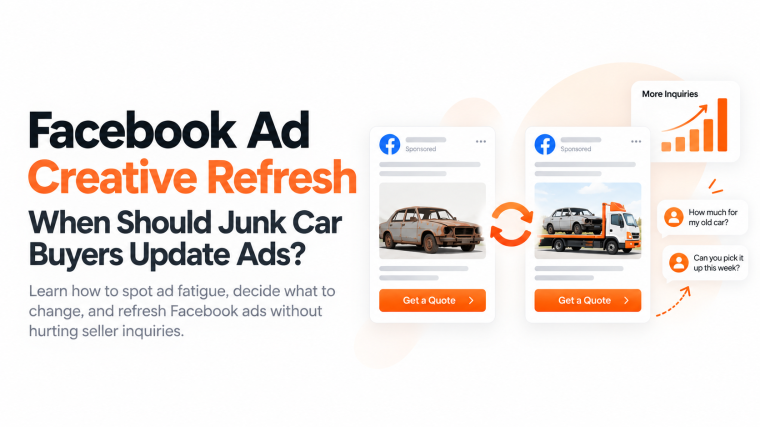
A Facebook ad creative refresh helps junk car buyers keep their advertising relevant when existing images, headlines, or buying messages begin losing effectiveness. However, updating ads too frequently can interrupt successful campaigns and waste advertising budget.
How often should junk car buyers refresh Facebook ads? There is no universal schedule. The right time to refresh creative is when performance data indicates declining seller responses, increasing cost per inquiry, or reduced advertising relevance—not simply because an ad has been running for a certain number of weeks.
At Pull Your Part Accelerator (PYP), we focus on Facebook advertising specifically for junk car buyers and self-service salvage yards. Our approach to a Facebook ad creative refresh is centered on maintaining relevant local seller inquiries while avoiding unnecessary changes to advertisements that are already performing well.
In this guide, we’ll explain how to recognize Facebook ad fatigue, identify when creative updates are necessary, choose what to change, and evaluate whether refreshed advertisements improve seller inquiry performance.
Need More Junk Car Leads in Your Local Market?
Stop relying on unpredictable seller inquiries. Pull Your Part Accelerator helps junk car buyers and salvage yards reach local vehicle owners through targeted Facebook Ads, local SEO, and organized lead tracking
📌 KEY TAKEAWAYS
- Refresh ads based on performance, not a fixed schedule: Update creative when seller inquiries decline, costs rise consistently, or ad relevance decreases—not simply because an ad is old.
- Recognize creative fatigue: Watch for rising ad frequency alongside declining responses, lower click-through rates (CTR), and increasing cost per inquiry.
- Keep successful ads running: If an ad continues generating relevant local seller inquiries at an acceptable cost, preserve it while testing new variations.
- Diagnose the real problem first: Poor performance may come from geographic targeting, higher delivery costs, campaign objectives, or contact issues—not necessarily ad creative.
- Know when creative needs updating: Investigate sustained increases in cost per genuine seller inquiry, fewer messages or calls, falling CTR, and inquiries from unsuitable sellers.
- Refresh vehicle images: Test authentic photos of damaged, unwanted, older, or non-running vehicles, using different angles and compositions.
- Test new headlines: Experiment with seller-focused messages such as “Got a Car You Don’t Want?” or “Have a Non-Running Vehicle?”
- Improve ad copy and offers: Test concise versus detailed copy, different seller motivations, clearer contact instructions, and accurate buying messages.
- Experiment with video: Compare static images with short videos featuring real vehicles, walkarounds, or pickup activity. Measure seller inquiries, not video views alone.
- Keep local messaging accurate: Update city references, service areas, and pickup claims when acquisition coverage or buying priorities change.
- Change one major variable at a time: Keep other campaign settings consistent where practical so you can identify which creative change influenced performance.
- Start with a manageable number of variations: Prepare two or three meaningful creative options when budget and audience size allow. Avoid spreading a limited budget across too many ads.
- Compare refreshed ads with the original: Track advertising spend, messaging conversations, cost per genuine seller inquiry, CTR, and qualified local seller opportunities.
- Prioritize lead quality over engagement: Cheap clicks and numerous messages don’t guarantee valuable leads. Check seller locations, vehicle suitability, and selling intent.
- Use acquisition feedback: When available, monitor qualified opportunities, quotes, completed vehicle purchases, and advertising cost per acquired vehicle.
- Avoid common mistakes: Don’t replace ads just because they’re old, react to one bad day, change several variables simultaneously, or launch new ads without tracking results.
- Follow a structured process: Establish a baseline, identify one issue, test a refreshed variation, compare results, and keep, replace, or retest based on sufficient evidence.
- Understand PYP’s role: Pull Your Part Accelerator (PYP) manages advertising strategy, creative development, and campaign optimization. Junk car buyers handle seller qualification, pricing, follow-up, pickup, and purchases.
How Often Should Junk Car Buyers Refresh Facebook Ad Creative?
A Facebook ad creative refresh should be based on campaign performance rather than a fixed calendar schedule. For junk car buyers, updating advertisements becomes worthwhile when existing images, headlines, or selling messages stop generating relevant local seller inquiries efficiently.
At Pull Your Part Accelerator (PYP), we focus on monitoring seller response patterns and identifying when creative changes may improve performance without unnecessarily disrupting successful campaigns.
Why There Is No Fixed Refresh Schedule
There is no universal rule requiring junk car buyers to refresh Facebook ads every 7, 14, or 30 days.
An advertisement may continue producing affordable, relevant seller inquiries for an extended period, while another may lose effectiveness much sooner.
The appropriate timing depends on how the campaign performs in its specific market.
What to check before refreshing:
- Is the cost per genuine seller inquiry increasing consistently?
- Are messaging conversations or attributable phone inquiries declining?
- Is ad frequency increasing alongside weaker response rates?
- Has the quality of incoming seller inquiries changed?
- Are campaign delivery conditions affecting performance?
A Facebook ad creative refresh is more useful when these signals indicate a meaningful problem rather than a temporary performance fluctuation.
What Affects How Quickly Ads Become Less Effective
Several factors can influence how soon junk car advertising creative begins losing effectiveness.
Audience size and geographic coverage: Campaigns targeting smaller local buying areas may repeatedly reach the same people, potentially increasing creative fatigue.
Ad frequency: Repeated exposure can reduce attention over time, especially when frequency rises alongside falling response rates.
Advertising budget: Higher spending relative to the available audience may increase exposure to the same creative more quickly.
Competition and market conditions: Changes in competing advertising activity can affect delivery costs and inquiry efficiency without necessarily indicating creative fatigue.
Seller relevance: An advertisement may become less suitable when the yard changes the vehicle types it wants to purchase or adjusts its acquisition area.
What to do: Evaluate these factors together. A rising cost per inquiry doesn’t automatically mean the image or headline needs replacing.
When a High-Performing Ad Should Stay Active
Not every advertisement needs a Facebook ad creative refresh.
If an existing creative consistently attracts relevant vehicle sellers at an acceptable cost, keeping it active may be more valuable than replacing it simply because it has been running for several weeks.
A successful advertisement may deserve to remain active when:
- Genuine seller inquiries remain consistent.
- Cost per inquiry stays within the buyer’s acceptable range.
- Incoming sellers are located within practical acquisition areas.
- Vehicle types and seller intent remain relevant.
- No significant performance decline is evident.
What to do: Preserve proven creative while monitoring performance. If you want to explore improvements, introduce a new variation for testing instead of immediately replacing the successful advertisement.
At Pull Your Part Accelerator, our approach to Facebook ad creative refresh decisions prioritizes advertising performance, local seller relevance, and useful inquiry volume. PYP develops and manages the campaigns, while junk car buyers handle vehicle qualification, pricing, follow-up, pickup, and purchases.
What Is Facebook Ad Creative Fatigue?
Facebook ad creative fatigue occurs when an advertisement becomes less effective after repeated exposure to the same audience. For junk car buyers, this may result in fewer seller inquiries, declining response rates, or increasing advertising costs even though the image, headline, and buying offer remain unchanged.
However, not every performance decline indicates creative fatigue. A Facebook ad creative refresh should be considered only after reviewing whether repeated exposure is contributing to weaker seller responses.
At Pull Your Part Accelerator (PYP), we focus on identifying meaningful performance changes before recommending updates to seller-focused advertising.
How Repeated Exposure Affects Seller Response
When potential vehicle sellers repeatedly see the same advertisement, they may become less likely to notice or respond to it.
Meta’s frequency metric indicates how many times an advertisement was shown per person on average during the selected reporting period.
As frequency increases, an advertisement may begin generating fewer new conversations from the same audience.
Possible warning signs include:
- Rising ad frequency alongside declining seller inquiries.
- Lower click-through rates despite continued impressions.
- Increasing cost per messaging conversation.
- Fewer genuine seller contacts from comparable advertising spend.
For example, a junk car advertisement that previously generated steady Messenger conversations may become less effective as the same local audience encounters it repeatedly.
What to do: Compare frequency trends with actual inquiry performance. High frequency alone doesn’t prove that a Facebook ad creative refresh is necessary.
Creative Fatigue vs. Normal Performance Fluctuations
Facebook advertising performance naturally changes from day to day.
One day may produce several seller inquiries, while the next generates fewer. These fluctuations can result from audience activity, advertising competition, delivery conditions, or changes in local seller demand.
Creative fatigue is more likely when weaker performance persists alongside evidence of repeated exposure.
Performance Pattern | Possible Explanation | Recommended Action |
One day of higher inquiry costs | Normal performance variation | Review a longer reporting period |
Rising frequency and falling response rates | Possible creative fatigue | Test refreshed images or headlines |
Higher CPM with stable CTR | More expensive ad delivery | Investigate competition and delivery |
Fewer messages with stable frequency | Possible response or audience issue | Review the offer, CTA, and targeting |
Stable inquiry costs and seller quality | Creative remains effective | Keep the advertisement running |
What to do: Look for consistent patterns across multiple metrics before attributing declining results to creative fatigue.
A Facebook ad creative refresh should address an identifiable performance issue, not become an automatic reaction to every increase in advertising costs.
Why Small Local Audiences May Experience Fatigue Differently
Junk car buyers often advertise within defined cities, counties, ZIP codes, or practical vehicle pickup areas.
Because these campaigns target geographically limited markets, the potential audience may be smaller than that of a broad regional or national campaign.
A smaller audience can experience repeated exposure more quickly, particularly when the advertising budget is relatively high compared with the available audience size.
However, local junk car acquisition also has an important distinction: not everyone who sees an advertisement currently has a vehicle to sell.
A person who ignores an ad today may become a potential seller later when their vehicle breaks down or becomes unwanted.
This means repeated exposure isn’t automatically wasted, and a higher frequency doesn’t always indicate that the creative has stopped working.
What to do:
- Review frequency alongside genuine seller inquiries.
- Compare performance across the actual acquisition area.
- Avoid expanding targeting beyond practical pickup coverage just to lower frequency.
- Test fresh vehicle imagery or seller-focused messages when response efficiency declines.
- Keep successful creative active when results remain acceptable.
At Pull Your Part Accelerator, we evaluate creative performance in the context of the buyer’s local market, advertising response data, and available seller feedback. Our goal is to maintain relevant direct inquiries without making unnecessary campaign changes.
Signs Your Facebook Ad Creative Needs Refreshing
A Facebook ad creative refresh becomes worth considering when campaign data shows that existing advertisements are losing their ability to generate relevant junk car seller inquiries. Warning signs may include rising inquiry costs, declining messaging conversations, increasing frequency, or reduced seller relevance.
However, no single metric proves that an advertisement needs replacing. At Pull Your Part Accelerator (PYP), we focus on identifying consistent performance patterns before making creative changes.
Rising Cost per Genuine Seller Inquiry
An increasing cost per seller inquiry is one of the clearest reasons to investigate advertising performance.
For example, if an advertisement previously generated genuine seller inquiries at $4 each but now costs $7 per inquiry, the change deserves attention.
These figures are illustrative, not actual PYP campaign results.
However, rising costs may result from more expensive ad delivery, weaker creative relevance, or fewer sellers completing the intended contact action.
What to check: Compare inquiry costs across similar reporting periods. Review CPM, CTR, and messaging results to determine whether creative performance is contributing to the increase.
A Facebook ad creative refresh may help when the existing message or visuals are attracting fewer relevant responses.
Declining Messaging Conversations or Calls
A decrease in messaging conversations or attributable phone inquiries can indicate that an advertisement is becoming less effective.
However, lower response volume doesn’t necessarily mean sellers have stopped noticing the creative.
Possible causes include changes in campaign delivery, audience size, budget, contact settings, or seller demand.
What to check: Compare actual seller inquiries against advertising spend and impressions. Confirm that the intended messaging or calling destination is functioning correctly.
If delivery remains relatively consistent but genuine responses continue declining, testing refreshed creative may be appropriate.
Increasing Frequency Alongside Weaker Response Rates
Ad frequency measures the average number of times people see an advertisement during a selected reporting period.
For junk car buyers targeting smaller geographic markets, repeated exposure can become an important performance consideration.
A rising frequency becomes more concerning when accompanied by declining response rates or increasing cost per inquiry.
What to check: Review frequency, reach, messaging results, and inquiry costs together.
High frequency alone doesn’t justify a Facebook ad creative refresh. An advertisement may continue reaching relevant vehicle owners who become interested in selling at different times.
Falling CTR or Rising CPC
Click-through rate (CTR) and cost per click (CPC) can help identify changes in how users respond to an advertisement.
A falling CTR may suggest that the image, headline, or buying message is attracting less attention.
A rising CPC may result from weaker click-through performance, increasing CPM, or a combination of both.
What to check: Compare CTR, CPC, and CPM with genuine seller inquiry results.
If CTR declines while inquiry costs increase, creative relevance may deserve investigation. However, clicks are supporting metrics—not proof of seller interest.
Reduced Seller Relevance or Changes in Acquisition Priorities
Sometimes a creative refresh is necessary even when advertising costs remain stable. For example, a salvage yard may change the types of vehicles it wants to purchase, adjust its pickup coverage, or prioritize a different local acquisition area.
An advertisement promoting outdated buying criteria can generate inquiries that no longer match the business’s needs.
What to check: Confirm that the creative accurately reflects the buyer’s current vehicle requirements, geographic coverage, and available services.
When acquisition priorities change, update the advertising message to reflect what the buyer can actually offer.
Facebook Ad Creative Refresh Diagnostic Table
Performance Signal | Possible Explanation | What to Investigate |
Rising cost per genuine seller inquiry | Weaker response efficiency or more expensive delivery | CPM, CTR, conversations, inquiry quality |
Declining messaging conversations or calls | Reduced seller response or contact friction | Delivery, CTA, response destination |
Rising frequency with fewer inquiries | Possible creative fatigue | Reach, frequency, response trends |
Falling CTR | Declining creative relevance | Vehicle images, headlines, offers |
Rising CPC | Higher CPM or weaker CTR | Delivery costs and click performance |
More inquiries from unsuitable sellers | Creative attracting the wrong audience | Vehicle messaging, seller location, buying criteria |
Change in acquisition priorities | Advertisement no longer reflects the business | Vehicle types, pickup coverage, buying offer |
When Should You Act on These Warning Signs?
Before starting a Facebook ad creative refresh, compare current results with a relevant performance baseline.
Look for consistent patterns rather than reacting to one unusually expensive day or a small number of seller conversations.
If the evidence points toward weaker creative relevance, test an updated image, headline, or buying message against the existing advertisement. If the evidence points toward geographic targeting, delivery costs, or contact friction, investigate those issues first.
At Pull Your Part Accelerator, we approach creative updates through seller-focused advertising performance and available buyer feedback. PYP develops and manages campaigns intended to generate direct local seller inquiries, while the junk car buyer handles qualification, quotes, follow-up, pickup, and purchases.
When Should You Refresh Creative Instead of Changing Targeting?
A Facebook ad creative refresh is most useful when the existing advertisement is losing relevance with an otherwise suitable audience. However, declining seller inquiries can also result from geographic targeting problems, incorrect campaign optimization, or unnecessary contact friction.
For junk car buyers, identifying the actual cause matters. Changing images or headlines won’t necessarily improve performance if the campaign is reaching sellers outside the yard’s service area or optimizing for the wrong action.
At Pull Your Part Accelerator (PYP), we evaluate creative performance alongside audience relevance and direct seller response data before deciding what needs improvement.
Signs the Creative Is the Likely Problem
Creative may be the main issue when an advertisement continues reaching a relevant local audience but generates fewer genuine seller inquiries over time.
Potential indicators include:
- Declining CTR alongside increasing cost per inquiry.
- Rising ad frequency combined with weaker seller response rates.
- Reduced engagement with previously successful vehicle images or headlines.
- Stable campaign settings but consistently declining inquiry performance.
- An outdated buying message that no longer reflects seller needs.
What to do: Compare recent results against the advertisement’s previous performance. If targeting and contact settings remain appropriate, test a new vehicle image, seller-focused headline, or offer.
A Facebook ad creative refresh is particularly appropriate when the advertisement’s message appears to be losing effectiveness rather than the audience becoming less relevant.
When Geographic Targeting Needs Attention Instead
Sometimes an advertisement generates plenty of responses, but the sellers are located too far away for profitable vehicle acquisition.
In this situation, replacing creative may not resolve the underlying problem.
Geographic targeting may need attention when:
- Inquiries regularly come from outside practical pickup areas.
- Advertising spend is concentrated in locations the yard cannot serve.
- Some areas generate responses but few suitable acquisition opportunities.
- Geographic audience settings no longer match the buyer’s actual service coverage.
What to do: Review the campaign’s location settings and compare available geographic performance data with seller locations reported to the buying team.
Also remember that Meta’s geographic targeting is not a guarantee that every person reached or every vehicle offered will be located inside the intended acquisition area.
If location mismatch is the primary issue, correct the targeting strategy before investing in a Facebook ad creative refresh.
When Campaign Objectives or Contact Methods Are Causing Friction
An advertisement may have relevant imagery and a clear buying message but still generate too few seller conversations because the campaign isn’t optimized for the intended response.
For example, an advertisement encouraging vehicle owners to send a message may underperform if the campaign is primarily optimized for website traffic rather than an appropriate direct-response action.
Contact friction can also occur when the advertisement promises one response method but directs sellers somewhere else.
What to check:
- Does the selected campaign objective support seller inquiries?
- Is the performance goal aligned with the intended contact action?
- Does the CTA match the messaging or calling destination?
- Can interested vehicle owners contact the buyer without unnecessary steps?
- Are reported clicks translating into genuine seller conversations?
What to do: Review the objective, performance goal, contact destination, and available response data before assuming creative fatigue.
If Meta is optimizing for an unsuitable action, a fresh image alone is unlikely to solve the problem.
Creative Refresh vs. Targeting: Quick Decision Guide
Performance Pattern | Likely Issue to Investigate | Recommended Action |
Relevant local audience, declining CTR and inquiries | Creative relevance or fatigue | Test refreshed imagery or headlines |
Frequent inquiries from outside the service area | Geographic targeting | Review location settings and acquisition coverage |
Strong clicks but few seller conversations | Campaign optimization or contact friction | Check performance goal, CTA, and response destination |
Rising CPM with relatively stable CTR | Advertising delivery costs | Investigate delivery conditions before refreshing |
Relevant inquiries at acceptable costs | No clear performance problem | Keep successful creative active |
These patterns are diagnostic starting points, not definitive proof of the cause.
At Pull Your Part Accelerator, we approach Facebook ad creative refresh decisions as part of broader campaign optimization. We consider the advertising message, geographic relevance, campaign objective, and seller response process together.
PYP develops and manages the advertising campaigns, while the junk car buyer handles vehicle qualification, quotes, follow-up, pickup, and purchases.
What Should Junk Car Buyers Change When Refreshing Facebook Ads?
A Facebook ad creative refresh doesn’t always require rebuilding an advertisement from scratch. Often, updating a vehicle image, testing a different headline, or improving the buying message can help restore seller interest while preserving elements that already work.
For junk car buyers, the goal is to introduce meaningful creative changes that encourage relevant local vehicle owners to contact the business.
At Pull Your Part Accelerator (PYP), we focus on refreshing seller-focused advertising based on campaign performance, rather than changing creative simply to make advertisements look different.
Update Vehicle Images Without Changing the Buying Offer
Vehicle imagery is one of the first elements to consider when refreshing Facebook ads.
If an advertisement featuring a damaged car begins losing effectiveness, try a different realistic image while keeping the original headline, primary text, and buying offer consistent.
What to test:
- A different damaged or non-running vehicle.
- Authentic vehicle photography instead of generic automotive imagery.
- An alternative image angle or composition.
- A clearer photograph showing the type of vehicle the yard purchases.
What to do: Compare the refreshed image against the existing advertisement using genuine seller inquiries and cost per response.
Keeping the offer unchanged helps determine whether the visual update contributed to any performance difference.
Test New Seller-Focused Headline Angles
A headline that previously generated strong responses may become less effective over time.
Rather than completely changing the advertisement, test a new headline that addresses a different seller motivation.
For example:
Existing Headline | Refreshed Headline |
We Buy Junk Cars | Got a Car You Don’t Want? |
Sell Your Junk Car | Have a Non-Running Vehicle? |
We Buy Damaged Cars | Wrecked Car Taking Up Space? |
These are illustrative variations, not guaranteed winning headlines.
What to do: Keep the image, offer, and contact method consistent when evaluating headline changes.
The strongest headline is the one that generates relevant seller inquiries, not necessarily the highest CTR.
Refresh Primary Text and Buying Messages
Sometimes the image and headline remain relevant, but the advertisement’s primary text needs improvement.
A Facebook ad creative refresh can involve simplifying the message, emphasizing a different seller problem, or making the buying offer easier to understand.
What to test:
- Short, direct copy versus a slightly more detailed explanation.
- General junk car buying language versus condition-specific messaging.
- A convenience-focused message versus a straightforward selling opportunity.
- Clearer instructions for contacting the buyer.
For example, instead of focusing only on the business buying junk cars, refreshed copy might address an owner with an unwanted vehicle who wants to discuss selling it locally.
What to do: Keep advertised benefits realistic and aligned with the yard’s actual buying process. Avoid unsupported promises about guaranteed prices, purchasing every vehicle, or immediate pickup.
Try Short Videos or Authentic Pickup Footage
If static vehicle images begin losing effectiveness, short videos can provide another creative approach worth testing.
Videos may communicate the vehicle-buying process more clearly, especially when they feature genuine vehicles or pickup activity.
Possible concepts include:
- A short walkaround of an unwanted vehicle.
- Authentic footage of a vehicle being prepared for pickup.
- A brief explanation of the types of cars the buyer purchases.
- A simple video showing a damaged or non-running vehicle with clear on-screen text.
What to do: Compare video creative against an existing static image while maintaining a similar offer, audience, and response destination.
Use actual seller inquiries to evaluate performance. Video views alone do not establish that the refreshed advertisement is generating better acquisition opportunities.
Update Local Messaging When Acquisition Areas Change
A creative refresh may also be necessary when a junk car buyer expands, reduces, or changes its vehicle acquisition coverage.
For example, an advertisement promoting vehicle buying in one city may need updated wording if the yard begins serving additional nearby areas.
What to update:
- City or service-area references.
- Local vehicle-buying messages.
- Pickup availability claims, where applicable.
- Geographic wording that no longer matches acquisition operations.
What to do: Ensure the refreshed message reflects locations where the business can realistically purchase vehicles.
Updating creative alone doesn’t change Meta’s geographic targeting settings, so review both when acquisition coverage changes.
Facebook Ad Creative Refresh Checklist
Creative Element | What to Refresh | What to Keep Consistent During the Test |
Vehicle image | Photo, vehicle type, or image angle | Headline and buying offer |
Headline | Seller problem or buying message | Image and primary text |
Primary text | Offer explanation or seller-focused wording | Image, headline, and contact method |
Creative format | Static image versus short video | Core offer and response destination |
Local messaging | City or service-area references | Buying offer, where practical |
At Pull Your Part Accelerator, we approach Facebook ad creative refresh decisions by identifying which elements may be limiting seller responses and testing relevant improvements.
PYP develops and manages advertising campaigns designed to generate direct local seller inquiries, while the junk car buyer handles vehicle qualification, pricing, follow-up, pickup, and purchases.
How to Refresh Facebook Ad Creative Without Disrupting Performance
A Facebook ad creative refresh should improve advertising effectiveness without unnecessarily interrupting campaigns that already generate relevant junk car seller inquiries. Replacing successful advertisements too quickly, making several changes simultaneously, or launching too many variations can make performance harder to evaluate.
At Pull Your Part Accelerator (PYP), we approach creative updates by preserving proven advertising concepts while testing improvements based on actual seller response data.
Keep Your Existing Successful Creative Running
If an advertisement consistently generates genuine seller inquiries at an acceptable cost, there’s no need to turn it off simply because you want to test something new.
Keeping the existing creative active provides a performance baseline and helps maintain ongoing seller inquiry opportunities.
What to do:
- Identify the advertisement currently producing the most relevant seller responses.
- Record its cost per genuine seller inquiry and recent performance trends.
- Keep it running while introducing new variations, provided the overall budget allows.
- Avoid unnecessary edits to a successful advertisement.
Maintaining a proven creative can reduce the risk of losing a reliable source of seller inquiries during testing.
Introduce Replacement Variations Gradually
Launching several replacement advertisements simultaneously can divide a limited budget and make performance comparisons difficult.
Instead, introduce a manageable number of creative variations based on the campaign’s budget and expected inquiry volume.
For example, if a damaged-vehicle advertisement has been performing well, test a new photograph featuring a similar vehicle before experimenting with entirely different messages and formats.
What to do: Start with one or two meaningful variations when budget permits. Use Meta’s available testing features or a carefully structured comparison rather than assuming the platform will distribute impressions equally.
A gradual Facebook ad creative refresh allows buyers to explore improvements without replacing the entire creative approach at once.
Compare Refreshed Ads Against the Original
A refreshed advertisement should be evaluated against the creative it is intended to improve or replace.
For junk car buyers, the comparison should prioritize genuine seller inquiries and their relevance to the yard’s acquisition needs.
Metric | Original Creative | Refreshed Creative |
Advertising spend | Record baseline | Compare under suitable conditions |
Messaging conversations | Track actual responses | Track actual responses |
Cost per genuine seller inquiry | Establish existing cost | Look for meaningful improvement |
Qualified local seller opportunities | Review buyer feedback | Compare seller relevance |
CTR and CPC | Supporting metrics | Diagnose performance differences |
What to do: Use comparable reporting periods and consistent measurement definitions. Avoid declaring the refreshed advertisement a winner based on a few early conversations.
Where available, formal Meta A/B testing can help create a more controlled comparison.
Avoid Changing Multiple Campaign Variables at Once
A Facebook ad creative refresh becomes difficult to evaluate when advertisers change creative, targeting, budgets, and campaign objectives simultaneously.
For example, if an updated advertisement performs better after the geographic audience and campaign objective also change, it’s difficult to determine which adjustment contributed to the improvement.
What to do: Keep major campaign settings consistent where practical while testing a specific creative change.
If audience targeting or campaign optimization genuinely needs correction, address that issue deliberately rather than treating the results as a pure creative comparison.
Also avoid repeatedly editing active ads without considering potential delivery and learning effects.
Pause Outdated Creative Only When Results Justify It
An older advertisement shouldn’t automatically be paused because a newer version is available.
Consider replacing it when the refreshed creative demonstrates a meaningful advantage in relevant seller inquiries, the original consistently underperforms, or its message no longer accurately reflects the buyer’s operations.
Before pausing, check:
- Has the refreshed advertisement received enough delivery and seller responses for a useful comparison?
- Is its cost per genuine seller inquiry better or acceptably similar?
- Are incoming sellers located within practical acquisition areas?
- Does the new creative attract suitable vehicles?
- Is the original advertisement genuinely underperforming or simply experiencing normal fluctuations?
What to do: Preserve the stronger creative based on performance evidence and business relevance. If results remain inconclusive, continue or repeat the test within a defined spending limit.
A Practical Facebook Ad Creative Refresh Process
Step | Action | Purpose |
1 | Identify the current successful creative | Establish a baseline |
2 | Choose one meaningful improvement | Create a clear testing hypothesis |
3 | Introduce a refreshed variation | Test without immediately removing the original |
4 | Compare genuine seller inquiry results | Evaluate performance and relevance |
5 | Keep, replace, or retest | Make an evidence-based decision |
At Pull Your Part Accelerator, we treat Facebook ad creative refresh decisions as part of ongoing campaign optimization. Our focus is on maintaining direct local seller inquiries while using advertising performance and available buyer feedback to guide improvements.
PYP develops and manages the advertising campaigns, while the junk car buyer handles vehicle qualification, quoting, follow-up, pickup, and completed purchases.
How Many Fresh Facebook Ad Creatives Should You Prepare?
For junk car buyers, a Facebook ad creative refresh doesn’t require producing dozens of new advertisements. A practical starting point is to prepare two or three meaningful creative variations, provided the campaign has enough budget and audience reach to test them effectively.
The ideal number depends on advertising spend, local market size, and how quickly the campaign generates seller inquiries.
At Pull Your Part Accelerator (PYP), we focus on developing purposeful creative variations rather than increasing the number of advertisements without a clear testing strategy.
Start With a Manageable Number of Variations
When refreshing Facebook ads, begin with a small selection of creative concepts that address a specific performance issue.
For example, if an existing advertisement featuring an unwanted vehicle is losing effectiveness, possible replacements include:
- Variation A: A different photograph of an unwanted vehicle.
- Variation B: A damaged vehicle image with the existing buying message.
- Variation C: A new seller-focused headline using the original image.
Each variation should have a clear purpose. When testing a specific element, keep other major elements consistent wherever practical.
What to do: Prioritize one or two promising variations alongside the existing advertisement. Add further concepts only when the campaign can support meaningful comparisons.
Match Creative Volume to Budget and Audience Size
The number of creatives tested should reflect the campaign’s available advertising budget and geographic audience. A smaller salvage yard advertising within a limited pickup area may struggle to collect useful results if its budget is divided across too many variations.
For example, testing eight advertisements with a limited daily budget may leave each variation with too few seller inquiries to evaluate reliably. Larger campaigns may support more creative comparisons, but additional variations don’t automatically improve performance.
What to check:
- How much budget is available for testing?
- How many genuine seller inquiries does the campaign typically generate?
- Is the geographic audience large enough to support additional variations?
- Can each creative receive sufficient delivery for a useful comparison?
- Are the variations testing different hypotheses or simply repeating similar messages?
What to do: Choose a testing volume that allows meaningful evaluation without unnecessarily reducing the budget available to proven advertisements.
Maintain a Small Library of Proven Concepts
An effective Facebook ad creative refresh strategy becomes easier when advertisers maintain a record of previously successful creative concepts.
Instead of rebuilding campaigns from scratch, junk car buyers can revisit images, headlines, and offers that generated relevant seller inquiries.
A simple creative library might include:
Creative Concept | What to Save | Potential Future Refresh |
Unwanted vehicle imagery | Successful vehicle photos and headlines | Test a different photo |
Damaged vehicle messaging | Relevant seller-focused offers | Try a new headline angle |
Non-running vehicle ads | Effective images and copy | Test an updated visual |
Local buying messages | Accurate service-area wording | Update geographic messaging when coverage changes |
Pickup-focused creative | Authentic pickup photos or footage | Test a short video variation |
Store performance results alongside each concept, including cost per genuine seller inquiry and available seller-quality feedback.
What to do: Reuse proven ideas as starting points, but test them again when audience conditions, acquisition priorities, or campaign settings change. Previous success doesn’t guarantee future results.
At Pull Your Part Accelerator, we approach Facebook ad creative refresh planning by balancing creative variety with meaningful performance evaluation. Our focus is on developing relevant advertising concepts for junk car sellers while preserving successful campaigns whenever possible.
PYP manages the advertising strategy and creative optimization, while the junk car buyer handles seller qualification, quotes, follow-up, pickup, and purchases.
How Do You Know Whether a Creative Refresh Worked?
A Facebook ad creative refresh is successful when updated advertisements generate more relevant junk car seller inquiries, improve response efficiency, or maintain strong results at an acceptable cost.
To evaluate the changes, compare refreshed creative against the original advertisement using consistent reporting periods and comparable campaign conditions.
Compare Cost per Genuine Seller Inquiry
Cost per genuine seller inquiry is one of the most useful indicators of creative refresh performance.
Cost per seller inquiry = Advertising spend ÷ Genuine seller inquiries
For example, if the original advertisement costs $6 per genuine inquiry and the refreshed version costs $4.50, the updated creative may be more efficient.
These figures are illustrative, not actual PYP campaign results.
What to do: Look for a meaningful improvement supported by sufficient inquiries. A lower cost based on only a few responses isn’t conclusive.
Monitor Messaging and Call Responses
A successful Facebook ad creative refresh should encourage more potential sellers to complete the intended contact action.
Depending on the campaign setup, monitor:
- Messaging conversations started.
- Attributable phone inquiries, when measurable.
- Cost per messaging conversation or genuine call.
- Actual seller contacts compared with Meta’s reported results.
What to do: Evaluate completed seller inquiries rather than relying only on clicks, reactions, or call-button interactions.
Check Seller Location and Vehicle Relevance
More conversations don’t necessarily mean better advertising performance.
A refreshed advertisement might generate cheaper inquiries from sellers outside the yard’s pickup area or from owners of unsuitable vehicles.
What to do: Review whether incoming sellers are located within practical acquisition areas and whether their vehicles match the buyer’s purchasing criteria.
A refresh that improves inquiry quality may be valuable even without a substantial reduction in cost per conversation.
Use Acquisition Feedback When Available
When the buying team provides reliable feedback, compare how inquiries from each creative progress through the acquisition process.
Useful indicators include:
- Qualified seller opportunities.
- Vehicle quotes generated.
- Vehicles purchased.
- Advertising cost per acquired vehicle.
These results help determine whether the Facebook ad creative refresh contributes to stronger acquisition opportunities.
PYP manages advertising and generates direct seller inquiries, while the junk car buyer handles qualification, pricing, follow-up, pickup, and completed purchases.
Creative Refresh Performance Checklist
Metric | What to Evaluate |
Cost per genuine seller inquiry | Has inquiry efficiency improved? |
Messaging conversations or calls | Are more sellers contacting the buyer? |
Seller location | Are inquiries within the acquisition area? |
Vehicle relevance | Do inquiries match buying criteria? |
Acquisition feedback | Are inquiries progressing to quotes or purchases? |
The key takeaway: Measure a Facebook ad creative refresh by genuine seller inquiries, response costs, and seller relevance—not engagement alone. When available, acquisition feedback provides additional evidence of whether the updated creative is helping the business generate better vehicle-buying opportunities.
Common Facebook Ad Creative Refresh Mistakes
A Facebook ad creative refresh can help improve seller inquiry performance, but unnecessary changes may disrupt successful campaigns or make results harder to evaluate.
For junk car buyers, the goal is to update advertisements based on meaningful performance evidence rather than assumptions.
Replacing Successful Ads Based Only on Age
An advertisement doesn’t automatically become ineffective after running for several weeks.
If it continues generating relevant local seller inquiries at an acceptable cost, replacing it simply because it is old may be unnecessary.
What to do: Monitor cost per genuine seller inquiry, response volume, and seller relevance. Keep successful advertisements active until performance data or changes in buying priorities justify an update.
Refreshing Creative Without Diagnosing Performance
Rising advertising costs or declining inquiries don’t always indicate creative fatigue. The underlying cause may involve geographic targeting, campaign delivery, competition, or problems with the contact method.
What to do: Review CPM, CTR, frequency, and actual seller responses before deciding whether a Facebook ad creative refresh is appropriate. Fix targeting or response-path problems separately when those are the primary issues.
Making Too Many Changes Simultaneously
Changing the image, headline, offer, audience, and campaign objective together makes it difficult to identify what affected performance.
Even if results improve, the advertiser may not know which adjustment contributed to the change.
What to do: Test one major creative difference at a time where practical. Keep other campaign conditions comparable so the results provide useful information.
Using New Visuals That Attract the Wrong Audience
Fresh imagery can increase attention without improving seller inquiry quality.
For example, luxury vehicle photos, dealership-style graphics, or unrelated automotive images may attract people who aren’t interested in selling unwanted cars.
What to do: Use realistic images of damaged, unwanted, older, or non-running vehicles that match the yard’s purchasing criteria.
Evaluate refreshed visuals using genuine seller inquiries rather than engagement alone.
Ignoring Results After Launching Replacement Ads
Launching refreshed creative without measuring its performance defeats the purpose of updating it.
A new advertisement may generate cheaper conversations but attract sellers outside the acquisition area or owners of unsuitable vehicles.
What to do: Compare replacement creative with the original using consistent metrics, including cost per inquiry, response volume, and seller relevance.
Keep, adjust, or pause variations based on sufficient evidence.
The key takeaway: Avoid unnecessary Facebook ad creative refresh mistakes by diagnosing performance first, preserving successful advertisements, and evaluating every meaningful change against genuine seller inquiry results.
How Pull Your Part Accelerator Manages Facebook Ad Creative Refreshes
At Pull Your Part Accelerator (PYP), we approach Facebook ad creative refresh decisions specifically for junk car buyers and self-service salvage yards.
Our focus is on maintaining advertising relevance and generating direct inquiries from local vehicle owners who may want to sell unwanted, damaged, wrecked, or non-running cars.
Rather than changing advertisements on a fixed schedule, our approach centers on campaign performance and the buyer’s actual acquisition needs.
Monitoring seller response performance: We evaluate available advertising metrics, including messaging conversations, response costs, CTR, and frequency, to identify when existing creative may need attention.
Refreshing seller-focused messages: We develop relevant variations of vehicle imagery, headlines, and buying offers that address real seller situations without relying on exaggerated claims.
Maintaining geographic relevance: We align advertising messages with the yard’s practical acquisition areas so potential sellers understand where the buyer operates.
Protecting successful creative: When an advertisement continues generating useful seller inquiries, we prioritize preserving effective concepts while testing improvements where appropriate.
Evaluating meaningful results: We focus on direct seller responses rather than likes or clicks alone. When buyers share reliable information about seller quality, quotes, or purchased vehicles, that feedback can also inform advertising decisions.
PYP handles advertising strategy, creative development, and campaign optimization. The junk car buyer remains responsible for vehicle qualification, pricing, seller follow-up, pickup arrangements, and completed purchases.
Keep Your Facebook Advertising Relevant to Local Sellers
A successful Facebook ad creative refresh strategy isn’t about constantly replacing advertisements. It’s about recognizing when existing creative needs improvement and introducing changes that support relevant seller inquiries.
If your salvage yard wants specialized Facebook advertising focused on direct vehicle seller acquisition, explore Pull Your Part Accelerator’s Junk Car Lead Generation Services.
Frequently Asked Questions
Junk car buyers should refresh Facebook ad creative when performance data indicates declining seller inquiries, increasing response costs, or reduced advertising relevance.
There is no fixed 7-, 14-, or 30-day schedule. A Facebook ad creative refresh should be based on sustained performance changes rather than the advertisement’s age. Keep successful ads running while they continue generating relevant seller inquiries at an acceptable cost.
Common signs of Facebook ad fatigue include rising ad frequency, declining click-through rates, fewer messaging conversations, and increasing cost per genuine seller inquiry.
These signals are more meaningful when they occur together over time. Before refreshing creative, check whether geographic targeting, advertising competition, or campaign delivery changes may also explain the decline.
No. High Facebook ad frequency alone doesn’t mean an advertisement needs refreshing.
Frequency measures the average number of times people see an ad during a selected reporting period. A Facebook ad creative refresh becomes more relevant when increasing frequency is accompanied by fewer genuine seller inquiries or higher response costs.
If the advertisement continues generating suitable local sellers efficiently, it may remain effective despite repeated exposure.
Not immediately. An increase in cost per lead may reflect normal performance fluctuations, higher advertising competition, or reduced response efficiency.
Compare results across relevant reporting periods and investigate CPM, CTR, messaging conversations, and seller quality.
If creative fatigue appears to be the cause, test a refreshed variation before replacing the existing advertisement. Pause underperforming ads when sufficient evidence or a predefined spending limit justifies the decision.
Yes. Changing a vehicle image can improve Facebook ad performance if the new visual attracts more relevant local vehicle sellers.
For example, replacing a generic automotive image with a realistic damaged or non-running vehicle may make the buying message clearer.
However, improvement isn’t guaranteed. Test the new image against the original while keeping other major elements consistent, and compare genuine seller inquiries rather than clicks alone.
Refresh existing ad creative when the campaign’s objective, geographic targeting, and response method remain appropriate, but its images or messages need improvement.
A new campaign may be appropriate when the advertising objective, acquisition strategy, or contact method requires a substantial change.
For a typical Facebook ad creative refresh, testing new variations within a suitable existing campaign is often more practical than rebuilding the entire campaign.
To refresh Facebook ad creative without unnecessarily disrupting performance, keep your successful advertisement running while testing a new variation.
Follow these steps:
- Record the original creative’s cost per genuine seller inquiry.
- Change one meaningful element, such as the image or headline.
- Maintain comparable targeting and response settings.
- Allow enough time and budget to collect useful results.
- Compare seller inquiry costs and quality before replacing the original.
At Pull Your Part Accelerator (PYP), our approach to a Facebook ad creative refresh focuses on preserving effective seller-acquisition campaigns while testing improvements that support relevant local inquiries.