
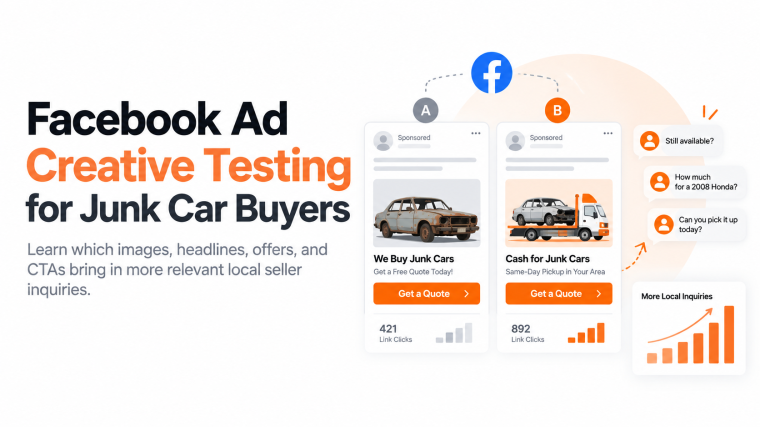
Facebook ad creative testing helps junk car buyers identify which images, headlines, offers, and advertising messages generate the most relevant seller inquiries. Instead of guessing what attracts vehicle owners, businesses can compare creative variations and use campaign results to improve advertising performance.
The most effective approach to Facebook ad creative testing is to establish a baseline, test meaningful differences while keeping other variables consistent where practical, and compare actual messaging conversations or seller calls—not just clicks and reactions. The goal is to understand which advertisements attract local vehicle owners who genuinely want to sell.
At Pull Your Part Accelerator (PYP), we specialize in Facebook advertising for junk car buyers and salvage yards. Our approach focuses on developing and evaluating seller-focused campaigns that connect businesses with owners of unwanted, damaged, older, or non-running vehicles.
In this guide, we’ll explain how Facebook ad creative testing works, what elements to test, how to measure results, and how to identify creative variations that generate stronger seller-acquisition opportunities.
Need More Junk Car Leads in Your Local Market?
Stop relying on unpredictable seller inquiries. Pull Your Part Accelerator helps junk car buyers and salvage yards reach local vehicle owners through targeted Facebook Ads, local SEO, and organized lead tracking
📌 KEY TAKEAWAYS
- Test ads instead of guessing: Compare different images, headlines, offers, and messages to identify which generate relevant junk car seller inquiries.
- Use seller-focused visuals: Test photos of damaged, older, unwanted, and non-running vehicles against branded graphics or pickup videos.
- Test clear headlines: Compare problem-focused messages like “Got a Car You Don’t Want?” with direct offers like “We Buy Junk Cars.”
- Experiment with ad copy and offers: Test short versus detailed copy, local buying messages, and accurate pickup offers to see what attracts genuine sellers.
- Test calls to action (CTAs): Compare messaging prompts such as “Message Us About Your Car” and “Tell Us What Vehicle You Want to Sell.”
- Change one major variable at a time: Keep the audience, budget, campaign objective, offer, and response method consistent where practical to make results easier to interpret.
- Establish a baseline: Record current ad spend, messaging conversations, cost per inquiry, click-through rate (CTR), and qualified seller opportunities before testing.
- Measure meaningful results: Prioritize genuine seller inquiries, cost per inquiry, qualified local sellers, and completed vehicle purchases when reliable data is available—not just clicks, likes, or reactions.
- Evaluate seller quality: Consider vehicle condition, location, selling intent, ownership documentation, and whether the vehicle meets the buyer’s requirements.
- Give tests enough time and budget: Avoid choosing a winner based on only a few inquiries. Define a spending limit and decision criteria before launching.
- Use structured A/B testing when appropriate: Meta’s testing tools can help compare creative variations more systematically. Avoid spreading a limited budget across too many ads.
- Learn from five practical tests: Compare damaged versus unwanted vehicle images, problem-focused versus direct headlines, local versus general offers, static images versus video, and different messaging CTAs.
- Avoid common mistakes: Don’t change multiple variables simultaneously, optimize for engagement alone, stop tests prematurely, or ignore feedback from the vehicle-buying team.
- Keep successful ads running: Build new variations around proven concepts, refresh creative when performance declines, and document results to guide future tests.
- Understand PYP’s role: Pull Your Part Accelerator (PYP) develops and optimizes Facebook advertising to generate direct seller inquiries. The junk car buyer handles qualification, pricing, follow-up, pickup, and purchases.
Why Facebook Ad Creative Testing Matters for Junk Car Buyers
Facebook ad creative testing helps junk car buyers understand which advertising messages, images, and offers encourage local vehicle owners to respond. An ad might generate plenty of clicks or reactions without attracting sellers who actually want to sell their cars.
At Pull Your Part Accelerator (PYP), we approach creative testing with a specific goal: identifying advertisements that generate relevant seller inquiries rather than simply increasing Facebook engagement.
Different Seller Problems Require Different Messages
Not every vehicle owner has the same reason for selling. Some have damaged cars, others have non-running vehicles, and some simply want to remove an unwanted car from their driveway.
A single advertising message may not connect equally well with every seller situation.
For example:
- Unwanted vehicle: “Got a Car You Don’t Want?”
- Non-running vehicle: “Car Won’t Start? We Buy Non-Running Cars.”
- Damaged vehicle: “Have a Wrecked or Damaged Car?”
- Local seller: “Sell Your Junk Car to a Local Buyer.”
Facebook ad creative testing allows buyers to compare these messaging angles and identify which ones generate more relevant conversations in their markets.
The Most Engaging Ad Isn't Always the Best-Performing Ad
An eye-catching advertisement may generate reactions, comments, and clicks without producing meaningful seller inquiries.
For example, a dramatic wrecked-car image might attract attention because it looks unusual, not because viewers are interested in selling a vehicle.
That’s why Facebook ad creative testing should evaluate more than engagement metrics.
Useful performance indicators include:
- Messaging conversations started.
- Phone inquiries, where applicable.
- Cost per seller inquiry.
- Relevant local seller contacts.
- Qualified acquisition opportunities, when buyer feedback is available.
The best-performing creative isn’t necessarily the one getting the most attention. It’s the one generating useful seller inquiries at an acceptable cost.
Testing Helps Reduce Decisions Based on Guesswork
Without structured testing, advertisers may choose creative based on personal preferences rather than actual campaign performance.
For example, a polished branded graphic may look more professional, while a simple photograph of an unwanted vehicle may generate more relevant responses. Neither should be assumed to perform better without testing.
Facebook ad creative testing provides a more reliable way to compare meaningful variations and understand which messages resonate with potential sellers.
What to do: Test one major creative difference at a time where practical, maintain comparable campaign conditions, and allow enough response data before drawing conclusions.
At Pull Your Part Accelerator, we focus on using advertising performance and available seller feedback to guide creative decisions. PYP develops the campaigns that generate direct seller inquiries, while the junk car buyer handles qualification, quoting, follow-up, and vehicle purchases.
What Should Junk Car Buyers Test in Facebook Ad Creative?
Effective Facebook ad creative testing involves comparing specific advertising elements to identify which ones generate more relevant junk car seller inquiries. Rather than changing every part of an advertisement, junk car buyers should test meaningful variations that can influence seller interest and response behavior.
At Pull Your Part Accelerator (PYP), we focus on evaluating the creative elements that help connect local vehicle owners with junk car buyers—not simply those that increase clicks or engagement.
Vehicle Images and Visual Concepts
Different vehicle images can attract different types of seller attention. Testing helps identify which visual concepts encourage potential sellers to contact the buyer.
What to test:
- Real unwanted vehicle photos vs. branded vehicle graphics.
- Damaged vehicles vs. older, unused vehicles.
- Vehicle-only images vs. actual pickup scenes.
What to measure:
Messaging conversations, cost per inquiry, and relevant seller responses. The objective is to determine which visual approach attracts vehicle owners with genuine selling intent.
Seller-Focused Headlines
Headlines can influence whether someone immediately recognizes that an advertisement applies to their situation.
Facebook ad creative testing can compare different headline approaches while keeping the main image and buying offer consistent.
What to test:
- Problem-focused headlines vs. direct buying statements.
- General junk car messaging vs. vehicle-condition-specific messaging.
- Local buying headlines vs. broader seller-focused language.
What to measure:
Seller inquiries generated by each headline variation, supported by CTR and other engagement metrics.
Primary Ad Copy and Buying Offers
The primary text should clearly explain what the buyer purchases and why contacting the business may be worthwhile.
Testing different messages can reveal whether sellers respond more strongly to convenience, local availability, or specific vehicle-buying offers.
What to test:
- Short, direct copy vs. slightly more detailed explanations.
- General vehicle-buying offers vs. condition-specific offers.
- Local pickup messaging vs. straightforward buying messages, where pickup is genuinely available.
What to measure:
Cost per seller inquiry and the relevance of resulting conversations. Every advertised benefit should reflect what the yard can actually deliver.
Images vs. Short Videos
Static images and videos communicate selling opportunities differently.
A photograph may quickly show the type of vehicle the buyer wants, while a short video can demonstrate a real pickup or explain the buying service.
What to test:
- Static vehicle images vs. short vehicle videos.
- Branded graphics vs. authentic pickup footage.
- Simple vehicle walkarounds vs. direct seller-focused messages.
What to measure:
Messaging conversations, cost per inquiry, and qualified seller opportunities when available. Facebook ad creative testing should determine which format performs better in the specific market rather than assuming video or images will always win.
Calls to Action and Response-Message Alignment
The call to action (CTA) should clearly match how potential sellers are expected to contact the junk car buyer.
For messaging campaigns, advertisers can test different wording that encourages sellers to start a conversation while keeping the actual response destination consistent.
What to test:
- “Message Us About Your Car” vs. “Tell Us What Vehicle You Have.”
- Direct selling language vs. qualification-focused messaging.
- Different CTA wording within the primary text or creative.
When comparing Messenger and phone-call destinations, treat them as separate response-path tests rather than pure creative tests because the contact experience also changes.
What to measure:
Completed messaging conversations or attributable calls, cost per actual inquiry, and seller relevance.
Test One Meaningful Difference at a Time
For Facebook ad creative testing to produce useful insights, avoid changing images, headlines, offers, audiences, and response methods simultaneously.
Where practical, keep campaign conditions comparable and isolate the main element being tested.
At Pull Your Part Accelerator, the objective is to identify which creative elements encourage relevant local vehicle owners to contact the junk car buyer. The buying team then handles qualification, pricing, follow-up, and vehicle purchases.
How to Set Up a Facebook Ad Creative Test
A successful Facebook ad creative testing process starts with a clear objective, a reliable performance baseline, and controlled comparisons. Without a structured approach, junk car buyers may spend money testing advertisements without understanding which changes actually improve seller inquiries.
At Pull Your Part Accelerator (PYP), we focus on evaluating creative variations based on their ability to attract relevant local vehicle sellers—not simply generate more engagement.
Choose One Clear Testing Objective
Before launching a test, decide exactly what you want to improve.
For junk car acquisition campaigns, useful testing objectives include:
- Increasing messaging conversations from potential sellers.
- Reducing cost per seller inquiry.
- Improving the relevance of incoming vehicle seller conversations.
- Identifying which advertising message attracts stronger local interest.
For example, a test might answer: “Do non-running vehicle images generate more relevant seller inquiries than general junk car images?”
What to do: Define one primary objective and select the metric that will determine whether the test is successful.
Establish a Baseline Using Current Campaign Performance
Before introducing new creative, review how your existing advertisements perform.
This baseline provides a reference for determining whether the new variation produces better results.
Record relevant metrics such as:
- Advertising spend.
- Messaging conversations started.
- Cost per seller inquiry.
- Click-through rate (CTR).
- Cost per click (CPC).
- Qualified seller opportunities, when buyer feedback is available.
For example, if your current advertisement generates seller conversations at $4 each, that becomes a useful comparison point for a new creative test.
This figure is illustrative, not an actual PYP client result.
What to do: Compare performance over a consistent reporting period and use the same definition of a seller inquiry throughout the test.
Create Meaningful Creative Variations
Effective Facebook ad creative testing should compare advertisements with a clear difference in their message or visual approach.
For example:
Creative A: An image of an older unwanted vehicle with the headline “Got a Car You Don’t Want?”
Creative B: An image of a non-running vehicle with the same headline and offer.
This test primarily examines whether the vehicle image influences seller response.
If the image, headline, copy, and offer all change, it becomes difficult to determine which element contributed to the result.
What to do: Develop variations around one specific hypothesis rather than making random creative changes.
Keep Audience, Budget, and Response Method Consistent Where Practical
Creative performance is easier to compare when other campaign conditions remain similar.
For example, testing two images against substantially different audiences may reveal more about audience differences than the effectiveness of the images themselves.
For a more reliable comparison:
- Use comparable geographic audiences.
- Maintain the same campaign objective and performance goal.
- Keep the response destination consistent.
- Use comparable budgets and testing periods.
- Avoid unnecessary campaign edits while collecting results.
What to do: Keep the test focused on the creative element you want to evaluate.
However, simply running two ads in the same ad set does not guarantee equal delivery. Meta may allocate impressions unevenly based on its delivery system.
Use Meta's A/B Testing Tools When Appropriate
Meta Ads Manager offers A/B testing capabilities that can help advertisers compare campaign variations under more controlled conditions.
Where available, these tools can be used to compare creative variations while reducing audience overlap and other factors that may distort results.
For example, a junk car buyer could test:
- Version A: A realistic damaged vehicle image.
- Version B: A realistic non-running vehicle image.
Both versions would use the same seller-focused headline, buying offer, and intended response method.
The comparison should prioritize relevant seller conversations and cost per inquiry rather than declaring a winner based only on clicks.
What to do: Use Meta’s available A/B testing features when the campaign has sufficient budget and expected response volume. Smaller campaigns may need simpler, carefully monitored tests rather than splitting limited spend across too many variations.
Document the Test Before Making Changes
A simple testing record can make Facebook ad creative testing more useful over time.
Test Element | Example |
Testing objective | Increase relevant seller inquiries |
Variable | Vehicle image |
Creative A | Older unwanted vehicle |
Creative B | Non-running vehicle |
Audience | Same local buying market |
Response method | Messenger |
Primary metric | Cost per genuine seller inquiry |
Supporting metric | Qualified seller opportunities |
Decision | Keep, retest, or replace based on sufficient evidence |
Illustrative testing plan, not actual PYP campaign results.
At Pull Your Part Accelerator, we approach Facebook ad creative testing as a structured process of evaluating seller-focused advertising concepts, comparing meaningful results, and using available buyer feedback to guide improvements.
PYP creates and optimizes the advertising campaigns, while the junk car buyer handles incoming conversations, qualification, quoting, follow-up, and vehicle purchases.
Facebook Ad Creative Testing Examples for Junk Car Buyers
Practical Facebook ad creative testing helps junk car buyers determine which advertising approaches generate more relevant seller inquiries. Instead of testing random advertisements, each experiment should answer a specific question about vehicle imagery, headlines, offers, video formats, or messaging.
At Pull Your Part Accelerator (PYP), we focus on comparing creative elements that influence genuine seller responses—not simply which advertisements receive the most clicks or reactions.
The following five tests provide practical starting points for junk car acquisition campaigns.
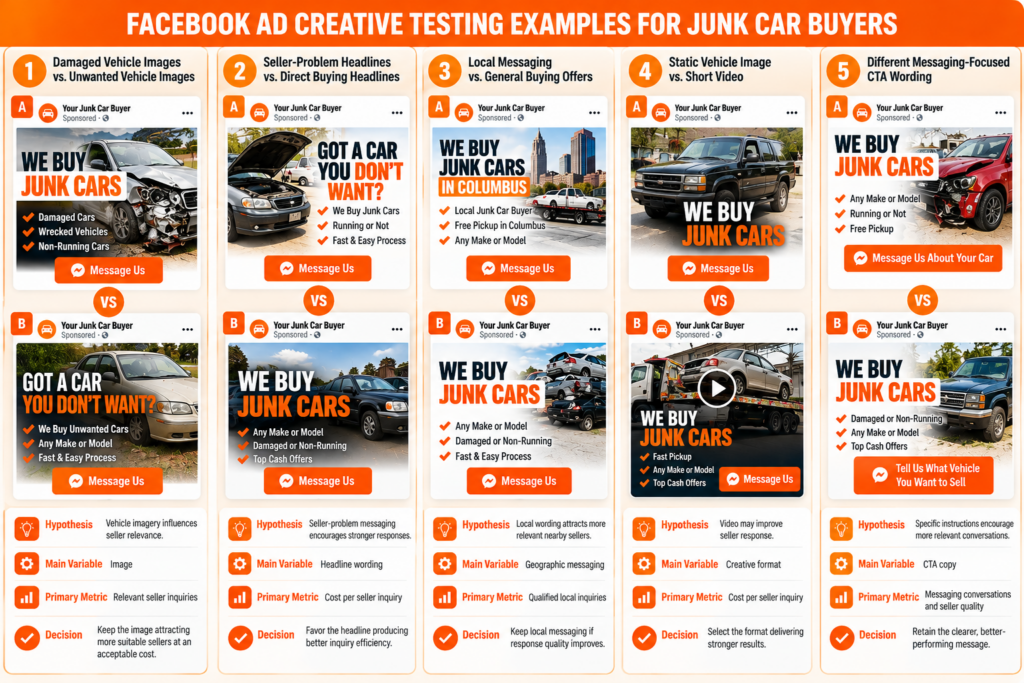
Test 1: Damaged Vehicle Images vs. Unwanted Vehicle Images
Different vehicle images may connect with different seller situations.
Testing hypothesis: Images showing visibly damaged vehicles may attract a different mix of sellers than images showing older, unwanted vehicles.
- Creative A: A collision-damaged car with the headline “We Buy Junk Cars.”
- Creative B: An older, unwanted car with the same headline.
- Variable: Vehicle imagery.
- Primary metric: Cost per genuine seller inquiry.
How to evaluate: Compare messaging conversations and seller relevance. Determine whether either image consistently generates inquiries involving vehicles the yard wants to purchase.
Test 2: Seller-Problem Headlines vs. Direct Buying Headlines
Some vehicle owners may respond more strongly to a message describing their problem, while others may prefer a straightforward buying offer.
Testing hypothesis: A problem-focused headline may encourage more seller responses than a general vehicle-buying statement.
- Creative A: “Got a Car You Don’t Want?”
- Creative B: “We Buy Junk Cars.”
- Variable: Headline wording.
- Primary metric: Cost per seller inquiry.
How to evaluate: Keep the image, primary text, and response method consistent. Compare which headline generates more relevant conversations at an acceptable cost.
Test 3: Local Messaging vs. General Buying Offers
Local messaging may help potential sellers recognize that the business operates in their area.
Testing hypothesis: Including the actual buying location may improve response relevance compared with general junk car buying language.
- Creative A: “We Buy Junk Cars in Columbus.”
- Creative B: “We Buy Junk Cars.”
- Variable: Geographic wording.
- Primary metric: Relevant local seller inquiries.
How to evaluate: Compare inquiry volume, cost per inquiry, and actual vehicle locations reported by sellers.
Use city names only where the buyer genuinely provides acquisition services.
Test 4: Static Vehicle Image vs. Short Video
Static images and videos communicate vehicle-buying opportunities differently.
Testing hypothesis: A short vehicle-focused video may generate more meaningful seller responses than a static image.
- Creative A: A clear photograph of an unwanted vehicle.
- Creative B: A short video showing the same vehicle with a simple buying message.
- Variable: Creative format.
- Primary metric: Cost per seller inquiry.
How to evaluate: Use consistent offers, headlines, and response destinations. Compare actual messaging conversations or calls rather than assuming video performs better because it receives more engagement.
Test 5: Different Messaging-Focused CTA Wording
The wording used to encourage sellers to respond may influence whether they start a conversation.
Testing hypothesis: A specific instruction about the vehicle may generate more relevant messages than a general contact request.
- Creative A: “Message Us About Your Car.”
- Creative B: “Tell Us What Vehicle You Want to Sell.”
- Variable: CTA wording within the advertising copy.
- Primary metric: Messaging conversations started and relevant seller inquiries.
How to evaluate: Keep the Messenger destination and available Meta CTA button consistent. Compare the conversations generated by each wording variation.
This isolates the advertising message rather than changing the actual contact method.
Facebook Ad Creative Testing Comparison Table
Test | Hypothesis | Main Variable | Primary Metric | Decision |
Damaged vs. unwanted vehicle | Vehicle imagery influences seller relevance | Image | Relevant seller inquiries | Keep the image attracting more suitable sellers at an acceptable cost |
Problem vs. buying headline | Seller-problem messaging encourages stronger responses | Headline | Cost per inquiry | Favor the headline producing better inquiry efficiency |
Local vs. general offer | Local wording attracts more relevant nearby sellers | Geographic messaging | Qualified local inquiries | Keep local messaging if response quality improves |
Static image vs. video | Video may improve seller response | Creative format | Cost per inquiry | Select the format delivering stronger results |
Messaging CTA wording | Specific instructions encourage more relevant conversations | CTA copy | Messaging conversations and seller quality | Retain the clearer, better-performing message |
These are proposed experiments, not verified PYP campaign results. Each decision should be based on sufficient evidence rather than a small difference in early performance.
How to Use These Tests Effectively
Facebook ad creative testing works best when each comparison isolates a meaningful difference.
Start with a clear hypothesis, maintain comparable campaign conditions, and track results using the same definitions. Avoid declaring a winning advertisement after only a few conversations.
At Pull Your Part Accelerator, our focus is on finding advertising messages that connect local vehicle owners with junk car buyers. When buyers provide feedback about seller locations, vehicle eligibility, and completed purchases, that information can make creative testing more valuable.
Which Metrics Should You Use to Evaluate Creative Tests?
Effective Facebook ad creative testing requires more than comparing impressions, clicks, or engagement. For junk car buyers, the most useful metrics reveal whether an advertisement attracts vehicle owners who are genuinely interested in selling.
At Pull Your Part Accelerator (PYP), we focus on evaluating campaign responses and, when available, seller quality and acquisition outcomes. The objective is to identify creative variations that generate valuable local seller inquiries at a sustainable cost.
Messaging Conversations Started
Messaging conversations started help measure how effectively a Facebook advertisement encourages potential sellers to initiate contact.
When comparing two creative variations, review how many messaging conversations each generates and how much advertising spend is required to produce them.
However, Meta’s reported messaging results should not automatically be treated as unique, qualified seller leads. The exact metric definition depends on the campaign setup and reporting options.
What to check:
- Messaging conversations attributed to each creative.
- Advertising spend associated with those conversations.
- Whether the conversations involve genuine vehicle sellers.
- Whether the reported results match actual incoming inquiries.
Use consistent reporting definitions when comparing advertisements.
Cost per Seller Inquiry
Cost per seller inquiry is one of the most important measurements in Facebook ad creative testing because it connects advertising spend with actual seller interest.
Cost per seller inquiry = Advertising spend ÷ Genuine seller inquiries
For example, consider two advertisements:
Metric | Creative A | Creative B |
Ad spend | $100 | $100 |
Genuine seller inquiries | 20 | 25 |
Cost per seller inquiry | $5.00 | $4.00 |
Illustrative figures only—not actual PYP campaign performance.
Creative B generates more inquiries at a lower cost, making it more efficient on this metric.
However, lower inquiry costs don’t automatically mean better acquisition results. Seller location, vehicle condition, and buying intent still matter.
What to check: Calculate costs using genuine seller inquiries rather than counting every click, repeated message, or unrelated conversation as a new lead.
Qualified Seller Opportunities
A qualified seller opportunity is an inquiry involving a vehicle the junk car buyer may realistically be able to purchase.
Qualification criteria vary by buyer, but relevant factors may include:
- Vehicle year, make, model, and condition.
- Seller location within the acquisition area.
- Vehicle ownership and available documentation.
- Genuine interest in selling.
- Alignment with the buyer’s purchasing requirements.
For example, one advertisement may generate 30 inquiries, while another generates 20. If the second advertisement attracts substantially more suitable vehicles, it may be the stronger creative despite producing fewer conversations.
What to check: Compare the number and cost of qualified seller opportunities when the buying team provides reliable feedback.
PYP generates advertising-driven inquiries, while the buyer determines vehicle eligibility and handles qualification.
CTR and CPC as Supporting Metrics
Click-through rate (CTR) and cost per click (CPC) can help explain how users interact with different creative variations.
- CTR: The percentage of impressions that generate clicks, using the selected click metric.
- CPC: The average advertising cost associated with those clicks.
A higher CTR can indicate that an image or headline attracts attention. A lower CPC can show that the advertisement is generating clicks more efficiently.
However, neither metric confirms that vehicle owners are contacting the buyer.
For example, an advertisement may achieve a strong CTR but generate few useful Messenger conversations.
What to check: Use consistent click definitions and interpret CTR and CPC alongside messaging results, cost per inquiry, and seller quality.
In Facebook ad creative testing, these are diagnostic metrics—not the final measure of success.
Vehicle Acquisitions When Buyer Data Is Available
The strongest business outcome is whether advertising-generated inquiries contribute to purchased vehicles.
When a junk car buyer provides reliable acquisition records, creative performance can be evaluated beyond Meta’s advertising reports.
Useful measurements include:
- Seller inquiries that receive quotes.
- Vehicles purchased from advertising-generated inquiries.
- Cost per acquired vehicle.
- Acquisition outcomes associated with specific creative variations.
Cost per acquired vehicle = Advertising spend ÷ Vehicles purchased from those advertisements
For example, a creative generating relatively expensive inquiries may still be valuable if those conversations result in more profitable vehicle purchases.
However, purchase outcomes also depend on factors outside PYP’s advertising management, including pricing, seller follow-up, pickup arrangements, and the buyer’s acquisition process.
What to check: Use available buyer records to connect seller inquiries with completed purchases, without assuming Meta can independently verify every acquisition.
Facebook Ad Creative Testing Metrics at a Glance
Metric | What It Measures | How to Use It |
Messaging conversations started | Initial messaging responses attributed to an ad | Evaluate response generation |
Cost per seller inquiry | Spend required to generate genuine seller contacts | Compare inquiry efficiency |
Qualified seller opportunities | Inquiries meeting buyer-specific criteria | Evaluate seller relevance |
CTR and CPC | Click engagement and traffic costs | Diagnose creative performance |
Cost per acquired vehicle | Ad spend relative to completed purchases | Assess acquisition efficiency when data is available |
At Pull Your Part Accelerator, we use Facebook ad creative testing to focus on the advertising results that matter to junk car buyers. We evaluate direct seller responses and use available buyer feedback to understand which creative approaches generate more relevant acquisition opportunities.
How Long Should a Facebook Ad Creative Test Run?
Facebook ad creative testing should run long enough to collect meaningful performance data, but not so long that underperforming advertisements continue consuming budget without a clear reason.
For junk car buyers, the right testing duration depends on advertising spend, audience size, campaign delivery, and the number of genuine seller inquiries generated. Instead of following a fixed schedule, evaluate whether each creative has received enough comparable exposure and responses to support a reasonable decision.
At Pull Your Part Accelerator (PYP), we focus on making creative decisions based on seller inquiry performance rather than arbitrary testing deadlines.
Why There Is No Universal Testing Duration
There is no single testing period that works for every junk car Facebook campaign.
A campaign operating in a large metropolitan area with sufficient daily spend may collect useful response data faster than a smaller campaign targeting a limited local acquisition market.
Several factors influence how long a test should run:
- Daily budget: Smaller budgets generally require more time to generate enough responses.
- Audience size: Narrow geographic markets may limit delivery and inquiry volume.
- Campaign performance: Creative variations generating few seller conversations take longer to evaluate.
- Number of variations: Testing too many advertisements simultaneously can spread a limited budget across insufficient data.
- Delivery conditions: Competition, audience behavior, and Meta’s optimization process can affect short-term results.
What to do: Establish a testing window before launching the experiment, but review the actual response data before deciding whether the results are conclusive.
Why Insufficient Results Can Create Misleading Conclusions
One of the biggest mistakes in Facebook ad creative testing is declaring a winner after only a few messaging conversations.
For example, consider two advertisements:
Metric | Creative A | Creative B |
Ad spend | $20 | $20 |
Genuine seller inquiries | 4 | 5 |
Cost per inquiry | $5.00 | $4.00 |
Illustrative figures only—not actual PYP campaign results.
Creative B appears more efficient, but the difference is based on just one additional inquiry.
A small change in seller responses could easily reverse the result. Differences in delivery timing, audience exposure, or normal campaign variation may also influence early performance.
What to do: Avoid selecting a winner based on a small number of inquiries or a single day’s results. Look for a meaningful, sustained difference and consider whether both variations received comparable opportunities to perform.
Even a test that runs for several days may remain inconclusive if it produces too few relevant seller inquiries.
When to Continue, Stop, or Repeat a Test
The decision to continue, stop, or repeat a creative test should depend on performance evidence and campaign conditions.
Decision | When It Makes Sense | Recommended Action |
Continue | Both variations are receiving delivery, but inquiry volume is too low to compare reliably | Collect more data within the planned budget |
Stop | A variation is consistently underperforming with sufficient evidence, or spending has reached a predefined safety limit | Pause the weaker variation and review the results |
Repeat | Results are close, delivery was uneven, or major campaign conditions changed | Run a cleaner comparison before declaring a winner |
Continue testing when: The experiment is generating useful responses, but there is not yet enough evidence to identify a stronger creative.
Stop testing when: A meaningful performance difference is supported by sufficient results, or continued spending is no longer justified. An ineffective advertisement does not need to run indefinitely.
Repeat testing when: The results are inconclusive or the original comparison was affected by changes in targeting, campaign settings, or response methods.
If using Meta’s formal A/B testing tools, review the experiment’s reported results and confidence information where available. Avoid treating an apparent numerical lead as proof of a reliable winner.
Set a Testing Budget and Decision Rule Before Launching
For more disciplined Facebook ad creative testing, define three things before starting:
- Primary metric: Cost per genuine seller inquiry or another clearly defined acquisition-related outcome.
- Spending limit: The maximum amount the business is prepared to spend on the experiment.
- Decision rule: The performance evidence needed to keep, stop, or retest a creative variation.
This prevents advertisers from extending weak tests indefinitely or stopping promising advertisements because of normal short-term fluctuations.
At Pull Your Part Accelerator, our approach is to evaluate creative variations using available Meta campaign data and relevant seller feedback. PYP manages advertising performance, while the junk car buyer handles qualification, quotes, follow-up, and purchases.
How to Identify Winning Facebook Ad Creative
Identifying a winning advertisement requires more than finding the creative with the highest click-through rate or lowest messaging cost. Effective Facebook ad creative testing evaluates which variation consistently generates relevant seller inquiries at an acceptable cost.
For junk car buyers, the strongest creative is one that reaches suitable local vehicle owners and encourages them to contact the buying team.
At Pull Your Part Accelerator (PYP), we focus on evaluating advertising performance in the context of real junk car acquisition opportunities—not engagement metrics alone.
Compare Results Against Your Original Creative
Every creative test should have a clear reference point. Your existing advertisement, often called the control, provides a baseline for evaluating new variations.
For example, if Creative A is already generating genuine seller inquiries, compare Creative B against it using consistent metrics and comparable campaign conditions.
Review:
- Cost per genuine seller inquiry.
- Number of messaging conversations or attributable calls.
- Seller inquiry quality, when feedback is available.
- Advertising spend and delivery volume.
- Performance across the testing period.
What to do: Identify whether the new creative delivers a meaningful improvement over the original advertisement. A small difference in cost or response volume does not automatically justify replacing a proven creative.
Look Beyond the Cheapest Messaging Conversation
A cheaper messaging conversation isn’t necessarily a better seller inquiry.
For example, one advertisement might generate messages from people asking general questions, while another attracts vehicle owners ready to discuss selling their cars.
Consider this illustrative comparison:
Metric | Creative A | Creative B |
Advertising spend | $100 | $100 |
Messaging conversations | 40 | 25 |
Cost per conversation | $2.50 | $4.00 |
Qualified seller opportunities | 8 | 15 |
Cost per qualified opportunity | $12.50 | $6.67 |
Illustrative figures only—not actual PYP campaign results.
Creative A generates cheaper conversations, but Creative B produces more qualified opportunities at a lower cost per qualified seller.
What to do: Use messaging costs as an initial performance indicator, then compare the relevance of incoming conversations before selecting a winner.
Consider Seller Quality and Location
Seller quality is particularly important because junk car buyers operate within specific acquisition areas and purchasing criteria.
An advertisement may generate inexpensive inquiries that are difficult to convert into purchases because the vehicles are too far away or do not match the buyer’s needs.
When seller information is available, review:
- Vehicle relevance: Are inquiries about vehicles the yard wants to purchase?
- Seller location: Are vehicles within practical pickup or acquisition areas?
- Selling intent: Does the vehicle owner genuinely want to sell?
- Acquisition potential: Can the buying team realistically quote and purchase the vehicle?
What to do: Compare creative variations using qualified local seller opportunities where reliable buyer feedback is available.
This helps Facebook ad creative testing identify advertisements that contribute to useful acquisition opportunities rather than simply generating more conversations.
Avoid Declaring Winners From Small Samples
Early campaign results can be misleading, especially when only a few people have responded.
If Creative A generates six inquiries and Creative B generates eight, the difference may be too small to support a confident decision.
Short-term performance can also be influenced by uneven delivery, audience exposure, competition, and normal response fluctuations.
To avoid premature conclusions:
- Allow enough time and budget for meaningful comparisons.
- Check whether both creatives received comparable delivery opportunities.
- Evaluate results across the planned testing period.
- Avoid treating small differences as conclusive evidence.
- Repeat inconclusive tests when further testing is economically justified.
When Meta’s A/B testing tools provide statistical confidence information, consider it alongside inquiry quality and practical business results.
What to do: Choose a winner only when the available evidence supports a meaningful performance advantage. Otherwise, continue or repeat the comparison within a defined testing budget.
What Makes a Creative the Winner?
A winning advertisement should demonstrate stronger performance against the test’s predefined objective.
For junk car buyers, that typically means generating more relevant seller inquiries, reducing the cost of qualified opportunities, or supporting better acquisition outcomes when purchase data is available.
At Pull Your Part Accelerator, we use Facebook ad creative testing to evaluate which seller-focused advertising concepts perform better in the buyer’s local market. PYP manages the advertising campaigns, while the junk car buyer handles seller qualification, pricing, follow-up, pickup, and vehicle purchases.
Common Facebook Ad Creative Testing Mistakes
Even a well-planned campaign can produce misleading results when testing methods are inconsistent. Common Facebook ad creative testing mistakes include changing too many elements, dividing a limited budget across too many advertisements, and selecting winners based on engagement rather than genuine seller inquiries.
At Pull Your Part Accelerator (PYP), we focus on testing practices that help junk car buyers make more informed advertising decisions without wasting budget on unreliable comparisons.
Changing Multiple Variables Simultaneously
Changing an advertisement’s image, headline, primary text, and offer at the same time makes it difficult to understand what influenced performance.
For example, if a new ad generates more seller messages, was the improvement caused by the vehicle image, the headline, or the buying offer?
Without a controlled comparison, advertisers can only speculate.
What to do: When testing a specific element, keep the other major elements consistent where practical. Compare vehicle images separately from headlines, or test a clearly defined creative concept if evaluating the entire advertisement is the objective.
Testing Too Many Creatives With a Limited Budget
Launching numerous variations at once can spread a small advertising budget too thin.
When each creative receives limited delivery, it becomes harder to collect enough seller inquiries to identify meaningful performance differences.
For example, a $20 daily testing budget divided across ten advertisements may provide insufficient response data for reliable comparisons.
What to do: Prioritize a small number of meaningful variations based on the available budget and expected inquiry volume. Expand testing only when the campaign can support additional comparisons.
Effective Facebook ad creative testing is about learning from useful experiments, not launching the largest number of advertisements.
Optimizing for Likes and Clicks Instead of Inquiries
An advertisement can generate reactions, comments, and inexpensive clicks without attracting people who actually want to sell vehicles.
This is particularly problematic when entertaining images or attention-grabbing headlines attract users with little interest in junk car selling.
What to do: Evaluate creative using genuine messaging conversations, attributable seller calls, cost per inquiry, and qualified seller opportunities where available.
Use CTR and CPC to diagnose advertising performance, but don’t treat them as proof that an advertisement generates valuable acquisition opportunities.
Turning Off Ads Before Collecting Useful Results
Stopping an advertisement after a few hours or a small number of conversations can lead to premature decisions.
Early results may reflect normal delivery fluctuations rather than a genuine difference between creative variations.
However, keeping an underperforming advertisement active indefinitely is also unnecessary.
What to do: Establish a testing budget, review period, and decision rule before launching. Allow sufficient response data to accumulate when practical, while maintaining a spending limit that protects the campaign budget.
If results remain inconclusive, consider repeating the test rather than declaring an unsupported winner.
Ignoring Seller Feedback From the Buying Team
Meta’s advertising reports can show messaging activity and other campaign results, but they don’t automatically establish whether an inquiry represents a suitable vehicle acquisition opportunity.
An advertisement might generate inexpensive messages from sellers outside the buyer’s service area or from owners of vehicles the yard doesn’t purchase.
Ignoring this information can lead to optimizing campaigns for low-cost but low-value conversations.
What to do: When available, review feedback from the junk car buyer about:
- Whether inquiries involve vehicles the yard wants.
- Whether sellers are within practical acquisition areas.
- Whether conversations progress to vehicle quotes.
- Whether advertising-generated inquiries lead to purchases.
This feedback helps connect Facebook ad creative testing with the buyer’s actual acquisition goals.
How to Avoid These Mistakes
Common Mistake | Better Approach |
Changing several creative elements together | Isolate the main variable being tested |
Testing too many ads on a small budget | Prioritize fewer, meaningful variations |
Choosing winners based on likes or clicks | Measure genuine seller inquiries |
Stopping tests too early | Use sufficient evidence and a defined spending limit |
Ignoring buyer feedback | Consider seller relevance and acquisition outcomes |
At Pull Your Part Accelerator, our approach to Facebook ad creative testing focuses on structured comparisons, relevant seller responses, and available feedback from the buying team. PYP develops and manages the advertising campaigns, while the junk car buyer handles qualification, pricing, follow-up, and vehicle purchases.
What Should You Do After Finding a Winning Creative?
Finding a winning advertisement is an important step in Facebook ad creative testing, but it shouldn’t be the end of the optimization process. Once a creative demonstrates stronger seller inquiry performance, junk car buyers should preserve what works, develop new variations, and monitor results as campaign conditions change.
At Pull Your Part Accelerator (PYP), we focus on building upon successful seller-focused advertising concepts rather than replacing effective advertisements simply to introduce something new.
Keep Successful Creative Running
An advertisement that consistently generates relevant seller inquiries at an acceptable cost can remain valuable even after the original test ends.
Replacing it immediately may disrupt performance without providing a clear benefit.
What to do:
- Keep the winning creative active while performance remains acceptable.
- Monitor cost per genuine seller inquiry and response volume.
- Review seller relevance when buyer feedback is available.
- Avoid unnecessary edits to an advertisement that is performing well.
A winning creative doesn’t need to be changed simply because a testing period has ended.
Develop New Variations of Proven Concepts
Successful Facebook ad creative testing helps identify which advertising concepts resonate with local vehicle owners.
Instead of starting every new test from scratch, use the winning concept to develop additional variations.
For example, if an advertisement featuring a non-running vehicle performs well, the next test might compare two different photographs of non-running vehicles while keeping the headline and offer consistent.
Other follow-up tests could explore alternative seller-focused headlines, local messaging, or short video versions of the proven concept.
What to do: Preserve the elements that contributed to the original creative’s success and test one meaningful improvement at a time where practical.
This creates a more structured testing process without abandoning effective advertising messages.
Refresh Creative When Performance Changes
Even successful advertisements can become less effective as audience exposure, competition, or local market conditions change.
However, declining performance doesn’t automatically mean the creative has become outdated.
Watch for combinations of signals such as:
- Increasing cost per seller inquiry.
- Declining messaging conversation volume.
- Rising ad frequency alongside weaker response rates.
- Reduced seller relevance.
- Changes in the buyer’s acquisition priorities or service area.
What to do: Review campaign delivery, targeting, and response performance before assuming creative fatigue is responsible.
When a refresh is justified, test updated imagery, headlines, or seller-focused messages against the existing advertisement rather than replacing it without comparison.
The objective is to improve performance while protecting concepts that already generate useful inquiries.
Document Findings for Future Campaigns
Recording creative test results helps junk car buyers avoid repeating unsuccessful experiments and makes future advertising decisions more informed.
A simple Facebook ad creative testing record should capture the hypothesis, creative variation, performance results, and next action.
What to Record | Example |
Winning concept | Non-running vehicle image |
Tested variable | Vehicle imagery |
Primary result | Lower cost per genuine seller inquiry |
Seller quality | Relevant local inquiries |
Next test | Different non-running vehicle photographs |
Decision | Keep the winner active and test a new variation |
Illustrative testing record—not actual PYP campaign results.
What to do: Maintain a simple record of successful concepts, unsuccessful tests, and inconclusive comparisons. Include feedback from the buying team when available.
Over time, these findings can help identify which vehicle types, selling situations, and advertising messages deserve further testing.
At Pull Your Part Accelerator, we approach creative optimization as an ongoing process of testing, measuring, and improving Facebook advertising for junk car buyers and salvage yards.
PYP develops and manages advertising campaigns designed to generate direct local seller inquiries, while the buyer handles vehicle qualification, pricing, follow-up, pickup, and purchases.
How Pull Your Part Accelerator Approaches Creative Testing
At Pull Your Part Accelerator (PYP), we approach Facebook ad creative testing specifically for junk car buyers and self-service salvage yards. Unlike general automotive advertising, junk car acquisition campaigns must attract vehicle owners who want to sell—not customers looking to purchase vehicles, schedule repairs, or browse auto parts.
Our focus is on developing and evaluating Facebook and Instagram advertising that encourages relevant local sellers to contact the buying business directly.
Testing Messages Around Real Seller Problems
Vehicle owners have different reasons for selling. Some have accident-damaged cars, others have non-running vehicles, and many simply want to remove an unwanted car.
PYP develops seller-focused creative concepts around these situations and compares how different messages perform.
Rather than assuming one headline or vehicle image will work in every market, our approach is to identify which concepts generate relevant seller responses.
Aligning Creative With Local Buying Areas
A successful advertisement must reach sellers the junk car buyer can realistically serve.
PYP considers the buyer’s geographic acquisition area when developing creative and evaluating responses. This includes using accurate local messaging and reviewing whether inquiries come from locations relevant to the business.
An advertisement generating inexpensive conversations outside the yard’s practical pickup area may be less valuable than one attracting suitable nearby sellers.
Testing Clear Buying Offers and Response Methods
Effective Facebook advertising should make three things immediately clear: the business buys vehicles, the offer is relevant to the seller, and contacting the buyer is straightforward.
PYP focuses on creative that communicates genuine buying opportunities without exaggerated pricing or pickup promises.
We also align advertising messages with the intended contact method, whether that involves supported messaging channels or phone calls, depending on the campaign setup.
This helps reduce confusion between seeing an advertisement and starting a seller inquiry.
Measuring Direct Seller Responses, Not Just Engagement
Our approach to Facebook ad creative testing goes beyond comparing likes, clicks, and impressions.
We evaluate available campaign metrics such as messaging conversations, inquiry volume, and cost per response. When the buying team provides reliable feedback, seller relevance, geographic suitability, and acquisition outcomes can also inform creative decisions.
PYP manages the advertising strategy, creative development, and campaign optimization. The junk car buyer remains responsible for qualifying vehicles, providing quotes, following up with sellers, arranging pickup, and completing purchases.
Turn Creative Testing Into Better Seller Acquisition Opportunities
Facebook ad creative testing is most valuable when each experiment contributes to better-informed advertising decisions.
By testing seller-focused imagery, relevant headlines, realistic offers, and clear response messaging, PYP aims to improve how junk car buyers connect with potential sellers in their local markets.
If your salvage yard wants Facebook advertising built around direct seller inquiries rather than generic automotive engagement, explore our Junk Car Lead Generation Services to learn how Pull Your Part Accelerator approaches vehicle seller acquisition.
Frequently Asked Questions
To A/B test Facebook ads for junk car buyers, create two advertisement variations that differ in one main element, such as the vehicle image, headline, or offer. Keep the audience, budget, and response method comparable where practical.
Use Meta’s A/B testing tools when appropriate, then compare genuine seller inquiries, cost per inquiry, and seller quality. Effective Facebook ad creative testing identifies which variation produces better acquisition opportunities, not simply more clicks.
Start with two or three meaningful creative variations if your advertising budget can support them. Smaller campaigns may benefit from testing just two versions at a time.
The ideal number depends on budget, audience size, and expected seller inquiry volume. Testing too many advertisements simultaneously can spread spending too thin and make the results unreliable.
Cost per genuine seller inquiry is one of the most useful metrics for Facebook ad creative testing because it shows how efficiently an advertisement generates direct contacts from potential vehicle sellers.
When reliable buyer feedback is available, cost per qualified seller opportunity provides additional insight. CTR, CPC, and messaging conversation costs are useful supporting metrics, but they don’t independently establish lead quality.
Junk car buyers can start with static vehicle images because they are generally simpler and less expensive to produce. Test short videos when suitable footage is available and the campaign has enough budget for a meaningful comparison.
Neither format is guaranteed to perform better. Compare images and videos using genuine seller inquiries, cost per response, and inquiry relevance rather than engagement alone.
There is no universal duration for Facebook ad creative testing. The required time depends on budget, audience size, campaign delivery, and how quickly advertisements generate seller inquiries.
Run tests long enough to collect meaningful, comparable results within a predefined spending limit. Avoid choosing a winner after only a few conversations or one unusually strong day.
Consider stopping an underperforming Facebook ad when sufficient performance data shows that it consistently generates fewer relevant seller inquiries or substantially higher acquisition-related costs than the alternative.
You should also respect any spending limit established before the test.
If results are inconclusive, review delivery conditions and consider repeating the experiment. Don’t stop an advertisement solely because of a short-term decline in clicks or engagement.