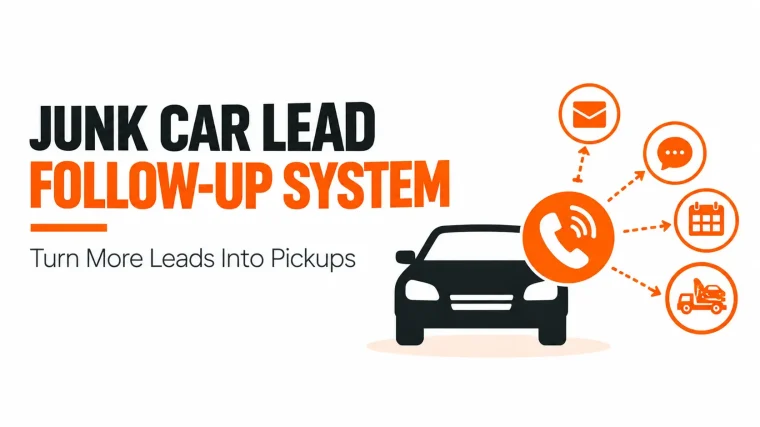
Junk car lead follow up helps salvage yards turn more seller inquiries into scheduled pickups and purchased vehicles. A fast, organized process keeps qualified leads from going cold while making it easier for teams to manage calls, texts, quotes, and next steps.
Effective junk car lead follow up combines quick response times, consistent communication, missed-call recovery, and CRM tracking so promising sellers do not fall through the cracks.
Need More Junk Car Leads in Your Local Market?
Stop relying on unpredictable seller inquiries. Pull Your Part Accelerator helps junk car buyers and salvage yards reach local vehicle owners through targeted Facebook Ads, local SEO, and organized lead tracking
📌 KEY TAKEAWAYS
- Respond to new seller inquiries as quickly as your staffed process allows.
- Assign every inquiry an owner, a status, and a next action.
- Use a planned sequence of calls, messages, and callbacks rather than one contact attempt.
- Prioritize follow-up using seller readiness, vehicle fit, and pickup feasibility.
- Track contact, quote, acceptance, pickup, and purchase outcomes in your CRM.
- Review stalled opportunities and missed calls to improve the workflow.
- Keep communication practices aligned with applicable consent and contact requirements.
What Is Junk Car Lead Follow Up?
Junk car lead follow up is the process of contacting and re-engaging vehicle sellers after they submit an inquiry, request a quote, or call your salvage yard. The goal is to keep qualified opportunities moving toward a clear next step, such as accepting an offer or scheduling pickup.
A structured follow-up process can include phone calls, SMS messages, reminders, quote follow-ups, and CRM tasks.
Why Follow-Up Starts After The Lead Arrives
Generating a lead only creates an opportunity. What happens after that determines whether the seller stays engaged.
Once an inquiry arrives, the yard should:
- Review the seller and vehicle details
- Respond quickly
- Clarify missing information
- Provide the next step
- Continue contact when needed
Effective junk car lead follow up prevents promising inquiries from being forgotten or lost to another buyer.
Junk Car Lead Follow Up vs Lead Conversion
Follow-up and conversion are connected, but they are not the same.
Junk car lead follow up focuses on maintaining communication after the inquiry arrives.
Lead conversion covers the broader process of turning that opportunity into a completed vehicle purchase.
In simple terms:
Follow-Up: Keep the seller engaged and move the conversation forward.
Conversion: Turn the qualified opportunity into an acquired vehicle.
This article focuses specifically on the follow-up system. If you want to go deeper into the full process of turning inquiries into purchased vehicles, read our complete Junk Car Lead Conversion guide.
Why One Call Is Not A Follow-Up System
Some sellers will not answer the first call. Others may need time to compare offers, locate documents, or decide when they are ready to sell.
A proper junk car lead follow up system uses multiple contact opportunities rather than relying on one attempt.
That may include:
- Initial phone call
- Follow-up text
- Quote reminder
- Missed-call recovery
- Scheduled callback
The purpose is not to pressure the seller. It is to create a consistent process so good opportunities do not disappear simply because the first contact attempt was unsuccessful.
Why Junk Car Leads Go Cold
Even strong leads can lose momentum if the seller is not contacted at the right time or given a clear reason to move forward. Effective junk car lead follow up helps prevent interested sellers from becoming unresponsive or choosing another buyer.
Understanding why leads go cold makes it easier to fix the gaps in your follow-up process.
Sellers Contact Multiple Junk Car Buyers
Many vehicle owners request quotes from more than one buyer before making a decision.
That means your salvage yard may be competing against:
- Other local junk car buyers
- National car-buying companies
- Auto recyclers
- Online vehicle-buying services
A seller who looked interested initially may disappear simply because another buyer reached them first or made the process easier.
This makes consistent junk car lead follow up especially important in competitive markets.
Slow Responses Reduce Your Chance Of Buying The Vehicle
Fresh seller intent does not last forever.
When a lead sits unanswered, the seller may continue searching and contact another buyer.
Slow responses can result in:
- Missed conversations
- Lost quote opportunities
- Competitors securing the vehicle
- Lower lead-to-purchase rates
The faster a qualified inquiry enters your follow-up process, the better chance your team has of keeping the opportunity active.
Sellers Get Distracted Or Delay Their Decision
Not every cold lead has rejected your offer.
Some sellers simply:
- Get busy
- Forget to respond
- Need time to find paperwork
- Delay deciding what to do with the vehicle
- Wait for another family member or owner
A structured junk car lead follow up process helps bring these sellers back into the conversation instead of assuming they are no longer interested.
Unclear Offers And Next Steps Create Friction
Sellers are more likely to disengage when they do not understand what happens next.
Confusion may involve:
- The offer amount
- Required paperwork
- Pickup timing
- Payment process
- Who should contact whom next
Every conversation should end with a clear next step.
For example:
“If the offer works for you, the next step is choosing a pickup time.”
Clear direction reduces uncertainty and keeps the seller moving forward.
Why Good Leads Can Still Be Lost
A high-quality lead does not guarantee a vehicle purchase.
Even a seller with strong intent, a desirable vehicle, clear ownership, and a good location can be lost because of:
- Slow response
- Missed calls
- Poor communication
- No follow-up after the quote
- An unclear next step
This is why lead quality and junk car lead follow up need to work together. Strong leads create better opportunities, but a reliable follow-up system helps make sure those opportunities do not disappear before the vehicle is purchased.
How Fast Should You Follow Up With A Junk Car Lead?
The best approach to junk car lead follow up is simple: respond as quickly as your team realistically can. A fresh inquiry represents active seller intent, and delays give the vehicle owner more time to contact competing buyers.
Response speed matters most when the seller is ready to sell, the vehicle fits your buying criteria, and the pickup location makes financial sense.
The First Response Should Happen As Quickly As Possible
A new junk car inquiry should not sit unnoticed in an inbox or CRM.
The first response should aim to:
- Confirm the seller received their inquiry
- Verify important vehicle details
- Establish contact
- Explain the next step
Even when a full quote cannot be provided immediately, acknowledging the seller quickly keeps the conversation active.
Fast junk car lead follow up is especially important because many vehicle owners request offers from several buyers at the same time.
Prioritize Fresh, High-Intent Leads First
Not every lead requires the same urgency.
Prioritize sellers who:
- Submitted the inquiry recently
- Want to sell soon
- Request a specific offer
- Provide complete vehicle information
- Fall within your profitable pickup area
- Have clear ownership information
A fresh, high-quality lead should generally receive attention before an older inquiry with weak seller intent.
For a deeper framework on deciding which leads deserve priority, internally link here to your Junk Car Lead Quality guide.
Set A Response-Time Standard For Your Team
Consistency is easier when everyone knows what is expected.
Create an internal response standard covering:
- New web leads
- Incoming calls
- Missed calls
- SMS inquiries
- Quote requests
The exact target should match your staffing and operating hours, but it should be clear enough that a new inquiry never sits indefinitely without an owner.
Your junk car lead follow up process should also assign responsibility. Every new lead should have a person or team responsible for making the first contact.
What To Do With Leads That Arrive After Hours
Vehicle owners do not always submit inquiries during business hours.
For after-hours leads, consider using:
- Automatic confirmation texts
- Email confirmations
- CRM notifications
- A next-business-day callback queue
- Missed-call text responses
The automated message should confirm that the inquiry was received and explain when the seller can expect contact.
For example:
“Thanks for contacting us about your vehicle. We received your request and our team will review the details and contact you during business hours.”
Automation should acknowledge the lead, not replace the actual conversation.
A reliable junk car lead follow up system combines fast responses during operating hours with a clear process for capturing and prioritizing after-hours opportunities.
Build A Junk Car Lead Follow-Up Sequence
A consistent junk car lead follow up sequence gives every qualified seller multiple opportunities to respond without relying on random callbacks.
The goal is not to contact sellers endlessly. It is to create a clear process for new inquiries, unresponsive sellers, outstanding quotes, and final follow-up attempts.
First Contact: Confirm The Seller And Vehicle
The first contact should confirm the basics and establish a clear next step.
Verify:
- Seller name and contact information
- Vehicle year, make, and model
- Vehicle condition
- Location
- Ownership or title status
- Seller timeline
If enough information is available, move toward an offer or explain what is needed next.
Good junk car lead follow up starts with making the first conversation useful rather than simply asking, “Are you still interested?”
Second Contact: Reconnect With Unresponsive Sellers
If the seller does not respond to the first attempt, follow up through another appropriate contact method.
For example:
- Call again
- Send a short text
- Leave a concise voicemail
- Schedule another CRM reminder
Reference the original inquiry so the message has context.
For example:
“Hi, this is [Name] from [Yard]. I’m following up about the [Year/Make/Model] you contacted us about. Let me know if you’d still like an offer.”
This makes the contact feel relevant rather than generic.
Quote Follow-Up: Bring The Seller Back To The Offer
Providing a quote does not always mean the seller will respond immediately.
They may be:
- Comparing offers
- Discussing the decision with someone else
- Looking for paperwork
- Deciding when the vehicle can be picked up
A quote follow-up should remind the seller of the offer and give them a simple way to continue.
Keep the message focused on the next action rather than restarting the entire conversation.
Final Follow-Up: Give The Seller A Clear Next Step
If earlier attempts receive no response, a final junk car lead follow up should be short and clear.
For example:
“Hi, I’m checking one last time about your [Year/Make/Model]. If you still want to sell it, reply here or call us and we can review the next steps.”
This gives the seller an easy way to re-engage without creating unnecessary pressure.
When To Stop Following Up
Not every lead should stay active indefinitely.
Consider closing or lowering the priority of a lead when:
- The seller confirms the vehicle was sold
- They clearly decline the offer
- The vehicle no longer fits your buying criteria
- Contact information is invalid
- Multiple reasonable attempts receive no response
- The opportunity has become too old to justify continued attention
The exact number of attempts should depend on your business process and the quality of the opportunity.
A structured junk car lead follow up sequence helps salvage yards stay persistent without becoming repetitive. Every contact should either gather useful information, clarify the offer, or move the seller toward a clear next step.
Junk Car Lead Follow-Up Call Scripts
Consistent call scripts make junk car lead follow up easier for staff and help ensure every seller receives clear, professional communication.
The scripts should sound natural rather than robotic. Teams can adjust the wording while keeping the same goal: confirm the opportunity, understand what the seller needs, and move the conversation toward a clear next step.
First Call Script For A New Junk Car Lead
Use the first call to confirm the inquiry and gather any missing information.
“Hi, this is [Name] from [Salvage Yard]. You contacted us about your [Year, Make, Model]. I’m calling to confirm a few details so we can evaluate the vehicle. Is now a good time?”
Then confirm:
- Vehicle condition
- Running status
- Location
- Ownership or title status
- Seller timeline
Finish with a clear next step:
“Thanks. I have what I need to review the vehicle. I’ll explain the offer and pickup options next.”
A good first call should feel helpful, not like an interrogation.
Voicemail Script When The Seller Does Not Answer
Keep voicemail short.
“Hi, this is [Name] from [Salvage Yard]. I’m calling about the [Year, Make, Model] you contacted us about. Give us a call or text back at [Number] when you’re available, and we can review the vehicle and next steps.”
Avoid leaving long explanations or complicated instructions.
The goal is simply to make it easy for the seller to reconnect.
Follow-Up Call Script After Providing A Quote
If the seller has received an offer but has not responded, bring the conversation back to the quote.
“Hi, this is [Name] from [Salvage Yard]. I’m following up on the offer for your [Year, Make, Model]. I wanted to see if you had any questions or if you’re ready to discuss pickup.”
If the seller hesitates, ask:
“Is there anything specific holding you back from moving forward?”
This helps uncover whether the issue is:
- Price
- Pickup timing
- Documentation
- Another offer
- Seller uncertainty
Effective junk car lead follow up should identify the real obstacle rather than repeating the same offer.
Script For A Seller Comparing Multiple Offers
Price comparisons are common, so the conversation should stay calm and professional.
“I understand you’re comparing offers. Besides price, is there anything else that matters to you, such as pickup timing, convenience, or how quickly the process can be completed?”
Then explain the value of your offer honestly.
For example:
“We can arrange pickup within [timeframe], and we’ll explain exactly what documents are needed before we schedule anything.”
Do not pressure the seller or make claims you cannot guarantee.
The goal is to give them enough information to compare the full transaction, not just the dollar amount.
Script For Moving A Ready Seller Toward Pickup
When the seller is ready, remove unnecessary friction.
“Great. The next step is scheduling pickup. I just need to confirm the vehicle location, access instructions, and the documents you’ll have available.”
Then confirm:
- Pickup address
- Best date or time window
- Vehicle accessibility
- Ownership documents
- Seller contact details
Finish with:
“Perfect. We have you scheduled for [date/time or confirmed window]. We’ll contact you if anything changes.”
At this stage, junk car lead follow up should become simple and operational. The seller has already decided to move forward, so the goal is to make pickup easy and predictable.
These scripts should be treated as frameworks rather than rigid wording. The strongest calls sound natural, address the seller’s actual concerns, and always end with a clear next step.
SMS Follow-Up For Junk Car Leads
SMS can strengthen junk car lead follow up because sellers may not always answer phone calls, especially when they are working, driving, or comparing several buyers.
A short, relevant text gives the seller an easy way to respond without restarting the entire conversation.
The best messages should be specific, useful, and tied to the vehicle rather than generic follow ups such as “Still interested?”
Why Texting Works Well For Junk Car Sellers
Text messaging is useful because it keeps communication simple.
It can help with:
- Confirming a new inquiry
- Requesting missing vehicle details
- Following up after a missed call
- Reminding sellers about an offer
- Confirming pickup details
SMS also gives sellers the flexibility to respond when they are available.
For effective junk car lead follow up, texts should support the conversation rather than replace important calls when more detailed discussion is needed.
Immediate SMS After A Quote Request
When a seller submits a quote request, a quick confirmation lets them know the inquiry was received.
Example:
“Hi [Name], this is [Salvage Yard]. We received your request for the [Year, Make, Model]. We’re reviewing the details and will contact you shortly.”
If important information is missing:
“Hi [Name], we received your request for the [Vehicle]. Can you confirm whether it runs and what ZIP code it is located in?”
The message should make the next step obvious.
Follow-Up Text When The Seller Does Not Respond
If the seller does not answer the first call, send a short contextual message.
Example:
“Hi [Name], this is [Name] from [Salvage Yard]. I tried reaching you about your [Year, Make, Model]. Reply here or call us when you’re available and we can continue with your vehicle offer.”
This works better than a vague message because the seller immediately knows:
- Who is contacting them
- Which vehicle the message concerns
- Why they are being contacted
Quote Reminder SMS
A seller may receive an offer and then stop responding while comparing options.
A quote reminder can bring the conversation back to the decision.
Example:
“Hi [Name], I’m following up on the offer for your [Year, Make, Model]. Let me know if you have any questions or if you’d like to move forward with pickup.”
Good junk car lead follow up keeps the message helpful rather than pressuring the seller to accept immediately.
Pickup Confirmation SMS
Once the seller agrees, SMS can reduce confusion around the pickup.
Example:
“Hi [Name], your [Year, Make, Model] pickup is scheduled for [Date/Time Window] at [Location]. Please have the required ownership documents available. Reply here if anything changes.”
A pickup confirmation can help verify:
- Date
- Time window
- Location
- Vehicle
- Required next steps
This reduces last minute misunderstandings.
Personalize Messages With Vehicle And Offer Details
Personalization makes follow up feel relevant.
Instead of:
“Are you still interested?”
Use:
“Hi [Name], I’m following up about your 2012 Honda Accord. Are you still looking to sell it, or do you have any questions about the offer?”
Useful personalization can include:
- Seller name
- Year, make, and model
- Offer information
- Pickup location
- Previous conversation details
A strong junk car lead follow up message should remind the seller exactly why you are contacting them and make responding easy.
The goal of SMS is not to send more messages. It is to keep promising seller conversations active and move each lead toward a clear next step.
How To Recover Missed Junk Car Calls And Leads
Missed calls are one of the easiest places for good leads to disappear. A strong junk car lead follow up system treats every missed call as an open opportunity until the seller is contacted or the lead is clearly closed.
The goal is to make sure unanswered calls do not become lost vehicle acquisitions.
Treat Every Missed Call As An Open Opportunity
A missed call usually means the seller already had enough intent to contact your yard.
That makes it worth prioritizing.
Every missed call should enter a clear recovery process that records:
- Caller number
- Time of call
- Whether they left a voicemail
- Whether a callback was attempted
- Current lead status
The lead should stay open until your team knows what happened.
Send An Immediate Missed-Call Text
If a call is missed, a short text can keep the conversation alive.
Example:
“Hi, this is [Salvage Yard]. Sorry we missed your call. If you’re contacting us about selling a vehicle, reply with the year, make, model, and ZIP code and we’ll get back to you.”
This gives the seller another way to respond without needing to call again.
It also improves junk car lead follow up by capturing useful vehicle information immediately.
Create A Callback Queue
Missed calls should not rely on staff remembering to return them later.
Use a dedicated callback queue in your CRM or lead-management system.
Prioritize callbacks based on:
- How recently the call came in
- Whether the seller left vehicle details
- Seller urgency
- Vehicle fit
- Previous contact history
Assign each callback to a specific team member so there is clear responsibility.
Recover After-Hours Junk Car Leads
Some sellers will call or submit forms when the yard is closed.
Use an after-hours process that can include:
- Automatic SMS confirmation
- Voicemail instructions
- CRM alerts
- Next-business-day callback tasks
For example:
“Thanks for contacting [Salvage Yard]. We’re currently closed, but we received your inquiry. Our team will contact you during business hours.”
After-hours automation should acknowledge the inquiry and keep the seller engaged until a real person can respond.
Track Missed Calls That Become Vehicle Purchases
Do not stop tracking once the call is returned.
Record whether each missed-call lead eventually becomes:
- Contacted
- Qualified
- Quoted
- Pickup scheduled
- Vehicle purchased
- Lost
This shows whether missed-call recovery is actually producing inventory.
For example, if recovered missed calls consistently become vehicle purchases, the yard can justify putting more attention into callback speed and after-hours coverage.
Effective junk car lead follow up means treating missed calls as measurable acquisition opportunities, not simply unanswered phone activity.
Prioritize Junk Car Leads Before Following Up
Not every inquiry should receive the same level of attention. A strong junk car lead follow up system prioritizes sellers based on intent, freshness, vehicle fit, location, and acquisition potential.
This helps your team spend time on the opportunities most likely to become completed vehicle purchases.
For a deeper framework on evaluating which leads are actually worth pursuing, read our Junk Car Lead Quality guide
Follow Up With High-Intent Sellers First
High-intent sellers should usually move to the front of the follow-up queue.
Strong intent signals include:
- Asking for a firm offer
- Wanting pickup soon
- Providing complete vehicle details
- Responding quickly
- Asking about the next step
- Clearly stating they are ready to sell
Prioritizing these sellers improves junk car lead follow up because your team focuses first on opportunities that are already close to a decision.
Prioritize Fresh Leads Over Stale Leads
Fresh leads generally deserve faster attention than older inquiries.
A seller who contacted your yard recently may still be:
- Comparing offers
- Waiting for a callback
- Ready to schedule pickup
- Actively trying to sell
Older leads may already have sold the vehicle, chosen another buyer, or lost interest.
Freshness should therefore influence how quickly each lead enters your follow-up sequence.
Consider Vehicle Value And Location
Seller intent alone should not determine priority.
The vehicle also needs to make sense for the yard.
Consider:
- Year, make, and model
- Vehicle condition
- Parts or scrap value
- Pickup distance
- Towing cost
- Service-area fit
A highly motivated seller with an unprofitable vehicle may deserve less attention than a strong vehicle opportunity closer to the yard.
This is where junk car lead follow up should connect with acquisition economics rather than treating every seller equally.
Separate Hot, Warm, And Cold Leads
A simple priority system can make follow-up easier for the entire team.
– Hot Leads
These sellers are ready to act.
Examples:
- Ready to sell now
- Offer already discussed
- Pickup timing requested
- Vehicle and ownership details confirmed
Action: Follow up immediately.
– Warm Leads
These sellers are interested but not yet ready.
Examples:
- Comparing offers
- Waiting on paperwork
- Considering the price
- Needs more time to decide
Action: Schedule a follow-up reminder.
– Cold Leads
These leads show little current intent or have become difficult to reach.
Examples:
- Repeatedly unresponsive
- Old inquiry
- Vehicle may already be sold
- Weak selling intent
Action: Lower priority or move into a reactivation sequence.
A structured junk car lead follow up process should always give the fastest attention to fresh, high-value, high-intent opportunities while still keeping lower-priority leads organized for later contact.
Use A CRM To Manage Junk Car Lead Follow Up
A CRM helps organize junk car lead follow up by keeping seller information, communication history, tasks, and lead status in one place.
Without a centralized system, leads can easily be forgotten, contacted twice by different employees, or left without a clear next step.
Capture Every Call, Form, And Seller Inquiry
Every new opportunity should enter the same lead-management system, whether it comes from:
- Website forms
- Phone calls
- SMS
- Google Ads
- Facebook Ads
- Referrals
- Third-party lead sources
Centralizing inquiries makes it easier to track where each seller came from and what happened afterward.
Assign Each Lead To A Team Member
Every lead should have a clear owner.
Assigning responsibility helps prevent situations where:
- Everyone assumes someone else responded
- Multiple staff members contact the same seller
- Follow-up gets delayed
- Important leads are forgotten
A strong junk car lead follow up process makes it clear who is responsible for the next action.
Track The Lead's Current Status
Each lead should have a simple status that shows where it currently sits in the process.
Examples include:
- New lead
- Contact attempted
- Seller contacted
- Qualified
- Offer sent
- Follow-up needed
- Pickup scheduled
- Vehicle purchased
- Lost
Clear statuses make it easier for managers and team members to understand the pipeline at a glance.
Set Follow-Up Tasks And Reminders
Do not rely on memory to decide when a seller should be contacted again.
Use CRM tasks or reminders for:
- Callbacks
- Quote follow-ups
- Document checks
- Pickup confirmations
- Seller reactivation
Every open opportunity should either have a scheduled next action or a clear reason why it has been closed.
Keep Call, SMS, Quote, And Pickup History Together
The CRM should give staff enough context to understand previous conversations before contacting a seller again.
Useful information includes:
- Calls made
- SMS messages
- Quote amount
- Vehicle details
- Seller objections
- Pickup arrangements
- Previous follow-up attempts
This prevents repetitive conversations and makes junk car lead follow up more personal and efficient.
Prevent Leads From Falling Through The Cracks
The biggest benefit of a CRM is visibility.
Managers should be able to quickly identify:
- New leads without a first response
- Sellers waiting for a callback
- Quotes needing follow-up
- Missed calls that were never returned
- Pickups waiting for confirmation
- Leads with no scheduled next action
A CRM does not replace good communication. It creates the structure that makes consistent junk car lead follow up possible as lead volume grows
Recommended Junk Car Lead CRM Stages
A clear CRM pipeline makes junk car lead follow up easier because every seller has a defined status and next action.
The stages do not need to be complicated. They simply need to reflect how a junk car lead moves from first inquiry to completed vehicle purchase.
New Lead
Use this stage when a fresh inquiry enters the system and no contact attempt has been made yet.
Examples:
- New website form
- New phone inquiry
- Facebook lead
- Google Ads lead
- Referral lead
Next action: Contact the seller as quickly as possible
Contact Attempted
Move the lead here when your team has tried to reach the seller but has not yet connected.
Examples:
- Call placed with no answer
- Voicemail left
- SMS sent
- Callback requested
This stage is useful for identifying leads that still need active junk car lead follow up.
Seller Contacted
Use this stage once someone has successfully spoken with or received a meaningful response from the seller.
At this point, the team should begin confirming:
- Vehicle details
- Location
- Ownership
- Seller intent
The lead is active, but it has not yet been fully qualified.
Qualified
Move a lead to Qualified when the opportunity meets your basic acquisition criteria.
Typical requirements may include:
- Seller is reachable
- Vehicle fits your buying criteria
- Location is workable
- Ownership is clear
- Seller shows real intent
This is where your Junk Car Lead Quality framework can support the CRM process.
Offer Sent
Use this stage once a firm or actionable offer has been provided.
The CRM record should include:
- Offer amount
- Date offered
- Vehicle details
- Any conditions
- Seller response
This makes future junk car lead follow up easier because the team knows exactly what was discussed.
Follow-Up Needed
Move leads here when the seller has not made a final decision but the opportunity is still active.
Examples:
- Seller is comparing offers
- Waiting for paperwork
- Needs more time
- Asked to be contacted later
- Has not responded after receiving a quote
Every lead in this stage should have a scheduled follow-up date or task
Pickup Scheduled
Use this stage once the seller has agreed and pickup details are confirmed.
Record:
- Pickup date
- Time window
- Vehicle location
- Access instructions
- Required documents
At this point, the focus shifts from persuasion to execution.
Vehicle Purchased
Move the lead here once the transaction is completed and the vehicle has been acquired.
This stage is important for reporting because it allows the yard to connect:
Lead Source → Follow-Up Process → Vehicle Purchase
That data helps measure which channels and follow-up activities produce real inventory.
Lost Or Not Qualified
Use this stage when the opportunity should no longer stay active.
Common reasons include:
- Vehicle already sold
- Seller declined the offer
- Outside service area
- Ownership issue
- Vehicle does not fit buying criteria
- Invalid contact information
- No response after reasonable attempts
Whenever possible, record the reason the lead was lost.
That turns the CRM into more than a contact list. It becomes a source of insight for improving junk car lead follow up, lead quality, and acquisition performance.
A simple pipeline could look like:
New Lead → Contact Attempted → Seller Contacted → Qualified → Offer Sent → Follow-Up Needed → Pickup Scheduled → Vehicle Purchased
or, when the opportunity does not work:
Qualified → Lost / Not Qualified
How To Close More Junk Car Leads Without Being Pushy
Good junk car lead follow up should help sellers make a clear decision, not pressure them into one.
At this stage, the goal is to understand what is preventing the seller from moving forward and remove unnecessary friction.
Identify What Is Stopping The Seller
If a seller hesitates, ask a simple question:
“What is the main thing holding you back from moving forward?”
Common objections include:
- Price
- Pickup timing
- Missing paperwork
- Comparing other offers
- Uncertainty about the process
Knowing the real objection makes the next step much easier.
Make The Offer And Pickup Process Clear
Confusion can slow down otherwise strong leads.
Make sure the seller understands:
- The offer
- What documents are needed
- How pickup works
- When payment happens
- What they need to do next
Clear information improves junk car lead follow up because sellers are less likely to disappear when the process feels simple.
Reduce Friction Around Scheduling
Once a seller is ready, make pickup as easy as possible.
Avoid unnecessary back-and-forth.
Confirm:
- Pickup location
- Available time window
- Vehicle accessibility
- Required documents
The easier the process feels, the more likely the seller is to complete the transaction.
Give The Seller A Specific Next Step
Every conversation should end with a clear action.
For example:
“If the offer works for you, the next step is choosing a pickup time.”
or:
“If you send the title details today, we can confirm whether we can move forward.”
A specific next step keeps the conversation moving.
Use Genuine Urgency Instead Of Pressure
Urgency should be based on real circumstances, not artificial pressure.
Examples include:
- Limited pickup availability
- Time-sensitive scheduling
- Offer conditions that may change
- Market or towing constraints
Avoid exaggerated claims such as “This is your only chance” unless that is actually true.
Strong junk car lead follow up builds trust by helping sellers act confidently rather than making them feel rushed.
For a deeper look at the full process of turning qualified leads into completed vehicle purchases, internally link here to your Junk Car Lead Conversion guide.
How To Follow Up With Old Junk Car Leads
Older leads can still produce vehicle purchases, but effective junk car lead follow up requires knowing which opportunities are worth reopening.
The goal is not to contact every old lead again. It is to identify sellers who may still have the vehicle, still need a buyer, and still fit your acquisition criteria.
Identify Leads Worth Reactivating
Start by reviewing older leads for signs that the opportunity may still be useful.
Prioritize leads that:
- Previously showed strong seller intent
- Received an offer but never made a decision
- Had a vehicle that fit your buying criteria
- Were inside your service area
- Had valid ownership information
- Stopped responding without clearly declining
These leads usually have more reactivation potential than inquiries that were unqualified from the beginning.
Check Whether The Vehicle Is Still Available
Before restarting a long conversation, confirm whether the vehicle is still available.
A simple message can work:
“Hi [Name], this is [Name] from [Salvage Yard]. You previously contacted us about your [Year, Make, Model]. Is the vehicle still available, and are you still considering selling it?”
This keeps junk car lead follow up relevant and avoids wasting time if the vehicle has already been sold.
Reopen The Conversation With Relevant Context
Avoid generic messages such as:
“Still interested?”
Instead, remind the seller why you are contacting them.
Reference:
- Their vehicle
- Previous offer
- Previous conversation
- Pickup discussion
- Any known reason the sale did not move forward
For example:
“Hi [Name], I’m following up about the 2014 Ford Fusion you contacted us about last month. We previously discussed an offer, and I wanted to check whether you’re still looking to sell it.”
Relevant context makes the message feel like a continuation of the original conversation rather than a random sales contact.
When Old Leads Should Be Removed From The Pipeline
Not every lead deserves repeated reactivation attempts.
Consider closing the lead when:
- The vehicle has already been sold
- The seller clearly declines further contact
- Contact information is no longer valid
- The vehicle no longer fits your acquisition criteria
- Ownership problems remain unresolved
- Repeated reasonable attempts receive no response
Recording the reason for closure helps keep the CRM clean and prevents the same dead opportunity from repeatedly entering the junk car lead follow up queue.
Old leads can still create value, but reactivation should be selective. Focus on sellers and vehicles that still have realistic acquisition potential rather than treating every historical inquiry as an active opportunity.
SMS And Call Follow-Up Compliance For US Salvage Yards
A junk car lead follow up system should include compliance safeguards, especially when using automated calls, prerecorded messages, or automated SMS.
Federal rules under the TCPA and Telemarketing Sales Rule may apply, and state requirements can add additional obligations. Salvage yards should build consent, opt-out handling, and recordkeeping into their follow-up process.
Get Appropriate Consent Before Automated Marketing Messages
Do not assume that receiving a phone number automatically permits every type of automated follow-up.
Depending on the technology and purpose of the message, prior consent—and for certain telemarketing communications, written consent—may be required.
Lead forms should clearly explain how the seller may be contacted and should preserve records of the consent provided.
Make It Easy For Sellers To Opt Out
Sellers must be able to communicate that they no longer want covered robocalls or robotexts.
Opt-out requests can be made through reasonable methods, and FCC rules require covered revocation requests to be honored as soon as practicable and no later than 10 business days after receipt.
Your junk car lead follow up system should recognize requests such as:
- “STOP”
- “Don’t text me”
- “Do not call again”
- Other clear requests to end communication
Do not make the seller complete unnecessary extra steps to opt out.
Maintain Do-Not-Contact Records
Keep records of sellers who ask not to receive further marketing calls or messages.
Your CRM should record:
- Phone number
- Date of request
- Communication channel
- Opt-out status
- Any relevant consent history
The FTC requires covered sellers and telemarketers to maintain company-specific Do Not Call records, and covered telemarketing programs must also account for the National Do Not Call Registry where applicable.
Follow Federal And Applicable State Requirements
Federal TCPA, FCC, and FTC rules are only part of the compliance picture. States may impose additional requirements covering calls, texts, consent, registration, calling hours, or recordkeeping.
Before automating junk car lead follow up at scale, salvage yards should review the rules applicable to the states where they contact sellers and have their specific process reviewed by qualified legal counsel.
Compliance should be built into the follow-up system from the beginning rather than added after campaigns are already running.
Common Junk Car Lead Follow-Up Mistakes
Even a strong junk car lead follow up system can lose opportunities when the process is inconsistent. The following mistakes often reduce contact rates, seller trust, and completed vehicle pickups.
Calling Only Once
One unanswered call should not automatically close the lead.
A seller may be working, driving, or unavailable when you call. Use a structured sequence that can include:
- Another call
- SMS
- Voicemail
- Scheduled callback
The goal is persistence without unnecessary pressure.
Responding Too Slowly
Fresh leads can lose value quickly.
If the seller contacts multiple buyers, a slow response gives competitors more time to secure the vehicle.
Good junk car lead follow up starts with a fast first response and a clear next step.
Sending Generic Follow-Up Messages
Messages such as:
“Still interested?”
provide little context.
A stronger follow-up references:
- Seller name
- Vehicle
- Previous offer
- Last conversation
- Next action
Relevant messages are easier for sellers to understand and respond to.
Failing To Track Previous Contact
Without communication history, staff may repeat questions, send duplicate messages, or miss important details.
Track:
- Calls
- Texts
- Voicemails
- Quotes
- Seller objections
- Scheduled follow-ups
This keeps the junk car lead follow up process organized.
Treating Every Lead The Same
Not every seller deserves the same priority.
High-intent, fresh, profitable opportunities should generally receive faster attention than:
- Old leads
- Low-value vehicles
- Poor service-area fits
- Weak-intent sellers
Prioritization helps teams focus on the leads most likely to become vehicle purchases.
Giving Up Too Early
Not every seller deserves the same priority.
High-intent, fresh, profitable opportunities should generally receive faster attention than:
- Old leads
- Low-value vehicles
- Poor service-area fits
- Weak-intent sellers
Prioritization helps teams focus on the leads most likely to become vehicle purchases.
Following Up Too Aggressively
Too much contact can damage trust.
Avoid:
- Repeated calls within a short period
- Pressure-based messaging
- Artificial urgency
- Ignoring opt-out requests
Effective junk car lead follow up should make it easier for the seller to move forward, not make them feel harassed.
Junk Car Lead Follow-Up Checklist
Use this checklist to make sure each qualified seller moves through a consistent follow-up process.
Respond Quickly
- Review new inquiries promptly
- Return missed calls
- Acknowledge after-hours leads
- Prioritize fresh opportunities
Confirm Seller And Vehicle Information
Verify:
- Seller contact details
- Year, make, and model
- Vehicle condition
- Location
- Ownership or title status
- Seller timeline
Provide A Clear Offer
Make sure the seller understands:
- Offer amount
- Any conditions
- Required documents
- What happens next
A clear offer reduces uncertainty during junk car lead follow up.
Follow Up Across Calls And SMS
Use the appropriate combination of:
- Phone calls
- Voicemail
- SMS
- Scheduled callbacks
Keep each contact relevant to the seller’s previous interaction.
Recover Missed Calls
Every missed call should:
- Enter the CRM
- Receive a callback
- Receive an appropriate missed-call message
- Remain open until the opportunity is resolved
Record Every Interaction In Your CRM
Log:
- Contact attempts
- Seller responses
- Quotes
- Follow-up dates
- Pickup details
- Final outcome
This creates a complete history for each lead.
Move Ready Sellers Toward Pickup
Once the seller agrees:
- Confirm pickup location
- Confirm timing
- Verify documentation
- Provide clear instructions
- Record the scheduled pickup
Do not keep a ready seller stuck in the follow-up stage.
Measure Which Follow-Ups Produce Vehicles
Track which activities lead to:
- Seller responses
- Accepted offers
- Scheduled pickups
- Vehicle purchases
The strongest junk car lead follow up system is not the one with the most calls or texts. It is the one that consistently turns qualified seller opportunities into completed acquisitions.
Frequently Asked Questions
Follow up as quickly as possible while the seller’s interest is still active. Fresh leads are more likely to respond, and faster contact reduces the chance that another junk car buyer reaches the seller first.
There is no fixed number for every lead. Use a reasonable sequence of calls, texts, and reminders, then stop when the seller declines, the vehicle is sold, contact details are invalid, or repeated attempts receive no response.
Use both when appropriate. Calls are useful for detailed conversations, while SMS works well for quick confirmations, reminders, and missed-call recovery. A good junk car lead follow up system uses each channel based on the seller’s situation.
Keep the message specific. Mention the seller’s name, vehicle, previous quote or conversation, and a clear next step. Avoid vague messages like “Still interested?” because they provide little context.
Reference the offer and ask whether the seller has questions or is ready to discuss pickup. If they hesitate, identify what is holding them back, such as price, paperwork, timing, or another offer.
Return missed calls quickly, send a short missed-call text, add the lead to a callback queue, and track the outcome in your CRM. Treat missed calls as open acquisition opportunities until they are resolved.
Automation can help with confirmations, reminders, missed-call texts, and CRM tasks. However, important seller conversations should still involve a real person when judgment, negotiation, or detailed vehicle information is required.
Stop when the seller clearly declines, the vehicle has been sold, the lead is no longer qualified, contact information is invalid, or reasonable follow-up attempts receive no response. Also honor any request to stop contacting the seller.