
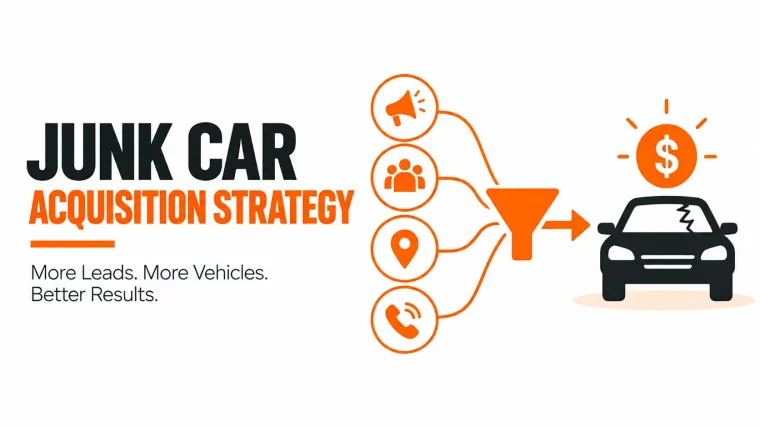
Junk Car Acquisition Strategy is the process of creating a repeatable system that helps salvage yards consistently attract vehicle owners, generate qualified leads, convert inquiries, and acquire more profitable junk cars. Instead of relying on unpredictable sources or waiting for vehicles to appear, successful yards use a structured acquisition approach to create a steady flow of inventory.
Many salvage yards focus only on getting more leads, but leads alone do not grow a business. The real goal is turning those opportunities into purchased vehicles that increase yard inventory and revenue. A strong Junk Car Acquisition Strategy connects marketing channels, seller qualification, follow-up processes, and performance tracking into one complete vehicle acquisition system.
Today, salvage yards compete with national buyers, online car-buying platforms, and other recyclers for the same vehicle owners. Without a clear acquisition strategy, businesses often waste money on low-quality leads, miss potential sellers, and struggle to maintain consistent inventory levels.
This guide explains how to create a complete Junk Car Acquisition Strategy that covers everything from attracting junk car sellers to converting inquiries into vehicle pickups. You will learn how successful salvage yards build predictable acquisition systems, improve lead quality, reduce wasted marketing spend, and create a sustainable pipeline of vehicles.
Need More Junk Car Leads in Your Local Market?
Stop relying on unpredictable seller inquiries. Pull Your Part Accelerator helps junk car buyers and salvage yards reach local vehicle owners through targeted Facebook Ads, local SEO, and organized lead tracking
📌 KEY TAKEAWAYS
- Junk Car Acquisition Strategy is a repeatable system for attracting sellers, generating qualified leads, converting inquiries, and acquiring profitable vehicles. Pasted text
- The goal is not just more leads – it is turning seller inquiries into purchased vehicles and profitable inventory.
- The acquisition process follows four stages: Attract Sellers → Capture Inquiries → Convert Leads → Purchase & Optimize.
- Set clear acquisition goals based on monthly vehicle needs, profitable vehicle types, service area, acquisition costs, and yard capacity.
- Build multiple lead sources using SEO, Google Business Profile, Google Ads, Facebook Ads, referrals, towing companies, mechanics, body shops, and insurance relationships.
- Focus on lead quality over lead volume by checking vehicle details, location, ownership, condition, seller intent, and profitability.
- Fast response and consistent follow-up are critical because sellers often contact multiple junk car buyers.
- Use a structured funnel: Awareness → Consideration → Conversion → Retention, with simple quote forms, clear communication, easy pickup scheduling, and referral opportunities.
- Measure vehicles purchased, conversion rate, cost per acquired vehicle, revenue per vehicle, and channel performance rather than relying only on clicks, calls, or lead volume. Pasted text
- Avoid common mistakes such as relying on one channel, chasing cheap leads, responding slowly, failing to follow up, and ignoring the seller experience.
- Scale with multiple acquisition channels, CRM and automation, documented processes, strategic geographic expansion, performance tracking, and long-term partnerships.
- Bottom line: A successful strategy turns junk car acquisition from a reactive process into a predictable, measurable, and scalable vehicle acquisition system.
What Is A Junk Car Acquisition Strategy?
A Junk Car Acquisition Strategy is a complete system that helps salvage yards consistently find vehicle sellers, generate qualified opportunities, convert inquiries into purchases, and maintain a reliable flow of inventory. Unlike simple marketing campaigns that only focus on getting attention or clicks, a true Junk Car Acquisition Strategy connects every step required to turn potential sellers into acquired vehicles.
For salvage yards, vehicle acquisition is the foundation of growth. A yard can have strong operations, experienced staff, and excellent parts sales, but without a consistent supply of vehicles, inventory levels decline and revenue opportunities disappear. This is why successful recyclers focus on building repeatable acquisition systems instead of relying only on occasional sellers, auctions, or unpredictable sources.
A strong Junk Car Acquisition Strategy combines multiple elements, including seller demand generation, lead capture, qualification processes, follow-up systems, and performance tracking. The goal is not simply to collect more inquiries but to create a predictable process that helps yards purchase more vehicles at profitable acquisition costs.
Modern salvage yards compete against national buyers, online vehicle purchasing platforms, and other local recyclers. To compete effectively, independent yards need a structured approach that improves visibility, builds trust with sellers, and creates more opportunities to acquire vehicles before competitors do.
Lead Generation vs Vehicle Acquisition: Understanding The Difference
Many salvage yards make the mistake of treating lead generation and vehicle acquisition as the same thing. While they are connected, they serve different purposes.
Lead generation focuses on creating opportunities by attracting people who may want to sell their vehicles. This can include search traffic, paid advertising, social media campaigns, referrals, and local partnerships.
A Junk Car Acquisition Strategy, however, goes beyond generating inquiries. It focuses on the complete process of turning those inquiries into actual purchased vehicles.
The difference looks like this:
Lead Generation | Vehicle Acquisition |
Generates seller inquiries | Creates purchased inventory |
Measures clicks, calls, and forms | Measures vehicles acquired |
Focuses on marketing channels | Focuses on business outcomes |
Stops when a lead arrives | Continues until the vehicle is purchased |
For example, a salvage yard may receive hundreds of junk car inquiries every month, but if those leads are not properly qualified, followed up with, and converted, the yard may still struggle with inventory shortages.
A successful Junk Car Acquisition Strategy connects marketing efforts with operational processes so every qualified opportunity has a clear path toward becoming a vehicle purchase.
Why Salvage Yards Need An Acquisition System
A predictable acquisition system allows salvage yards to move away from reactive buying and build a consistent inventory pipeline.
Without a structured Junk Car Acquisition Strategy, many yards depend heavily on:
- Walk-in sellers
- Word-of-mouth referrals
- Random vehicle opportunities
- Auction purchases
- Seasonal fluctuations
These sources can help, but they are difficult to scale because the yard has limited control over when and how many vehicles become available.
An acquisition system gives salvage yards more control by creating consistent opportunities through:
- Digital visibility
- Seller-focused campaigns
- Local market positioning
- Lead management processes
- Conversion optimization
The goal is not just more traffic or more inquiries. The goal is creating a repeatable system that helps the yard acquire more vehicles while controlling costs and improving profitability.
The Four Stages Of Junk Car Acquisition
Every effective Junk Car Acquisition Strategy follows four major stages:
Attract Sellers
The first stage is reaching vehicle owners who may be ready to sell.
This includes:
- Google search visibility
- Local SEO
- Paid advertising
- Social campaigns
- Referral partnerships
The objective is to place your salvage yard in front of sellers at the right moment.
Capture Inquiries
Once sellers discover your yard, the next step is capturing their information.
Common acquisition points include:
- Phone calls
- Quote forms
- Landing pages
- Online inquiries
- Messaging platforms
A strong capture process ensures potential sellers do not disappear before the sales team can respond.
Convert Leads Into Vehicle Purchases
Generating inquiries is only the beginning.
The conversion stage focuses on:
- Fast response times
- Accurate vehicle evaluation
- Seller communication
- Follow-up processes
- Pickup scheduling
This is where many yards lose opportunities because they focus heavily on generating leads but not enough on converting them.
Purchase Vehicles And Optimize Results
The final stage is acquiring the vehicle and improving the system over time.
Successful yards track:
- Which channels produce vehicles
- Cost per acquired vehicle
- Lead-to-purchase conversion rate
- Vehicle profitability
This data helps refine the Junk Car Acquisition Strategy and ensures marketing efforts contribute directly to inventory growth.
How Successful Salvage Yards Build A Predictable Vehicle Acquisition System
A successful salvage yard does not depend on random sellers, occasional opportunities, or unpredictable vehicle sources. Instead, profitable recyclers build a structured Junk Car Acquisition Strategy that creates a consistent pipeline of vehicles entering their yard.
The difference between struggling yards and growing yards is often not the ability to process vehicles – it is the ability to consistently acquire them.
A predictable vehicle acquisition system helps salvage yards understand:
- How many vehicles they need to acquire
- Which sources produce the best opportunities
- How much they should spend to acquire each vehicle
- Which processes improve conversion rates
- How to scale acquisition without wasting resources
A strong Junk Car Acquisition Strategy combines planning, multiple acquisition channels, seller targeting, and performance measurement. Instead of hoping that vehicle owners find them, successful yards actively create opportunities to acquire more inventory.
Step 1: Identify Your Ideal Vehicle Acquisition Goals
Before investing in marketing or lead generation, salvage yards need to define what successful vehicle acquisition looks like.
Many businesses focus on getting “more cars,” but effective acquisition requires clear goals based on inventory needs, profitability, and operational capacity.
A well-planned Junk Car Acquisition Strategy starts by answering important questions:
- How many vehicles does your yard need every month?
- Which vehicle types create the highest returns?
- Which locations provide the best acquisition opportunities?
- How much can you afford to spend to acquire each vehicle?
Without clear targets, yards may generate leads and purchase vehicles without understanding whether those acquisitions are actually profitable.
Determine How Many Cars You Need Monthly
The first step is calculating your ideal acquisition volume.
Consider:
- Current inventory levels
- Parts demand
- Processing capacity
- Sales goals
- Available yard space
For example, a smaller salvage yard may need a steady flow of a few dozen vehicles each month, while a larger operation may require hundreds of acquisitions to maintain inventory levels.
Your Junk Car Acquisition Strategy should be built around your actual business capacity rather than simply chasing the highest possible lead volume.
Define Your Target Vehicle Types
Not every junk vehicle has the same value.
Successful salvage yards understand which vehicles create the strongest return based on:
- Parts demand
- Vehicle popularity
- Scrap value
- Repair potential
- Local market demand
A targeted acquisition approach helps yards spend resources attracting the right sellers instead of generating opportunities that do not match their inventory goals.
Understand Acquisition Costs And Profit Margins
A predictable acquisition system requires understanding the numbers behind every purchase.
Important measurements include:
- Average vehicle purchase cost
- Transportation expenses
- Processing costs
- Parts revenue
- Scrap revenue
- Total profit per vehicle
A Junk Car Acquisition Strategy should focus on profitable vehicle acquisition, not simply increasing the number of cars entering the yard.
Define Your Service Area
Your acquisition opportunities depend heavily on location.
Salvage yards should analyze:
- Cities and neighborhoods they currently serve
- Areas with high vehicle ownership
- Competitor presence
- Pickup distance
- Transportation costs
A focused service area allows yards to create more effective marketing campaigns and improve acquisition efficiency.
Step 2: Build Multiple Junk Car Lead Sources
A predictable Junk Car Acquisition Strategy cannot depend on a single source of vehicles.
Many salvage yards make the mistake of relying only on one channel, such as referrals, auctions, or paid advertisements. When that source slows down, vehicle acquisition also decreases.
Successful yards create multiple acquisition channels that work together.
These sources typically include:
- Organic search
- Local visibility
- Paid advertising
- Social media campaigns
- Industry partnerships
- Referral networks
The goal is to create a consistent flow of opportunities from multiple sources instead of depending on one marketing method.
Organic Channels For Vehicle Acquisition
Organic channels help salvage yards capture sellers who are already searching for solutions.
Google Search Visibility
Many vehicle owners search online when they are ready to sell an unwanted vehicle.
Examples:
- “sell my junk car”
- “junk car removal near me”
- “cash for junk cars”
A strong search presence allows salvage yards to appear when sellers have immediate intent.
Google Business Profile And Local Search
For local salvage yards, Google Business Profile visibility plays a major role in acquisition.
Optimizing local visibility helps businesses:
- Appear in map results
- Receive calls from nearby sellers
- Build trust through reviews
- Increase local discovery
Local search is especially valuable because junk vehicle sellers often prefer working with nearby buyers.
Local SEO Content
Educational content can help yards capture additional search demand.
Examples:
- Vehicle selling guides
- Junk car valuation content
- Location-based pages
- Salvage yard buying information
A strong content strategy supports the overall Junk Car Acquisition Strategy by creating more opportunities for sellers to discover the business.
Paid Channels For Vehicle Acquisition
Paid advertising allows salvage yards to reach sellers faster and scale acquisition efforts.
Google Ads For High-Intent Sellers
Google Ads can help capture people actively searching for junk car buyers.
Advantages:
- Immediate visibility
- Strong purchase intent
- Location targeting
- Measurable results
However, campaigns need proper tracking because the goal is not just generating clicks — it is acquiring vehicles.
Facebook Ads For Creating Seller Demand
Facebook Ads can help salvage yards reach vehicle owners who may not be actively searching yet but have vehicles they want to sell.
Effective campaigns can target:
- Local audiences
- Vehicle owners
- Specific geographic areas
- Retargeting audiences
Facebook can become a valuable part of a broader Junk Car Acquisition Strategy when combined with strong follow-up and conversion processes.
Partnership Channels That Create More Vehicle Opportunities
Some of the most valuable acquisition opportunities come from relationships rather than advertising.
Successful salvage yards often build partnerships with businesses that regularly interact with vehicle owners.
Potential partners include:
Tow Companies
Tow operators frequently encounter:
- Abandoned vehicles
- Damaged vehicles
- Non-running vehicles
Building referral relationships can create a consistent acquisition source.
Mechanics And Repair Shops
Repair shops often work with customers who decide a vehicle is no longer worth fixing.
A partnership can create opportunities before those vehicles leave the market.
Insurance Companies And Body Shops
Accident-damaged vehicles often become candidates for salvage.
Relationships with industry partners can help yards access these opportunities earlier.
A successful Junk Car Acquisition Strategy combines these channels into one connected system. The goal is not to rely on one marketing tactic, but to create multiple paths that consistently bring qualified vehicle sellers into the acquisition process.
The Best Lead Sources For Salvage Yard Vehicle Acquisition
A successful Junk Car Acquisition Strategy depends on having reliable sources that consistently connect salvage yards with vehicle owners. While many yards focus on increasing lead volume, the real objective is finding acquisition channels that produce qualified sellers and profitable vehicle purchases.
Not every lead source delivers the same results. Some channels create immediate buying opportunities, while others require longer-term trust building. The most successful salvage yards combine multiple sources to create a balanced acquisition system instead of depending on one method.
The strongest vehicle acquisition channels usually include:
- Organic search visibility
- Google Business Profile and Maps
- Paid search advertising
- Social media campaigns
- Referral partnerships
- Local industry relationships
By combining these sources, salvage yards can create a more predictable flow of vehicle opportunities and strengthen their overall Junk Car Acquisition Strategy.
Google Search And Local SEO For Junk Car Acquisition
Google search remains one of the most valuable acquisition channels because it connects salvage yards with people who are already looking for solutions.
When a vehicle owner searches terms like:
- “sell my junk car”
- “junk car buyer near me”
- “cash for junk cars”
- “remove my old vehicle”
they usually have immediate intent to take action.
A strong organic search presence allows salvage yards to appear at the exact moment potential sellers are looking for a buyer.
As part of a Junk Car Acquisition Strategy, SEO helps create a long-term acquisition channel that can generate seller opportunities without paying for every individual click.
Create Content Around Seller Intent
Successful salvage yards do not only optimize for broad keywords. They create content that answers questions vehicle owners have before selling.
Examples include:
- How much is my junk car worth?
- What documents do I need to sell my vehicle?
- Can I sell a car without keys?
- What happens after I schedule a pickup?
This type of content builds trust and captures sellers earlier in the buying journey.
Build Location-Based Search Visibility
Because junk car acquisition is highly local, location-focused SEO is essential.
Salvage yards should optimize for:
- Service area pages
- City-specific landing pages
- Local business information
- Customer reviews
- Local search signals
A seller usually chooses a buyer who can provide convenient pickup and a simple selling process. Local visibility helps yards appear when those opportunities arise.
Google Business Profile And Maps Visibility
For local salvage yards, Google Business Profile visibility is one of the most important parts of a complete Junk Car Acquisition Strategy.
Many vehicle owners search through Google Maps when looking for nearby junk car buyers. A strong Maps presence can generate direct phone calls from sellers who are ready to take action.
An optimized profile helps salvage yards:
- Appear in local searches
- Showcase services
- Display reviews
- Provide contact information
- Build credibility with sellers
Optimize Your Business Profile For Vehicle Acquisition
A salvage yard’s Google Business Profile should clearly communicate:
- Junk car buying services
- Service areas
- Vehicle pickup options
- Business hours
- Contact methods
The goal is to remove friction and make it easy for sellers to start the process.
Reviews Influence Seller Decisions
Selling an unwanted vehicle requires trust.
Many sellers want confidence that:
- The buyer is legitimate
- Pickup will happen as promised
- Payment will be handled properly
Positive reviews help reduce uncertainty and improve conversion rates from local searches.
Google Ads For High-Intent Junk Car Sellers
Google Ads can become a powerful acquisition channel because they reach people actively searching for junk car solutions.
Unlike awareness-based advertising, search ads capture users who already have intent.
A well-built campaign can target searches related to:
- Selling unwanted vehicles
- Removing old cars
- Getting cash offers
- Local junk car buyers
Within a Junk Car Acquisition Strategy, Google Ads works best when campaigns focus on vehicle purchases rather than just generating traffic.
Target High-Value Search Intent
Not every keyword represents the same opportunity.
For example:
Lower intent:
- “What is a junk car?”
- “How does car recycling work?”
Higher intent:
- “Sell my junk car today”
- “Junk car buyer near me”
- “Get cash for old car”
The goal is attracting sellers who are closer to making a decision.
Track Vehicles Acquired, Not Just Leads
A common mistake is measuring paid campaigns only by:
- Clicks
- Impressions
- Form submissions
A better approach is tracking:
- Qualified leads
- Scheduled pickups
- Purchased vehicles
- Cost per acquired vehicle
This allows salvage yards to understand whether their advertising investment is actually improving inventory.
Facebook Ads For Creating Seller Demand
Facebook Ads can support a Junk Car Acquisition Strategy by reaching vehicle owners who may not currently be searching but have vehicles they want to sell.
Many people own:
- Old unused vehicles
- Damaged cars
- Non-running vehicles
- Vehicles taking up space
Social advertising allows salvage yards to introduce their buying service before competitors reach those sellers.
Use Local Targeting To Reach Vehicle Owners
Facebook campaigns can be targeted based on:
- Geographic area
- Local communities
- Demographic factors
- Retargeting audiences
For salvage yards, local targeting is important because vehicle pickup distance directly affects profitability.
Combine Ads With Strong Conversion Systems
Advertising alone does not create vehicle acquisitions.
A successful process requires:
- Clear offer messaging
- Simple quote forms
- Fast responses
- Follow-up systems
Without conversion processes, paid traffic can create inquiries without producing actual vehicles.
Referral Partnerships That Bring More Vehicles
Some of the most valuable acquisition opportunities come from relationships with businesses that interact with vehicle owners every day.
Partnership-based acquisition can create a steady flow of vehicles without competing directly for every online search.
Potential referral partners include:
Towing Companies
Tow companies frequently encounter vehicles that may become salvage opportunities.
Partnerships can create access to:
- Abandoned vehicles
- Accident vehicles
- Non-running vehicles
- Unwanted vehicles
Auto Repair Shops
Repair shops often work with customers who decide that fixing a vehicle is no longer financially practical.
A referral relationship allows salvage yards to connect with these owners at the right time.
Insurance And Body Shop Relationships
Collision-related businesses may encounter vehicles that owners no longer want to repair.
Building professional relationships can create additional acquisition opportunities.
How To Qualify Junk Car Leads Before Spending Money
A successful Junk Car Acquisition Strategy is not about generating the highest number of inquiries it is about identifying sellers who are most likely to become actual vehicle purchases.
Many salvage yards waste time and money following up with low-quality leads that do not match their buying requirements. A proper qualification process helps teams focus on serious sellers, improve conversion rates, and reduce acquisition costs.
What Makes A High-Quality Junk Car Lead?
A high-quality junk car lead has the characteristics that make a vehicle acquisition profitable and realistic.
Important qualification factors include:
- Vehicle availability: The seller owns or has access to the vehicle.
- Vehicle details: Make, model, year, mileage, and condition match your buying criteria.
- Location: The vehicle is within your profitable pickup area.
- Seller intent: The owner is ready to sell rather than only researching value.
- Ownership status: Required documents are available for a smooth transaction.
A strong Junk Car Acquisition Strategy focuses on lead quality because a smaller number of qualified sellers can produce better results than a large volume of unqualified inquiries.
Questions To Ask Every Vehicle Seller
Before investing time and resources into a lead, salvage yards should collect key information about the vehicle and seller.
Important questions include:
- Where is the vehicle located?
- What is the year, make, and model?
- Is the vehicle running or non-running?
- What is the overall condition?
- Does the seller have ownership documents?
- How soon are they looking to sell?
- Are there pickup or access limitations?
These questions help determine whether the opportunity fits your acquisition goals before scheduling resources.
How To Reduce Wasted Time On Low-Value Leads
Low-quality leads can increase costs without improving vehicle acquisition results.
Salvage yards can reduce wasted effort by:
- Setting clear buying criteria
- Using detailed lead forms
- Prioritizing high-intent sellers
- Responding quickly to qualified opportunities
- Tracking which sources produce actual vehicle purchases
The goal of a Junk Car Acquisition Strategy is not simply collecting more leads – it is creating a process that consistently turns the right leads into acquired vehicles.
How Salvage Yards Convert More Leads Into Purchased Vehicles
Generating junk car leads is only the first step of a successful Junk Car Acquisition Strategy. The real growth comes from converting those inquiries into completed vehicle purchases.
Many salvage yards invest heavily in advertising and lead generation but lose potential acquisitions because of slow responses, weak follow-up, or inconsistent communication. A strong conversion process ensures that valuable seller opportunities do not disappear before the vehicle reaches the yard.
The goal is simple: turn more qualified inquiries into scheduled pickups and completed acquisitions.
Why Lead Volume Does Not Always Increase Car Purchases
More leads do not automatically mean more vehicles.
A salvage yard can receive hundreds of inquiries but still struggle with acquisitions if those leads are not properly managed.
Common reasons include:
- Slow response times
- Poor lead qualification
- Lack of follow-up
- Inconsistent pricing communication
- No process for missed opportunities
A successful Junk Car Acquisition Strategy focuses on the entire journey from first contact to vehicle purchase, not just the number of inquiries generated.
The key metrics are not only:
- Leads received
but also:
- Leads contacted
- Quotes provided
- Pickups scheduled
- Vehicles acquired
Speed-To-Lead: Why Fast Response Matters
Vehicle sellers often contact multiple buyers at the same time. The salvage yard that responds quickly has a better chance of securing the acquisition opportunity.
Fast response helps:
- Build seller confidence
- Reduce competitor loss
- Increase scheduled pickups
- Improve conversion rates
An effective process includes:
- Immediate call response when possible
- Quick text confirmation
- Fast quote communication
- Clear next steps for pickup
Within a Junk Car Acquisition Strategy, speed-to-lead is one of the simplest ways to improve results without increasing advertising spend.
Building A Junk Car Follow-Up Process
Not every seller is ready to complete a transaction immediately. Some need time to decide, compare offers, or arrange vehicle access.
A structured follow-up system helps salvage yards recover opportunities that would otherwise be lost.
Phone Calls
Phone communication remains one of the most effective methods for junk car acquisition.
Teams should:
- Respond quickly to new inquiries
- Confirm vehicle details
- Answer seller questions
- Schedule pickup appointments
SMS Follow-Up
Text messaging allows yards to stay connected with sellers who may not answer calls.
Useful SMS messages include:
- Quote confirmations
- Pickup reminders
- Additional information requests
- Follow-up messages after missed contact
Email Follow-Up
Email can support longer decision cycles by providing:
- Company information
- Selling instructions
- Service details
- Additional reminders
Retargeting Campaigns
Some potential sellers visit a website but do not complete a quote request.
Retargeting helps keep the salvage yard visible by showing relevant messages to previous visitors and encouraging them to return
Turning Missed Calls Into Future Pickups
Missed calls represent lost acquisition opportunities.
Many vehicle owners who cannot reach a salvage yard immediately may contact another buyer instead.
A better process includes:
- Automatic missed-call alerts
- Callback systems
- Text responses after missed calls
- Tracking unanswered inquiries
Every missed opportunity should have a recovery process.
A complete Junk Car Acquisition Strategy does not stop when a seller leaves the website or ends a call. It creates systems that continue building relationships until the vehicle acquisition is completed.
How To Create A Junk Car Acquisition Funnel
A successful Junk Car Acquisition Strategy requires more than generating leads. Salvage yards need a structured funnel that guides potential sellers through every stage — from discovering the business to completing a vehicle sale.
A junk car acquisition funnel helps yards understand where sellers enter the process, what actions move them closer to selling, and where opportunities are being lost.
The four main stages include:
- Finding vehicle owners
- Capturing seller interest
- Converting inquiries into pickups
- Creating future acquisition opportunities
By optimizing each stage, salvage yards can create a more predictable system for acquiring vehicles.
Awareness Stage: Finding Vehicle Owners
The awareness stage focuses on making potential sellers aware that your salvage yard is available to buy their vehicles.
At this stage, many vehicle owners may not have contacted a buyer yet. They may simply be searching for solutions because they have:
- An unwanted vehicle
- A damaged car
- A non-running vehicle
- A vehicle that is expensive to repair
A strong Junk Car Acquisition Strategy uses multiple channels to reach these sellers, including:
- Google search visibility
- Local SEO
- Google Business Profile
- Paid advertising
- Social media campaigns
- Referral partnerships
The objective at this stage is visibility – ensuring vehicle owners discover your salvage yard before choosing another buyer.
Consideration Stage: Getting Quotes And Information
During the consideration stage, sellers are evaluating their options and deciding whether to move forward.
This is where salvage yards need to make the selling process simple and trustworthy.
Important elements include:
- Easy quote forms
- Clear buying information
- Transparent communication
- Fast responses
- Information about pickup services
Many sellers compare multiple buyers before making a decision. A well-designed Junk Car Acquisition Strategy helps your yard stand out by reducing friction and building confidence.
Key information to collect includes:
- Vehicle details
- Location
- Condition
- Ownership status
- Seller timeline
This allows the yard to determine whether the opportunity matches acquisition goals.
Conversion Stage: Scheduling Pickup
The conversion stage is where a lead becomes an actual vehicle acquisition.
A successful process focuses on making pickup scheduling easy and removing barriers that prevent sellers from completing the transaction.
Important conversion factors include:
- Quick communication
- Accurate vehicle evaluation
- Clear pickup arrangements
- Reliable scheduling
- Professional seller experience
Many acquisition opportunities are lost because the process becomes complicated or sellers do not receive timely communication.
A strong Junk Car Acquisition Strategy ensures every qualified seller has a clear path from inquiry to completed pickup.
Retention Stage: Building Referral Sources
Vehicle acquisition does not have to end after a single purchase.
Successful salvage yards create long-term relationships that generate additional opportunities through referrals and partnerships.
Retention strategies can include:
- Maintaining relationships with previous sellers
- Encouraging customer reviews
- Building referral programs
- Developing partnerships with local businesses
Referral sources can include:
- Previous customers
- Tow companies
- Mechanics
- Body shops
- Local automotive businesses
These relationships create additional acquisition opportunities and reduce dependence on paid marketing channels.
How Much Does Junk Car Acquisition Cost?
The cost of a Junk Car Acquisition Strategy depends on several factors, including marketing channels, competition, location, lead quality, and the conversion process used by the salvage yard.
Many yards focus only on the price of generating a lead, but the real measurement is how much it costs to acquire a vehicle that creates profit for the business.
A successful Junk Car Acquisition Strategy tracks the complete acquisition journey:
Marketing Spend → Leads Generated → Qualified Sellers → Vehicle Purchases → Profit Generated
Understanding these costs helps salvage yards decide which channels are producing valuable inventory and where improvements are needed.
Cost Per Junk Car Lead
Cost per lead measures how much a salvage yard spends to generate a potential seller inquiry.
The cost can vary depending on:
- Marketing channel
- Geographic location
- Competition level
- Campaign optimization
- Lead quality
Common lead sources include:
- Google Ads
- Facebook Ads
- SEO
- Referral partnerships
- Local marketing campaigns
A lower cost per lead does not always mean better results.
For example, a cheap lead source may generate many inquiries but few actual vehicle purchases. Meanwhile, a higher-cost channel may produce fewer leads but significantly more acquired vehicles.
A strong Junk Car Acquisition Strategy evaluates lead sources based on quality, not just volume.
Cost Per Acquired Vehicle
The most important metric for salvage yards is not the cost of generating inquiries – it is the cost of acquiring an actual vehicle.
Cost per acquired vehicle includes:
- Marketing expenses
- Lead generation costs
- Sales team effort
- Follow-up resources
- Pickup and transportation expenses
The calculation is simple:
Total Acquisition Costs ÷ Number Of Vehicles Purchased = Cost Per Acquired Vehicle
For example:
A salvage yard spends $2,000 on marketing and acquires 20 vehicles.
The acquisition cost would be:
$2,000 ÷ 20 = $100 per acquired vehicle
Tracking this number gives a clearer understanding of whether a Junk Car Acquisition Strategy is profitable.
Measuring Acquisition ROI
A successful acquisition system should measure more than leads and calls.
Salvage yards should track metrics that connect marketing activity with business results.
Important metrics include:
Lead Volume → How many seller inquiries are being generated?
Lead Quality → How many inquiries match your buying requirements?
Conversion Rate → How many qualified leads become completed vehicle purchases?
Cost Per Acquired Vehicle → How much investment is required to purchase each vehicle?
Revenue Per Vehicle → How much value does each acquired vehicle generate through:
- Parts sales
- Scrap value
- Resale opportunities
Channel Performance → Which sources produce the most profitable acquisitions?
Examples:
- Google Ads may produce high-intent sellers.
- Facebook Ads may create additional demand.
- SEO may generate consistent long-term traffic.
- Partnerships may provide low-cost acquisition opportunities.
Why Acquisition Cost Matters For Salvage Yard Growth
Without tracking acquisition costs, salvage yards may increase marketing spend without improving inventory quality or profitability.
A data-driven Junk Car Acquisition Strategy helps businesses:
- Identify profitable channels
- Reduce wasted spending
- Improve lead quality
- Increase vehicle purchases
- Scale acquisition more effectively
The goal is not simply to generate more leads.
The goal is to build a predictable system that acquires the right vehicles at a profitable cost.
Metrics Every Salvage Yard Should Track
A successful Junk Car Acquisition Strategy requires more than generating inquiries. Salvage yards need clear performance metrics to understand which channels, processes, and investments are creating real business growth.
Tracking the right metrics helps yards identify:
- Which marketing sources produce the best vehicles
- Where leads are being lost
- How much each acquisition costs
- Which strategies improve profitability
Without accurate tracking, salvage yards may continue spending money on campaigns that generate activity but fail to increase vehicle inventory.
The most important metrics to monitor include:
Leads Generated
The first measurement in any Junk Car Acquisition Strategy is understanding how many seller opportunities are being created.
Lead volume shows whether your marketing efforts are reaching potential vehicle sellers.
Track:
- Total inquiries received
- Phone calls
- Quote form submissions
- Website conversions
- Source of each lead
However, lead volume alone does not determine success.
A large number of inquiries does not always mean more vehicles acquired. The quality of those leads and how they move through the acquisition process are equally important.
Lead Conversion Rate
Lead conversion rate measures how effectively your salvage yard turns inquiries into actual vehicle purchases.
A simple way to measure this is:
Vehicles Purchased ÷ Qualified Leads × 100 = Conversion Rate
A higher conversion rate usually indicates:
- Better lead quality
- Faster response times
- Stronger follow-up processes
- More effective seller communication
Tracking conversion rate helps identify whether problems are coming from marketing or from the sales and acquisition process.
For example:
- Low leads + high conversion = marketing opportunity
- High leads + low conversion = qualification or follow-up issue
A complete Junk Car Acquisition Strategy improves both lead generation and conversion performance.
Vehicles Purchased Per Channel
Not every acquisition source produces the same results.
Salvage yards should track which channels generate actual vehicle purchases, not just inquiries.
Measure acquisitions from sources such as:
- Google Search
- Google Ads
- Facebook Ads
- Referral partnerships
- Organic traffic
- Local campaigns
For example:
A Facebook campaign may generate many inquiries but fewer completed purchases, while Google Search may produce fewer leads but more ready-to-sell vehicle owners.
Understanding channel performance allows salvage yards to invest more in the sources that create profitable acquisitions.
Cost Per Acquired Vehicle
Cost per acquired vehicle is one of the most important measurements for any Junk Car Acquisition Strategy.
This metric shows how much money is required to purchase each vehicle.
Calculation:
Total Acquisition Costs ÷ Total Vehicles Purchased = Cost Per Acquired Vehicle
Include costs such as:
- Advertising spend
- Marketing expenses
- Lead generation costs
- Sales team resources
- Acquisition-related expenses
This metric helps salvage yards determine whether their acquisition efforts are financially sustainable.
A channel producing cheaper leads may not always be better if those leads rarely become vehicles.
Revenue Generated Per Vehicle
Acquiring more vehicles only creates value when those vehicles generate profitable returns.
Salvage yards should measure the revenue produced from each acquired vehicle through:
- Used parts sales
- Scrap value
- Resale opportunities
- Additional inventory value
Important questions include:
- Which vehicle types generate the highest returns?
- Which acquisition sources produce the most profitable vehicles?
- Are acquisition costs aligned with expected revenue?
By connecting acquisition costs with vehicle profitability, salvage yards can optimize their entire Junk Car Acquisition Strategy instead of focusing only on increasing inventory volume.
Common Junk Car Acquisition Mistakes Salvage Yards Make
A strong Junk Car Acquisition Strategy helps salvage yards avoid costly mistakes that reduce vehicle purchases, waste marketing budgets, and slow inventory growth.
Many yards struggle with acquisition not because there are no sellers in the market, but because their process has gaps between attracting sellers, managing leads, and completing purchases.
Understanding these common mistakes allows salvage yards to improve their acquisition systems and create a more predictable flow of vehicles.
Depending On Only One Acquisition Channel
One of the biggest mistakes salvage yards make is relying on a single source for vehicle acquisitions.
For example, a yard may depend only on:
- Referrals
- Auctions
- Facebook Ads
- Walk-in sellers
- One advertising platform
While these sources can produce results, relying on only one channel creates risk.
If that source slows down, the entire vehicle acquisition process can suffer.
A stronger Junk Car Acquisition Strategy combines multiple channels, including:
- Organic search
- Local SEO
- Paid advertising
- Partnerships
- Referral networks
Multiple acquisition sources create stability and reduce dependency on one method.
Focusing On Lead Quantity Instead Of Lead Quality
More leads do not always mean more vehicles.
Many salvage yards measure success by the number of inquiries they receive instead of the number of vehicles they actually purchase.
Common problems include:
- Unqualified sellers
- Wrong service locations
- Vehicles with low acquisition value
- Sellers who are only researching prices
A better approach focuses on attracting and converting qualified sellers.
A successful Junk Car Acquisition Strategy prioritizes:
- Seller intent
- Vehicle condition
- Location profitability
- Acquisition potential
The goal is not more conversations — it is more completed vehicle purchases.
Slow Response Times
Vehicle sellers often contact multiple buyers when they decide to sell.
If a salvage yard responds too slowly, another buyer may secure the opportunity first.
Common response issues include:
- Missed calls
- Delayed quotes
- No follow-up process
- Lack of seller communication
Improving response speed can increase acquisition results without increasing marketing spend.
Effective systems include:
- Immediate call handling
- Automated responses
- Follow-up reminders
- Lead tracking
Speed is a major advantage in a competitive junk car market.
Not Having A Proper Lead Follow-Up System
Many potential vehicle acquisitions are lost because salvage yards only contact sellers once.
Some sellers may need:
- Additional information
- Time to decide
- Pickup scheduling
- Price clarification
Without follow-up, valuable opportunities disappear.
A complete Junk Car Acquisition Strategy includes processes for:
- Calling back missed inquiries
- Sending reminders
- Re-engaging previous leads
- Tracking lead status
Consistent follow-up helps recover opportunities that would otherwise be lost.
Measuring Leads Instead Of Actual Acquisitions
Another common mistake is tracking activity without measuring business results.
Metrics like:
- Website visits
- Clicks
- Calls
- Form submissions
are useful, but they do not show whether the yard is actually growing.
Salvage yards should focus on:
- Vehicles purchased
- Cost per acquired vehicle
- Profit per vehicle
- Best-performing acquisition channels
A data-driven Junk Car Acquisition Strategy connects marketing activity directly to inventory growth.
Ignoring The Seller Experience
The selling process affects whether a vehicle owner chooses your yard or a competitor.
Common problems include:
- Complicated quote processes
- Poor communication
- Unclear pickup expectations
- Lack of trust signals
A smoother seller experience improves conversion by making it easier for owners to complete the transaction.
Important improvements include:
- Simple quote forms
- Clear instructions
- Professional communication
- Reliable pickup scheduling
How To Scale Junk Car Acquisition As Your Salvage Yard Grows
A successful Junk Car Acquisition Strategy should not only help a salvage yard acquire more vehicles today – it should create a system that can scale as the business grows.
Many yards reach a point where their existing acquisition methods stop producing enough inventory. They may generate leads consistently but lack the systems, processes, or data needed to handle larger acquisition goals.
Scaling requires improving every part of the acquisition process:
- Increasing seller opportunities
- Improving lead management
- Expanding acquisition channels
- Automating repetitive tasks
- Measuring profitability
A scalable Junk Car Acquisition Strategy allows salvage yards to grow vehicle inventory without relying entirely on manual effort or unpredictable sources.
Expand Your Acquisition Channels
One of the first steps in scaling is reducing dependence on a single source of vehicles.
A growing salvage yard should continue developing multiple acquisition channels, including:
- Organic search traffic
- Paid advertising
- Local partnerships
- Referral programs
- Community relationships
Different channels reach different types of sellers.
For example:
- Google Search captures high-intent vehicle sellers.
- Social campaigns create additional awareness.
- Partnerships create consistent referral opportunities.
A diversified acquisition approach creates stability and helps yards maintain vehicle flow as demand increases.
Increase Your Service Area Strategically
As salvage yards grow, expanding the geographic area they serve can create additional acquisition opportunities.
However, expansion should be based on profitability, not simply reaching more locations.
Before expanding, yards should evaluate:
- Transportation costs
- Pickup efficiency
- Local competition
- Vehicle availability
- Market demand
A well-planned Junk Car Acquisition Strategy focuses on profitable expansion rather than acquiring vehicles that create unnecessary costs.
Improve Lead Management And Automation
Manual lead handling becomes difficult as acquisition volume increases.
Scaling requires systems that help teams manage more seller opportunities efficiently.
Useful improvements include:
- Customer relationship management (CRM) systems
- Automated lead notifications
- Follow-up reminders
- Call tracking
- Lead source reporting
Automation helps ensure that valuable opportunities are not missed while allowing teams to focus on completing vehicle acquisitions.
Build A Repeatable Acquisition Process
Growth becomes easier when acquisition is based on a documented process instead of individual effort.
A repeatable system should define:
- How leads are captured
- How sellers are contacted
- How vehicles are evaluated
- How pickups are scheduled
- How results are measured
This creates consistency across the business and makes it easier to train employees as operations expand.
Use Data To Optimize Acquisition Performance
Scaling without measurement can increase costs without improving results.
Growing salvage yards should continuously analyze:
- Which channels produce the most vehicles
- Which campaigns generate profitable acquisitions
- Which locations perform best
- Which vehicle types create the highest returns
Data allows businesses to improve their Junk Car Acquisition Strategy and allocate resources toward the methods that create the strongest results.
Build Long-Term Acquisition Partnerships
Long-term partnerships can become a valuable growth engine for salvage yards.
Strategic relationships with:
- Towing companies
- Repair shops
- Body shops
- Insurance-related businesses
- Local automotive companies
can create consistent acquisition opportunities.
These partnerships help yards access vehicles before they reach competitive marketplaces.
Junk Car Acquisition Strategy Checklist
Building a successful Junk Car Acquisition Strategy requires a complete system that covers everything from attracting sellers to measuring acquisition results.
Use this checklist to evaluate whether your salvage yard has the right processes in place to consistently acquire more vehicles.
Define Your Acquisition Goals
✅ Determine how many vehicles you need to acquire monthly
✅ Identify your most profitable vehicle types
✅ Define your target service area
✅ Calculate acceptable acquisition costs
✅ Understand your inventory requirements
A clear goal helps your Junk Car Acquisition Strategy focus on profitable growth instead of simply generating more activity.
Build Multiple Vehicle Acquisition Channels
✅ Optimize your Google search visibility
✅ Improve your Google Business Profile presence
✅ Create seller-focused website pages
✅ Use paid advertising strategically
✅ Build referral partnerships
✅ Develop relationships with local automotive businesses
A strong acquisition system does not depend on one source. Multiple channels create a more predictable flow of vehicle opportunities.
Improve Lead Quality
✅ Collect important vehicle details
✅ Verify seller location
✅ Confirm ownership information
✅ Identify serious sellers
✅ Prioritize profitable acquisition opportunities
Quality matters more than quantity. The goal is to attract sellers who are likely to complete a vehicle sale.
Create A Lead Conversion Process
✅ Respond quickly to inquiries
✅ Follow up with missed opportunities
✅ Use phone, SMS, and email communication
✅ Make pickup scheduling simple
✅ Track seller progress from inquiry to purchase
A strong Junk Car Acquisition Strategy ensures valuable leads do not disappear after the first contact.
Track Acquisition Performance
✅ Measure leads generated
✅ Track conversion rates
✅ Monitor vehicles purchased by channel
✅ Calculate cost per acquired vehicle
✅ Measure revenue generated per vehicle
Tracking performance helps salvage yards understand which efforts create real inventory growth.
Optimize And Scale Your System
✅ Expand successful acquisition channels
✅ Improve marketing campaigns
✅ Automate repetitive processes
✅ Strengthen referral partnerships
✅ Review performance data regularly
A scalable acquisition system allows salvage yards to increase vehicle purchases without increasing wasteful spending.
Frequently Asked Questions
A Junk Car Acquisition Strategy is a structured system that helps salvage yards consistently find vehicle sellers, generate qualified opportunities, convert leads into purchases, and maintain a steady flow of inventory.
It combines marketing channels, seller qualification, follow-up processes, and performance tracking to help yards acquire more vehicles efficiently.
Salvage yards can acquire more junk cars by combining multiple acquisition channels, including:
- Local SEO
- Google Business Profile optimization
- Paid advertising
- Referral partnerships
- Website quote forms
- Community relationships
The most effective approach is creating a repeatable acquisition system instead of relying only on random sellers or walk-in traffic.
The best way to acquire junk vehicles depends on the salvage yard’s location, goals, and available resources.
A strong Junk Car Acquisition Strategy usually combines high-intent sources like Google Search with additional channels such as paid advertising, referrals, and local partnerships.
The goal is finding qualified sellers while maintaining profitable acquisition costs.
Salvage yards can increase vehicle acquisitions by improving every stage of the buying process:
- Attract more qualified sellers
- Respond faster to inquiries
- Improve lead follow-up
- Simplify pickup scheduling
- Track which channels produce vehicles
Increasing acquisitions is not only about generating more leads – it is about converting more opportunities into completed purchases.
The cost of a junk car lead varies depending on factors such as location, competition, advertising channel, and lead quality.
However, salvage yards should focus less on the cheapest leads and more on the cost of acquiring an actual vehicle.
A quality Junk Car Acquisition Strategy measures results based on profitable vehicle purchases rather than lead volume alone.
Paid leads can be valuable for salvage yards when campaigns are properly targeted and tracked.
The effectiveness depends on:
- Lead quality
- Response speed
- Conversion process
- Acquisition costs
- Vehicle profitability
Paid channels work best when they are part of a complete acquisition system rather than used alone.
Salvage yards can reduce acquisition costs by:
- Improving lead quality
- Tracking profitable channels
- Increasing conversion rates
- Reducing missed opportunities
- Building referral partnerships
A data-driven Junk Car Acquisition Strategy helps businesses spend resources on methods that generate the best return.
Low conversion usually happens because of issues such as:
- Slow response times
- Poor lead qualification
- Weak follow-up
- Unclear buying process
- Lack of seller trust
Improving the acquisition process helps turn more inquiries into completed vehicle purchases.
The timeline depends on the salvage yard’s market, competition, existing visibility, and resources.
Building a reliable Junk Car Acquisition Strategy usually requires improving multiple areas, including marketing channels, conversion processes, and tracking systems.
Consistent optimization over time creates stronger and more predictable acquisition results.
Build A Stronger Junk Car Acquisition Strategy For Your Salvage Yard
Acquiring more vehicles requires more than generating random leads. A successful salvage yard needs a complete system that attracts sellers, converts opportunities, and improves acquisition performance.
By building a structured Junk Car Acquisition Strategy, your yard can create a more predictable inventory pipeline and compete more effectively in the local market.
Ready to get more calls, more quotes, and more booked pickups. We’ll show you exactly where your current marketing is losing you leads, and what to fix first. Our junk car buyer clients have seen up to 35% more off-street car buying in 45 days. No generic advice, no pressure. Just a clear plan built for your business.