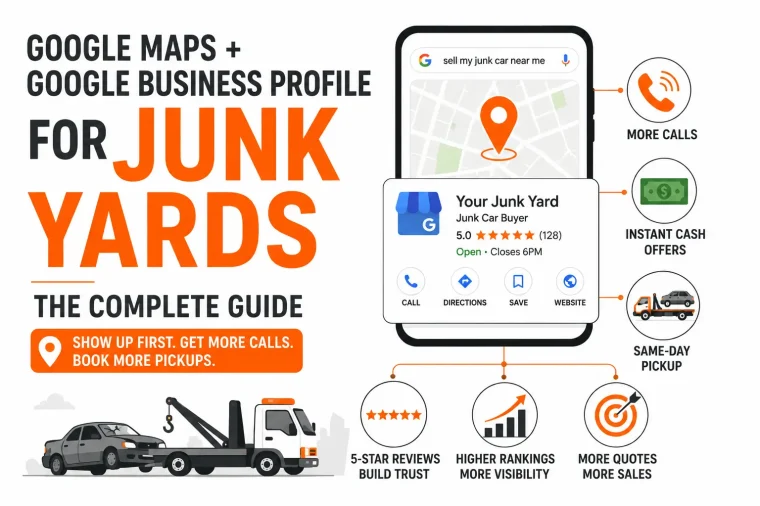
Google Maps for junkyards is where most sellers make their decision before they ever visit a website. This guide covers exactly how to show up first, get your Google Business Profile set up right, and turn that visibility into more calls and quote requests, built specifically for businesses that buy junk cars, not businesses that sell parts. This is part of our full Junk Car Buyer Marketing: The Complete Local Growth Guide, covering everything from GBP setup to first-call trust and reviews.
Google Maps for junkyards is no longer just about appearing on a map. It is about becoming the first trusted option when someone searches for a way to sell their vehicle. A properly optimized profile helps junkyards and junk car buyers capture sellers at the exact moment they are ready to request a quote or schedule pickup.
📌 KEY TAKEAWAYS
- GBP is often the whole decision moment, no browsing, seller calls one of three results fast
- Ranking runs on relevance, distance, prominence, all three need junk-car-specific language, not parts-yard language
- Correct category is Junkyard, not “Junk Car Buyer” (doesn’t exist) and not Used Auto Parts Store
- Services list, description, and photos all need to match cash-for-cars reality, no yard-row inventory shots
- Not showing up on Maps usually traces to wrong category, thin profile, stale reviews, or bad service area setup
- Seller decides on trust, not logistics, reviews naming fair price and fast pickup convert better than generic ones
- Quote requests need their own path, messaging, Q&A, and description all pointed at making that ask easy
What a Google Business Profile Does for a Junk Car Buyer
For a junk car buyer, a Google Business Profile isn’t a digital brochure, it’s often the entire decision-making moment. Someone with a car they want gone searches “sell my junk car near me,” sees three local results, and calls one of them within minutes. There’s no browsing, no comparing inventory, no deciding whether the drive is worth it. It’s a single, fast decision built almost entirely on what that profile shows in that moment.
That changes what the profile actually needs to do. It’s not there to showcase parts availability or yard size, it’s there to answer the two things a seller is silently asking before they dial: is this a real business, and will they give me a fair, fast offer. Hours, reviews, and photos still matter, but they’re doing a different job here than they would for a parts-selling business. A photo of a busy yard full of vehicles doesn’t reassure a seller the way a photo of a tow truck actually showing up does. A review mentioning “great parts selection” doesn’t build the same trust as one mentioning “showed up in an hour, paid cash on the spot.”
The profile also needs to move fast, because the seller’s timeline is short. Most people selling a junk car want it gone this week, sometimes today. A profile that’s slow to respond to messages, thin on recent activity, or unclear about how quickly you can pick up the vehicle loses that seller to whichever competitor answers those questions first. Everything covered in this guide is built around that single reality, a junk car buyer isn’t winning a browsing decision, they’re winning a fast, trust-based one.
How to Rank on Google Maps for junkyards
Google ranks every local business, junk car buyers included, on three factors: relevance, distance, and prominence. Understanding how each one applies specifically to a cash-for-cars business, not a parts-selling one, is what separates a profile that actually ranks from one that sits buried on page two.
Improving junkyard Google Maps SEO requires optimizing every part of the profile around seller intent. The goal is not simply ranking for “junkyard” searches, but appearing when people search terms connected to selling unwanted vehicles, cash offers, and local pickup services.
Relevance is how closely your profile matches what a seller is actually searching. A profile with a generic description and no specific services listed gives Google very little to work with. If your services section doesn’t clearly state that you buy junk cars, offer same-day tow, and pay cash on the spot, Google has no strong reason to match you to those exact searches, “sell my junk car,” “cash for junk cars near me,” “junk car buyer no title.” A thin profile gets shown for broad searches and skipped entirely for the specific, high-intent ones that actually convert into a booked pickup.
Distance works the same way for every local business, Google factors in how far your location is from the searcher. But distance isn’t destiny. A junk car buyer with a stronger, more complete profile can outrank a closer competitor with a weak one. This matters even more for junk car buyers than for a walk-in business, since sellers aren’t traveling to you, you’re coming to them, which means your service area setup and how clearly you communicate your pickup radius carries real weight here.
Prominence is Google’s measure of how trusted and well-known your business is, and it’s built almost entirely on reviews, consistency, and activity. For a junk car buyer, prominence signals look different than they do for a parts yard. It’s not about review count tied to repeat customers, since most sellers only transact with you once. It’s about review velocity and recency, a steady stream of fresh reviews mentioning fast response and a fair cash offer tells Google, and tells the next seller, that you’re actively, currently doing business right now.
Strong junkyard Google Maps ranking depends on keeping these signals active over time. A profile that was optimized once and ignored will usually lose visibility to competitors that continue improving their categories, services, reviews, photos, and customer activity.
Ranking well means working all three signals together, a services list built entirely around junk car buying language, a service area that reflects how far you’ll actually drive for a pickup, and a consistent flow of recent reviews from sellers who got exactly what they were promised.
Best Google Business Profile Category for Junk Car Buyers
Here’s a mistake worth catching early: “Junk Car Buyer” isn’t actually a category Google offers. A lot of marketing content online repeats it anyway, which means plenty of owners go looking for it during setup and never find it, then default to something less accurate out of frustration. The real options come from Google’s own category list, and picking the right one among them matters just as much as we said, it’s just not the option most articles tell you to look for.
Category selection is one of the biggest factors in junkyard Google Maps SEO because it determines which searches Google associates with your business. The right category supports visibility for sellers looking for vehicle removal, cash offers, and local junk car buying services.
For a business that buys whole junk cars for cash, Junkyard is the correct primary category. Google itself describes it as the most direct primary category for a traditional automotive or general scrap yard, which matches exactly what a junk car buyer does, buying vehicles, not selling parts to walk-in customers.
Used Auto Parts Store, by contrast, is built for a different business entirely, one whose primary model is selling recycled OEM parts pulled from vehicles. That’s the correct category for a self-service or full-service salvage yard, not for a junk car buyer. Using it here would actively work against you, matching your profile to parts-buyer searches instead of car-seller searches.
For secondary categories, two options are worth adding depending on what your business actually does:
- Car Wrecker (Auto Wrecker) if you tow, dismantle, or break down vehicles as part of your process
- Towing Service if pickup and hauling are part of your offer, which they usually are for a cash-for-cars business
Salvage Yard and Scrap Metal Dealer can work as secondary categories too, but only if they genuinely reflect part of your operation, adding categories that don’t match what you actually do can dilute relevance rather than strengthen it.
What to check right now: log into your Google Business Profile and confirm your primary category is Junkyard, not Used Auto Parts Store, and not a made-up category like “Junk Car Buyer” that doesn’t exist in Google’s system. Then add Car Wrecker and Towing Service as secondaries if they reflect your actual service.
Setting Up Your Junk Car Buyer GBP Profile Correctly
Once your category is right, the rest of the profile needs to reinforce it, not undercut it. A complete profile is what allows Google Maps for junkyards to generate consistent results. Categories, services, descriptions, photos, and reviews should all communicate the same message: this business buys unwanted vehicles and provides a reliable pickup experience. This is where a lot of otherwise well-ranked profiles quietly lose sellers, the category says “junkyard,” but everything else on the page still reads like a generic auto business.
Services list. This is one of the most overlooked fields on the entire profile, and it’s also one of the strongest relevance signals you control. List services in the exact language a seller would use, not vague industry terms:
- Junk car buying
- Same-day pickup
- No-title purchases accepted
- Instant cash offers
- Free towing
Each of these matches a real, specific search a seller might type. A profile that just says “vehicle services” gives Google nothing to match you against.
Business description. Write it the way you’d explain your business to someone on the phone. Say plainly that you buy junk, wrecked, and non-running cars for cash, that pickup is fast, and that you handle paperwork even without a title. Avoid generic filler like “quality service since 2010,” it doesn’t tell Google or the seller anything useful.
Photos. This is where the biggest mismatch happens. A lot of junk car buyers upload photos that would work great for a salvage yard, wide shots of the lot, rows of vehicles, inventory scale, and none of it reassures the actual person deciding whether to call. What builds trust here is different:
- Your tow truck arriving at a pickup
- The cash handoff moment
- Before-and-after shots of a vehicle removed from someone’s driveway
- Your team actually doing the work
These photos answer the seller’s real question, will this actually happen the way it’s described, not “how big is your inventory.”
Attributes and hours. Keep hours accurate, especially if you offer same-day or after-hours pickup, since that’s often the deciding factor for someone who wants a car gone today. If Google offers attributes relevant to your service, like “onsite service” or similar, use them, they’re small signals that add up.
Set up this way, the whole profile tells one consistent story, category, services, description, and photos all point the same direction: fast, trustworthy, cash-in-hand. A mismatched profile, right category but generic everything else, still loses to a competitor whose whole page reinforces the same message.
Why Your Junk Car Business Isn't Showing Up on Google Maps
If you’ve done real work on your business and you’re still not showing up when someone searches “sell my junk car near me,” the problem is almost always one of a handful of specific, fixable issues. Here’s how to diagnose it.
- Wrong or mismatched primary category. This is the single most common cause. If your primary category is Used Auto Parts Store, Auto Repair, or anything other than Junkyard, Google is matching your profile to the wrong searches entirely. Log in and check this first, before anything else on this list.
- A thin or incomplete profile. A profile missing services, hours, or a real business description gives Google very little to match you against. If you’ve never filled out the services section with specific terms like junk car buying or same-day pickup, you’re invisible for those exact searches, even if you rank fine for broader ones.
- Low or stale reviews. A profile with a handful of old reviews looks inactive to Google, and to sellers. Since most junk car sellers only transact once, review count doesn’t build the same way it does for a repeat-customer business, it needs constant, fresh activity to signal you’re actively operating right now.
- No recent activity. A profile that hasn’t posted, added a photo, or been updated in months sends a quiet signal that the business may not be active. Regular photo uploads and posts, even simple ones, keep the profile looking current.
- Service area set up incorrectly. If your service area is too narrow, too broad, or doesn’t reflect where you’ll actually drive for a pickup, you may be showing up for the wrong searches or missing nearby ones entirely. This matters more for a junk car buyer than a walk-in business, since you’re the one traveling to the seller.
- A duplicate or unclaimed listing. Sometimes an old, unclaimed, or duplicate profile is quietly splitting your visibility. If you suspect this, search your business name directly and see if more than one listing appears.
- A suspended or unverified profile. Occasionally the issue isn’t ranking at all, it’s that the profile was flagged, suspended, or never fully verified. If nothing else on this list explains the problem, check your profile status directly in Google Business Profile manager.
- Quick self-check: go through this list in order, category first, then completeness, then reviews and activity, then service area, then listing status. Most junk car buyers find the answer in the first two or three items, since those are the ones people skip fastest during setup and never revisit.
Improving junkyard Google Maps ranking usually starts by fixing the fundamentals before chasing advanced tactics. A correct category, complete profile, consistent reviews, and accurate service area information create the foundation needed for long-term visibility.
How to Get More Calls from Google Maps for Your Junk Yard
Ranking well on Maps gets you seen. It doesn’t automatically get you called. The purpose of Google Maps for junkyards is not only visibility; it is generating conversations with sellers. A profile that ranks but fails to build trust will miss opportunities to competitors with stronger reviews, clearer messaging, and easier quote options. Once a seller sees your profile alongside two or three others, the decision comes down to trust, not position. Understanding what actually drives that decision is what turns visibility into calls.
- A puller decides on logistics. A seller decides on trust. This is the key difference from salvage yard marketing, and it changes everything about what makes a profile convert. A DIY parts customer is weighing whether the drive is worth it. A junk car seller is weighing whether they’re handing their car over to someone legitimate. That’s a much higher-stakes decision made much faster, often within minutes of searching, which means your profile has to earn trust instantly, not just show up.
- Reviews that mention the actual experience win. A review that says “fair price, showed up when they said they would” does more to convert a seller than ten reviews about parts selection ever could. If your reviews skew generic, encourage sellers to mention specifics, response time, fairness of the offer, how pickup actually went.
- Respond to messages fast, or don’t offer messaging at all. A seller who messages through your profile and waits hours for a reply often just calls the next result instead. If you can’t respond quickly, a clear note in your description pointing sellers straight to the phone number performs better than a messaging option that quietly goes unanswered.
- Your business description should answer the unspoken question. Every seller reading your profile is silently asking, is this real, and will I get a fair deal. A description that plainly states you buy cars for cash, handle pickup and paperwork, and pay on the spot answers that question before they even have to ask it on the phone.
- Recent photos beat inventory photos. A profile with photos from an actual pickup last week reads as active and trustworthy. A profile with the same five stock-feeling photos from years ago reads as uncertain, even if the business is thriving. Consistency here matters more than volume.
- The result: a #3 ranked profile that visibly earns trust in these ways will often out-convert a #1 profile that looks generic or inactive. Ranking gets you in front of the seller. Everything covered here is what gets the phone to actually ring.
How to Get More Quote Requests from a Junk Car Google Business Profile
A call isn’t the only outcome worth optimizing for. A lot of sellers, especially ones still deciding whether to sell at all, want a quote first before they commit to a phone call. Optimizing junkyard Google Maps leads requires making the next action obvious. Sellers should immediately understand how to request a quote, what information is needed, and how quickly they can expect a response. If your profile doesn’t make requesting a quote easy and obvious, you’re losing that entire segment of sellers to a competitor who does.
- Use messaging to invite a quote request directly. Google Business Profile messaging lets sellers reach out without calling, which suits someone who isn’t ready to talk yet. Set your welcome message to prompt action directly, something like “Tell us your car’s year, make, and condition for a fast cash offer,” rather than leaving the message field blank or generic.
- Use Q&A to plant the question yourself. The Questions and Answers section on a profile isn’t just for fielding questions, you can seed it. Post and answer a question like “How do I get a quote for my junk car?” directly, walking through what info you need and how fast you’ll respond. This does double duty, it answers a real seller question and it signals to Google exactly what your business does.
- Your description should make requesting a quote the obvious next step. Instead of ending with something vague, close with a direct instruction: “Message us your car’s details for a same-day cash offer.” A seller scanning quickly should never have to guess what to do next.
- Posts can prompt quote requests too. A simple weekly post, a recent pickup, a reminder that quotes are free and fast, keeps the profile active and reinforces the same call to action every time someone sees it.
- Photos and posts should reduce the friction of asking. A seller who isn’t sure their car qualifies, too old, doesn’t run, no title, often hesitates to reach out at all. A post or photo caption that says plainly “we buy non-running cars, no title needed” removes that hesitation before it stops someone from messaging.
Frequently Asked Questions
Usually one of a few things: the wrong primary category, a thin profile missing services or a real description, stale reviews, or a service area that doesn’t match where you actually operate.
Junkyard is the correct primary category, not Used Auto Parts Store or Auto Repair. Car Wrecker and Towing Service work well as secondary categories if they reflect your actual services.
A salvage yard sells parts to repeat, walk-in customers, so its profile is built around inventory and browsing appeal. A junk car buyer’s profile is built around fast trust and a single, high-stakes transaction, different services, different photos, different review content entirely.
Category and profile fixes can show early movement within weeks. Meaningful, compounding ranking gains from reviews and consistent activity typically build over a few months.
Google Maps helps junkyards appear when local sellers search for services like selling a junk car, vehicle removal, and cash offers. A properly optimized profile improves visibility, builds trust through reviews, and creates more opportunities for calls and quote requests.
Get Your Free Junk Car Marketing Audit
Ready to get more calls, more quotes, and more booked pickups. We’ll show you exactly where your current marketing is losing you leads, and what to fix first. Our junk car buyer clients have seen up to 35% more off-street car buying in 45 days. No generic advice, no pressure. Just a clear plan built for your business.