
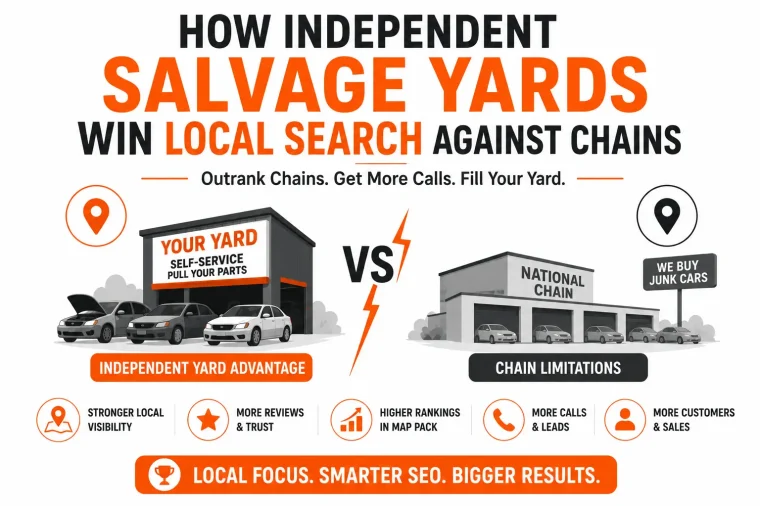
National chains have bigger budgets, bigger fleets, and bigger ad accounts. They still don’t have to win local search, not automatically. Local search runs on different rules than ad spend. It runs on proximity, relevance, and consistent local signals, things an independent yard can build just as fast, sometimes faster, than a chain with ten locations spread thin across a state.
The yards that consistently win local search are not always the biggest companies. They are the ones that build stronger local signals, create better customer experiences, and make it easier for Google to understand who they serve and where they operate.
This guide breaks down exactly how independent self-service salvage yards win local search against chains. Not with a bigger budget, but with sharper local signals, real content chains can’t write, and a Google Business Profile that gets worked daily instead of set up once and forgotten. If you’ve been watching a chain sit above you in the map pack and assumed it was a money problem, it’s usually not. It’s a systems problem, and it’s fixable.
This guide focuses specifically on competing with national chains. For the complete foundation-including Google Business Profile setup, near-me search intent, city pages, citations, reviews, and local ranking factors- read our complete local SEO playbook for self-service salvage yards.
📌 KEY TAKEAWAYS
- Chains outrank independent yards because of consistent systems, not bigger budgets, they run the same GBP, review, and content playbook at every location.
- Local search gaps chains leave open – specific city-level keywords, real inventory content, and personalized review responses, all things a templated chain page can’t do.
- Free local signals that beat ad spend – daily Google Business Profile activity and steady review velocity, both cost nothing and compound over time.
- Content chains structurally can’t write – real inventory, real local knowledge, real customer stories, only the yard that actually has them can tell it authentically.
- You don’t need a chain’s budget, you need their system, right-sized for one yard instead of thirty, and run consistently.
- A focused plan wins over a scattered one – GBP first, reviews second, content third, citations fourth, each step compounds on the last.
- This is System 3 of a bigger growth framework, local search sits alongside off-street car buying, yard admissions, and reporting.
Why Chains Show Up First (It's Not Their Yards, It's Their Systems)
Watch a chain sit above your yard in the map pack long enough and it starts to feel personal, like they simply have more of everything. More locations, more budget, more staff. But that’s not actually why they outrank independent yards in local search. The gap isn’t resources. It’s process. Chains run the exact same online playbook at every location, and that repetition is what search engines reward.
- What Big Salvage Yard Chains Do Differently Online
Big salvage yard chains don’t win local search because they run better yards. They win because they run tighter online systems, the same ones across every single location.
Here’s what that looks like in practice. Chains claim and fully build out every Google Business Profile the day a location opens, complete photos, complete categories, complete hours, no gaps. They post regularly across every location, not just the flagship one. On social media, they run the same content playbook nationally, new inventory posts, promotions, and customer photos, just swapped by city.
Their review systems are automated. Every customer gets a text or email asking for a review within a day of their visit, at every location, every time. That’s not a marketing team working harder. That’s a system running the same way whether it’s location 3 or location 30.
Their site structure also plays a role. Chains build one page per location with consistent local SEO basics, city name, address, hours, service area, baked into a template that scales. It’s not custom content for each city, but it’s consistent, and consistency compounds in local search over time.
None of this requires a huge team or a massive budget per location. It requires a repeatable system. That’s the actual gap between a chain and an independent yard, not resources, process. And it’s exactly the kind of gap an independent yard can close, because a smaller operation running a tight system locally can out-move a chain running a stretched system nationally.
How Salvage Yards Win Local Search Against Larger Competitors
Salvage yards win local search by focusing on the factors that matter most in local rankings: relevance, location signals, authority, and customer trust. Unlike traditional advertising, local search rewards businesses that consistently prove they are the best option for customers in their service area.
A strong salvage yard local search strategy includes optimizing your Google Business Profile, building location-focused website content, earning customer reviews, and creating signals that show Google your yard is active and trusted in the community.
National chains may have larger budgets, but independent yards can win local search by becoming more relevant locally. A yard that dominates its specific market with accurate information, strong reviews, and helpful content can compete effectively against companies with much larger footprints.
The Local Search Gaps Chains Leave Open
Chains win on consistency, but consistency has a cost. To run the same system across thirty locations, everything has to be templated, and templates can’t be specific. That’s the crack an independent yard can work into an actual advantage.
- Keywords Chains Don't Bother Targeting at the City Level
A chain’s city page usually targets the broad terms, “salvage yard [city],” “used auto parts [city],” the obvious ones every location needs. What it almost never targets are the specific, lower-volume searches real local buyers type in, “used transmission for a 2015 Silverado near [city],” “who buys non-running cars in [neighborhood],” “self-service yard open Sundays [city].” Corporate SEO teams build for scale, not specificity, so this entire layer of long-tail, high-intent local search sits open.
An independent yard writing real content around actual inventory, actual neighborhoods, and actual customer questions can rank for dozens of these searches a templated chain page will never touch.
- Where Chains Get Generic and Independent Yards Can Get Specific
Look closely at a chain’s Google Business Profile and website, and the gaps in data quality show up fast. Photos are often stock or years old. Descriptions read the same at every location with just the city name swapped. Reviews get a copy-paste response, “Thanks for visiting, we appreciate your business,” at every location, every time.
An independent yard can out-specify all of it. Real photos of this week’s inventory. A description that names actual makes and models sitting in the yard right now. Review responses that mention the actual part a customer found. None of that is expensive, and none of it takes a big team. It just takes someone paying attention to one yard instead of managing thirty locations from a spreadsheet. That specificity is exactly what Google’s local algorithm rewards under relevance, and it’s exactly what a stretched chain system can’t produce at scale.
Local Signals That Beat Ad Spend
Ad spend gets you visibility while you’re paying for it. Local signals get you visibility that compounds and stays, no monthly bill required. For an independent yard going up against a chain’s ad budget, that difference matters more than it sounds like it should.
- Google Business Profile Activity as a Daily Habit, Not a One-Time Setup
Most yards treat their Google Business Profile like a form they fill out once and forget. Chains treat theirs like a channel that needs feeding, new photos, new posts, inventory updates, several times a week, at every location.
That ongoing activity is a ranking signal on its own. Google reads a profile that’s updated regularly as a business that’s actually open, actually operating, actually worth recommending today, not a business that existed once. An independent yard can match that cadence without spending a cent, a few photos of new arrivals, a quick post about a promotion, a response to every review. We covered the full setup mechanics in our Google Business Profile guide, this section is about the habit, not the setup.
Improving your salvage yard local search rankings requires more than simply having a listing online. Google looks for consistent business information, customer engagement, reviews, location relevance, and website signals that match what people are searching for.
When these signals work together, your yard has a better chance to appear in front of people searching for parts, recycling services, and salvage yards nearby.
- Review Velocity as a Free Ranking Lever Chains Often Neglect Per Location
Chains run automated review requests, which sounds like an advantage until you look at what actually comes back. Automated systems generate volume, not necessarily velocity at the individual location level, and a lot of chain locations end up with reviews that trickle in slowly between corporate campaigns.
An independent yard can out-pace that easily. Ask every customer at checkout, respond to every review within a day, and do it consistently, week after week, not in bursts. A steady stream of five new reviews a week beats a chain location that gets ten in one automated push and then nothing for two months. Google’s algorithm reads that steady rhythm as an active, trustworthy local business, and that reading doesn’t cost a single ad dollar to earn.
Content Chains Can't Write (Because They Don't Know Your Yard)
A corporate content team writing for thirty locations can produce plenty of pages. What they can’t produce is the truth of any single yard, what actually landed this week, what actually happened at the gate on Saturday, who actually works the counter. That gap is where an independent yard’s content wins, not on volume, on specificity nobody else can copy.
- Local, Specific, Real: What Independent Yards Can Say That Chains Can't
Start with what’s actually sitting in the yard right now. A post about a 2016 F-150 that just landed, with real photos and a real stock number, beats any generic “we have trucks” page a chain template will ever produce. Specific inventory content ranks for specific searches, and only the yard that actually has the vehicle can write it honestly.
Local knowledge is another edge. Which neighborhoods send the most walk-ins, which cross streets people use for directions, which local mechanics send customers your way, none of that lives in a corporate content calendar. A chain writer in another state can’t fake it, but the person running your counter already knows it.
Real stories carry weight too. The regular who’s been pulling parts from your yard for ten years. The first-timer who found exactly what they needed and left a five-star review because of it. The Saturday your lot got slammed after a promotion. This is content chains structurally can’t write, because it didn’t happen at their location, it happened at yours.
None of this needs a professional writer or a content team. It needs someone who was actually there, telling it straight. That authenticity is exactly what separates hyper-local content from the templated pages a chain scales across every city, and it’s exactly what Google’s local algorithm rewards when it’s looking for real relevance, not just keyword matches.
A Focused Local Search Plan for Independent Yards
Everything above is a real advantage. None of it matters if you try to do all of it at once, half-finished. A focused plan beats a scattered one every time, especially when you’re the smaller name in the market.
- What to Prioritize First When You're Competing Against a Bigger Name
Start where the return is fastest and the effort is lowest. Fully complete your Google Business Profile first, every field, every category, real photos, this alone closes a gap most independent yards leave wide open for free. Next, get review requests into your checkout routine so velocity starts building immediately, not months from now.
After that, pick the local content chains can’t write and start publishing it consistently, real inventory posts, real yard updates, one or two a week is enough to start. Last, tighten your NAP consistency across every directory your yard is listed on, this quietly supports everything else you’re doing and takes a single afternoon to audit.
That order matters. Profile first, reviews second, content third, citations fourth, each one compounds on the last, and none of them require an ad budget to move.
- You Don't Need a Chain's Budget, You Need Their System, Right-Sized
Here’s the part most independent yards get wrong. They assume chains win because of scale, so they either try to copy everything a thirty-location chain does, or they give up and do none of it. Neither works. What actually works is running the same kind of system a chain runs, automated review requests, consistent content across channels, structured local pages, just built for one yard instead of thirty.
A single-location review system, run consistently, converts just as well as a chain’s automated one, sometimes better, because a real ask from a real person at checkout still lands more personally than a corporate text blast. A focused content and social presence on one or two platforms, run properly, out-performs a chain account spread thin across five. The system is the advantage. The budget was never the requirement.
This is exactly the kind of system we build for independent self-service yards, right-sized, automated where it should be, and built to compete without needing a chain’s marketing budget behind it. See how it comes together on our services page.
Salvage Yard Local Search Optimization Checklist
Successful salvage yard local search optimization comes down to improving every signal that helps Google and customers trust your business.
Key areas include:
- Optimizing your Google Business Profile with accurate categories, services, photos, and updates.
- Building pages that target the locations your yard serves.
- Collecting consistent customer reviews.
- Creating useful content around parts availability, buying vehicles, and visiting your yard.
- Improving website experience so visitors quickly understand what your salvage yard offers.
Where This Fits Into Your Overall Growth System
Everything covered here, Google Business Profile activity, review velocity, hyper-local content, sits inside System 3 of a bigger growth framework: brand authority and local presence. Winning local search against chains isn’t a standalone tactic, it’s one piece of a system that also covers off-street car buying, yard admissions, and reporting, all feeding into each other.
If you want the full picture of how local search fits alongside the other three systems, read the complete breakdown in How to Grow a Self-Service Salvage Yard (Without a Chain’s Budget)
Ready to put a real system behind your local search?
You don’t need a chain’s budget to win local search, you need a system built for one yard instead of thirty, and run consistently. That’s exactly what we build for independent self-service salvage yards.
Frequently Asked Questions
A salvage yard can win local search by improving its local SEO foundation, optimizing Google Business Profile, creating location-focused content, earning customer reviews, and building authority around the services customers are searching for. The goal is to make Google understand that your yard is a trusted local option.
Chains outrank independents mostly because of consistency, not budget. They run the same Google Business Profile, review request, and content system across every location, and that repeatable process is what search engines reward, not the size of the yard itself.
Yes. Local search rewards proximity, relevance, and prominence, all things an independent yard can build through Google Business Profile activity, review velocity, and hyper-local content, none of which requires a huge ad spend to move.
Chains typically miss specific, long-tail local searches, exact makes, models, and neighborhood-level queries, because their content is templated to scale across many locations rather than written for any one of them.
Review velocity, steady, ongoing reviews over time, is one of the strongest local ranking signals available, and it’s completely free. A yard collecting reviews consistently every week often outperforms a chain location that only gets a burst of reviews occasionally.
Start with a fully completed Google Business Profile, then build a consistent review request habit at checkout, followed by hyper-local content and NAP consistency across directories. That order gives the fastest return with the least effort.