If you want to get more calls from Google Maps, you are already ahead of most yard owners. Most salvage yards have the parts. They have the rows. They have the staff who know every make and model on the lot. But their Google Maps listing? It looks like the yard has been closed for two years.
Buyers in your area are searching right now. They pick the yard that looks active, has real photos, and has reviews from people who actually called. If that is not your yard, those calls are going somewhere else. This guide gives you 9 field-tested ways to fix your Google Maps presence and start getting more calls this week. No ad spend. No agency. Just the stuff that actually works for independent salvage yards.
📌 KEY TAKEAWAYS
- Google Maps is where high-intent buyers choose which salvage yard to call, making your Google Business Profile one of your most valuable marketing assets.
- Buyers compare photos, reviews, business hours, and profile activity before making a call, so a neglected profile silently sends customers to competitors.
- Selecting the right primary Google Business Profile category is one of the biggest ranking factors and determines which local searches your yard can appear for.
- Consistently adding real yard photos, collecting detailed customer reviews, and publishing weekly Google Posts strengthen both customer trust and local search visibility.
- Accurate business hours, a complete Q&A section, and an optimized business description reduce buyer hesitation and increase call volume.
- NAP consistency across every directory helps Google trust your business information and improves your position in Google Maps results.
- Tracking calls from your Google Business Profile helps identify which optimization efforts generate the most customer inquiries.
- Your website directly influences your Google Maps rankings by reinforcing location relevance, business information, and local SEO signals.
- Small improvements across multiple Google Business Profile ranking signals compound over time and lead to more calls without relying on paid advertising.
- A fully optimized Google Maps presence helps independent salvage yards generate more qualified calls, more yard visits, and more parts sales month after month.
Why Salvage Yard Buyers Call Instead of Just Showing Up
Nobody wants to drive 45 minutes to a yard and leave empty handed. That is why buyers call first.
They are not browsing. They are not just curious. By the time someone picks up their phone and searches Google Maps for a salvage yard, they already know what they need. They just want to know if you have it before they make the trip.
That call is not a question. It is a buying signal.
- What Buyers Are Actually Asking When They Call
Three questions drive almost every call a salvage yard gets.
Do you have the part? Buyers pull up Google Maps, find the yards closest to them, and start dialing. The first yard that answers and confirms they have the part gets the visit.
How much does it cost to pull? Self-service yards attract buyers who care about price. They want a number before they load up their tools and head out. If you can give them a straight answer fast, you win the visit.
Can I bring my own tools? First-time buyers especially ask this. They are not sure how your yard works. A quick, confident answer builds trust in under 30 seconds.
These are not hard questions. But if no one picks up to answer them, the buyer moves on to the next yard on the list.
- The Moment Your Google Maps Listing Either Wins or Loses the Call
Here is how it actually plays out.
A buyer searches “salvage yard near me” on Google Maps. They see three or four yards. They look at photos, check hours, skim reviews. Then they pick one and call.
If you answer, you have a real shot at that visit. If you do not answer, they dial the next yard. It is that simple.
Your Google Maps listing is what gets you that first call. But it only works if your hours are right, your profile looks active, and your reviews give buyers enough confidence to choose you over the yard down the road.
- How Google Maps Becomes a Salvage Yard Phone Lead Generation Channel
Google Maps works as a salvage yard phone lead generation channel when local visibility turns into a real conversation with a buyer. A profile view is useful, but the lead begins when someone calls to ask about a part, price, vehicle, hours, or yard policy.
That is why Google Maps leads for salvage yards should be measured by more than profile views. Track call actions, website clicks, direction requests, and the calls your staff can connect back to Google. Then compare those interactions with actual yard visits and purchases.
The strongest salvage yard phone leads usually come from people with a specific need. They want to know whether the salvage yard has the right vehicle, whether the part is likely to be available, what admission or pricing looks like, or whether the yard is worth the drive.
Your Google Business Profile should make that next step easy. Keep the phone number accurate, hours current, photos useful, and inventory-related information clear. The easier the salvage yard is to understand before the call, the more qualified the conversation can be.
3 Reasons Your Salvage Yard Isn't Getting Enough Google Maps Calls
Most yard owners think they have a slow season problem. Or a location problem. Or a competition problem. Usually it is none of those. It is a Google Maps problem. Here are the three reasons buyers are not calling you.
- Your Google Business Profile Is Missing the Details Buyers Need
Think about those three questions buyers always call to ask. Part availability. Pull cost. Whether they can bring tools.
Now look at your Google Business Profile. Does it answer any of them?
Most yard profiles have a name, an address, and maybe a phone number. That is it. No description that tells buyers what makes and models you carry. No posts about what just came in. No Q&A section where someone already answered the tools question. So buyers look at your profile, get nothing, and move on to a yard that gives them more to work with before they dial.
- Your Yard Looks Inactive on Maps and Buyers Can Tell
When did you last add a photo to your Google profile? When did you last post an update?
Buyers do not just look at your star rating. They look at whether your yard seems alive. Old photos, no posts, reviews from two years ago with no responses. That profile tells a buyer the yard might not even be open anymore.
An active competitor with fresher photos and a recent post will get the call over you every time. Not because their yard is better. Because their profile looks like someone is actually running the place.
- Competitors Show Up First Because Their Signals Are Stronger
Google Maps does not just show the closest yard. It shows the most relevant, most trusted, most active yard in your area.
If a competitor has more reviews, more consistent business info across directories, and a stronger connection between their website and their Google profile, they rank higher. And the yard that ranks higher gets called first.
Most buyers never scroll past the top three results on Maps. If you are not in that pack, you are invisible. It does not matter how good your inventory is.
The good news? Every signal Google uses to rank you is something you can fix. That is exactly what the next section covers.
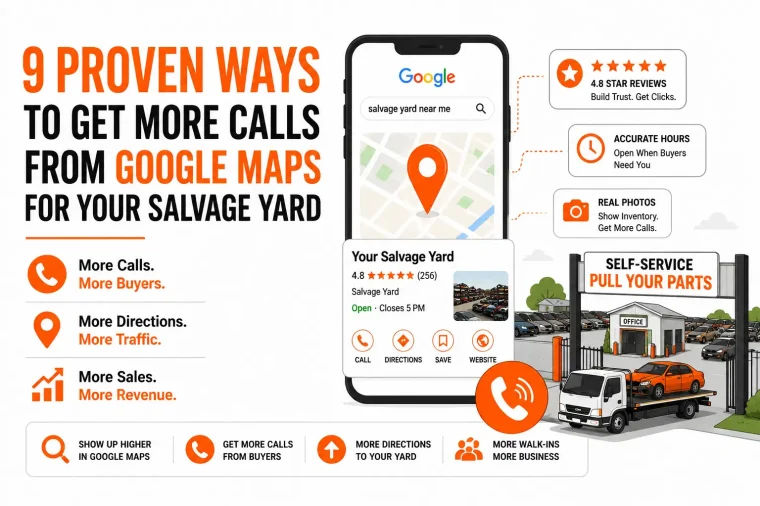
9 Proven Ways to Get More Calls From Google Maps for Your Salvage Yard
1. Set the Right GBP Category (Most Yards Get This Wrong)
Your primary category tells Google exactly what your business is. Get it wrong and you show up for the wrong searches, or worse, you barely show up at all.
Most salvage yards pick something generic and leave it there. That is a mistake.
For most self-service salvage yards, the strongest primary category is usually “Used Auto Parts Store” or “Salvage Yard,” depending on what Google shows in your area. The right choice comes down to what your yard is mainly trying to win from search. If buyers in your market search “salvage yard near me,” go with Salvage Yard. If they search “used auto parts,” go with Used Auto Parts Store.
After your primary category is set, add secondary categories to fill in the gaps. This gives Google more context about what you offer without diluting your main signal.
One category change can move you up in the local pack. It takes two minutes to fix and most of your competitors have not done it. Your business category is only one part of a high-performing profile. For a complete walkthrough of every field, feature, and optimization opportunity, read our guide to Google Business Profile for Salvage Yards.
2. Add Photos That Prove You Have What Buyers Are Looking For
Buyers are visual. Before they call, they want to see the yard. Not stock photos. Not a logo. Real photos of your rows, your entrance, your parts, and your pulled inventory. A buyer looking for a specific engine wants to see that you have rows full of vehicles, not a picture of a phone number on a sign.
Post photos consistently. Add new ones every week if you can. Google rewards active profiles and buyers trust yards that look real and current.
Here is what works best for salvage yards specifically. Photos of vehicle rows organized by make or model. Close-up shots of high-demand parts like engines, transmissions, and doors. Your entrance and signage so buyers know what to look for when they arrive. Staff photos build trust too.
The yards getting the most calls on Google Maps are not always the biggest. They are the ones with the most photos.
3. Get Reviews That Mention Parts, Price, and Fast Phone Response
Star ratings matter. But what the review actually says matters more.
A review that says “Great yard, found the alternator I needed, fair price and they picked up right away” does more for you than ten reviews that just say “Good place.”
Those specific words, parts, price, phone response, are exactly what the next buyer is thinking about before they call. Seeing them in a real review removes doubt and pushes them to dial your number.
Ask for reviews the right way. After a buyer pulls a part and pays, your staff can simply say “If you got what you needed today, a quick Google review really helps us out.” Most happy customers will do it if someone asks.
You can also put a QR code on your receipt that links straight to your Google review page. One scan and they are there. Respond to every review too. Good ones and bad ones. A yard that responds looks like a yard that cares. That alone puts you ahead of most competitors.
4. Keep Hours 100% Accurate — Wrong Hours Kill Calls Instantly
This one sounds basic. It is costing yards more calls than almost anything else.
A buyer checks your hours on Google Maps. They see you close at 5pm. They plan to come after work. They call at 4:45 to confirm you have the part. Nobody picks up because you actually close at 4.
Or worse. Your Google profile says you are open on Saturday. You are not. A buyer drives 30 minutes to your yard on a Saturday morning and finds a locked gate. That buyer leaves a one-star review and never comes back.
Keep your hours updated in real time. Holidays, weather closures, early closings. Update them before the day, not after the complaint. Your hours are one of the first things buyers check before calling. If they are wrong even once, you lose that buyer for good.
5. Use Google Q&A to Answer the Questions Buyers Call to Ask
Your Google Business Profile has a Q&A section. Most yards ignore it completely. That is a missed opportunity.
Buyers have the same questions every time. Can I bring my own tools? Do you have a specific make or model? What is your pricing? Do you have a row map?
If those questions are already answered on your profile, a buyer gets the information they need and calls you with confidence instead of calling to ask and hanging up when no one answers.
Here is the thing. You do not have to wait for buyers to ask. You can add the questions yourself and answer them. Go to your GBP, find the Q&A section, and post the five most common questions your staff gets on the phone every day. Then answer each one clearly.
This also helps with AI Overviews. Google pulls Q&A content when answering local search queries. Your answers can show up before a buyer even clicks on your profile.
6. Post Weekly Updates to Signal Your Yard Is Active
Google Posts are free. They take five minutes. And almost no salvage yard uses them.
A weekly post tells Google your profile is active. It also gives buyers a reason to trust that your yard is open and running. Even a simple post works. New arrivals this week. A row of 2015 to 2019 Silverados just came in. Call us or stop by.
That post does two things. It signals freshness to Google, which helps your ranking. And it gives buyers something specific to call about.
You do not need to write an essay. Two or three sentences and a photo is enough. Post about new inventory, seasonal reminders like “stocking up on AC compressors heading into summer,” or simple yard updates.
Yards that post consistently look more active than yards that do not. Google notices. Buyers notice.
7. Lock Down NAP Consistency Across Every Directory
NAP stands for Name, Address, and Phone Number. It needs to be identical everywhere your yard is listed online.
Your Google profile, your website, Yelp, Yellow Pages, Facebook, every directory needs to show the exact same business name, address, and phone number. Not close. Exact.
Even small differences confuse Google. “Riverside Auto Salvage” on one site and “Riverside Auto Salvage Yard” on another splits your authority. Google is not sure which listing is real, so it trusts neither one fully. That hurts your ranking in the local pack.
Run a citation audit. Check every place your yard is listed and fix anything that does not match your Google profile exactly. Tools like Semrush Local can show you all your listings in one place and flag the inconsistencies. This is not exciting work. But it is one of the fastest ways to strengthen your Maps ranking without doing anything visible to buyers.
Not sure which primary and secondary categories are best for your yard? Our guide to 6 Best Categories for Salvage Yards explains how to choose the right combination for stronger local rankings.
8. Add Your Inventory or Make and Model Specialties to Your Description
Your Google Business Profile description is 750 characters. Most yards use maybe 100 of them, if that.
Use the full space. Tell buyers exactly what you carry. If your yard is heavy on domestic trucks, say that. If you have a strong inventory of Japanese imports, say that too. If you specialize in certain years or body types, put it in the description.
A buyer searching for a part from a 2017 F-150 sees your description mentions late-model Ford trucks. That alone can make them choose your yard over a competitor with a vague description.
Your description also helps Google understand what your yard is relevant for. More relevant matches mean more calls from buyers who actually need what you have. Write it in plain language. No marketing fluff. Just clear, specific information about what makes your yard worth calling.
9. Enable and Monitor Your GBP Call Button — Then Track Every Call
Your call button needs to be on. This sounds obvious but some yards have it disabled or have the wrong number attached to it.
Go into your Google Business Profile and confirm your phone number is correct and your call button is active. Then test it. Search your own yard on Google Maps and tap the call button. Does it ring the right number? Does someone answer?
Once that is confirmed, set up call tracking so you know exactly how many calls your Maps profile is generating. There are two ways to do it.
- The free way. Google still tracks “click to call” interactions inside your GBP dashboard. Go to Performance, then the Calls tab and you will see total call volume from buyers who tapped your call button on their phone. It is not perfect since it misses anyone who reads your number on a screen and dials manually, but it gives you a baseline for free.
- The accurate way. For full tracking including call logs, recordings, and duration, you need a third-party tool like CallRail or WhatConverts. Here is how to set it up without hurting your local ranking:
- Get a local tracking number from your chosen platform
- Paste that tracking number into the Primary Phone field on your GBP
- Move your real business number into the Additional Phone field
That last step is important. Keeping your real number in the secondary field means Google can still match your business information across the web. Your NAP stays consistent and your ranking stays protected.
That data tells you what is working. If calls spike after you add new photos, you know photos matter. If calls are coming in Saturday morning but nobody is picking up, you know you need coverage then.
You cannot improve what you do not track.
How to Increase Calls From Google Business Profile Views You Already Have
If the salvage yard is already getting visibility on Google Maps, the next opportunity is improving how many of those views turn into calls. More impressions alone do not guarantee more customers. The profile has to remove enough uncertainty for a buyer to choose your yard and tap the call button.
Start with the information closest to the decision. Make sure the salvage yard phone number is correct, business hours are current, the primary category fits the operation, and recent photos show what customers can expect. Use the description, services, Q&A, and posts to answer common questions about parts, inventory, pricing, tools, admissions, and vehicle buying.
To increase calls from Google Business Profile, give buyers a reason to call now. Fresh inventory, hard-to-find makes, weekend availability, updated yard hours, or a clear junk-car buying message can create a more specific reason to contact the salvage yard than a generic business description.
Also check the path after the click. If a buyer lands on the website, the salvage yard phone number should be easy to find and tap on mobile. Important pages should support the same message the customer saw on Google instead of forcing them to search again.
Measure the result over time. Compare Google Business Profile interactions with tracked phone activity and yard outcomes. If visibility rises but calls remain flat, the salvage yard may have a conversion problem rather than a ranking problem.
How Your Salvage Yard Website Directly Boosts Your Google Maps Ranking
Most yard owners think Google Maps and their website are two separate things. They are not.
Google looks at your website to decide how much to trust your Maps listing. A strong website with the right signals pushes your yard higher in the local pack. A weak or missing website holds you back no matter how good your GBP looks.
- The Website Signals Google Uses to Decide Which Yard Gets the Call
Google cross-references your website with your GBP every time it ranks local results. Here is what it is looking for.
Your NAP on your website needs to match your GBP exactly. Same business name, same address, same phone number. If your website says one thing and your GBP says another, Google loses confidence in your listing and your ranking drops.
Your website also needs to mention your location and what you do. A page that talks about your city, your services, and the makes and models you carry tells Google your yard is relevant for local searches. Generic websites with no location-specific content give Google nothing to work with.
Schema markup is another signal most yards skip entirely. Adding LocalBusiness schema to your website puts your business name, address, phone number, and hours directly in a format Google can read without guessing. It strengthens the connection between your website and your Maps listing and can push your contact details into search results before a buyer even clicks anything.
Finally, your website needs to be fast and work properly on mobile. Most buyers search on their phones. If your site loads slowly or looks broken on a small screen, Google notices that too.
- Pages Every Salvage Yard Website Needs to Drive Maps Calls
You do not need a complicated website. You need the right pages with the right information on them.
Your homepage should state clearly what you are, where you are, and what you carry. Your phone number should be at the top, clickable, and easy to find. Do not make buyers hunt for it.
A dedicated services page that covers how your yard works, what buyers need to bring, your pricing structure, and your pull policy answers the questions buyers would otherwise call to ask. The more you answer upfront, the more confident a buyer feels when they do pick up the phone.
A location page with your full address, an embedded Google Map, your hours, and a click-to-call button ties your website directly to your Maps listing. This is one of the strongest local SEO signals you can add to your site.
If you carry specific makes or models in strong supply, build pages around them. A page targeting “used Ford F-150 parts” or “Chevy Silverado salvage yard” in your city connects your inventory to the exact searches buyers are using before they call.
These pages do not need to be long. They need to be clear, local, and easy to navigate on a phone.
Salvage Yard Call Conversion: Turn Parts and Inventory Calls Into Yard Visits
Generating the call is only half the job. Salvage yard call conversion is what turns an interested local searcher into a customer who actually visits the yard, buys a part, or moves forward with a vehicle sale.
A strong call should answer the buyer’s immediate question quickly, reduce uncertainty, and give a clear next step. For parts calls, that may mean explaining how inventory is organized, what the customer should bring, current hours, admission details, or how to check vehicle availability. For seller calls, it may mean collecting the vehicle details needed for the next step without making the process feel complicated.
Track more than total calls. Record answered calls, missed calls, qualified inquiries, yard visits when they can be attributed, and completed transactions. That gives the salvage yard a clearer picture of whether marketing is producing real opportunities and whether the phone process is converting them.
- Salvage Yard Phone Answering Strategy for Parts, Price, and Inventory Calls
A practical salvage yard phone answering strategy starts with consistency. Staff should know how to handle the questions buyers ask most often without transferring every call or giving conflicting information.
Create a short call guide for parts availability, pricing structure, admission fees, accepted payment methods, tools, hours, inventory lookup, and yard policies. The goal is not to turn staff into scripted call-center agents. It is to make sure each salvage yard caller gets a useful answer and a clear next step.
When exact part availability cannot be guaranteed, say so clearly. Explain what inventory information is available, when it was updated, and what the buyer can do before making the trip. Overpromising may win the call but lose trust when the customer reaches the salvage yard.
For high-intent calls, end with a practical action: visit during current hours, check the inventory page, bring the required tools, submit vehicle details, or speak with the right team member. That small step improves salvage yard call conversion because the conversation ends with direction instead of uncertainty.
- Salvage Yard Missed Call Management: Recover High-Intent Buyers Before They Call a Competitor
Salvage yard missed call management matters because a buyer who cannot reach one yard can quickly call another result on Google Maps. A missed call should therefore enter a simple recovery process instead of disappearing from the day.
First, identify when missed calls happen most often. Compare them by day and time, then adjust staffing or call coverage where the pattern is consistent. If the salvage yard receives a heavy volume during lunch, late afternoon, or Saturday mornings, build coverage around those windows.
Return missed calls as quickly as operations allow. Give staff a simple callback process that records the caller’s name, number, reason for calling, and outcome. If voicemail is used, keep the message short and tell callers what information to leave so the salvage yard can respond efficiently.
Also separate missed calls from abandoned or low-quality calls when reviewing performance. The goal is to understand how many legitimate buyer or seller opportunities were lost because nobody answered.
When the salvage yard tracks missed calls, callbacks, and outcomes alongside Google Maps activity, phone management becomes part of the marketing system. You can see whether the problem is generating enough calls, answering them, or converting them into visits and transactions.
Frequently Asked Questions
Start with your Google Business Profile. Set the right category, add real photos, keep your hours accurate, and collect reviews that mention parts and phone response. These are the signals Google uses to decide which yard shows up first and gets the call.
The most common reasons are an incomplete GBP, weak NAP consistency across directories, little to no reviews, and no active posting history. Google favors yards that look active and trustworthy. If your profile is thin or outdated, a competitor with a stronger presence will outrank you.
You can rank without one but it is much harder. Your website sends trust signals to Google that strengthen your Maps listing. A basic site with your location, services, phone number, and schema markup gives Google the confirmation it needs to rank you higher in local results.
There is no magic number but yards with 50 or more reviews that mention specific parts, pricing, and fast phone response consistently outperform yards with fewer or vague reviews. Consistency matters more than volume. Keep asking after every successful pull.
Photos of your vehicle rows organized by make and model perform best. They answer the buyer’s first question visually before they even call. Add new photos regularly since fresh content signals to Google that your yard is active.
Want More Google Maps Calls Without Doing All This Yourself?
Everything in this guide works. But it only works if someone actually does it consistently.
Most independent yard owners are already running a full operation. Managing inventory, buying cars, handling staff, dealing with customers. Adding Google profile management, weekly posts, citation audits, and call tracking on top of that is a lot.
That is exactly what Pull Your Part Accelerator exists for.
We work exclusively with independent self-service salvage yards. We know your buyers, your search behavior, and the Google signals that move the needle for yards specifically. No learning curve. No generic marketing playbook. Just focused execution on the things that get your yard more calls.