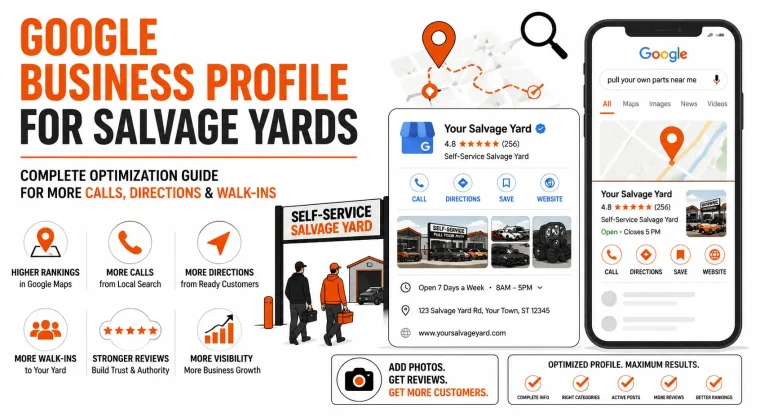
If you want your Google Business Profile for salvage yards to actually bring in sellers and pullers instead of just existing online, this guide is built for you. Not generic Google advice. This is specifically for independent self-service yards that want to show up in local search, get more calls, and drive more walk-ins without spending a dollar on ads. For the broader approach, see our SEO for salvage yards.
📌 KEY TAKEAWAYS
- A Google Business Profile is the single most important free tool a salvage yard has for showing up in Google Maps and local search when sellers and pullers are ready to act
- Most independent yards are invisible in local search not because of competition but because their profile is incomplete, inactive, or set up wrong from the start
- Google ranks salvage yards based on three factors: relevance and prominence are both entirely in your control and that is where all your optimization effort should go
- Your primary category selection is the single most important decision in your entire profile and the wrong choice limits which searches your yard is eligible to appear for
- Categories, services, and attributes work together to tell Google precisely what your yard does and every empty field is a missed ranking signal
- Photos are the fastest trust signal your profile has and adding five to ten new ones every month keeps your profile looking active to both Google and customers
- Reviews are the strongest prominence signal Google uses and generating them consistently requires a system built into every transaction not a one time ask
- Common mistakes like keyword stuffed business names, inconsistent information, and zero review responses are silently costing independent yards customers every single day
- Your Google Business Profile checklist covers every field, every signal, and every active habit that separates a profile that ranks from one that sits dormant
- A fully optimized profile drives calls, direction requests, and walk-ins without any ongoing ad spend and compounds stronger every single month it stays active
- Results in 45 days or you pay nothing
What Is a Google Business Profile for Salvage Yards?
A Google Business Profile is a free listing that puts your salvage yard on Google Maps and in local search results when sellers and pullers search for what you offer in your area. It is the first thing most customers see before they ever visit your website, call your number, or drive through your gate.
When someone searches “sell my junk car” or “pull your own parts near me” on their phone, Google shows them a map with three local business listings before anything else. That is the Google Maps three-pack and your Google Business Profile is what gets you into it. Without a profile your yard does not exist in that result. With a fully optimized one your yard shows up at the exact moment a high intent customer is ready to act.
Understanding keywords is essential before optimizing your Google Business Profile.
This Best Salvage Yard Keywords for More Parts Buyers and Junk Car Leads breakdown explains how salvage yard keywords actually work in search.
Why Every Self-Service Salvage Yard Needs a Google Business Profile
For a self-service salvage yard specifically, a Google Business Profile does more than just list your name and address. It shows your hours so pullers know if you are open before they make the drive. It shows your reviews so sellers can decide whether to trust you before they call. It shows your photos so customers can see the scale of your operation before they arrive. And it tracks every call, every direction request, and every profile view so you can see exactly how many customers Google is sending you every single month.
The yards getting consistent calls and walk-ins from local search are not doing anything complicated. They have a complete, active, and well optimized Google Business Profile working for them around the clock. The yards that are invisible on Google Maps almost always have the same problem: a profile that is incomplete, inactive, or set up wrong from the start. Once the profile is accurate, focus on how to turn profile views into qualified calls.
How Google Ranks Salvage Yards: Relevance, Distance and Prominence
Getting into the Google Maps three-pack is not random. Google uses three specific ranking factors to decide which salvage yards show up for every local search. Understanding all three tells you exactly where to focus your optimization effort and why some yards consistently outrank better operations in the same market
- Relevance
Relevance is how well your Google Business Profile matches what someone is actually searching for. When a seller searches “cash for junk cars” or a puller searches “self-service salvage yard” Google looks at your profile and decides whether your yard is a strong match for that specific search.
Most yards hurt their relevance without knowing it. A profile with one generic business category, a thin business description, and no services listed gives Google very little to work with. The result is that your yard gets shown for broad searches but missed entirely for the specific high intent searches your best customers are using.
Improving relevance comes down to completeness and specificity. The right primary and secondary categories selected. A business description that uses the exact language your customers search with. Services listed that match the searches you want to rank for. Every field Google gives you to fill out is an opportunity to tell Google more precisely what your yard does and who it serves. Leave those fields empty and a competitor who filled them out ranks above you.
- Distance
Distance is the one ranking factor you cannot control. Google calculates how far your yard is from the person searching and uses that as part of the ranking decision. A yard two miles from the searcher has a natural distance advantage over one that is eight miles away for the same search.
What most yard owners do not realize is that distance is not an absolute barrier. A yard further away with stronger relevance and higher prominence can and regularly does outrank a closer yard with a weak profile. Distance matters but it rarely decides the outcome on its own.
For self-service yards that want to rank in a wider regional area beyond their immediate location, the strategy is to build enough relevance and prominence to overcome the distance factor. Location specific content on your website targeting surrounding cities and zip codes, consistent citations across local directories, and a high volume of reviews from customers across your full service area all signal to Google that your yard is worth showing to searchers beyond your immediate neighborhood.
- Prominence
Prominence is Google’s measure of how well known and trusted your yard is both online and in the real world. It is the most complex of the three factors and the one that compounds the most over time.
Google builds its prominence score from multiple signals. How many reviews your yard has and how recent they are. How consistently your business name, address, and phone number appear across the web. How many authoritative local and automotive directories list your yard. How active your profile is with regular posts, photos, and responses. And how strong your website is in supporting your local rankings.
Building prominence for a salvage yard means working all of those signals consistently. A steady flow of genuine reviews from real customers. Citations on high authority automotive and local business directories like Yelp, Yellow Pages, and industry specific sites like car-part.com. Regular profile activity that signals to Google your yard is open, active, and worth recommending. And a website that reinforces your local authority rather than undermining it.
The yards sitting at the top of Google Maps in any market did not get there overnight. They got there because their prominence score kept climbing month after month while competitors stayed static. That gap is entirely closeable for any independent yard willing to work the signals consistently.
A well-optimized Google Business Profile is only one piece of a successful online marketing strategy. For a complete framework covering local SEO, website optimization, content strategy, citations, reviews, and lead generation, explore our comprehensive
SEO for Salvage Yards Guide.
How to Set Up Your Google Business Profile for Salvage Yards Step by Step
Setting up your Google Business Profile correctly from the start saves you from ranking problems that are frustrating to diagnose and slow to fix. Most salvage yards either rush the setup and leave critical fields empty or claim an auto-generated listing that already has wrong information attached to it. Here is how to do it right the first time.
- Step 1: Claim or Create Your Profile Go to google.com/business and search for your yard by name before creating anything new. Google may have already generated a listing for your yard based on data it collected from other sources. If that listing exists, claim it rather than creating a duplicate. Two listings for the same yard confuse Google and hurt your rankings. If nothing exists, create a fresh profile from scratch.
- Step 2: Enter Your Core Business Information Your business name should be your actual yard name with no added keywords. Google explicitly penalizes keyword stuffing in business names and a suspension is not worth the marginal ranking benefit. Enter your exact address, local phone number, and website URL. This information needs to match exactly what appears on your website and every other directory your yard is listed on. One inconsistency is enough to suppress your local rankings quietly.
- Step 3: Choose the Right Primary Category This is the single most important selection in your entire profile. Your primary category tells Google what type of business you are and which searches you are eligible to appear for. For a self-service salvage yard the best primary category is “Used Auto Parts Store” or “Salvage Yard” depending on which one Google currently shows as an option in your region. Do not pick a generic category like “Auto Parts Store” and leave it there. Add every relevant secondary category available including “Junkyard,” “Auto Wrecker,” and “Recycling Center” where applicable.
- Step 4: Write a Business Description That Works for Both Google and Customers You have 750 characters. Use them. Your description should include your primary keyword naturally, mention your specific location, describe what type of yard you run, and tell a seller or puller exactly what makes your yard worth choosing. Write it for the customer first and Google second. A description that reads naturally and includes your most important search terms in context is more effective than one that is stuffed with keywords and reads like a list.
- Step 5: Verify Your Profile Google requires verification before your profile goes live in search results. The most common method is a postcard sent to your business address with a verification code. Some yards qualify for phone or email verification depending on how Google classifies the listing. Complete verification as quickly as possible. An unverified profile does not rank and cannot be fully managed.
- Step 6: Complete Every Section Before Going Live Hours of operation including any seasonal variations. Service area if your yard offers pickup. Products or services if applicable. Attributes that describe your yard like whether you accept cash, offer same day pickup, or have accessibility features. The more complete your profile is at launch the stronger your starting position in local rankings. Every empty field is a missed signal.
The Right Categories, Services and Attributes for a Salvage Yard Profile
Categories, services, and attributes are the three fields that tell Google precisely what your yard does and who it serves. Most yards fill in one category and leave everything else blank. That single decision quietly limits which searches your profile is eligible to appear for every single day.
- Primary and Secondary Categories Your primary category carries the most weight in local rankings so it needs to be the most accurate match for your core business. For a self-service salvage yard the strongest primary category is “Used Auto Parts Store” or “Salvage Yard” depending on availability in your region. Once your primary is set add every relevant secondary category Google allows. “Junkyard,” “Auto Wrecker,” “Recycling Center,” and “Auto Parts Store” all expand the range of searches your profile can rank for. Each secondary category is an additional signal telling Google your yard is relevant for a wider set of customer searches. One of the most overlooked optimization steps is selecting the right Google Business Profile categories. Before adding secondary categories, Choose categories that match your yard and the services you actually provide.
- Services The services section is one of the most underused ranking opportunities in the entire profile. Google allows you to list specific services your yard offers and each one becomes a searchable term attached to your listing. For a self-service yard your services should include junk car buying, self-service auto parts, vehicle recycling, same day car pickup, and cash for cars at minimum. Add as many specific and accurate services as apply to your operation. A seller searching for “same day junk car pickup” has a much higher chance of finding your yard if that service is explicitly listed in your profile.
- Attributes Attributes are the descriptive details that help customers make a quick decision about whether your yard fits their needs before they even click on your listing. Payment methods accepted, accessibility features, whether you offer online quotes, same day service availability, and whether you are veteran or locally owned are all attributes Google makes available depending on your category. These details feel minor but they influence both rankings and conversions. A seller comparing two yards in the three-pack who sees “cash payment accepted” and “same day pickup available” on your listing already has a reason to choose you before reading anything else.
Google Business Profile Services for Salvage Yards
Your services section should make it easy for Google and customers to understand what the salvage yard actually offers. Start with services that match real customer actions, then describe them in plain language instead of adding every option that sounds automotive.
For a self-service salvage yard, useful services may include self-service used auto parts, junk car buying, vehicle recycling, same-day vehicle pickup, cash-for-cars service, and other services the yard genuinely provides.
Keep the list aligned with the business model. If the salvage yard doesn’t provide full-service dismantling, public towing, repairs, or another service, don’t add it simply to appear for more searches.
Write each service for the customer first. A short description can explain who the service is for, what happens next, and whether the customer should call, request a quote, or visit the yard.
Review these services whenever operations change. New pickup options, expanded seller services, or discontinued offerings should be reflected on the profile so customers always see accurate information.
Photos That Get More Calls and Walk-Ins to Your Salvage Yard
Photos are the fastest trust signal your profile has. Before a seller decides to call and before a puller decides to make the drive, they look at your photos. What they see in those first few seconds determines whether your yard feels like a legitimate operation worth visiting or a risk not worth taking. Most salvage yards upload three photos at setup and never touch them again. That is a direct ranking and conversion disadvantage against any competitor who is adding photos consistently.
- What Photos to Upload Every photo category serves a different customer need. Exterior shots of your entrance and signage tell first time visitors exactly what to look for when they arrive. Wide shots of your yard rows show the scale of your inventory and signal to pullers that the drive is worth it. Close ups of specific vehicles or makes and models attract pullers hunting for particular parts. Photos of your team at the gate and processing vehicles build personal trust with sellers who want to know who they are dealing with. And photos of the transaction process itself, a seller handing over keys, cash being exchanged, a tow truck in the lot, tell the selling story visually better than any written description can.
- Which Photos Drive the Most Action Exterior and interior yard photos consistently generate the most direction requests because they help customers confirm they are going to the right place. Photos showing active inventory turn, cars being processed and rows being worked, signal to Google and to customers that your yard is busy and worth visiting right now. A profile with photos that show real daily activity at your yard will outperform a profile with polished but static images every single time.
- How Often to Add Photos Google rewards consistent photo activity over time not a single large upload. Adding five to ten new photos every month keeps your profile looking active and signals to Google that your yard is a living breathing business. New inventory arrivals, seasonal yard updates, and behind the scenes shots from daily operations all make natural regular content without requiring any professional photography. A phone camera and a habit of capturing what is happening in your yard is all you need.
Optimizing your profile is only the first step. Once your listing is complete, you also need strategies that encourage buyers to choose your yard and actually make the call. Learn these practical tactics in our guide on 9 Proven Ways to Get More Calls From Google Maps for Your Salvage Yard.
Google Posts for Salvage Yards: Turn Profile Views Into Calls and Walk-Ins
Google Posts give a salvage yard a practical way to publish timely updates, offers, and events directly on its Business Profile. Use them when there is something useful for a seller or puller to act on, not simply because another week has passed.
For pullers, useful posts can highlight fresh vehicle arrivals, new rows, weekend hours, seasonal updates, or make-specific inventory. For sellers, posts can explain junk car buying, pickup availability, or give customers a reason to request an offer.
Keep each message specific. “New inventory this week” is less useful than a post that identifies the vehicle types or makes that recently arrived at the salvage yard.
A salvage yard can also publish offer or event posts when the promotion is genuine and the dates are accurate. Each post should have one clear purpose and an appropriate next step.
Don’t treat Google Posts as a shortcut to higher rankings. Their main value is helping customers understand what is happening at the salvage yard and giving them another reason to call, visit, or click through to the right page.
Google Business Profile Q&A for Salvage Yards
The Q&A section can answer common questions before they turn into missed calls or abandoned visits. A salvage yard should monitor customer questions and provide short, factual answers that reflect current policies and operations.
Useful questions may cover salvage yard admission fees, age requirements, tools allowed in the yard, payment methods, inventory availability, junk car paperwork, pickup areas, and whether customers can check vehicle availability before driving over.
If an answer changes, update it instead of leaving outdated information visible.
Don’t use Q&A as a place to force keywords or create fake customer questions. The goal is to remove friction. When pullers and vehicle sellers can find clear answers quickly, the salvage yard becomes easier to understand and easier to choose.
Reviews and Reputation Signals That Strengthen Your Salvage Yard GBP Rankings
Reviews are the most direct prominence signal Google uses to rank local businesses and the most powerful trust signal a customer uses to choose between two yards sitting next to each other in the three-pack. A yard with 150 recent reviews with consistent responses beats a yard with a better operation and a weaker profile every single time. The number matters, the recency matters, and the responses matter equally.
Getting reviews consistently requires a system not a reminder. Every smooth transaction is a review waiting to happen. Build a simple process that asks every satisfied seller and puller for a review at the right moment while the experience is still fresh. A text with a direct link sent within an hour of the transaction closes more reviews than any follow up a day later. Respond to every review including the negative ones. A calm professional response to a bad review tells every future customer reading that exchange that your yard handles problems like a real business and that signal builds more trust than the negative review takes away.
Google Business Profile Insights for Salvage Yards: What to Track
Google Business Profile performance data helps a salvage yard understand how customers find and interact with its listing. Instead of focusing on one number, track the actions that connect most closely with actual customer behavior.
Review the search terms people use to discover the salvage yard, along with calls, website clicks, direction requests, and other available interaction metrics.
Compare these numbers month over month and look for meaningful patterns. An increase in direction requests may support stronger walk-in activity, while more seller-related searches and calls may indicate growing junk car demand.
Don’t judge the salvage yard by Business Profile activity alone. Connect profile data with website leads, tracked calls, admissions, and acquired vehicles whenever possible.
Review performance on a consistent schedule, such as monthly, rather than reacting to daily fluctuations. The goal is to identify trends, find weak areas, and determine what needs improvement.
Common Google Business Profile Mistakes Salvage Yards Make
The most damaging GBP mistakes are not complicated errors. They are simple oversights that quietly suppress rankings for months without any visible sign that something is wrong. Wrong primary category selected. Business name stuffed with keywords that violates Google policy and risks suspension. Hours not updated after a seasonal change. Zero responses to reviews. No photos added since the profile was created. Service area left blank. These mistakes are common across independent yards and every one of them is a direct ranking disadvantage against a competitor who got them right.
The second most common mistake is inconsistency. A phone number on your profile that does not match your website. An address formatted differently across three directories. A business name that appears slightly different on Yelp than it does on Google. Each inconsistency is a trust signal working against you. Google cross references your information across the web and any mismatch reduces the confidence it has in your listing which directly suppresses where you rank.
Google Business Profile Optimization Checklist for Salvage Yards
Use this to audit your profile right now and identify exactly what needs fixing:
- Business name matches your actual yard name with no added keywords
- Correct primary category selected for a self-service salvage yard
- All relevant secondary categories added
- Complete and accurate address, phone number, and website URL
- Business description written with primary keywords used naturally
- All available services listed specifically
- Relevant attributes selected and accurate
- Hours of operation complete including holiday and seasonal variations
- Service area defined if your yard offers pickup
- Minimum 25 photos uploaded across all relevant categories
- Photos being added consistently every month
- Review generation process in place and active
- Every review responded to including negative ones
- Regular posts going out at least twice per month
- Google Business Profile insights being checked monthly
- Business information matches exactly across every directory your yard appears on
How Often Should Salvage Yards Update Their Google Business Profile?
There is no reason to change a profile simply to make it look active. Update important information immediately whenever salvage yard hours, phone numbers, services, pickup areas, or other business details change.
Add new photos when there is genuine inventory, facility, team, or operational activity worth showing. Publish Google Posts when there is a timely update, offer, event, or inventory announcement that gives customers a reason to act.
For routine management, check the salvage yard profile at least weekly for new reviews, customer questions, incorrect information, and outdated details.
Review performance data monthly so you can compare calls, clicks, direction requests, and search behavior over a meaningful period.
The goal is to keep the profile accurate and useful rather than creating updates simply for the sake of activity.
How to Audit a Google Business Profile for a Salvage Yard
Use the existing optimization checklist as a working salvage yard audit rather than treating it as a one-time setup task.
Start with information that can create immediate customer problems: business name, address, phone number, website, hours, map pin, and verification status.
Next, review categories, services, attributes, description, photos, reviews, Google Posts, and Q&A. Every service shown on the profile should accurately represent something the salvage yard provides.
Compare the Business Profile with the salvage yard website and major business directories. Important information should agree across these sources. Remove outdated details instead of adding unnecessary fields simply to make the profile appear more complete.
Finish the Google Business Profile audit by reviewing performance. Look at how customers discover the salvage yard, which actions they take, and whether those actions connect with calls, visits, vehicle-seller leads, or acquired vehicles.
This turns the audit into a repeatable process for finding missed opportunities instead of a simple box-ticking exercise.
Ready to Optimize Your Salvage Yard's Google Business Profile?
Most independent yards are sitting on a Google Business Profile that is doing a fraction of what it should. Incomplete fields, inactive photos, zero reviews coming in, and basic setup mistakes that are quietly handing local search traffic to competitors every single day.
We build and fully optimize Google Business Profiles for independent self-service salvage yards as part of a complete local authority system. The guarantee is the same across everything we do. Plus 40% yard admissions. Plus 35% off-street car buying. In 45 days or you pay nothing.
Book Your Free Salvage Yard SEO Audit →
Go to google.com/business and search for your yard name before creating anything new. If Google has already generated a listing claim it rather than creating a duplicate. Complete every field including your business name, address, phone number, website, hours, primary and secondary categories, services, and attributes. Verify your profile through the postcard or phone verification method Google provides and your yard will start appearing in local search results within a few days of verification.
The strongest primary category for a self-service yard is either “Used Auto Parts Store” or “Salvage Yard” depending on which option Google shows in your region. Add every relevant secondary category available including “Junkyard,” “Auto Wrecker,” and “Recycling Center.” Your primary category is the single most important selection in your profile because it determines which searches Google considers your yard eligible to appear for.
There is no fixed number but yards consistently appearing in the three-pack in competitive local markets typically have 50 or more reviews with recent activity and consistent responses. What matters as much as the total count is recency and engagement. Ten new reviews this month signals more active prominence to Google than 100 reviews with nothing added in the past year.
At minimum twice a month through posts and consistently through photo uploads. Adding five to ten new photos monthly, posting yard updates and new inventory arrivals regularly, and responding to every review as it comes in keeps your profile active and signals to Google that your yard is a current and relevant local business. Inactive profiles lose ranking ground to competitors who are posting consistently.
The most common reasons are an unverified profile, incorrect or missing primary category, inconsistent business information across directories, very few or no reviews, and a profile that has had no activity since it was created. Each of these suppresses your local rankings without any visible error message. Run through the full optimization checklist in this guide and address every gap. Most yards see ranking movement within 30 to 60 days of completing a full profile optimization.