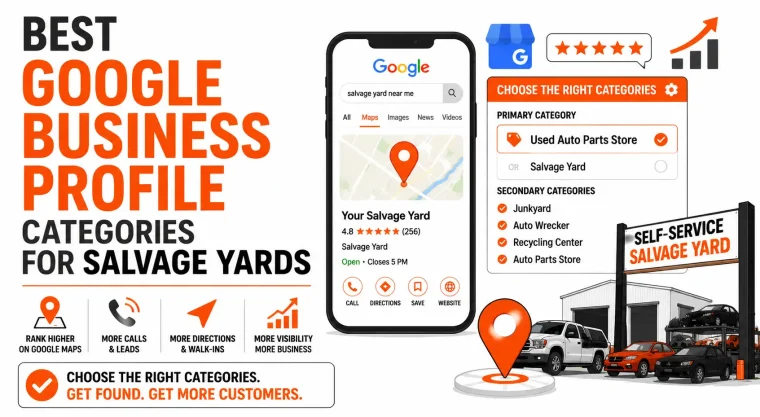
Categories for Salvage Yards are not just a small Google Business Profile setting. They can decide whether your yard shows up when someone nearby is trying to sell a junk car, find used auto parts, or visit a self-service yard. If the wrong categories are selected, Google may not fully understand what your yard does, and the calls that should come to you can end up going to a competitor down the road.
📌 KEY TAKEAWAYS
- Categories for Salvage Yards are not just another Google Business Profile setting. They help decide whether your yard shows up for the searches that bring real buyers, sellers, and pullers.
- Most yards set their categories once and never check them again. That is how small profile mistakes sit there for months while calls and map visibility stay weaker than they should be.
- Your primary category carries the most weight. For most self-service salvage yards, the first category to check is usually “Used Auto Parts Store” or “Salvage Yard,” depending on what Google offers in your area.
- Secondary categories help Google understand the rest of what your yard does. “Junkyard,” “Auto Wrecker,” “Recycling Center,” and “Auto Parts Store” can all support the right searches when they match real services.
- The goal is not to add every category that sounds close. The goal is to keep your Categories for Salvage Yards accurate, clear, and tied to how customers actually search.
- Use GMB Everywhere to check what primary and secondary categories the local 3-pack yards are using in your area. That gives you a real market reference instead of guessing.
- Clean up your categories when services change, when calls slow down, when rankings drop, or when the profile has not been reviewed in a long time.
- A strong category setup will not fix a weak profile by itself, but it gives Google a clearer starting point for understanding your yard.
- We help independent self-service salvage yards clean up their local visibility from the ground up with the right categories, stronger profile signals, and a system built around how real customers search.
- Results in 45 days or you pay nothing
Why the Right Category Helps More Local Buyers Find Your Yard
The category you choose on your Google Business Profile tells Google what kind of yard you are and which local searches your business should show up for. If someone nearby searches for used auto parts, junk car buyers, or a salvage yard near them, Google looks at your category first before it decides whether your profile is a good match.
This is why Categories for Salvage Yards matter more than most owners think. If your main category is too broad, wrong, or not close enough to what your yard actually does, Google may show another yard instead of yours. That means fewer calls, fewer direction requests, and fewer people walking into your yard even if you are the better option.
Your primary category carries the most weight because it tells Google your main business type. Secondary categories help support the rest of your services, like auto parts, junk car buying, recycling, or used parts sales. When both are selected correctly, Google gets a clearer picture of your yard and can connect you with more local buyers.
The goal is not to add random categories just to look bigger. The goal is to choose the categories that match how real customers search. When your category setup lines up with what people are typing into Google, your yard has a better chance of showing up in Maps, getting more calls, and taking traffic that may currently be going to a competitor.
How the Wrong Category Can Hide Your Salvage Yard From Ready-to-Call Customers
The wrong Google Business Profile category can make your yard almost invisible for the searches that actually bring customers. You may still have a verified profile, photos, reviews, and a real location, but if Google does not understand that you are a salvage yard, it may not show you when someone nearby is ready to call or visit.
This usually happens when the main category is too broad or does not match what customers are searching for. If your profile is set up more like a general auto business, recycler, or repair-related company, Google may connect you with the wrong searches and skip you for the ones that matter most. That is how local buyers end up seeing another yard even when yours is closer.
High-intent searches depend on strong local signals. Your category, services, business description, reviews, photos, website content, and location all work together to tell Google when your yard should appear. If the category is wrong, the rest of those signals become weaker because Google is starting from the wrong understanding of your business.
This is why Categories for Salvage Yards should be checked carefully before anything else. The right category helps Google match your yard with people looking for used auto parts, junk car selling, self-service parts pulling, or nearby salvage options. The wrong one can quietly send those calls, clicks, and direction requests to a competitor.
Categories are only one piece of a fully optimized profile. Our complete guide to Google Business Profile for Salvage Yards explains how reviews, services, photos, and profile optimization work together to improve local visibility.
The Main Category Every Salvage Yard Should Check First
The first category to check is your primary category, because this is the category Google leans on the hardest when deciding where your yard belongs in local search. This is where a lot of yards lose ground without realizing it. They may have decent reviews, photos, and a real location, but their main category is not as strong as the yard ranking above them. Google does not need your competitor to be better. It only needs to understand their profile faster than yours.
For most self-service salvage yards, the strongest primary category is usually “Used Auto Parts Store” or “Salvage Yard,” depending on what Google shows in your area. The right choice comes down to what your yard is mainly trying to win from search. If most people come to you to pull parts, find used parts, or call about available vehicles, your primary category needs to match that search intent as closely as possible.
If you are still not sure which primary category to choose, do not guess. Install the GMB Everywhere extension and search your main keywords in Google Maps. It will show you the primary and secondary categories being used by the yards already ranking in the local 3-pack in your area.
That gives you a real-world starting point. Look at the yards Google is already rewarding, see which category they are using as their primary, and compare it with your own. You are not copying blindly. You are checking the local pattern so your yard can send the same clear signal and stop losing visibility over a category choice that should have been fixed first.
Choosing the Best Primary Google Business Profile Category for Your Yard
The best Google Business Profile category for a salvage yard depends on the main reason customers choose that location. Don’t select a category simply because it has more search volume or because a competitor uses it. The primary category should describe the salvage yard’s core business as accurately as possible.
If the operation mainly serves people who visit to find and pull used parts, Used Auto Parts Store may be the strongest fit when Google offers that category in your market. If the business is positioned more broadly around salvage vehicles, recycled parts, and yard-based services, Salvage Yard may be the closer match.
For a Google Business Profile category for a junkyard, use the same rule. Choose Junkyard only when it accurately describes the business customers will encounter. Don’t use it simply as another keyword label if the salvage yard operates under a different model.
The Google Business Profile category for an auto recycler should fit an operation primarily centered on vehicle recycling or dismantling. If the salvage yard mainly serves self-service parts customers, an auto-recycling category may make more sense as an additional category when it accurately represents a real service.
For a Google Business Profile category for a used auto parts store, use that category when selling used parts is the main customer-facing function. A self-service salvage yard that earns most of its customer traffic from parts pullers may fit this description well.
or yards heavily focused on vehicle acquisition, a Google Business Profile category such as Auto Wrecker or Junkyard should still describe the business itself, not just one service. If the salvage yard buys junk cars alongside its primary operation, represent that activity through accurate additional categories, services, and website content rather than forcing a poor-fit primary category.
The goal is one clear primary category supported by additional categories that accurately describe what the salvage yard actually does.
Secondary Categories That Help Google Understand What Your Yard Offers
Once your primary category is set, the work is not finished. Most yards stop there, and that is where they start giving away extra visibility. Your main category may tell Google what your yard is, but your secondary categories help Google understand everything your yard can actually help a local customer do.
Think about how people search. One customer types used auto parts near me. Another types junkyard near me. Another may search for an auto wrecker, recycling center, or a place that handles junk vehicles. Those are different searches, but they can all connect back to the same yard if the profile is set up correctly.
That is why Categories for Salvage Yards should include every relevant secondary category Google allows. Categories like “Junkyard,” “Auto Wrecker,” “Recycling Center,” and “Auto Parts Store” can expand the range of searches your profile has a chance to appear for. Each one is another signal telling Google that your yard is relevant for more than one type of customer intent.
The mistake is adding categories blindly just because they sound close. If your yard does not offer that service, leave it alone. But if the category matches what your yard actually does, not adding it is leaving the door open for a competitor to take that search instead.
How Competitor Yards Use Categories to Win More Map Visibility
The yard showing above you in Google Maps may not have better cars, better parts, or a better operation. It may simply have a cleaner category setup. Google understands that yard faster, connects it to more local searches, and puts it in front of buyers before your profile even gets a chance.
This is one of the easiest gaps to miss. A competitor may have the right primary category, plus secondary categories that support used parts, junk vehicles, auto wrecking, and recycling. Your profile may only have one category selected, or worse, a category that is close but not strong enough. That small difference can affect who shows up when a customer searches for a yard near them.
This is why Categories for Salvage Yards should never be chosen in isolation. You need to look at what Google is already rewarding in your market. Search your main keywords in Google Maps and check the yards sitting in the local 3-pack. If the same primary category keeps showing up across the top results, that is not random. It is a signal.
The goal is not to copy every competitor blindly. Some yards add categories that do not fit their real services. But if the top-ranking yards all use strong salvage-related categories and your profile does not, they are sending Google a clearer signal than you are.
Choosing the right categories helps, but Google Maps rankings also depend on reviews, proximity, website authority, and profile optimization. Learn more in our guide on How to Rank a Salvage Yard on Google Maps.
Google Business Profile Category Competitor Research: What to Compare
Competitor research can help a salvage yard understand the category patterns Google is already showing in its market, but use it as evidence rather than a copy-and-paste strategy.
Start with several high-intent searches that matter to the salvage yard, such as salvage yard near me, used auto parts near me, junkyard near me, or sell my junk car. Record which businesses consistently appear in local results, then compare their primary and additional categories.
For Google Business Profile category competitor research, look for patterns across several strong competitors instead of copying the yard in position one. If multiple visible salvage yard competitors use the same primary category and it accurately describes your operation, that gives you a useful category to investigate. If only one competitor uses an unusual category, don’t assume that category caused its ranking.
Also compare business models. A full-service auto recycler, self-service salvage yard, used auto parts store, and junk car buyer may compete in some of the same searches while still needing different category setups. Category research only helps when you’re comparing businesses that genuinely offer similar services.
Document the categories you find, the searches where each competitor appears, and whether those categories match services clearly shown on their websites and profiles. This gives the salvage yard a stronger basis for deciding whether its category setup is incomplete, inaccurate, or already aligned with the market.
The purpose of competitor research isn’t to imitate every category. It’s to identify accurate category choices that repeatedly appear among businesses competing for the same local customers.
How to Choose Categories Based on What Customers Actually Search
Yard owners usually describe the business one way. Customers search another way. A yard may think in terms of inventory, cores, processing, or dismantling, but the customer is typing simple things like used auto parts, junkyard near me, salvage yard near me, auto wrecker, or sell my junk car.
That is why Categories for Salvage Yards need to be chosen from the customer’s side of the search. The category setup should match what people are already looking for when they need parts, want to sell a vehicle, or are trying to find a yard nearby. When that language lines up, Google has a much clearer reason to show the profile for the right local searches.
This is one of the easiest gaps to miss. A competitor may have the right primary category, plus secondary categories that support used parts, junk vehicles, auto wrecking, and recycling. Your profile may only have one category selected, or worse, a category that is close but not strong enough. That small difference can affect who shows up when a customer searches for a yard near them.
This is why Categories for Salvage Yards should never be chosen in isolation. You need to look at what Google is already rewarding in your market. Search your main keywords in Google Maps and check the yards sitting in the local 3-pack. If the same primary category keeps showing up across the top results, that is not random. It is a signal.
The goal is not to copy every competitor blindly. Some yards add categories that do not fit their real services. But if the top-ranking yards all use strong salvage-related categories and your profile does not, they are sending Google a clearer signal than you are.
Choosing the right categories helps you appear in more searches, but attracting more phone calls requires optimizing every part of your Google Maps listing. Read our guide on 9 Proven Ways to Get More Calls From Google Maps for Your Salvage Yard for the complete optimization checklist.
When to Update or Clean Up Your Google Business Profile Categories
Most yards set their categories once and forget about them. That is normal. The yard gets busy, the profile stays the same, and nobody checks whether those categories still match what the business actually does today.
A category cleanup is worth doing when services change, when a new location opens, when calls feel slower than usual, or when the profile has not been reviewed in a long time. The goal is not to keep changing things. The goal is to make sure your Categories for Salvage Yards still give a clean, accurate picture of what customers can come to you for.
That is why Categories for Salvage Yards need to be chosen from the customer’s side of the search. The category setup should match what people are already looking for when they need parts, want to sell a vehicle, or are trying to find a yard nearby. When that language lines up, Google has a much clearer reason to show the profile for the right local searches.
This is one of the easiest gaps to miss. A competitor may have the right primary category, plus secondary categories that support used parts, junk vehicles, auto wrecking, and recycling. Your profile may only have one category selected, or worse, a category that is close but not strong enough. That small difference can affect who shows up when a customer searches for a yard near them.
This is why Categories for Salvage Yards should never be chosen in isolation. You need to look at what Google is already rewarding in your market. Search your main keywords in Google Maps and check the yards sitting in the local 3-pack. If the same primary category keeps showing up across the top results, that is not random. It is a signal.
The goal is not to copy every competitor blindly. Some yards add categories that do not fit their real services. But if the top-ranking yards all use strong salvage-related categories and your profile does not, they are sending Google a clearer signal than you are.
Google Business Profile Category Optimization: When to Make Changes
Google Business Profile category optimization should be deliberate. A salvage yard doesn’t need to change categories every time rankings move or a competitor updates its profile.
Review the primary and additional categories when the salvage yard changes its main business model, adds or removes a meaningful service, opens a location with a different purpose, or discovers that the existing category no longer describes the operation accurately.
Start with the primary category. Ask whether it still represents the main reason customers contact or visit the salvage yard. Then review every additional category and remove anything that no longer matches a real service. Additional categories should help describe the business, not act as a list of keywords the salvage yard wants to rank for.
When considering a new category, check three things:
- Does Google currently offer the category?
- Does the salvage yard genuinely provide that type of service?
- Does the category accurately represent the customer intent you want to support?
If all three are true, the category may be worth adding or testing.
Avoid making several major category changes at once when you’re trying to understand performance. Record the previous setup, the date of the change, and the new setup. Then monitor local visibility, calls, direction requests, and other meaningful outcomes over time.
Good Google Business Profile category optimization keeps the salvage yard accurately classified while giving Google enough context to understand the real services available at that location.
Final Category Checklist for Salvage Yard Owners
Before you move on, check the basics:
- Make sure the primary category matches the main reason customers choose your yard.
- For most self-service yards, check “Used Auto Parts Store” or “Salvage Yard” first.
- Add secondary categories only when they match real services.
- Consider options like “Junkyard,” “Auto Wrecker,” “Recycling Center,” or “Auto Parts Store.”
- Use GMB Everywhere to see what categories the local 3-pack yards are using.
- Do not copy competitors blindly.
- Remove anything that does not match what your yard actually offers.
- Keep your Categories for Salvage Yards simple, accurate, and based on how real local customers search.
Want More Local Buyers Finding Your Yard?
Right now, your Google Business Profile may be sending a clear signal, or it may be leaving Google to guess what your yard actually does. Without the right Categories for Salvage Yards in place, your profile can miss the searches that bring real buyers, sellers, and pullers to the gate.
We help independent self-service salvage yards clean up their local visibility from the ground up. The right primary category. The right secondary categories. A profile built around how real customers search in your market.
The guarantee stays the same. Results in 45 days or you pay nothing.